Corpus Christi College: A College of the University of Cambridge
Site at a Glance
- Popularity
- Very High
- Country
- United Kingdom
- Primary era
- Medieval
- Eras represented
- Medieval, Early Modern, Modern
- Civilizations
- British, English
- Site type
- Civic
- Remains
- University
On this page21 sections
History
Foundation and medieval college
Corpus Christi College, formally the College of Corpus Christi and the Blessed Virgin Mary, is a constituent college of the University of Cambridge in central Cambridge, England, United Kingdom. Founded in 1352 by two Cambridge guilds, it is the university’s sixth-oldest college and the only one established by Cambridge townspeople. A guild was an association for shared religious observance, mutual support, or trade. The Guild of Corpus Christi was formed in 1349 by William Horwode, Henry de Tangmere, and John Hardy during the Black Death, the plague pandemic that reached Europe in the mid-fourteenth century. Later that year it joined the older Guild of the Blessed Virgin Mary, which the plague had severely diminished.
The united guilds acquired land in the town centre, and their patron, the Duke of Lancaster, secured a foundation licence from King Edward III in 1352. Building of the first court began soon afterward. By 1356 it could house the Master, the head of the college, and two fellows, members of its academic community. The college inherited the guilds’ land, ceremonies, and income. Its first court could accommodate 22 fellows and students, while its statutes initially governed fellows alone. Students came under those rules about two centuries later.
Medieval traditions and conflict
The college continued the guilds’ annual Corpus Christi procession, held for the Christian feast celebrating Christ’s body and blood. A priest carried the consecrated bread used in Communion, while the Master and fellows carried college treasures through the streets to Magdalene Bridge. A large dinner followed. In 1535, Master William Sowode ended the procession during the English Reformation, the sixteenth-century break between the English church and papal authority. The college still holds a substantial dinner for the feast.
In 1381, during the Peasants’ Revolt, a townspeople’s mob led by the mayor attacked and sacked the college. Some students apparently joined the crowd. The attack focused on Corpus because it strictly collected candle rents. The mob reportedly took college plate and its charter to burn and gutted buildings; the college calculated its losses at £80. In 1460, amid the Wars of the Roses, England’s fifteenth-century dynastic conflicts, the college paid for artillery, arrows, and protective clothing to guard its treasures against a threatened riot. During the 1460s, Elizabeth, Duchess of Norfolk, and her sister Lady Eleanor Botelar funded scholarships and repairs.
From the late fourteenth century into the early nineteenth, the college was also commonly called Bene’t or St Bene’t’s College, after the nearby church associated with its founding guild. The name was especially common when “Corpus Christi” was thought to carry a strongly Roman Catholic association. St Bene’t’s served as the college chapel until 1579, and St Botolph’s Church was used for some services. In the late fifteenth century, Master Thomas Cosyn built a connecting gallery and the college’s first chapel.
The Reformation and the sixteenth century
Religious upheaval brought sharply contrasting outcomes for people associated with the college. Richard Reynolds, an English monk, was martyred under Henry VIII, while the Protestant preacher George Wishart and Thomas Dusgate were burned as Protestants. Master William Sowode’s end to the Corpus Christi procession was another change in the college’s religious life.
Matthew Parker, Master from 1544 to 1553 and later Archbishop of Canterbury, gave the college a major library and silver plate. His bequest placed conditions on the library: if its holdings fell below specified levels, it would pass first to Gonville and Caius College and then to Trinity Hall. Representatives of those colleges continue to inspect it. Similar conditions applied to Parker’s silver, helping preserve the collections from piecemeal sale. Parker resigned as Master after Mary I came to the throne in 1553 and became Archbishop of Canterbury after Elizabeth I succeeded her.
In 1578, Sir Nicholas Bacon gave £200 towards a new chapel, but the money was insufficient. The college sold silver other than Parker’s gifts to support the work, which was not completed until 1662. Elizabeth I and Sir Francis Drake were among the other contributors. In 1590, amid a dispute over appointments, Elizabeth I imposed John Jegon as Master. He addressed financial problems by admitting fee-paying “fellow commoners” for one or two years; their parents paid with a silver cup or tankard, which was melted down.
Seventeenth-century crises and rebuilding
When plague returned to Cambridge, Master Henry Butts, also the university’s Vice-Chancellor, stayed at the college and tried to limit its spread after much of the university had left. He was found hanged in 1632. During the English Civil War, fought from 1642 to 1651, and the subsequent Commonwealth, the college remained neutral under Master Richard Love. A college tradition says that silver plate was distributed among fellows to prevent its seizure, then returned after the fighting; some was melted to pay for repairs. Love and three other college heads kept their posts when twelve were removed. During an inspection, Puritan inspector William Dowsing found nothing at the college that he considered needed amendment.
In 1688, an anti-Catholic mob attacked bursar Clement Scott’s rooms, suspecting him of Catholicism, and destroyed his books and papers. Plans for major rebuilding took longer to realize. Archbishop Thomas Herring left £1,000 for the project in the 1740s, and former Master Matthias Mawson, Bishop of Ely, bequeathed £3,000 in 1770. Neither gift was enough. Work got under way after the fund reached £55,000 by 1822. Under architect William Wilkins, several buildings, including the Elizabethan chapel, were replaced by New Court. The enlarged court allowed student numbers to rise from 48 to 100.
Reform and expansion
During the nineteenth century, Corpus was associated with the Evangelical movement, a Protestant tradition emphasizing personal faith and scripture, and had a strongly clerical character. Fellows were required to be ordained in the Church of England, and many graduates became clergy. As the Test Acts were repealed and Catholics gained emancipation, Catholics could enter the university. The curriculum broadened, and fellow commoners became less common. Fellows were first allowed to marry in 1882, making an academic fellowship a possible lifelong career. Edward Byles Cowell, the first married fellow, was also the first Professor of Sanskrit. Later in the century, undergraduate numbers fell below 50.
Robert Caldwell became Master in 1906, the first layman to hold the position. He changed admissions to encourage fellows and undergraduates from other colleges and from beyond Cambridge, and the college ceased to be chiefly a training institution for clergy. During the Second World War, Master Sir Will Spens also served as Regional Commissioner of Civil Defence for the Eastern Region. The college housed government departments and might have hosted an organization able to act as an autonomous authority if central government became incapacitated. Cadets and armed-forces officers attended short courses there. The college lost more members in this war than in the First World War.
Women were permitted to sing in the chapel choir and dine in the hall during the 1960s. They could already be research students and fellows before the college admitted women undergraduates in 1983. In 1962, the college approved the conversion of its Leckhampton property for fellows and postgraduate students and acquired neighboring properties; the George Thomson Building there was completed in 1964. Botolph Court added undergraduate accommodation in 1983. Work above the Eagle pub in the 1990s included the Robert Beldam Building.
After the lease on an adjacent bank ended in 2005, the college reclaimed the building for a new court. Archaeological discoveries and the difficulty of removing the bank vault delayed the project, and Library Court became the main campus’s third court. It was renamed Kwee Court in 2013 after a donation from the Kwee family, which was conditional on building a balcony. In 2012, silver worth £11,596 was stolen from the college collection while the chapel was open. The theft included chalices and plates for Communion; pieces worth £956 were recovered two weeks later, while the rest had been melted down. None of the lost pieces came from Parker’s bequest.
Christopher Kelly, then the college’s president and a former Senior Tutor, was elected its 52nd Master in 2017 and took office in 2018. Restoration of the dining hall and servery in 2017–18, completed in February 2019, uncovered medieval stonework concealed during a restoration in the 1950s. The college chapel is an ecclesiastical “peculiar,” a jurisdiction exempt from the ordinary authority of the local diocesan bishop. Its clergy need the bishop’s permission to serve outside the college and to be granted the right to solemnize marriages.
Remains
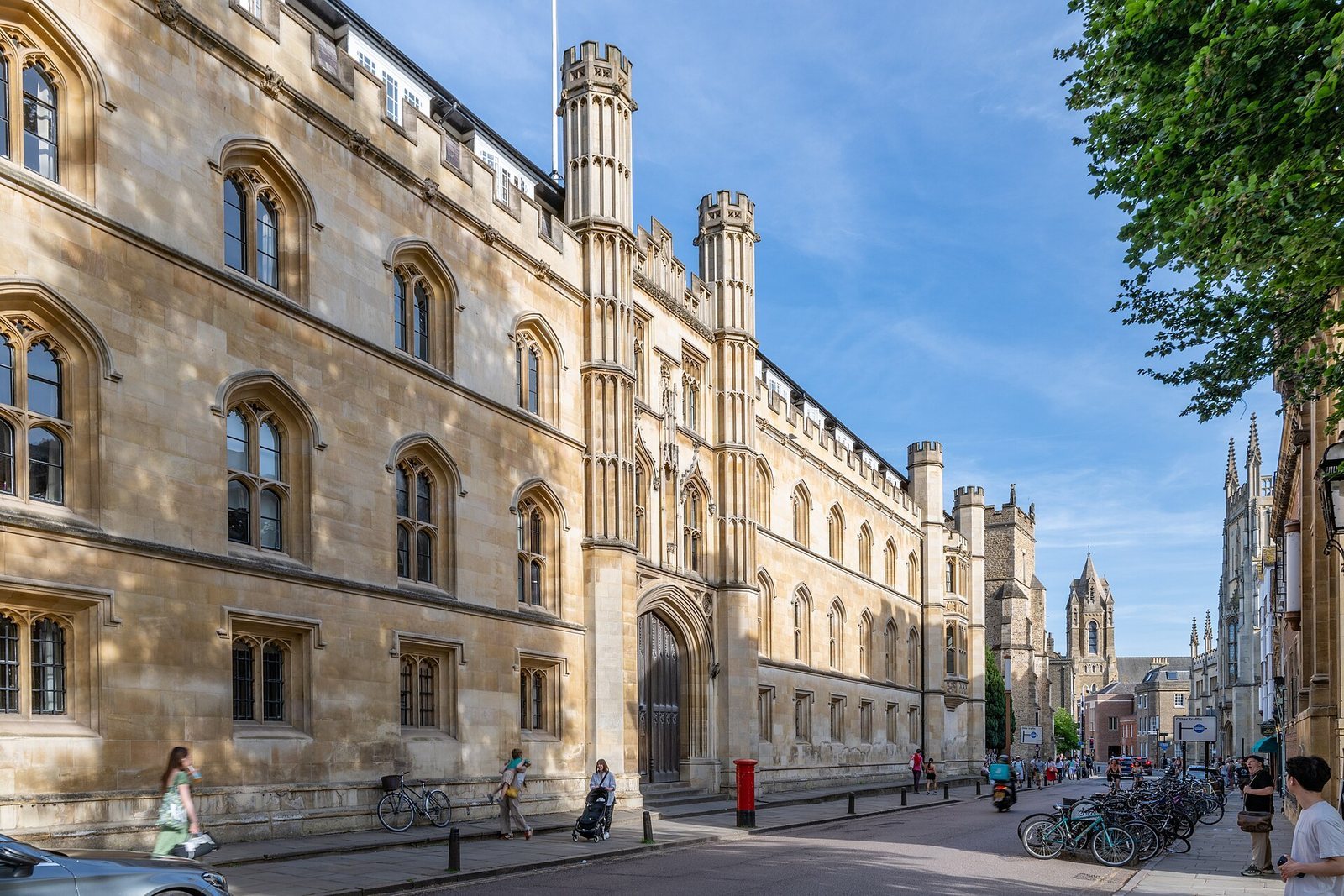
The college’s principal site is arranged around courts in central Cambridge, with buildings from several periods and two gardens. Its surviving fabric includes a four-sided medieval court, the neighboring church of St Bene’t’s, and later college courts and buildings. Leckhampton, a separate postgraduate campus about a mile west, forms another part of the college’s built and landscaped estate.
The medieval precinct
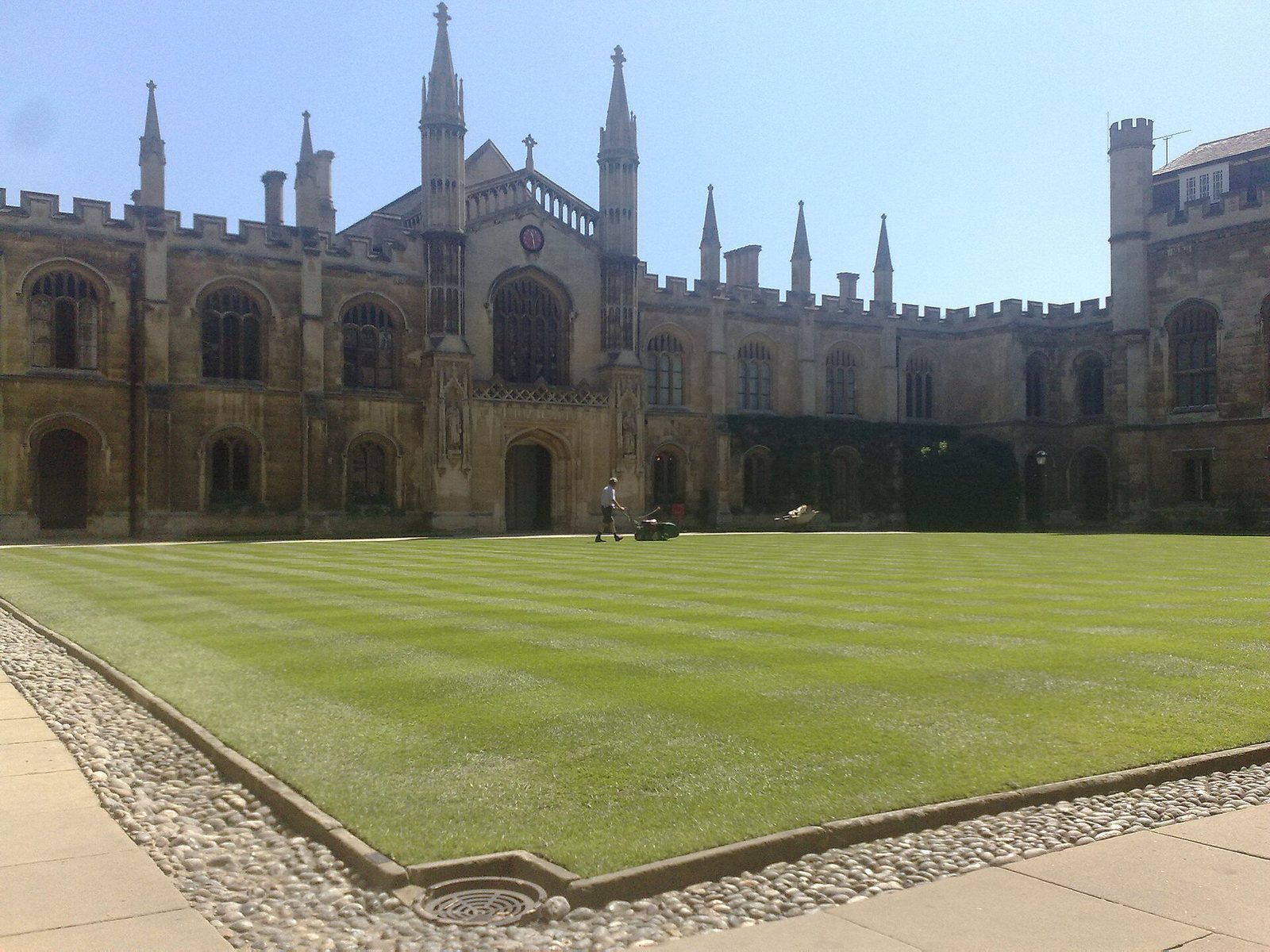
Old Court
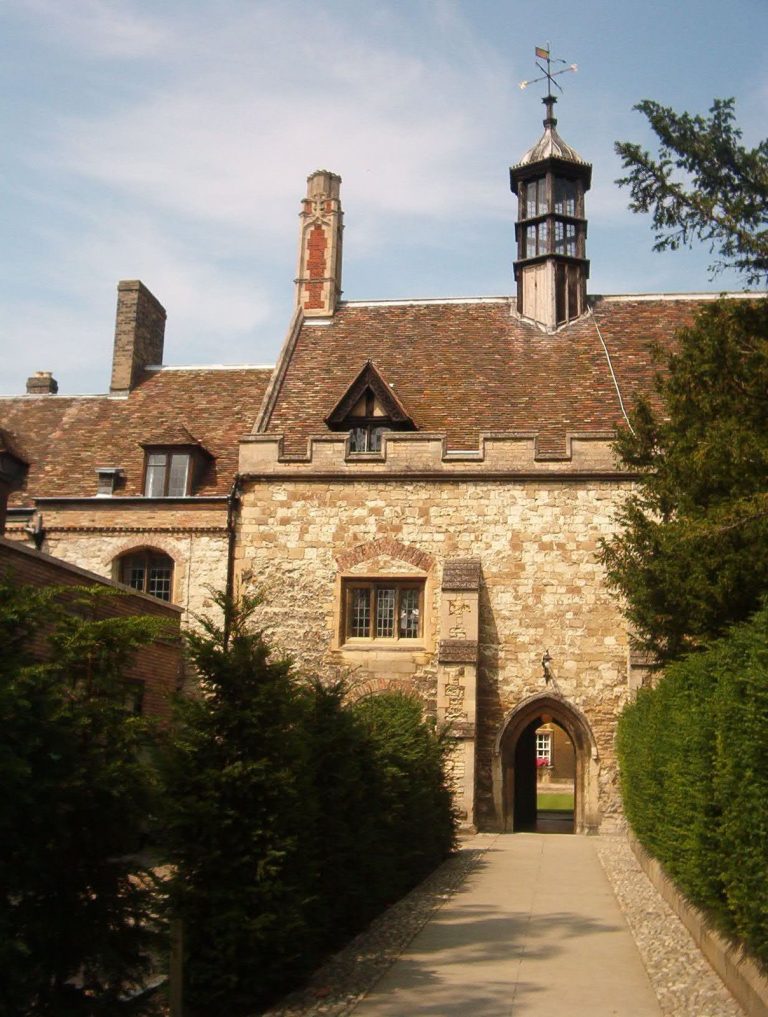
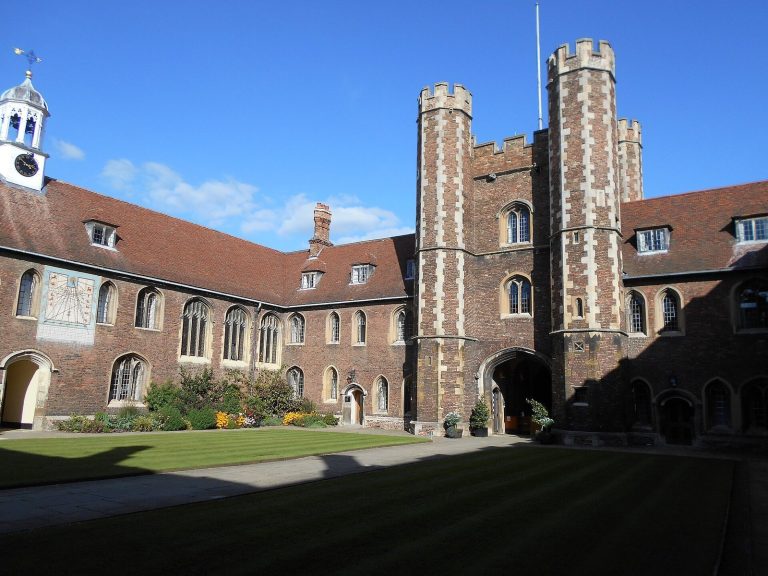
Built in the 1350s, Old Court is a four-sided courtyard with a passage leading to Bene’t Street. It retains original window ledges and side frames that supported oil-soaked linen before glass windows became widespread. The court may also incorporate the core of an earlier building. Its rooms contain antique furniture. The college claims that Old Court is the country’s oldest continuously inhabited courtyard, a distinction also claimed by Merton College, Oxford, for Mob Quad.
Ivy was removed from Old Court in 1919 and replaced by rough-textured exterior rendering; a major restoration followed in 1952. A large plaque on the north wall commemorates playwrights Christopher Marlowe and John Fletcher. A heraldic hound associated with the Talbot family appears on a gable. Around 1500, Thomas Cosyn built a brick gallery linking the court to St Bene’t’s Church; the gallery is now part of a group of rooms. The court affords views of the church tower and the Old Cavendish Laboratory, associated with the work of Watson and Crick, J. J. Thomson, and Ernest Rutherford.
St Bene’t’s Church
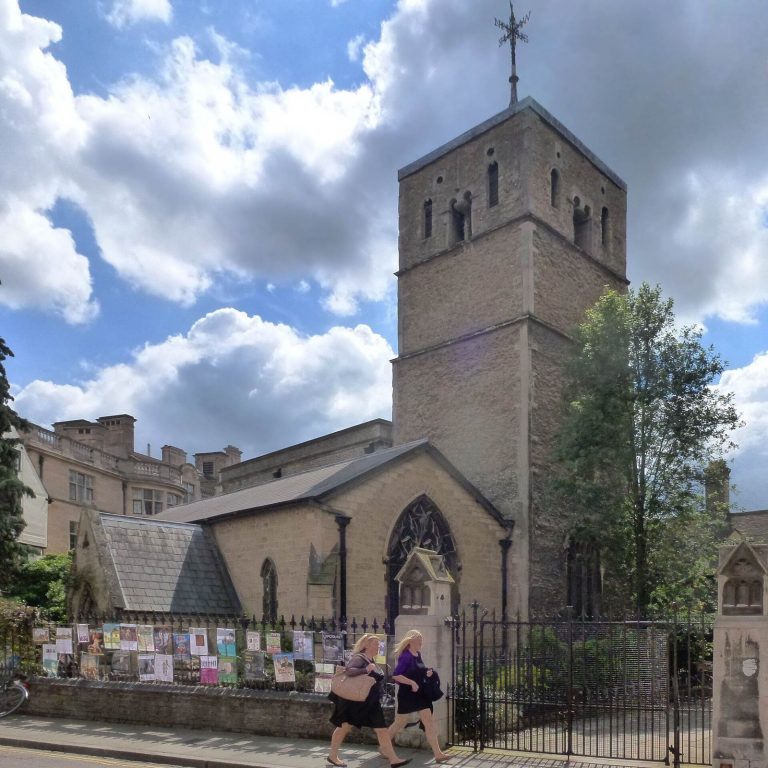
St Bene’t’s stands beside the college. Its tower dates from the late Anglo-Saxon period, before the Norman Conquest of 1066, and is Cambridge’s oldest building.
New Court
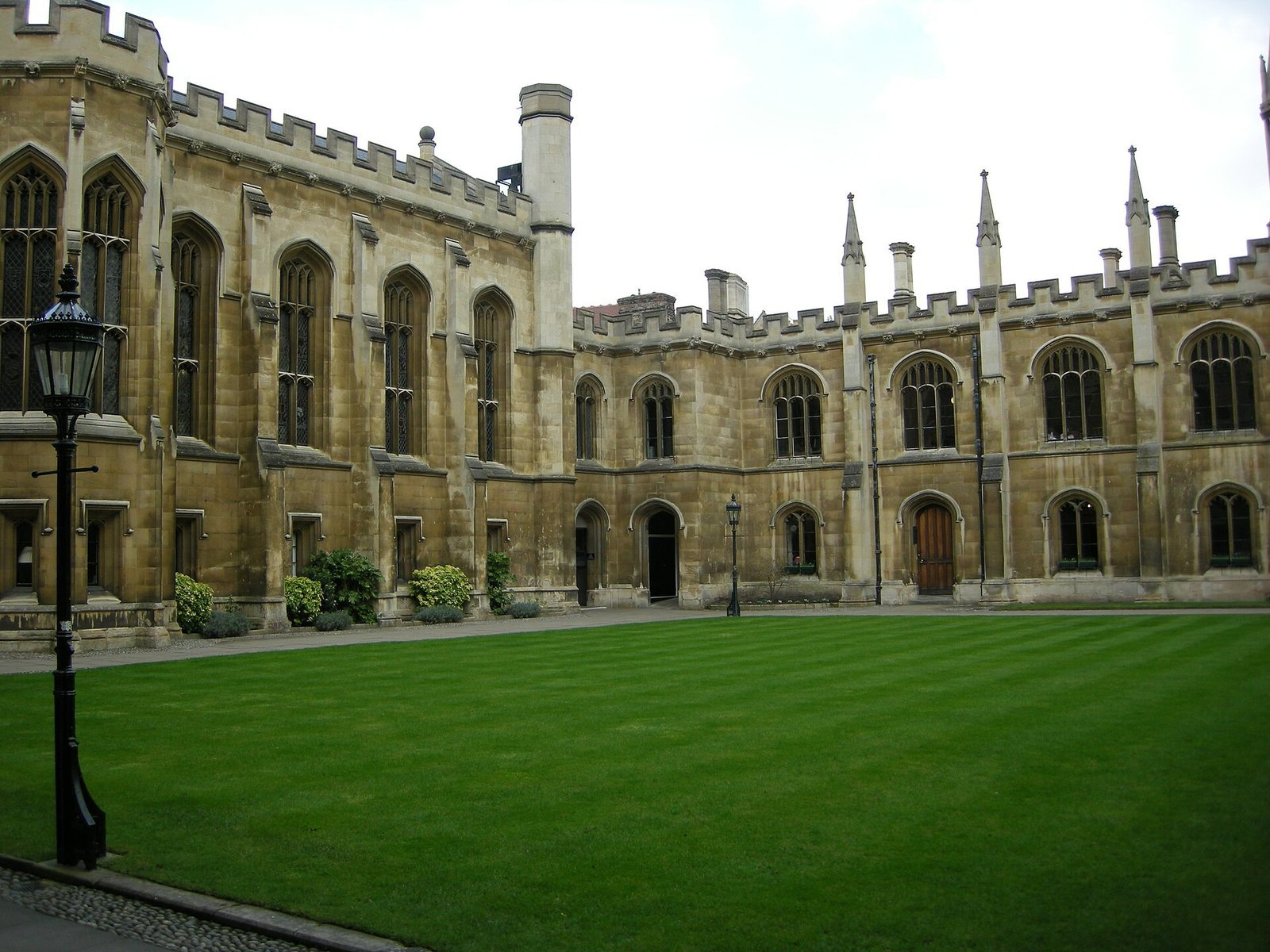
Designed by William Wilkins in the neo-Gothic style, which revived medieval Gothic forms, New Court was completed in 1827. Its arrangement was intended to express harmony among mind, body, and soul: the Parker Library represented the mind, the hall and kitchens the body, and the chapel the soul. Wilkins is buried in the chapel vaults, and a plaque to him stands by the Parker Library entrance.
The chapel
The present chapel, the college’s third, was completed with New Court in 1827. It incorporates medieval glass, fellows’ stalls, memorials, and the floor of the Elizabethan chapel demolished during rebuilding. Its first four stained-glass windows date to about 1500 and are believed to have come from Mariawald Abbey in Germany, which was dissolved under Napoleon. Some pews and the pulpit from the Elizabethan chapel are now at St Andrew’s Church in Thurning, Norfolk.
The chapel contains a depiction of the Madonna and Child by seventeenth-century Italian artist Elisabetta Sirani, as well as an icon of Christ Pantocrator, a traditional image of Christ as ruler of the universe. A Greek Orthodox monk painted the icon for the college, where it is used as a focus for meditation. The chapel was extended in the late nineteenth century to accommodate more students. Its chancel, the part containing the altar, dates from that extension. A stone ceiling with ribs spreading in fan patterns was replaced by the painted wooden ceiling still in place.
The current organ was built by Noel Mander in 1968, with its casework designed by Stephen Dykes Bower. The earlier organ was given to Methodist College Belfast that year. Names of college members lost in both world wars are inscribed in the chapel.
The Parker Library
Built as part of New Court, the Parker Library holds a collection begun in 1376. It contains more than 600 manuscripts, around 480 of them given by Matthew Parker, and approximately 1,000 printed books. The collection was digitized in 2010, with more than 200,000 pages made available in digital form.
Among its holdings are the St Augustine Gospels, the principal manuscript of the Anglo-Saxon Chronicle, a series of historical annals recording events in England, works by Matthew Paris, and Chaucer’s Troilus and Criseyde. The Gospels were probably brought to England by Augustine, a missionary sent by Pope Gregory I in 598. They are still used at the enthronement of Archbishops of Canterbury and are carried between the college and Canterbury by the Master and college representatives.
Later courts and college properties
Library Court
Library Court was formed by adapting a former bank and other college buildings. The bank’s exterior on Trumpington Street was designed by Horace Francis, while its interior was stripped out and fitted with a modern library. The court contains the student centre, bar, Taylor Library, undergraduate common room and student association, and college offices. A large window facing the court bears an engraving by Lida Kindersley. The Kwee Balcony stands at the far end from the library entrance.
Near the former bank entrance, at the corner of King’s Parade and Trumpington Street, is the Chronophage, or “Time Eater,” clock. Stephen Hawking unveiled it in 2008. Conceived, designed, and funded by John Taylor, it was donated to the college. The clock is lit by neon at night and shows the correct time only once every five minutes.
Other college buildings
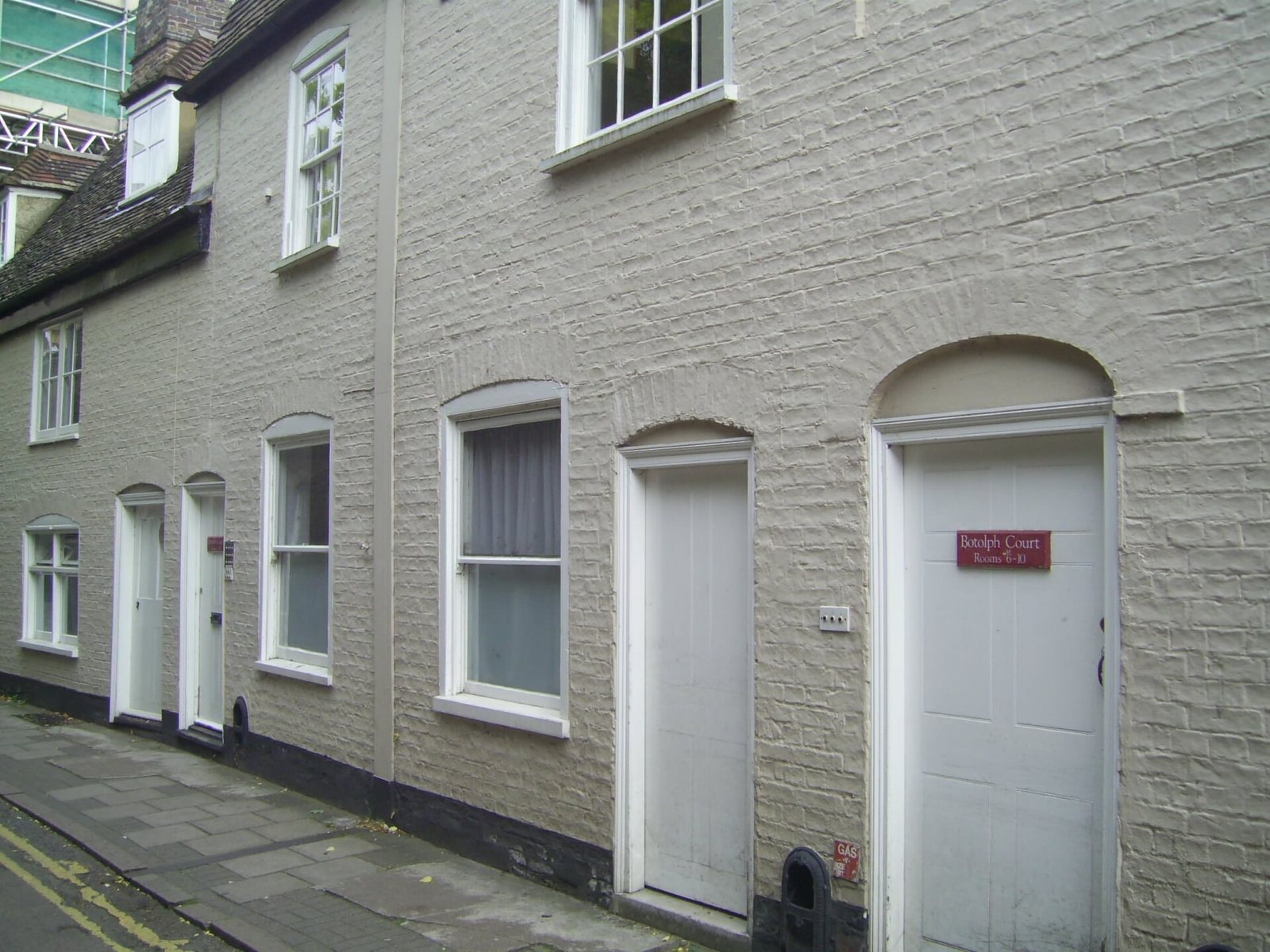
Botolph Court provides undergraduate accommodation. Bene’t Street Hostel is above the Eagle, and the modern Robert Beldam Building, completed in the 1990s beside the hostel, includes the McCrum Lecture Theatre. The college also owns Newnham House near Newnham College, houses at 6 and 8 Trumpington Street, and terraced houses designed by Wilkins between Trumpington Street and Library Court. The terraced houses have been adapted for student rooms or library use, apart from the block occupied by Trumpington Street Medical Practice; their Trumpington Street doors are sealed and access is through Library Court.
Leckhampton
Leckhampton is the college’s separate postgraduate campus, about a mile west of the main site off Grange Road. Its grounds include playing fields, 9.5 acres of gardens, and an outdoor swimming pool. The property brings together Victorian Leckhampton House, the George Thomson Building, five detached houses on Cranmer Road, a house on Selwyn Gardens, and a house on Barton Road. Apart from the Barton Road property, the buildings back onto shared gardens and form a single site.
The George Thomson Building, completed in 1964 and named for a former Master, is part of the campus. The purpose-built Kho Building added accommodation in 2012.
College grounds and associated features
The Eagle
The college owns the Eagle pub, which served as a gathering place for Royal Air Force officers during the Second World War. Renovations revealed hundreds of officers’ signatures, drawings, and messages written or burned into its walls and ceilings. Watson and Crick may have celebrated their 1952 discovery of DNA’s structure at the pub; a blue plaque on its front commemorates the story.
Gardens
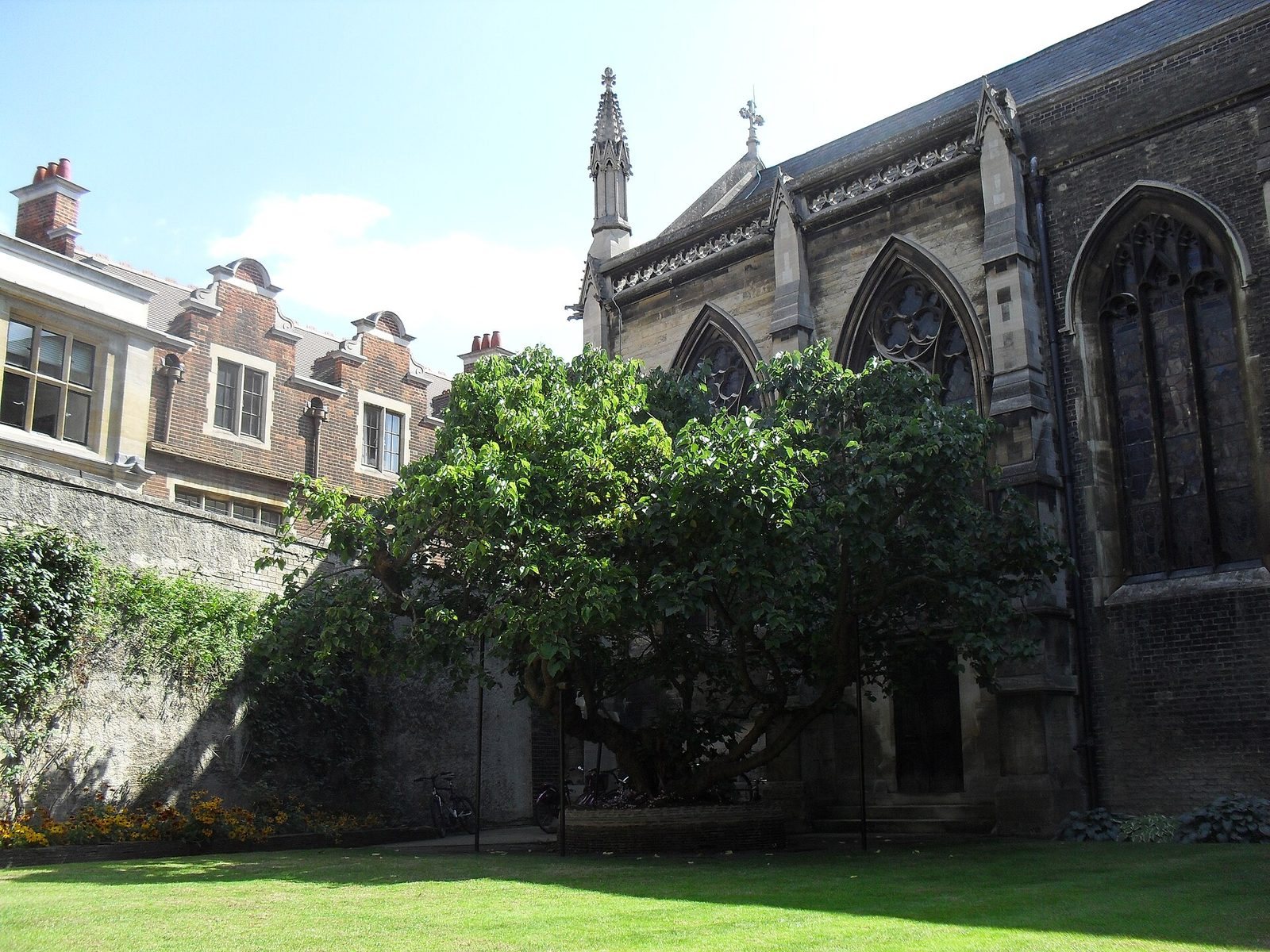
The main campus has two gardens. The Bursar’s Garden lies between New Court, the chapel, and Old Court, while the Master’s Garden is a private garden attached to the Master’s Lodge. James I gave the college a mulberry tree in the Bursar’s Garden as part of an unsuccessful effort to establish a silk industry in England. A door from the garden leads to Free School Lane.
Coat of arms
Granted in 1570 by herald Robert Cooke at Matthew Parker’s request, the college’s coat of arms is divided into four quarters. A pelican appears on a red field in the first and fourth quarters, and three white lilies on blue in the second and third. The pelican represents the Guild of Corpus Christi, while the lilies represent the Guild of the Blessed Virgin Mary.