Fährbrück Augustinian Monastery and Its Pilgrimage Church
Site at a Glance
- Popularity
- Medium
- Country
- Germany
- Primary era
- Early Modern
- Eras represented
- Early Modern, Modern
- Civilizations
- German, Holy Roman Empire
- Site type
- Religious
- Remains
- Church
On this page10 sections
History
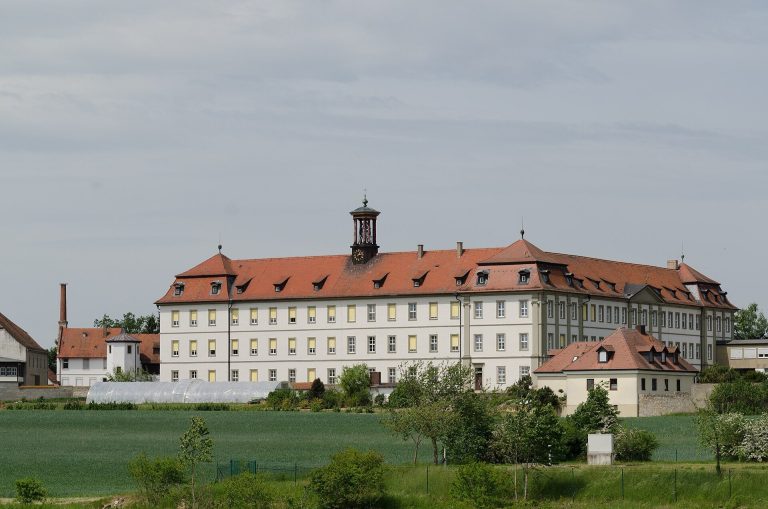
Fährbrück Augustinian Monastery is a Catholic monastic community in the hamlet of Fährbrück, within Hausen bei Würzburg, Germany. It is associated with a pilgrimage church whose history began with a Benedictine chapel and whose present Baroque building was commissioned during the pilgrimage’s 17th-century revival.
Medieval beginnings
In 1164, a knight of Wickershausen gave land in the area of present-day Hausen to the Benedictine Abbey of Neustadt am Main. The grant probably included a castle mound near Erbshausen-Sulzwiesen and what is now the Unterhof, formerly the knight’s manor. A document from 1414 places Wickershausen near Burggrumbach.
Monks from Neustadt am Main built a chapel for workers on their estates and people living on neighboring properties. Its beginnings are uncertain, but it was probably placed under the protection of the Virgin Mary in connection with the mother abbey. St Gregory the Great was its principal patron from the start. The pilgrimage is thought to have developed around the 14th century, and Fährbrück was already a well-visited destination before 1525.
The Benedictines left Fährbrück in 1414, after about 250 years there. The church did not have parish rights. From 1250, when Bergtheim became a parish, Bergtheim served Hausen, Erbshausen-Sulzwiesen, and Fährbrück. Hausen became an independent parish in 1613, after which Fährbrück and Erbshausen-Sulzwiesen joined it.
Destruction and rebuilding
The Reformation, a 16th-century religious movement that led to the formation of Protestant churches, and especially the Peasants’ War, a major uprising in German-speaking lands in 1524–25, brought severe damage to the church and pilgrimage. The church and several houses were burned and destroyed. Julius Echter von Mespelbrunn, the Würzburg prince-bishop who held both church authority and power over the territory, ordered the surviving church walls demolished. Their stone was taken for repairs in Bergtheim and Jobsthal.
In 1580, Julius Echter acquired the Jobsthal estate near Hausen and granted its use to the Juliusspital, a historic charitable foundation and hospital in Würzburg. Buildings there, including a church dedicated to St Jodocus, were repaired with material from Fährbrück. This reuse gave the impression that the prince-bishop might move the pilgrimage to Jobsthal.
Pilgrims continued to come to Fährbrück even though the site had no pilgrimage church between 1525 and 1651. An early rebuilding effort had reached the laying of foundations and delivery of materials when Swedish forces invaded in October. After the forces were expelled in 1635, work was attempted again, but the Thirty Years’ War, a European conflict lasting from 1618 to 1648, delayed progress. Construction resumed in 1648, and a new chapel was completed in 1651.
Pilgrimage and monastic life
After the chapel was completed, about 3,000 to 4,000 pilgrims came for the Marian feasts, celebrations associated with the Virgin Mary. Johann Bartholomäus Heinrich, an official at Arnstein, made the largest contribution to the new building and its subsequent enlargement. In the second half of the 17th century, the pilgrimage flourished. Würzburg Prince-Bishop Johann Gottfried von Guttenberg reported that Fährbrück ranked third among pilgrimage destinations in his territory and second among its Marian shrines, after the Würzburg Käppele. With its finances in good order, he commissioned the church that stands at Fährbrück today.
Hunters founded the Catholic men’s association St. Hubertus Fährbrück in the Gramschatz Forest in 1843. In 1853, the association placed itself under the protection of the Virgin Mary. It later had about 3,000 members and supported social assistance, including kindergartens.
The Redemptorists, a Catholic religious congregation, established a monastery at Fährbrück in 1867. They were expelled during the Kulturkampf, the 19th-century conflict between the German state and the Catholic Church. Augustinians, members of an order following the Rule of St Augustine, took over in 1880. In 1934, the monastery complex was remodeled to house 25 pupils preparing for admission to a Gymnasium, a German academic secondary school. The school closed in 1962 because of insufficient demand.
After consultations in 1975, a parish association began work on 1 March 1976, bringing together Fährbrück, Hausen, Erbshausen-Sulzwiesen, Gramschatz, Opferbaum, Rieden, Hilpertshausen, and Rupprechtshausen to coordinate pastoral care. The pilgrimage church underwent a comprehensive renovation in 2002. In 2011, the Diocese of Würzburg bought the monastery from the Augustinian order to relieve the monks of building-maintenance responsibilities. The monastic community continued its pilgrimage and pastoral work with a prior, the head of the community, and six other monks.
Remains
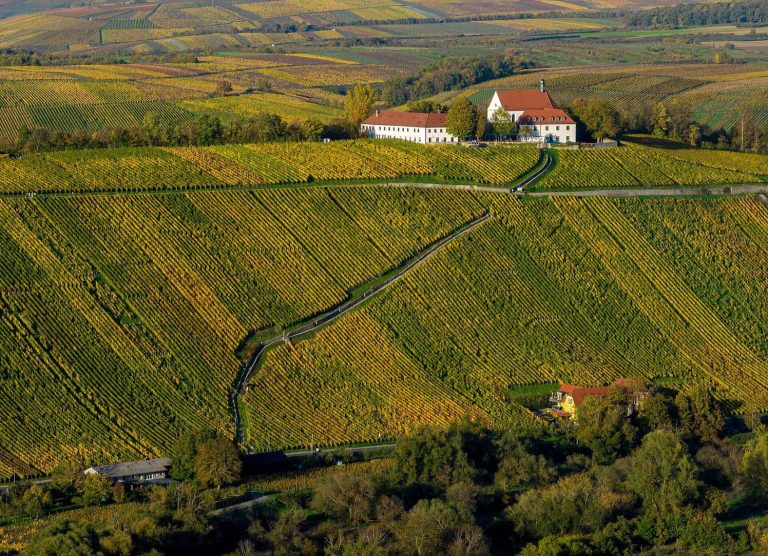
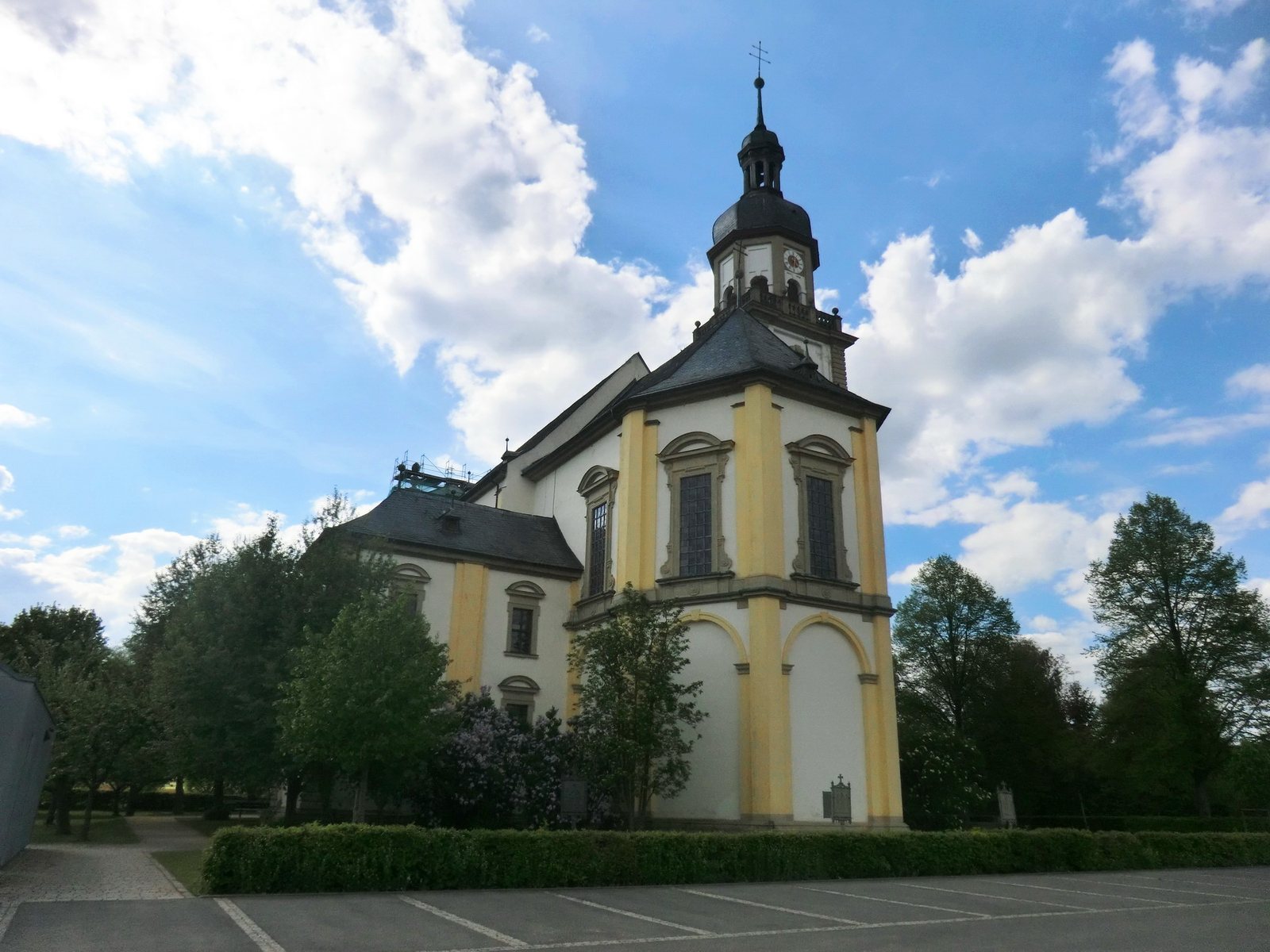
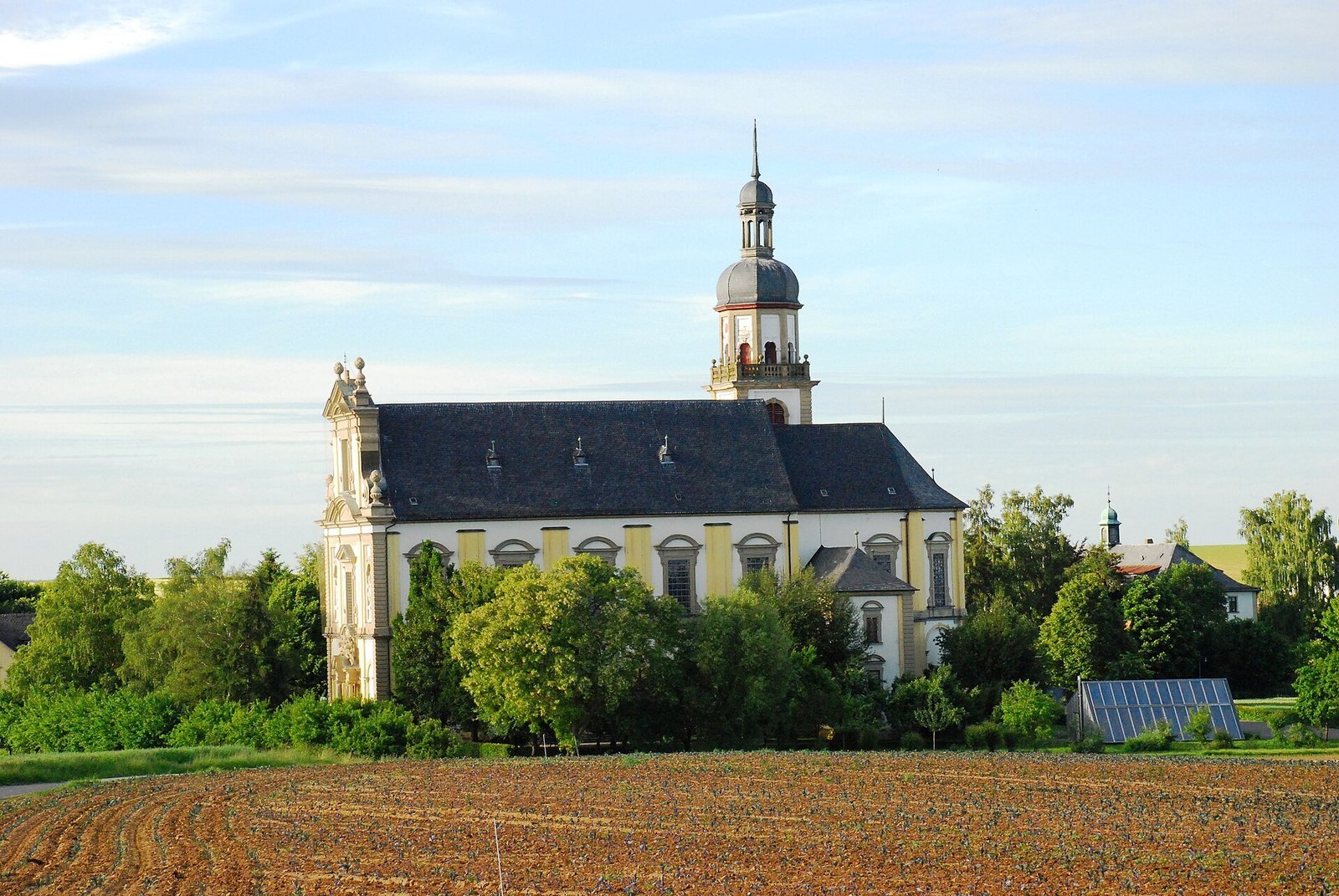
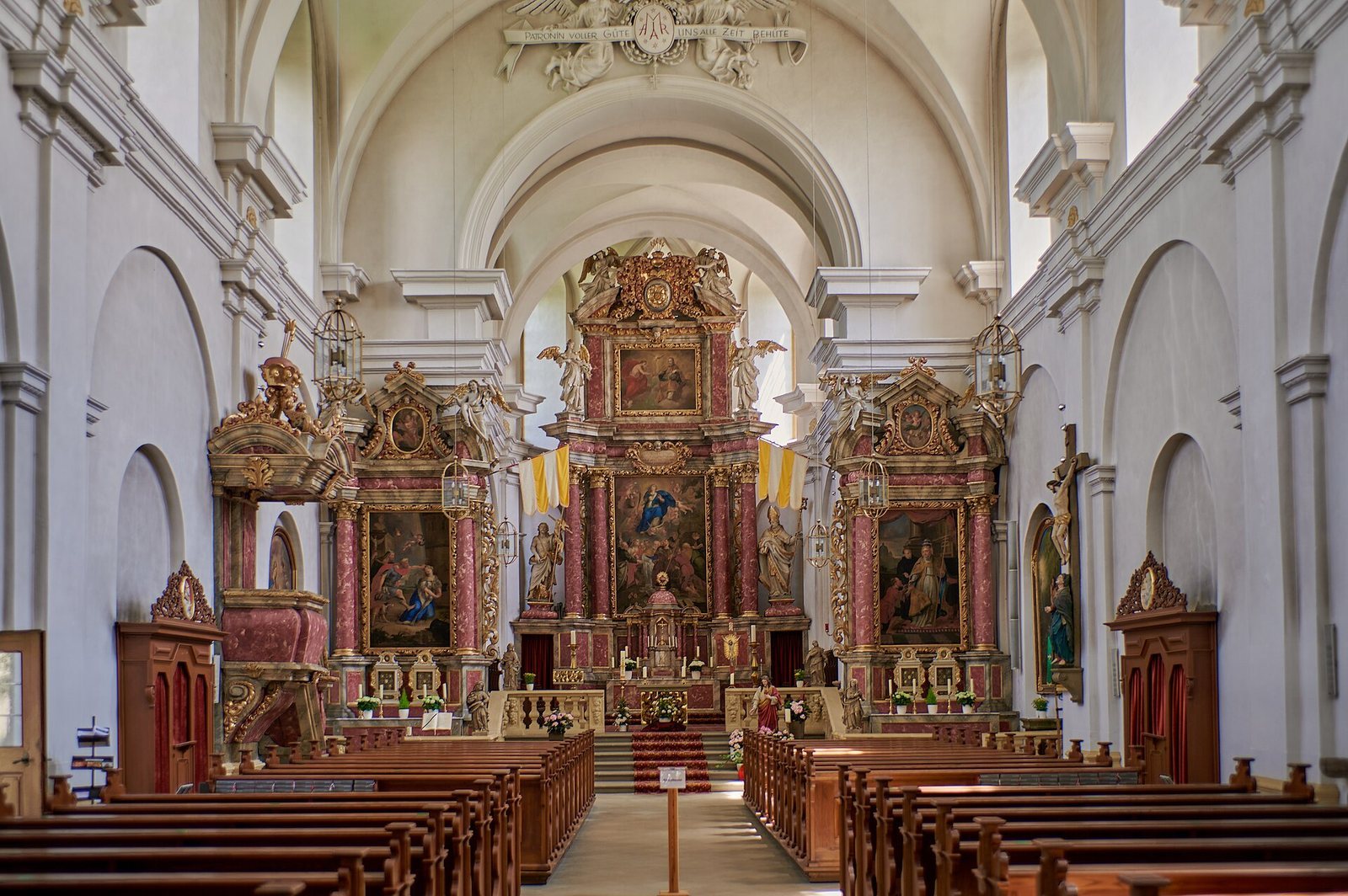
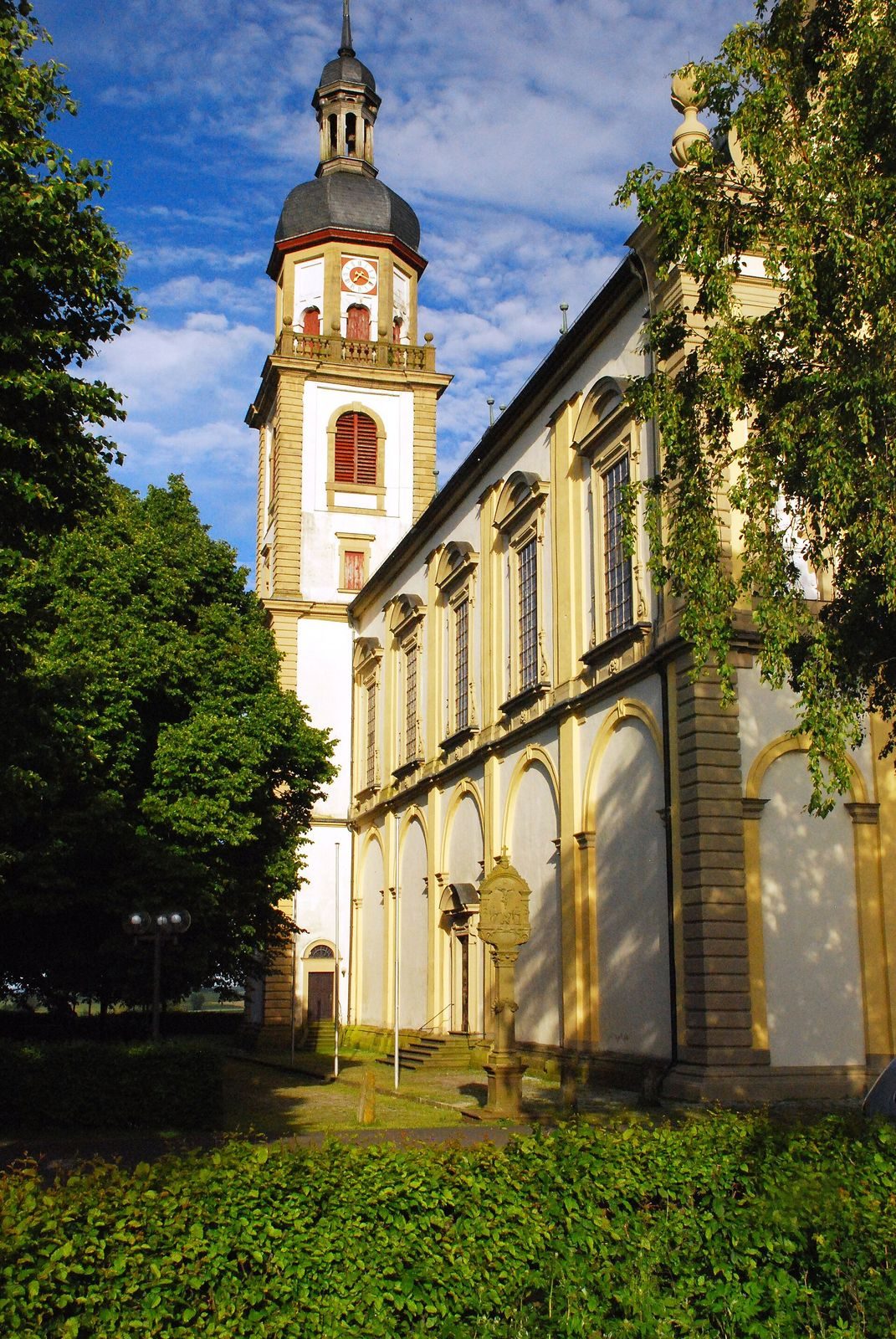
Fährbrück is a hamlet comprising a farm, the Augustinian monastery, the pilgrimage church, and an inn. Its principal religious building is the Baroque church, a style of European art and architecture prominent in the 17th and early 18th centuries.
Pilgrimage church
Church building and façade
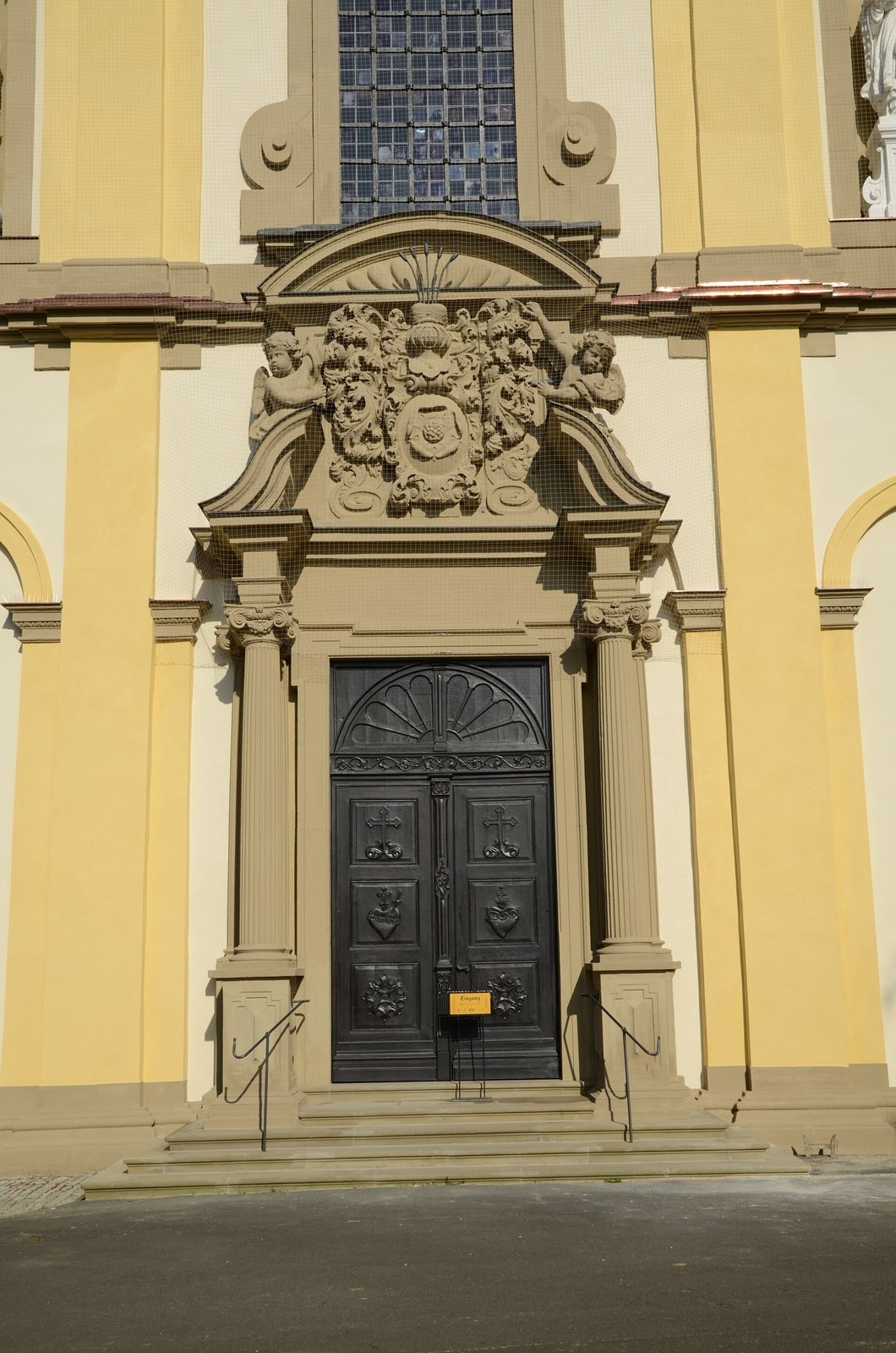
The present pilgrimage church was built between 1683 and 1697 by architect Antonio Petrini. It is dedicated to the Assumption of Mary, the Christian belief that Mary was taken into heaven at the end of her earthly life, and to St Gregory the Great. Its tower rises 58 metres. Images of St Gregory and St Wolfgang appear on the west façade.
Earlier chapel
The chapel that preceded the present church was built entirely of wood. It was later enlarged to twice its original size.
Organ
Würzburg organ builder Martin Joseph Schlimbach installed the church’s late-Romantic organ in 1900, reflecting a musical style associated with the late 19th and early 20th centuries. The instrument has 17 stops, which control sets of pipes, and three couplers (II/I, I/P, and II/P), which connect keyboards or a keyboard to the pedals. Its mechanical cone chests use conical valves to admit wind to the pipes.
Liturgical object
A donated Mass chalice bears an engraved inscription naming Johann Bartholomäus Heinrich as an official at Arnstein and giving 1666 as the inscription’s date.