Stjernsund Castle: A Swedish Estate and Protected Historic Building
Site at a Glance
- Rating
- 4.4
- Popularity
- High
- Country
- Sweden
- Primary era
- Unclassified
- Eras represented
- Unclassified
- Civilizations
- Unclassified
- Site type
- Domestic
- Remains
- Manor House
On this page6 sections
History
Stjernsund Castle is a neoclassical castle in Sweden. Its associated estate was established in 1637 by Swedish nobleman Johan Gabrielsson Oxenstierna, who brought several smaller properties together. The estate is also the founding estate of the Swedish Red dairy cattle breed.
Expansion and royal ownership
The estate grew through purchases and exchanges, at times covering much of the parishes of Askersund and Hammar. After passing between noble families, it was sold in 1823 to Karl XIV Johan, king of Sweden and Norway from 1818 to 1844. During his ownership, a royal administrator allowed the castle to deteriorate.
Prince Gustaf and later owners
In 1851, Oskar I, king of Sweden and Norway from 1844 to 1859, sold the castle to his second-born son, Prince Gustaf, Duke of Uppland. A major repair followed under P. A. Nyström’s supervision. Gustaf was a composer and reportedly wrote some of his best-known songs at the castle. After Gustaf’s early death, Oskar sold the estate to his fifth child, Prince August, Duke of Dalarna. August later sold it to the Cassel noble family.
Preservation
By testament, the castle passed in 1951 to the Royal Swedish Academy of Letters, History and Antiquities, a scholarly institution concerned with history and antiquities, so it could be preserved as a cultural monument. Since 1965, it has had Sweden’s protected historic-building status.
Remains
Main building and setting
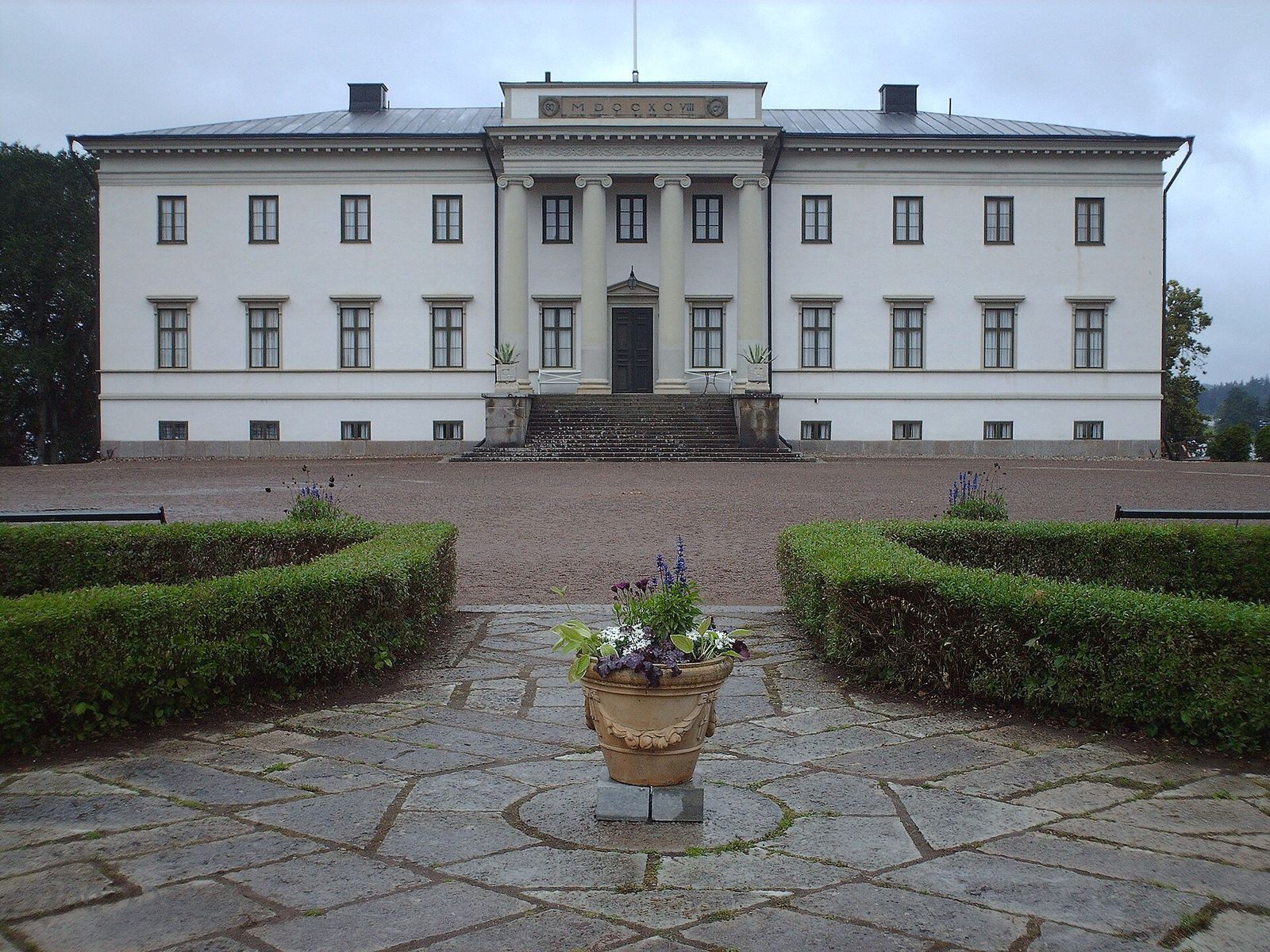
The castle stands on a high promontory between Lake Alsen and a waterway connecting it with Lake Vättern. Its main building has two storeys above a lower-set administrative floor. A projecting central section carries a portico with four columns, which stand on a raised stone staircase.