Greek Pontifical College of Saint Athanasius: A Seminary for Greek-Rite Communities
Site at a Glance
- Popularity
- Medium
- Country
- Italy
- Primary era
- Early Modern
- Eras represented
- Early Modern
- Civilizations
- Papal States
- Site type
- Civic
- Remains
- University
On this page7 sections
History
Greek communities and the college’s foundation
The Greek Pontifical College of Saint Athanasius is a clergy-training institution in Rome, Italy, established to serve Greek-rite Christian communities. It began operating in 1576 and received formal approval from Pope Gregory XIII in 1577. Its foundation answered the needs of Greek-speaking communities in the mountainous parts of Calabria and Sicily, whose members remained in communion with Rome while retaining Byzantine rites and customs, a family of Eastern Christian liturgical practices associated with the Byzantine tradition.
After the Norman conquests of the eleventh century severed these communities’ contacts with Byzantium, Albanian immigration helped preserve their distinct identity into the fifteenth century. By the sixteenth century, however, Greek communities had lost their bishops. Monasteries such as Grottaferrata and the new college helped sustain their religious life. Cardinal Giulio Antonio Santorio, protector of the Basilian monks, developed the college project and established a reformed congregation for the Greek-Byzantine rite in 1573.
Gregory XIII hoped that teaching Greek language and culture would improve relations with the Eastern Orthodox churches, which are distinct from the Catholic Church. The college was also intended to improve clerical education in keeping with the Council of Trent and to prepare priests who might bring Eastern churches into communion with Rome. Its founders further saw this work as a way to counter Ottoman expansion and Protestantism in former Byzantine lands.
Teaching and administration, 1576–1773
At first, the college operated from several houses on Via di Ripetta. In 1577 it moved to permanent premises on Via del Babuino, where construction began on the college and its adjoining church. Five cardinals initially supervised the institution. For its first fourteen years, Santorio appointed rectors from both the clergy and the laity. In 1579, John Zigomalas, a representative of the Patriarch of Constantinople, sent a letter of thanks for the school’s establishment. Patriarch Jeremiah II also praised it in letters to Gregory XIII and sent two nephews to study there.
The college taught the works of the Greek Church Fathers, early Christian writers and theologians whose works were composed in Greek. Greek was central to the course of study: students learned classical Greek, while former pupils helped newcomers acquire modern Greek. Latin was taught to those who did not already know it. Early instructors included paid professors, and later teachers included Jesuits, other clergy, and laypeople. The college initially had authority to award degrees, including doctorates; under Jesuit direction, students instead went to the Roman College to receive their doctorates.
Between 1577 and 1599, 125 Greek students studied at the college. Enrollment varied with its finances, usually staying near fifty and briefly reaching 56. Some students paid fees. Although the statutes set fourteen as the minimum age for admission, children of eight or nine also entered, and courses lasted eight to ten years.
The college’s activity was suspended during the reorganization under Pope Sixtus V and resumed in 1591 under Pope Gregory XIV, who placed it in Jesuit hands despite opposition from the order’s superior general, Claudio Acquaviva. Disagreements with Cardinal Benedetto Giustiniani led the Jesuits to withdraw in 1604. The Somaschi directed the college until 1609, followed by the Dominicans. The Jesuits returned in 1622 and remained until the Society of Jesus was suppressed in 1773. Andreas Eudaemon-Joannes, appointed rector that year, was the college’s only Greek rector.
In 1624, Pope Urban VIII revised the statutes, defining the college as a seminary for Greek Catholics, Eastern Christians in communion with Rome who retain their own rites, from territories under Venetian and Ottoman control. A limited number of places remained for Italo-Greeks and Albano-Greeks. Graduates were required to pledge adherence to the Byzantine rite, though this rule was often disregarded. Under these statutes, students’ religious exercises took place in Latin, and they attended Latin Mass each day. On Sundays and during the Easter season, a Greek liturgy followed the Latin Mass. Receiving Communion in both bread and wine was limited to Christmas, Easter, and Pentecost.
The college also housed paying students who were not candidates for the priesthood, mostly from the Latin Church. They answered directly to the rector and had fewer obligations than seminarians, although their privileges diminished over time.
Reorganization and a wider Eastern mission
After the Jesuits left in 1773, Roman diocesan priests directed the college until 1802. It closed in 1803, and during the closure its students attended the College of the Propagation of the Faith. The institution reopened in 1845. In 1886 it reopened under the Resurrectionist Congregation, returned to the Jesuits in 1890, and passed to the Benedictines in 1897.
In 1897, Pope Leo XIII refounded the college and revised its aims, seeking to change the Latin Church’s attitudes toward Eastern churches and rites. Hildebrand de Hemptinne, a Belgian Benedictine leader, replaced the cardinal protector. The Belgian Benedictine community took charge in 1919; since 1956, responsibility has rested with the Eastern Benedictines of Chevetogne Abbey.
The college came to serve a broader range of communities than its original Italo-Albanian constituency. Its students included members of Melkite, Greek, Albanian, Bulgarian, Macedonian, Romanian, Slovak, Hungarian, Belarusian, Croatian-Serbian, Russian, Ukrainian, and Ruthenian communities. Students from the Eastern Orthodox world were also received. The college trained bishops, Ruthenian metropolitans, and leading hierarchs of the Russian Uniate Church, an Eastern Catholic body. Some students later left clerical life, while others pursued secular studies in Padua or Venice.
Disputes over worship practices continued for many years, as some seminarians insisted on the Byzantine rite while others used the Latin rite. Leo XIII affirmed the validity of both, citing Pope Benedict XIV’s 1755 document Allatae Sunt.
Remains
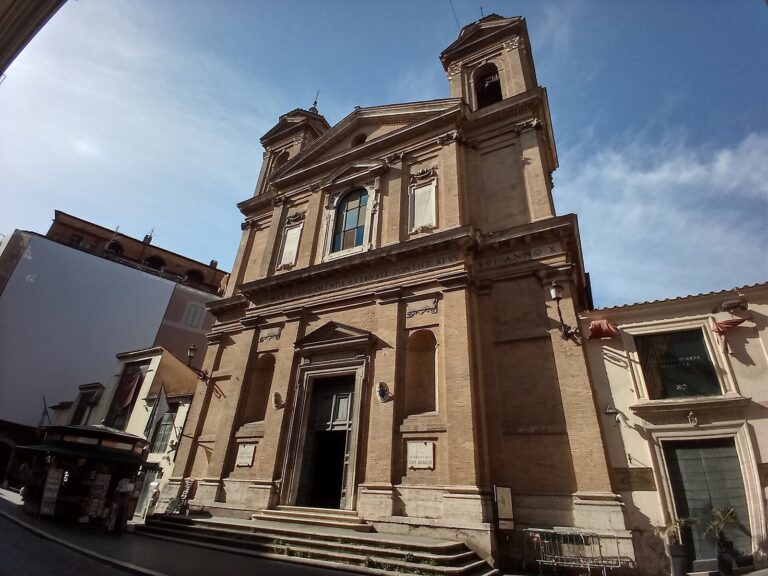
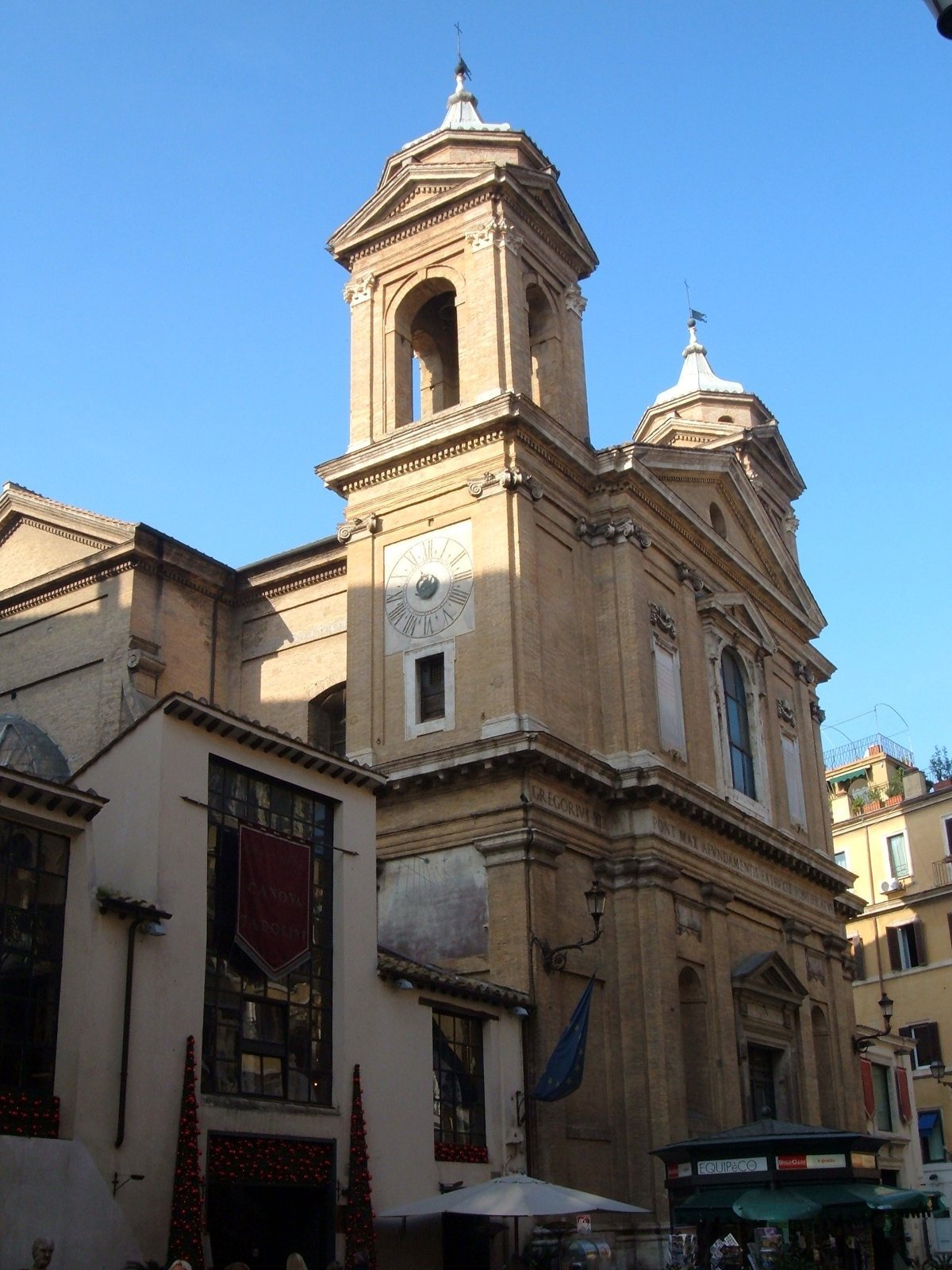
The site comprises the college building and the adjoining Church of Sant’Atanasio, connected by a bridge. The surviving features include the college’s renovated façade and the church, which serves as a chapel for Italo-Albanians in Rome and elsewhere in Lazio.
College building
The college’s present façade dates to a renovation carried out in 1769 under Pope Clement XIII. A plaque on the façade commemorates the work. The college’s religious-art collection includes works by the Italian painter Francesco Traballesi.
Church of Sant’Atanasio
The church stands beside the college and is linked to it by the bridge. It has four altars of the Latin rite and is a titular church, assigned to a cardinal as his ecclesiastical title. It also serves as a chapel for Italo-Albanians living in Rome and elsewhere in Lazio.