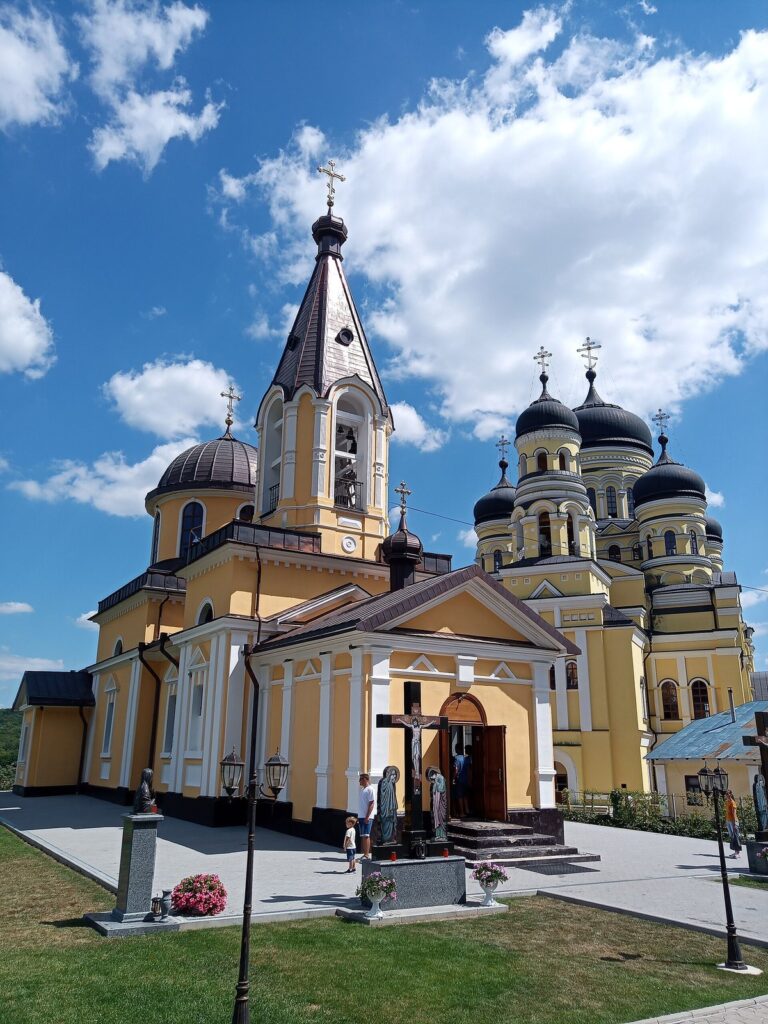
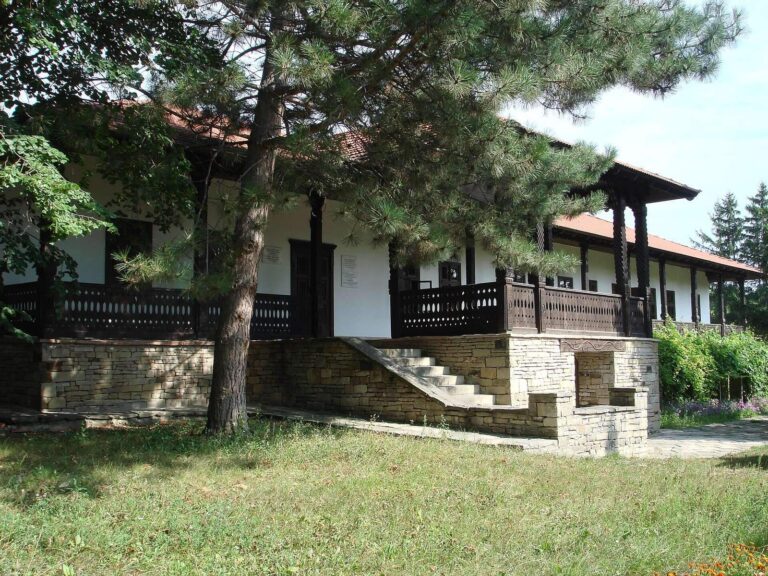
Huși Cathedral: Seat of the Diocese of Huși
Site at a Glance
- Popularity
- Medium
- Country
- Romania
- Primary era
- Early Modern
- Eras represented
- Medieval, Early Modern, Modern
- Civilizations
- Kingdom of Romania, Ottoman, Principality of Moldavia
- Site type
- Religious
- Remains
- Cathedral
On this page18 sections
History
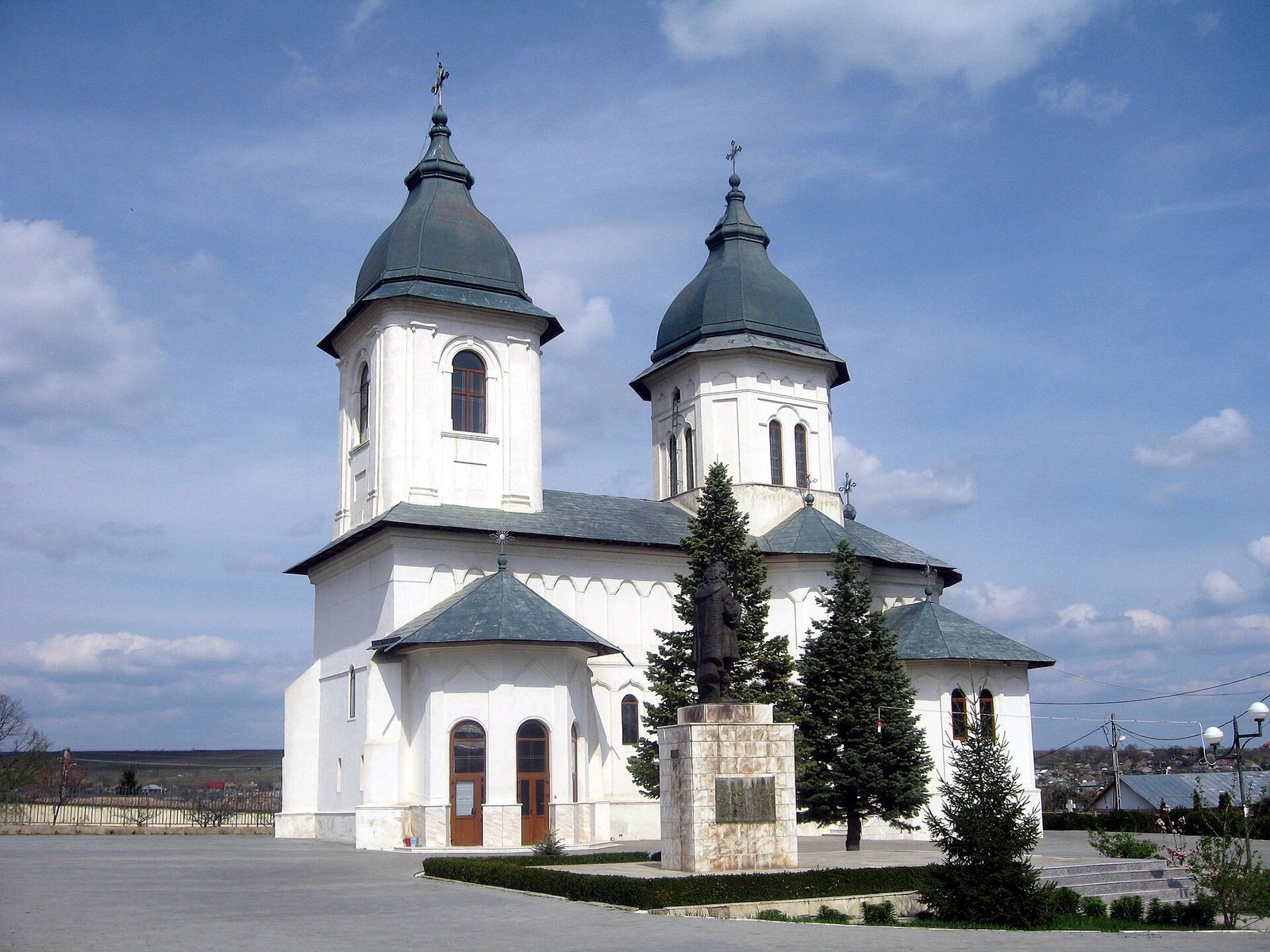
Huși Cathedral, the Church of Saints Peter and Paul, is an Orthodox cathedral in Huși, Romania. Stephen the Great, ruler of Moldavia, a historic principality centered in what is now eastern Romania and the Republic of Moldova, founded the original church in 1495 as part of his princely court. It became a cathedral in 1598, and the present church reflects a later Baroque rebuilding. The Diocese of Huși was re-established in 1996, restoring the cathedral’s role as its episcopal seat.
From princely church to cathedral
A local tradition traces the name Huși to a fifteenth-century boyar called Husul. According to the story, his family built a wooden church for residents. The settlement was modest in the middle of the fifteenth century and had developed into a market town by its close. Stephen the Great granted it market-town status, set its boundaries, and established a princely court there. In 1495 he built the Church of Saints Peter and Paul within the court as the church of his residence, not as a monastery or parish church. Huși remained princely property for more than a century, and the church was not endowed with estates or villages.
In 1598, Moldavian ruler Ieremia Movilă established the Diocese of Huși and made the church its cathedral. The diocese covered the Fălciu District on both banks of the Prut River, the part of the Lăpușna District left after Tighina and twelve villages came under Ottoman rule, and the districts of Orhei and Soroca. Movilă also endowed the cathedral with several villages.
Damage and rebuilding, 1692–1756
An earthquake in 1692 brought down both church towers and cracked the walls. By 1708–1709, the building had been burned and plundered and was in severe disrepair. Bishop Sava attempted repairs, but Turkish and Tatar forces plundered and burned the church after the Battle of Stănilești in 1711, leaving its walls standing. The attackers also burned the episcopal residence within the grounds.
With support from Moldavian ruler Nicolae Mavrocordat, Sava rebuilt the residence in 1714. Mavrocordat also arranged for the church to be repaired and roofed and for enclosure walls and monastic cells to be provided. In 1740, Tatars seized church valuables and vestments during wartime disturbances and troop movements along a major route. Moldavian ruler Grigore II Ghica granted the church tax exemptions to aid its recovery.
Appointed in 1752, Bishop Inochentie found the church too ruinous for services. With support from ruler Matei Ghica, he had the earlier building taken down to its foundations and rebuilt between 1753 and 1756. The work was completed on 9 January 1756, with Stephen the Great’s founder’s inscription incorporated into the new walls. Inochentie was later buried inside the church.
Patronage and changes to the complex
Between 1769 and 1770, Inochentie led a Moldavian delegation to Russia to thank Empress Catherine II for the Russian army’s intervention, which had driven Turkish forces from Moldavia. Catherine gave him an enkolpion, a devotional pendant worn on the chest, especially by bishops. In 1784, Bishop Iacob Stamati provided a painted iconostasis, a screen of icons separating the sanctuary from the main church, along with a large bell, vestments from Venice, and other furnishings. He also brought a hand relic of Saint Kyriaki from Mount Athos.
Bishop Veniamin Costachi repaired and painted the church in 1793. An earthquake badly damaged it in 1802. Bishop Meletie Lefter, whose tenure lasted from 1803 to 1826, then had it dismantled down to the windows and rebuilt with one tower. In 1849, a new iconostasis replaced the earlier one, which was transferred to the Church of the Holy Archangels elsewhere in Huși.
The episcopal palace was built between 1771 and 1792 on the ruins of the former princely palace, at the initiative of Bishops Inochentie and Iacob Stamati. After a fire in 1813, Bishop Sofronie Miclescu rebuilt it in 1849; its façades were later altered in 1890 and 1934–1938. Miclescu also enclosed the episcopal grounds with a substantial brick wall between 1826 and 1848 and initiated rooms for diocesan staff. Those rooms stood on the site of earlier buildings, were renovated in 1934, and served at different times as a church singers’ school and diocesan seminary. The palace housed a diocesan museum in 1926–1949 and 1983–2004, and a municipal museum in 1960–1982. Since 2004 it has been the bishop’s residence.
Repairs, earthquakes, and the restored diocese
During Bishop Silvestru Bălănescu’s tenure, repairs included the addition of a second tower in 1891, stained-glass windows, and interior and iconostasis paintings by Gheorghe Tattarescu in 1890–1891. Bălănescu also erected a monument to the church’s benefactors in 1889 and one to Veniamin Costachi in 1898. Alterations in 1910–1911 enlarged the porch and the area for preparing the Eucharistic bread and wine, added two vestries, and introduced other changes to the interior and towers.
Repairs under Bishop Nifon Criveanu took place in 1934–1935. In 1935, painter Gh. Tomescu cleaned Tattarescu’s murals, which had darkened with soot. The earthquake of 10 November 1940 brought down the tower added in 1891, cracked the walls, and caused much of the painting to fall. Work from September 1941 to May 1945 rebuilt the tower and restored the painting, as well as renewing furnishings and altering the gallery and porch. The cathedral was reconsecrated on 29 June 1945.
On 5 February 1949, the communist government abolished the Diocese of Huși and united it with the Diocese of Roman as the Diocese of Roman and Huși, based in Roman. Huși was no longer an episcopal seat. The Romanian Orthodox Church re-established the Diocese of Huși in 1996 and appointed Ioachim Mareș as bishop. The cathedral and complex were then consolidated and restored. The church was repainted in 1997–1998 and reconsecrated on 11 October 1998 by Patriarch Teoctist Arăpașu and Metropolitan Daniel Ciobotea. In 2015, the episcopal ensemble was included on Vaslui County’s historic-monument list.
Remains
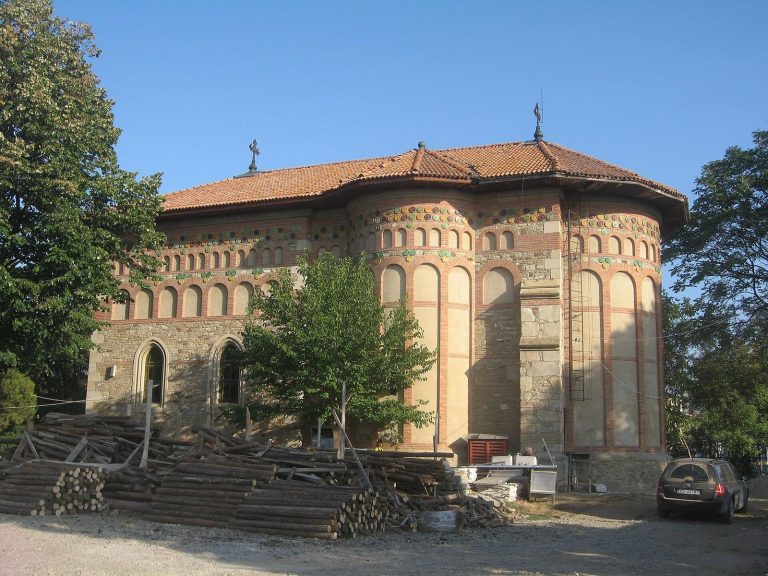
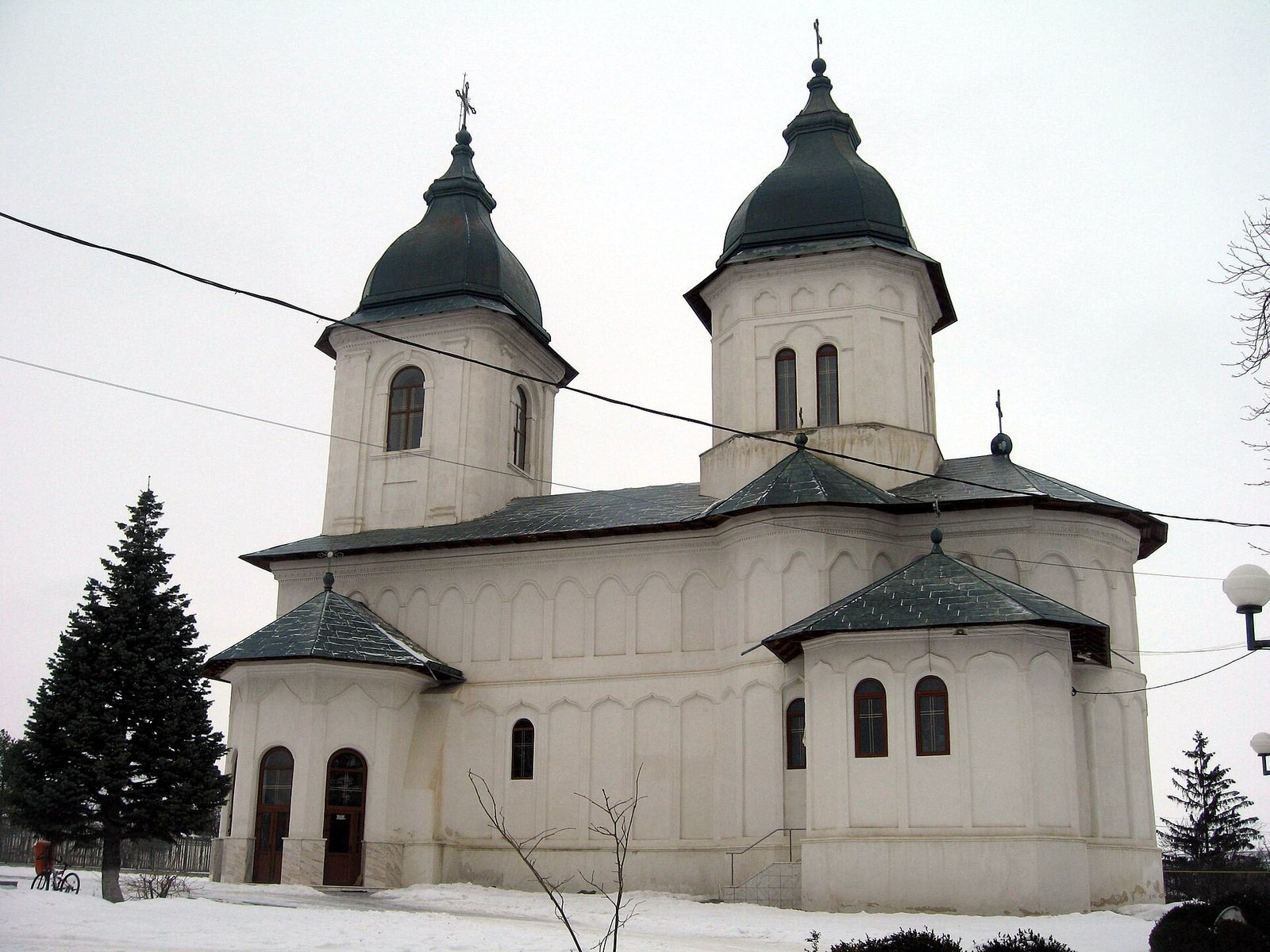
The episcopal ensemble brings together the Church of Saints Peter and Paul, the palace, staff buildings, an enclosure, and courtyard monuments. The church has Baroque façades and a three-apsed plan, while the surrounding grounds retain buildings and features associated with the former princely court and later diocese.
The cathedral
Plan and structure
The church’s three apsidal projections are arranged at the sanctuary and on each side of the main body. The exterior of the sanctuary apse has seven sides. The entrance hall is covered by a dome supported by curved transition surfaces and transverse arches. Above the nave, an octagonal tower rests on transverse arches and columns attached to the walls. The sanctuary and side apses have continuous, barrel-shaped ceilings. The façades retain a traditional two-level arrangement, divided by a horizontal band.
Inscription, paintings, burials, and treasures
The foundations of Stephen the Great’s church lie beneath the present building, and its founder’s inscription is set into the later walls. Originally placed above the entrance and written in Slavonic, it says that Stephen began the church at Huși and that it was completed on 30 November in his thirty-eighth regnal year. The date is understood as 30 November 1495, using the dating practice then followed in Moldavia. An inscription added after the 1793 repairs records Costachi’s renewal of the church; another commemorates the 1940 earthquake and the work of 1941–1945.
The church walls also carry a painted version of the tradition about Husul and his family’s wooden church. Tattarescu painted the interior in 1890–1891. Tomescu cleaned the murals in 1935, they were restored after the earthquake in 1943–1945, and Dumitru Bănică repainted them in 1997–1998. A further inscription was added after the 1996–1998 restoration.
Inside the church, Bishop Inochentie is buried near the bishop’s seat, and Bishop Meletie Istrati is also buried there. The grounds behind the sanctuary contain the graves of Bishops Iacov Antonovici and Grigorie Leu. The cathedral’s treasures include Saint Kyriaki’s hand relic in a gilded-silver reliquary donated by Russian general Pavel Kiseleff, and Catherine II’s enkolpion. A silver-bound Gospel and a large brass hanging lamp with multiple lights date from Costachi’s period.
Palace and staff building
Episcopal palace
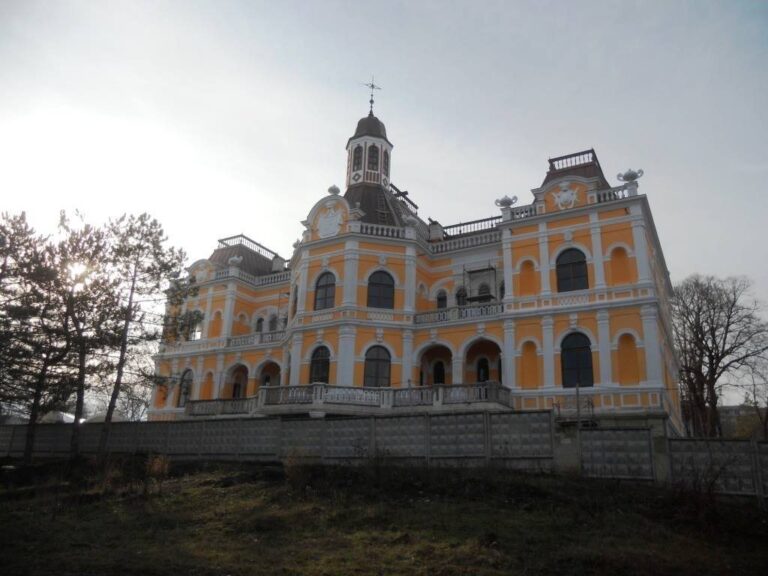
The rectangular palace stands above cellars belonging to the fifteenth-century princely house. Those cellars, built with stone-and-brick walls, have barrel-shaped vaults and stone stairs. The palace has a ground floor and an upper storey, with pronounced projections on its east, north, and south façades. Its interior is arranged symmetrically around a central hall with a monumental wooden staircase. The exterior combines neoclassical design with Baroque elements.
Diocesan staff building
The surviving staff building is a single-storey rectangular block on the northeast side of the grounds. Its rooms form a row behind a portico supported by brick columns. The portico is now glazed.
Enclosure and entrance
Wall and gate tower
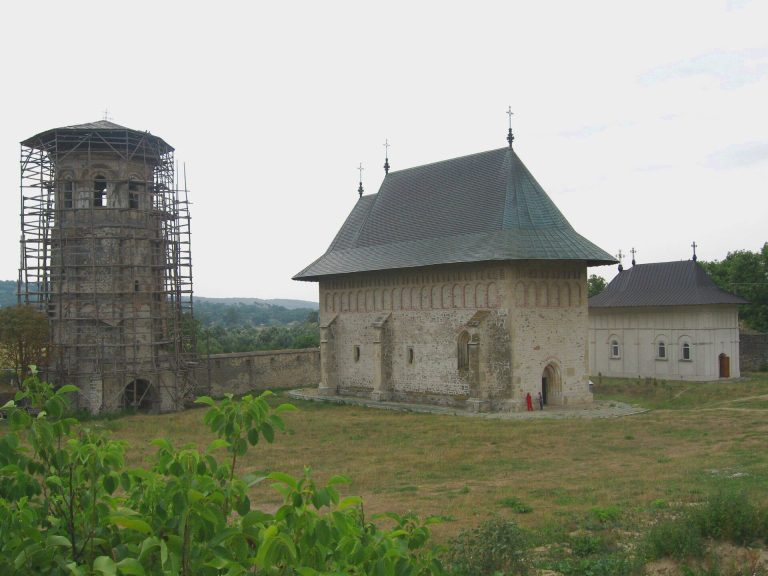
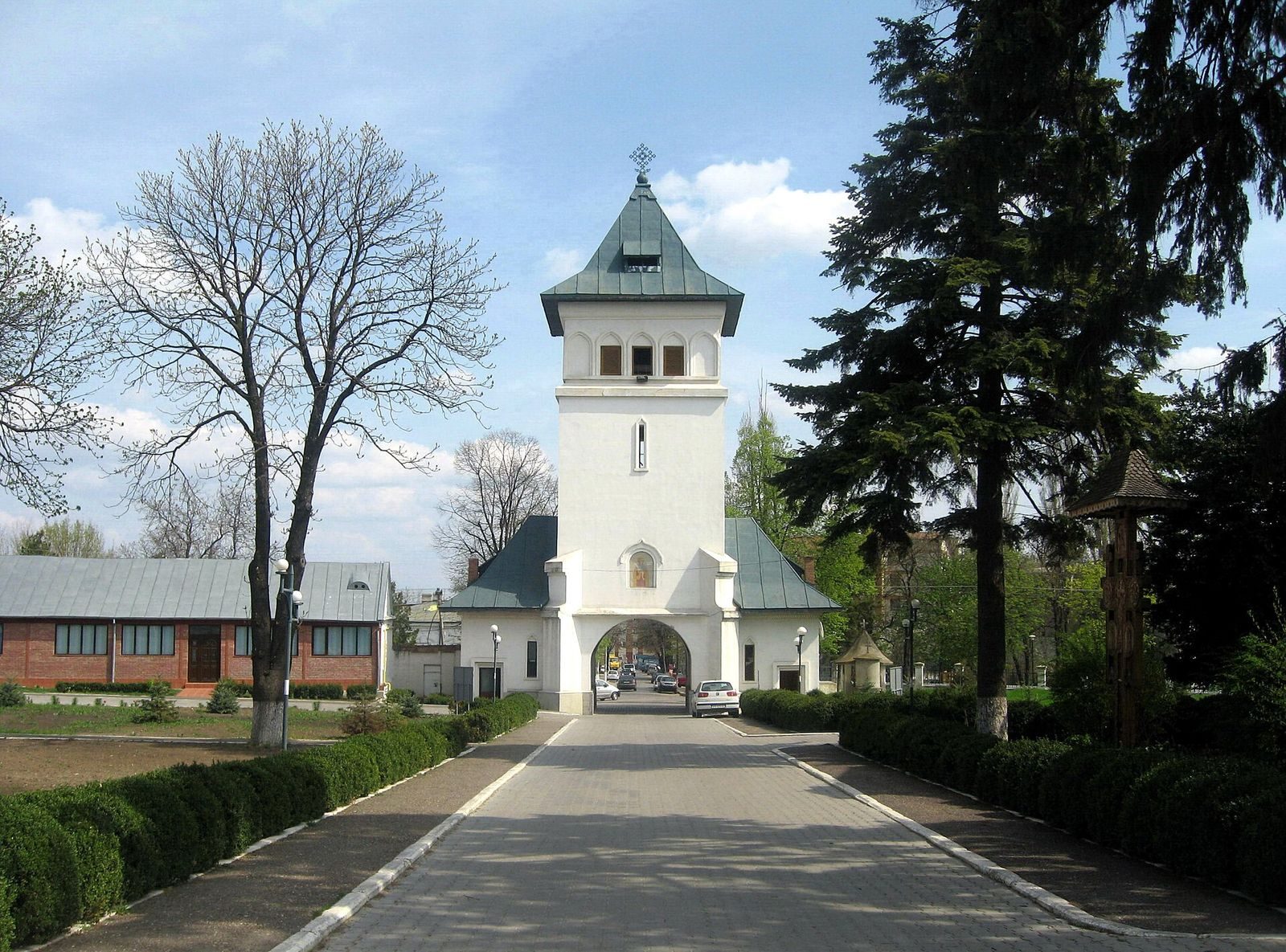
The present enclosure fence has a stone parapet topped by a metal grille and follows the line of the former wall. The sixteenth-century gate was rebuilt in 1714 and renewed in 1849. The present gate tower was constructed in 1938 on the earlier entrance site. Built in Moldavian style, it has a square plan and four levels, with a semicircular-headed vehicle entrance at ground level. Stepped supports reinforce its corners, and low wings on either side provide access to the tower and gatekeeper’s residence. A line of niches with S-curved arches marks the bell chamber. Its 1,730-kilogram bell was cast from two smaller bells and follows the model of a bell made at Kyiv for the princely church in Bârlad by Vasile Lupu.
Courtyard features and monuments
Fountain
South of the church, the old stone fountain takes the form of an obelisk topped by a cross. Its western face has an inscription recording its rebuilding in 1864. A second inscription beneath it marks its reconstruction from the foundations and its consecration on 24 June 1930.
Memorials and tombstones
At the level of the sanctuary stands a hexagonal monument topped by a cross. Bălănescu erected it in September 1889 in memory of the church’s clergy and benefactors. Tombstones around the monument commemorate Zanfiraki and Zmaranda, whose stone was ornamented by Kir Nekolaki in March 1808; members of Bishop Meletie Lefter’s family who died between 1825 and 1870; and Anastasia Panu, née Hurmuzaki, who died in 1882.
East of the church is a stone obelisk on a base, crowned by a cross, which Bălănescu erected in October 1898 in memory of Veniamin Costachi. Its southern inscription records Costachi’s service as bishop of Huși from 27 June 1792, bishop of Roman from 1 June 1796, and metropolitan of Moldavia and Suceava from 16 March 1803 to 8 January 1842.
Other courtyard monuments
A statue of Stephen the Great stands south of the church. Sculptors Gheorghe Alupoae and Cristian Pântea made it, and it was cast by Metamar S.A. in Baia Mare in 1995. The grounds also contain a carved wooden cross-shrine made by archimandrite Mina Dobzeu.