Zhihua Temple: A Ming Buddhist Temple in Beijing
Site at a Glance
- Rating
- 4.4
- Popularity
- Low
- Country
- China
- Primary era
- Medieval
- Eras represented
- Medieval
- Civilizations
- Ming
- Site type
- Religious
- Remains
- Monastery
On this page19 sections
History
Foundation and the Ming court
Zhihua Temple is a Ming Buddhist temple in Beijing, China, founded in 1443 by the court eunuch Wang Zhen and completed the following year as his private family temple. Its surviving architecture preserves features described as transitional between Song and Ming–Qing styles. The temple is also the home of Jing music, an inherited tradition combining court, Buddhist and folk music.
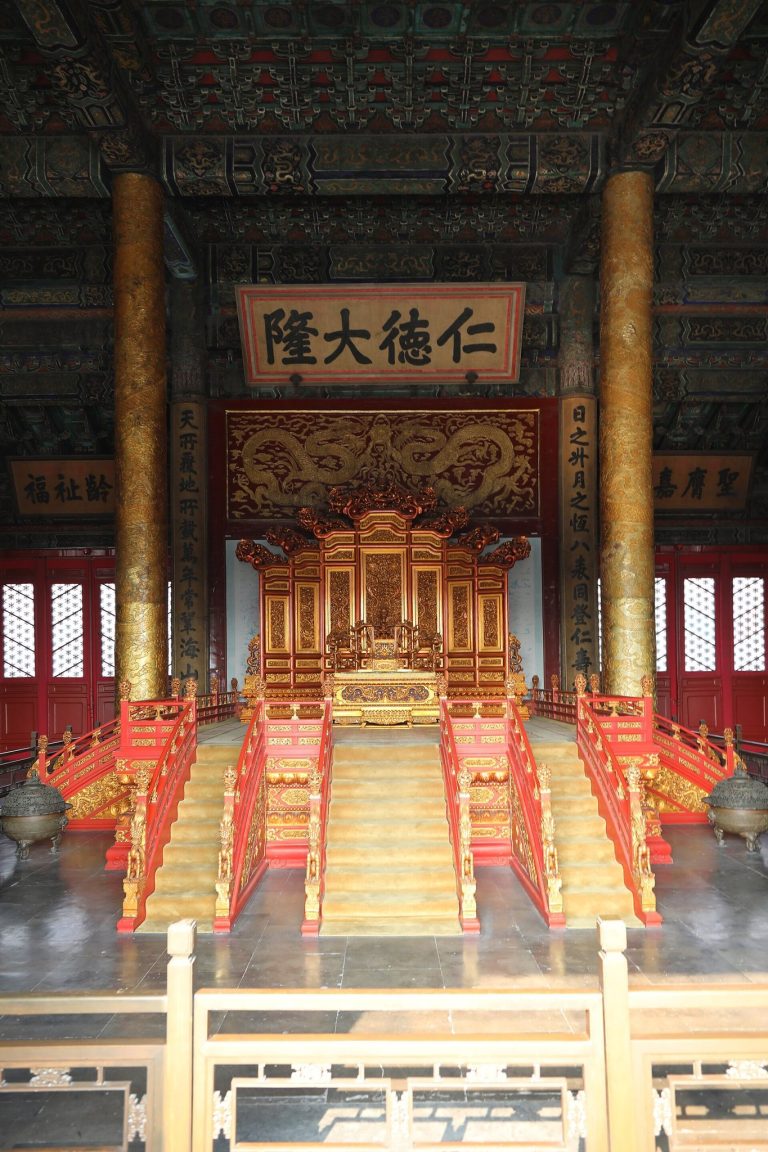
Wang Zhen served in the Ming court’s Rites Supervising Office and gained greater influence after the Grand Empress Dowager died in 1442. In 1446, he brought court music into the temple. Three years later, during the Tumu Crisis, a Ming military defeat in which Oirat forces captured the emperor, Wang died. After Emperor Yingzong returned and regained power in a coup, he arranged rites for Wang, including a ceremony summoning Wang’s spirit for burial. Wang’s memorial tablet was placed in the temple, and the emperor named a shrine there the Shrine of Utmost Loyalty. People continued to worship at the temple.
Qing-era changes and twentieth-century disruption
In 1742, the censor Shen Tingfang asked the Qianlong Emperor to order the destruction of Wang Zhen’s statue and an imperial stele. Shen opposed the continued veneration of Wang, whom he regarded as harmful to the Ming dynasty. The emperor approved the request, and the temple subsequently fell into increasing disrepair.
During the Eight-Nation Alliance intervention in 1900, several temple buildings were destroyed and ancient cypress trees were cut down. After the Republic of China was established, the monks earned income by renting rooms. Following the Japanese occupation of Beiping in 1937, small businesses took over parts of the compound. Coffins were frequently stored in Buddhist halls, and rubbish and mud accumulated there.
Music, research and preservation
Jing music continued to pass from one generation of temple musicians to the next. A distinct tradition called Chan music consists of Buddhist ritual chants, while Jing music became the form performed most widely. During the Daoguang and Xianfeng reigns of the Qing dynasty, Jing music also spread to more than ten other temples in Beijing.
In late 1952, musicians and researchers Cha Fuxi and Yang Yinliu visited Zhihua Temple to study and record its music. They considered a possible link with the Northern Song court’s drum-and-blow music institution, a form of organized court music. A research organization devoted to Jing music was established in 1954. In 1955, a Beijing cultural bureau team moved residents out of the temple. The site received municipal cultural-protection status in 1957, municipal funds supported repairs the following year, and it became a National Key Cultural Relics Protection Unit in 1961.
A temple cultural-relics office was established under the Beijing municipal heritage administration in 1982. A comprehensive repair project began in 1986, followed by further renovation from 2005 to 2008. Also in 1986, with support from the Tenth Panchen Lama and Buddhist leader Zhao Puchu, the Beijing Buddhist Music Ensemble was founded with Zhihua Temple Jing music as its principal focus. It was China’s first organization devoted to Buddhist music research and performance. Temple musicians performed in seven cities in Germany, France and Switzerland in 1987, and in 1991 six young people from Qujiaying Village in Hebei came to study the tradition.
In 1992, the Beijing Cultural Exchange Museum was established in the compound to support exchange among Beijing-area museums and private collectors, as well as the study of cultural relics and museums. It took the place of the temple’s relics office while remaining under the municipal heritage administration. In 2004, the twenty-sixth-generation musician Zhang Benxing and six pupils, after ten years of study, recorded 43 surviving Jing music pieces. The tradition entered China’s first national list of representative elements of intangible cultural heritage in 2006. By the early twenty-first century, it had reached its twenty-seventh generation of transmitters.
Remains
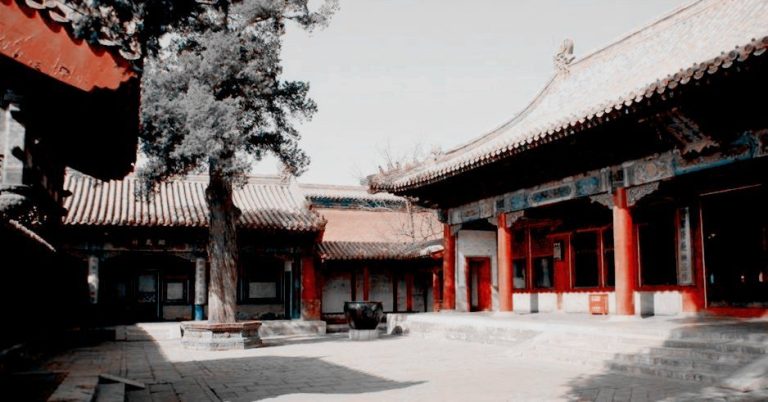
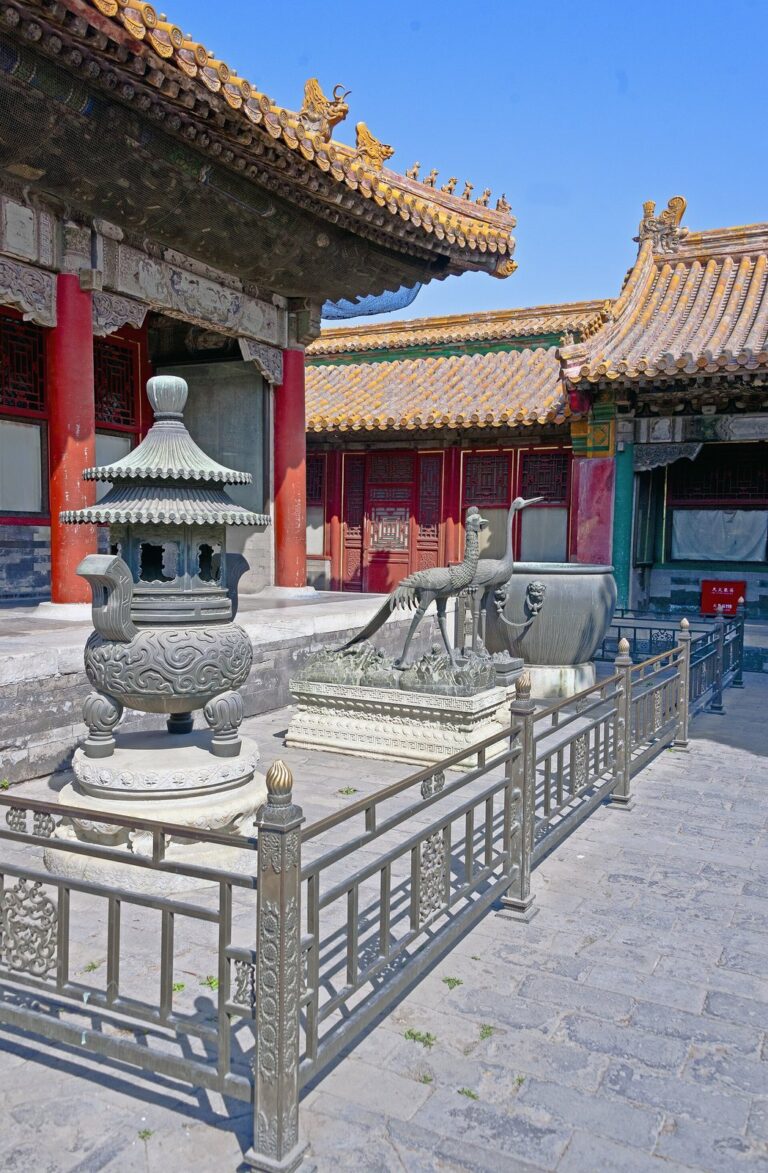
The temple faces south, and its surviving compound follows the central route of an original plan with three parallel routes. Principal buildings stand along a north–south axis. The compound measures about 278.8 metres long by 44.5 metres wide, with an area of approximately 1.24 hectares; the temple, surrounding buildings and grounds together cover about two hectares. Its arrangement reflects the Buddhist plan of seven principal halls in a monastic compound. Principal halls generally have single-eaved hip-and-gable roofs, which combine sloping sides with gabled ends, covered with black glazed tubular tiles. The use of black was associated with a Buddhist teaching connecting the colour to the wind element and the subduing of demons.
Entrance and front precinct
Main gate
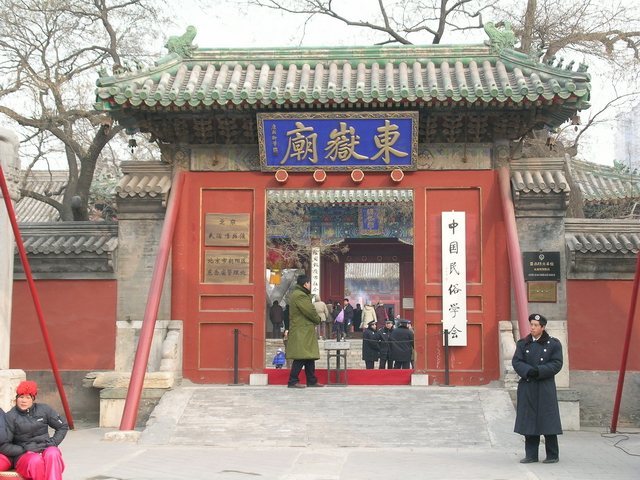
The main gate is a brick-and-stone structure built to resemble timber construction. It is three bays wide, meaning it has three structural sections, and measures about 7.10 metres across. Its depth is five purlins, or horizontal roof-support beams, approximately five metres. An arched entrance sits below a single-eaved hip-and-gable roof covered in black glazed tiles. A white-marble plaque above the entrance bears the inscription Imperially Bestowed Zhihua Temple. Its eastern inscription records construction by imperial order in 1444; the western one describes rebuilding in 1577 by the eunuch Zheng Zhen and others. A pair of stone lions stands before the gate. The present entrance arrangement has a central gate flanked by a side gate on either side, opened during a restoration.
Zhihua Gate
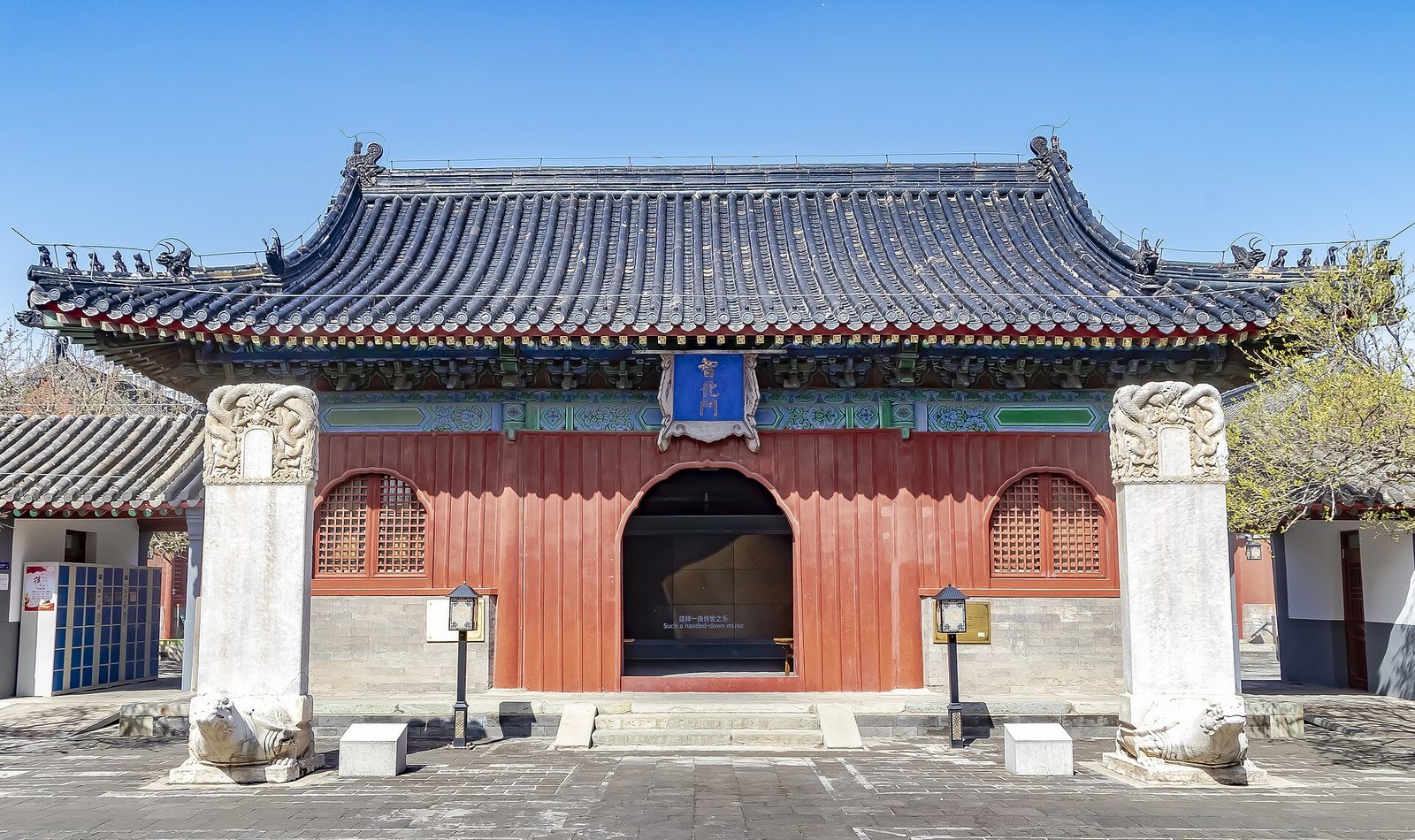
Zhihua Gate, a Ming-period building about 13 metres wide and 7.8 metres deep, serves a role comparable to a Hall of the Heavenly Kings. It now contains an exhibition on the temple’s history, and musicians perform Jing music there. Two stone steles stand in front. One describes Wang Zhen’s financing of the temple and the emperor’s naming of it; the other recounts Wang’s service to the Ming court and the temple’s prayers for the state, emperor and people. Wang’s name was chiselled from both inscriptions during the Qianlong-era removal of his statue, while the remaining text survives.
Bell tower and bronze bell
The two-storey bell tower stands east of Zhihua Gate and resembles the drum tower opposite it. Its bronze bell, cast in 1444, is 1.60 metres high and 1.05 metres in diameter, with a rim nine centimetres thick. More than twenty Buddhist mantras in Sanskrit script decorate its surface. The original bell is now held at the Great Bell Temple Ancient Bell Museum.
Drum tower and ceremonial drum
The two-storey drum tower stands west of Zhihua Gate. Its black-tiled hip-and-gable roof covers a structure measuring 7.1 metres in both width and depth. The lower storey has brick walls and an arched doorway; the upper storey has doors on all four sides and wooden sun-screen walls. Bracket sets, structural assemblies that support roof eaves, appear in three tiers on both floors. At the lower corners, bearing blocks about twice the width of ordinary ones increase the load they can carry without extending the eaves or disrupting the proportions between floors.
A Ming drum once kept in the tower was moved to the Tathagata Hall during repairs in 1987. Dust removal in 2003 revealed its golden dragon decoration; restoration began in 2006 and finished in 2011. The drum is now displayed west of Zhihua Hall, while a smaller replica is kept in the tower. It is 1.45 metres high, with a drumhead 1.07 metres across and a maximum width of 1.37 metres. Its lacquered surface bears four designs of two dragons playing with a pearl, with a further design on each drumhead. The twelve gold dragons represent favourable weather through the twelve months and were made with raised ornament and gilding.
Halls along the central route
Zhihua Hall and its mural
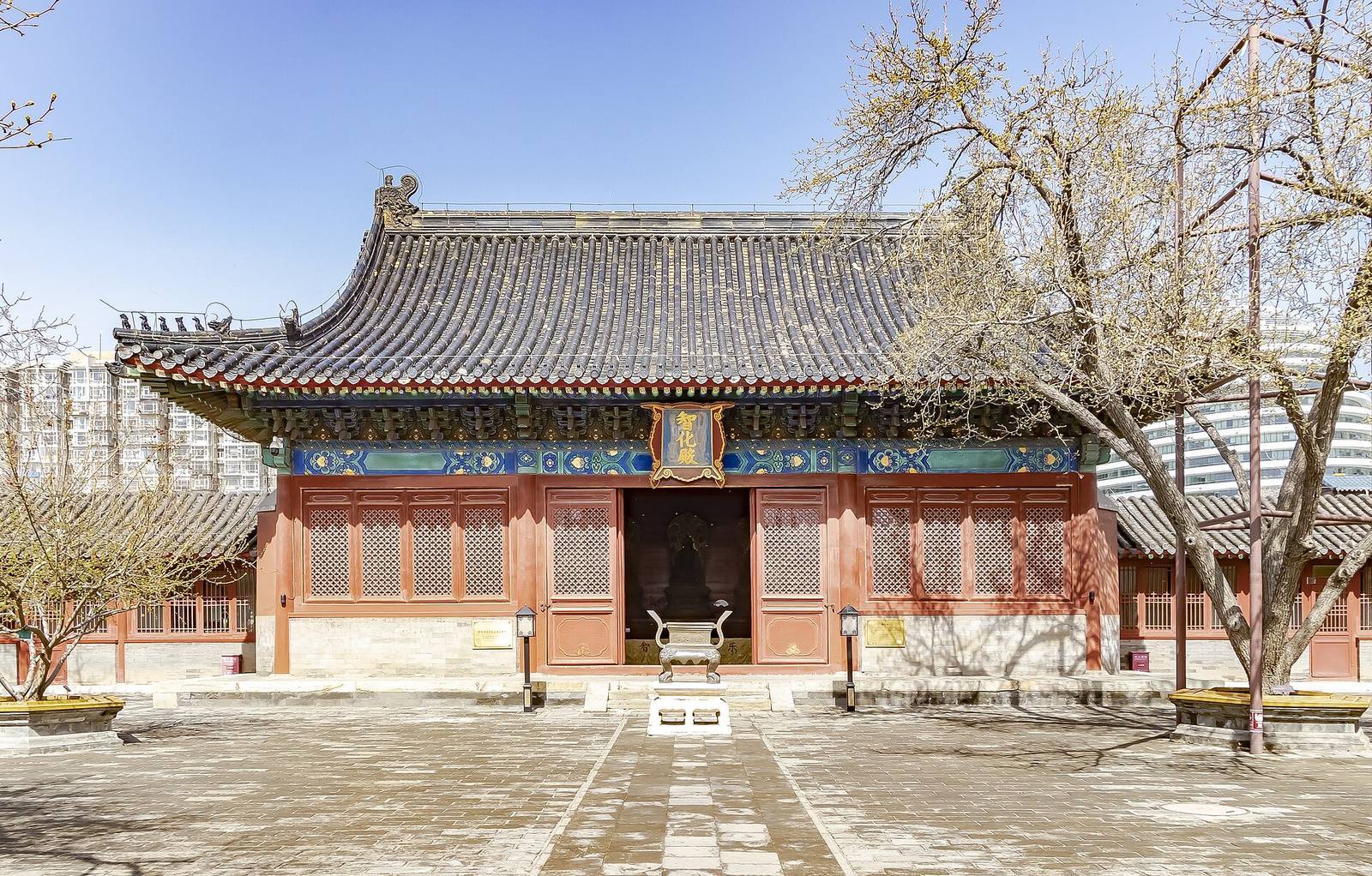
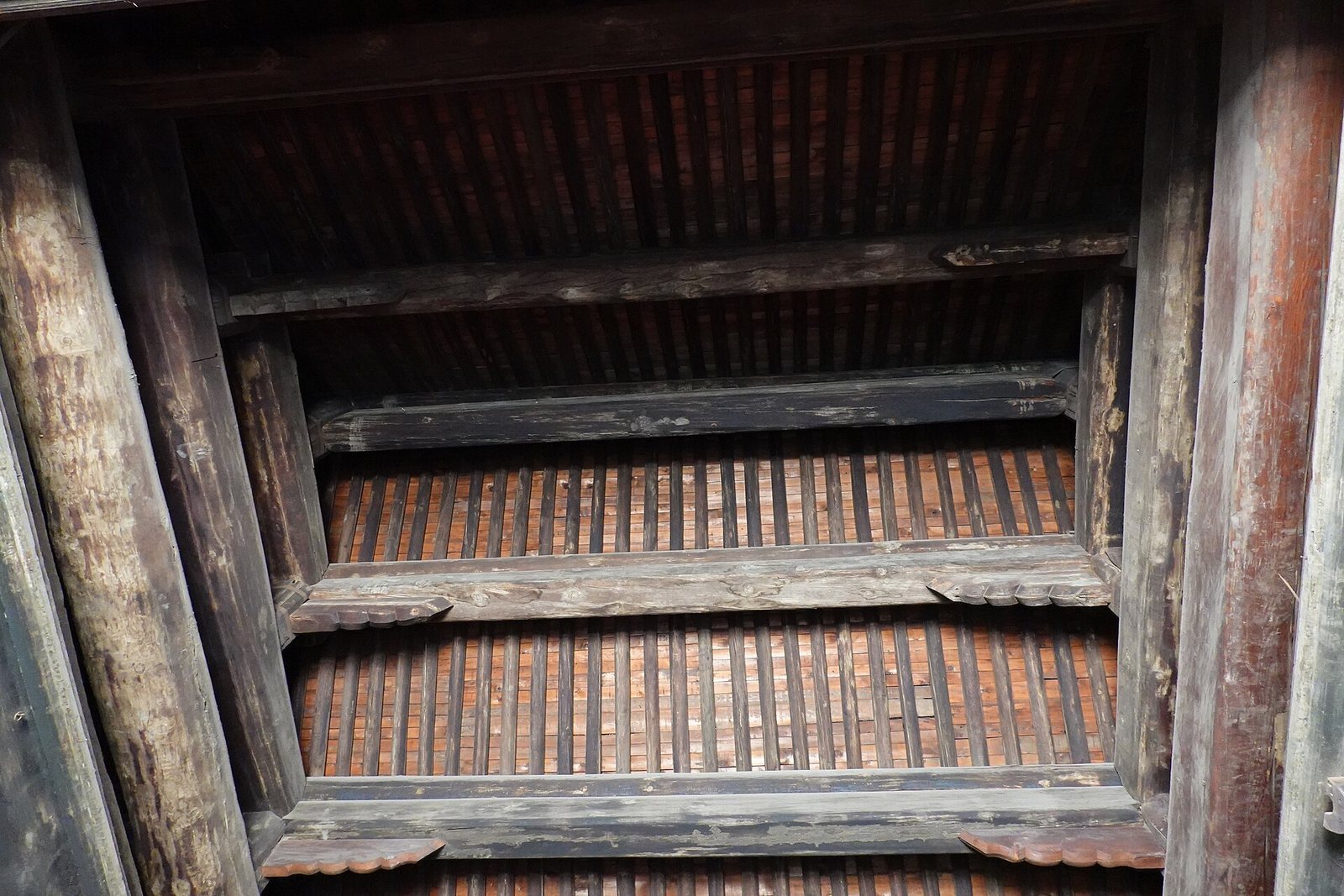
Zhihua Hall is three bays wide and has a single-eaved hip-and-gable roof covered with black glazed tiles. Inside, its coffered ceiling is formed from recessed ceiling panels. A white-stone Sumeru pedestal, a tiered support named for a mountain in Buddhist cosmology, once stood at the centre beneath gilded wooden images of Shakyamuni, the Medicine Buddha and Amitabha, with figures of the Eighteen Arhats at the sides. In 1972, the three main images were moved to the Mahavira Hall at Dajue Temple, and the Arhats were also removed. The hall now holds a smaller set of the three Buddhas, formerly kept in the Great Compassion Hall, along with display cases and additional Buddha and Arhat figures.
A northern annex projects from Zhihua Hall and contains exhibition cases. From the annex, the hall’s south-facing wall displays a Ming mural of Ksitigarbha preaching. Ksitigarbha is a bodhisattva associated with relieving suffering in the underworld. The painting measures 3.14 metres high by 4.7 metres wide and covers 14.76 square metres. Its thirteen figures are arranged symmetrically, with Ksitigarbha at the centre, the elder Min to the viewer’s left and the monk Daoming to the right. Five of the Ten Kings of the Dead appear on each side. The mural is distinguished by its ordered composition and fine brushwork.
The former ceiling of Zhihua Hall was a square caisson, a recessed and ornamented ceiling structure, with complex construction and elaborate wood carving. Temple monks sold it in the 1930s, along with the caisson from the Thousand Buddha Pavilion. The Zhihua Hall ceiling is now in the Philadelphia Museum of Art, while the pavilion ceiling is in the Nelson-Atkins Museum of Art.
Side halls
The Great Wisdom Hall, east of Zhihua Hall and in front of it, formerly housed Guanyin riding a mythical beast, Manjusri on a lion and Samantabhadra on a six-tusked white elephant. Guanyin is a bodhisattva of compassion, Manjusri is associated with wisdom, and Samantabhadra with practice.
The Sutra Repository Hall stands opposite the Great Wisdom Hall. At its centre is an octagonal Ming-period rotating sutra cabinet, a revolving case for Buddhist scriptures and the only surviving Ming example in Beijing. More than four metres high, it has a stone Sumeru pedestal, a central scripture cabinet and an upper canopy shaped like a Vairocana crown. The pedestal corners show the Eight Classes of Devas and Nagas, supernatural beings in Buddhist cosmology. Carvings on the cabinet include elephants, lions, a mythical beast, bodhisattvas, heavenly kings, Weituo and vajra warriors; the upper section depicts Garuda, dragons, dragon maidens and Vairocana. The temple’s only surviving ceiling caisson is directly above the cabinet.
Tathagata Hall and Thousand Buddha Pavilion
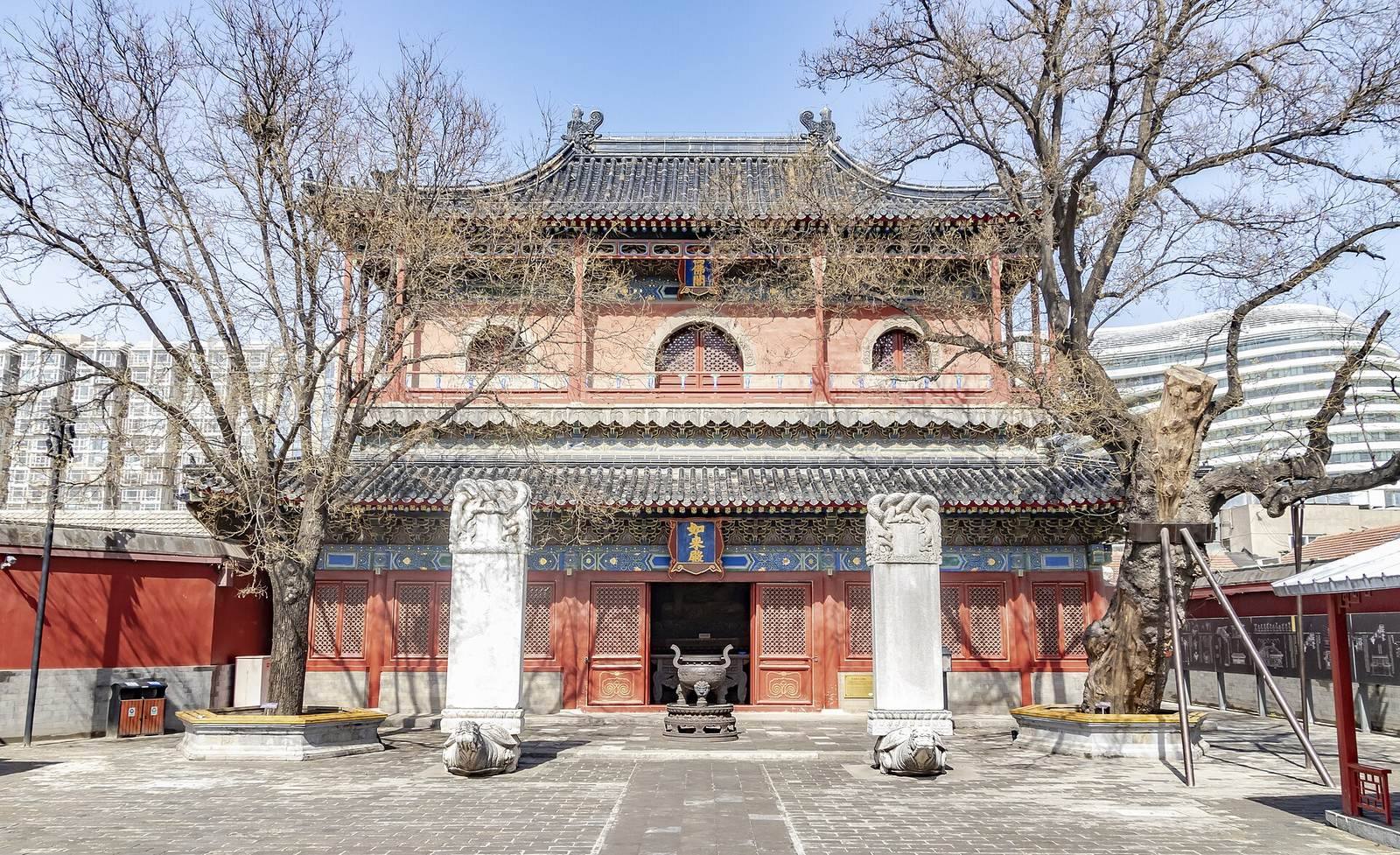
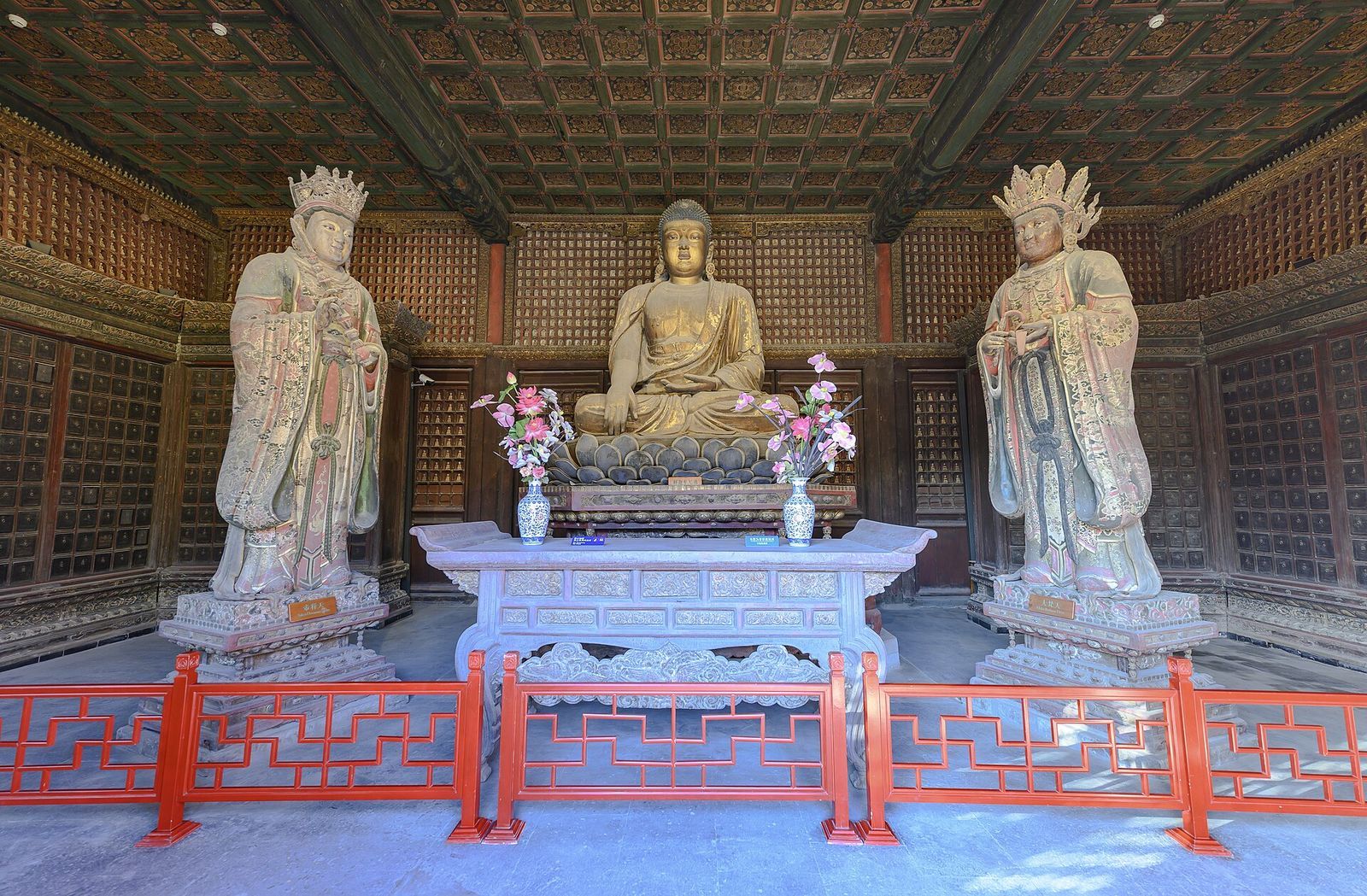
The building containing the Tathagata Hall below and the Thousand Buddha Pavilion above is the temple’s largest and tallest structure. Its two storeys stand beneath a black-glazed tiled hip roof. The lower hall is five bays wide and measures about 19 by 12.6 metres. At its centre, an octagonal wooden Sumeru pedestal supports Shakyamuni, the historical Buddha. Brahma stands to the east and Indra to the west; both are deities incorporated into Buddhist traditions. Scripture cabinets line the north, east and west sides, and stairs behind the central image lead upstairs.
The upper pavilion is three bays wide, with arched doors and windows, a surrounding corridor and a wooden balustrade with bottle-shaped elements. Vairocana is enshrined at the centre, Rocana to the left and Shakyamuni to the right. Niches cover the gable walls on both floors and contain 9,999 small Buddha images, the number behind the pavilion’s name. Two blank steles with tortoise-shaped bases and dragon-shaped crowns stand outside, one on each side, and a Ming bronze incense burner stands before the entrance.
Great Compassion Hall
The Great Compassion Hall, also called the Hall of Ultimate Bliss, formerly had a stone Sumeru pedestal supporting a wooden seated image of thousand-armed, thousand-eyed Guanyin. The hall is now used for exhibitions. Emperor Yingzong named its western side room the Shrine of Utmost Loyalty, where Wang Zhen’s image was enshrined. The abbot’s courtyard east of the hall and the northernmost Hall of Ten Thousand Dharmas belonged to the temple’s former central-route complex.
Scriptures and religious objects
Scripture holdings
The temple’s scripture collection includes dated works from the Yuan, Ming and Qing dynasties, with Ming-period material particularly abundant. Its dated Ming holdings span the Hongwu, Yongle, Hongxi, Xuande, Jingtai, Tianshun, Chenghua, Hongzhi, Zhengde, Jiajing, Longqing and Tianqi reigns. Qing-period holdings include scriptures dated to two years in the Kangxi reign. The collection also contains a palm-leaf-style bound copy of the Assembly of the Nine Sovereigns, donated in 1921 by Peking opera actor Yu Shuyan. This style imitates palm-leaf manuscripts and does not indicate that the text is written in Sanskrit.
Yongle and Qianlong canons
Emperor Yingzong gave the temple a copy of the Yongle Northern Canon, scripture cabinets and a stele in 1462. The stele remains in the Tathagata Hall. The Ming emperor Yongle had ordered the canon’s carving in 1410; work began in 1419 and concluded in 1440. The temple’s cabinets have three sections and crown-like tops. The central section contains 640 drawers ordered using the Thousand Character sequence, a traditional text used to arrange items. Cloud, scrolling-plant, lotus-petal and floral patterns, Sanskrit mantras and auspicious emblems decorate the cabinets; their gilded and painted surfaces have faded.
Zhihua Temple also holds printing blocks and volumes of the Qianlong-era canon, known as the Dragon Canon. Commissioned by the Yongzheng Emperor, its carving ran from 1733 to 1738. It comprised 78,230 blocks and 7,240 volumes. One hundred sets were printed initially, with another 22 made in 1935 and a smaller number in other printings; the total did not exceed 150 sets.
Yuan sutra scrolls and the blood-written Diamond Sutra
In 1984, three Yuan-dynasty printed sutra scrolls were found inside a Buddha image in the Tathagata Hall: the Great Golden Peacock King Dharani Sutra, the Dharani Collection Sutra and the Great Jewel Heap Sutra. Dharani are ritual formulas or sacred utterances. The scrolls are printed on sutra paper and carry different sequence numbers from the Thousand Character Classic. Their labels describe them as printed and refer to thirty-three canons, suggesting they belonged to an official edition of a complete Buddhist canon rather than being isolated volumes. Their format resembles the Zhaocheng Canon, and they may have formed part of the Hongfa Canon.
The temple preserves a blood-written copy of the Diamond Sutra completed in 1435 by two Buddhist lay officials, one of them named Puming. They first impressed the text into the paper and then traced it in blood. The writing has since turned reddish brown.