Carafa Chapel: A Renaissance Funerary Chapel in Rome
Site at a Glance
- Popularity
- High
- Country
- Italy
- Primary era
- Medieval
- Eras represented
- Medieval, Early Modern
- Civilizations
- Papal States
- Site type
- Religious
- Remains
- Chapel
On this page18 sections
History
Commission and decoration
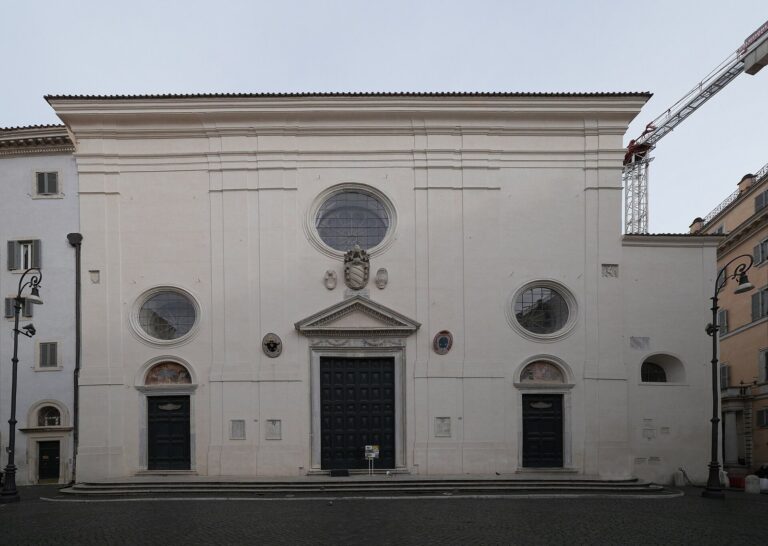
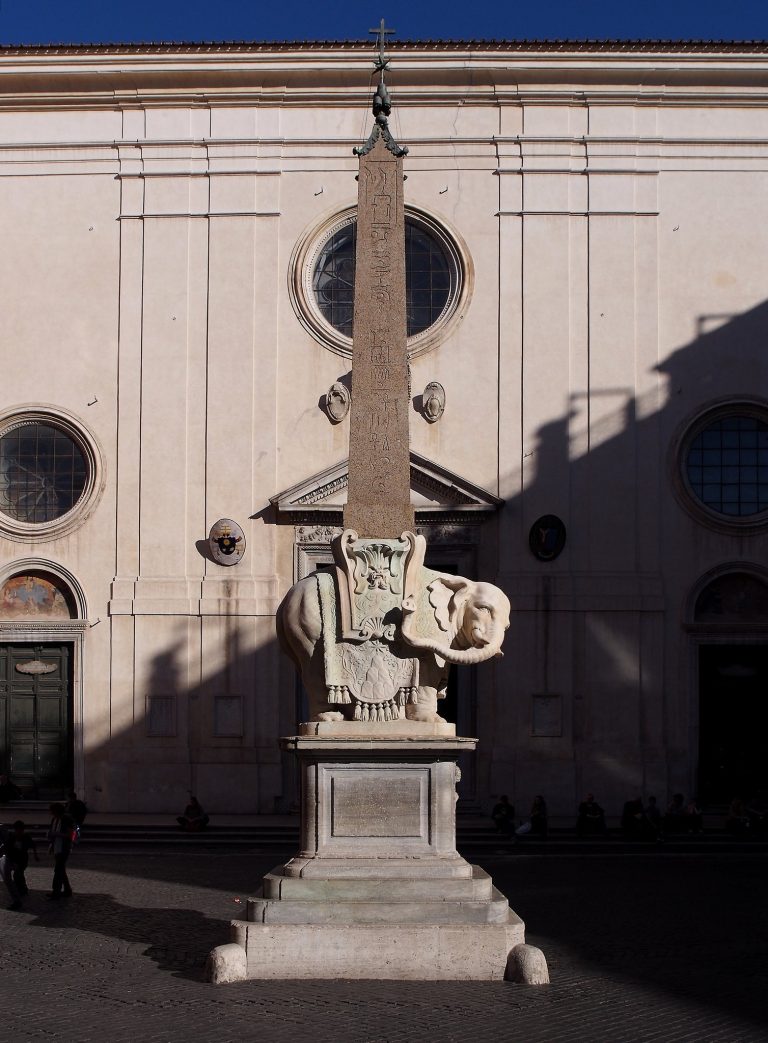
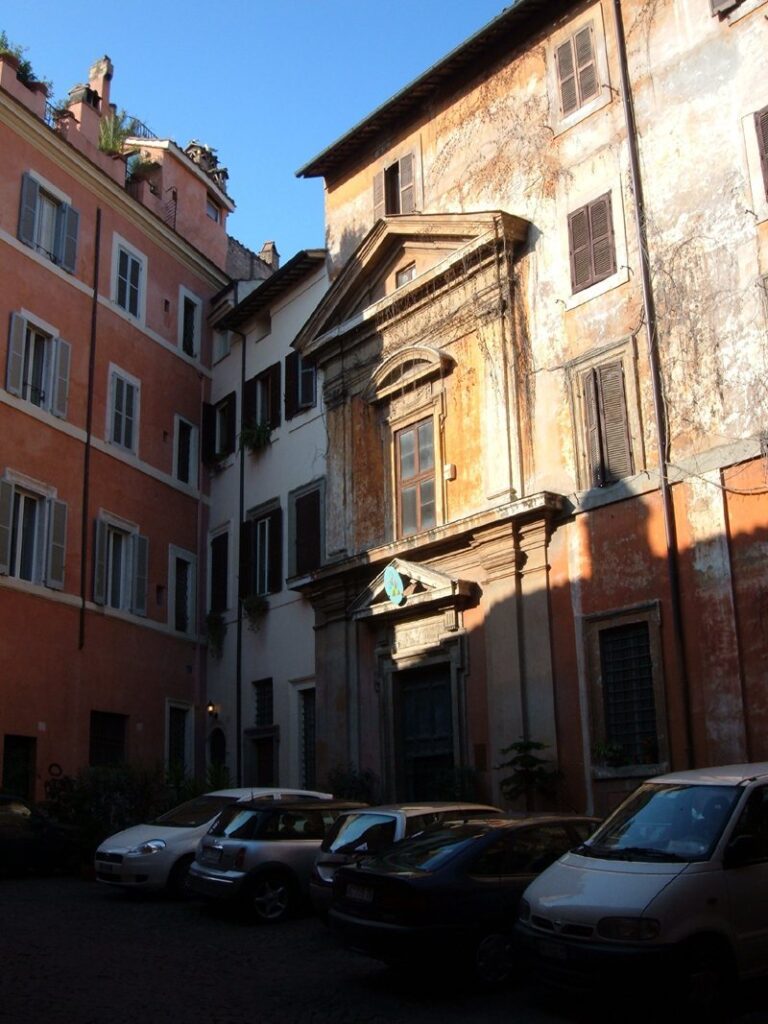
The Carafa Chapel is a late-fifteenth-century chapel in the church of Santa Maria sopra Minerva in Rome, Italy, commissioned by Cardinal Oliviero Carafa as a funerary and devotional space. A member of a Neapolitan noble family, Carafa belonged to the Dominican Order, a Catholic religious order associated with preaching and theological study. From 1478 he served as the Dominicans’ cardinal protector, a cardinal who acted as an advocate for the order. The church and its monastery were then an important Dominican center in Rome.
The chapel had previously been dedicated to the Virgin Mary. Carafa chose it for his own burial and rededicated it to Mary and Thomas Aquinas, a medieval Dominican theologian. Its frescoes were painted between 1488 and 1493, and the chapel was consecrated in 1493. At Lorenzo de’ Medici’s recommendation, Carafa commissioned the Florentine painter Filippino Lippi. Lippi was in Rome by 27 August 1488, working with his assistant Raffaellino del Garbo. This was Lippi’s first major fresco cycle and his only work in Rome. Its religious imagery and family emblems also conveyed claims about Carafa’s virtues and relationships.
Pope Alexander VI visited the completed chapel in March 1493, at the end of his official visit to the church for the Feast of the Annunciation. Raffaellino painted a small adjoining room intended to receive Carafa’s remains. Its frescoes included the story of Virginia, a legendary Roman maiden associated with chastity, and other subjects on that theme. Carafa was instead buried in Naples in 1511.
Later burial and alteration
Carafa’s nephew, Pope Paul IV, was later buried in the chapel. In 1559, a funerary monument for Paul IV was made to a design by Pirro Ligorio and executed by Giacomo and Tommaso Cassignuola. Its construction destroyed Lippi’s frescoes of the Vices and Virtues. Giorgio Vasari’s description preserves an account of that painted cycle.
Remains
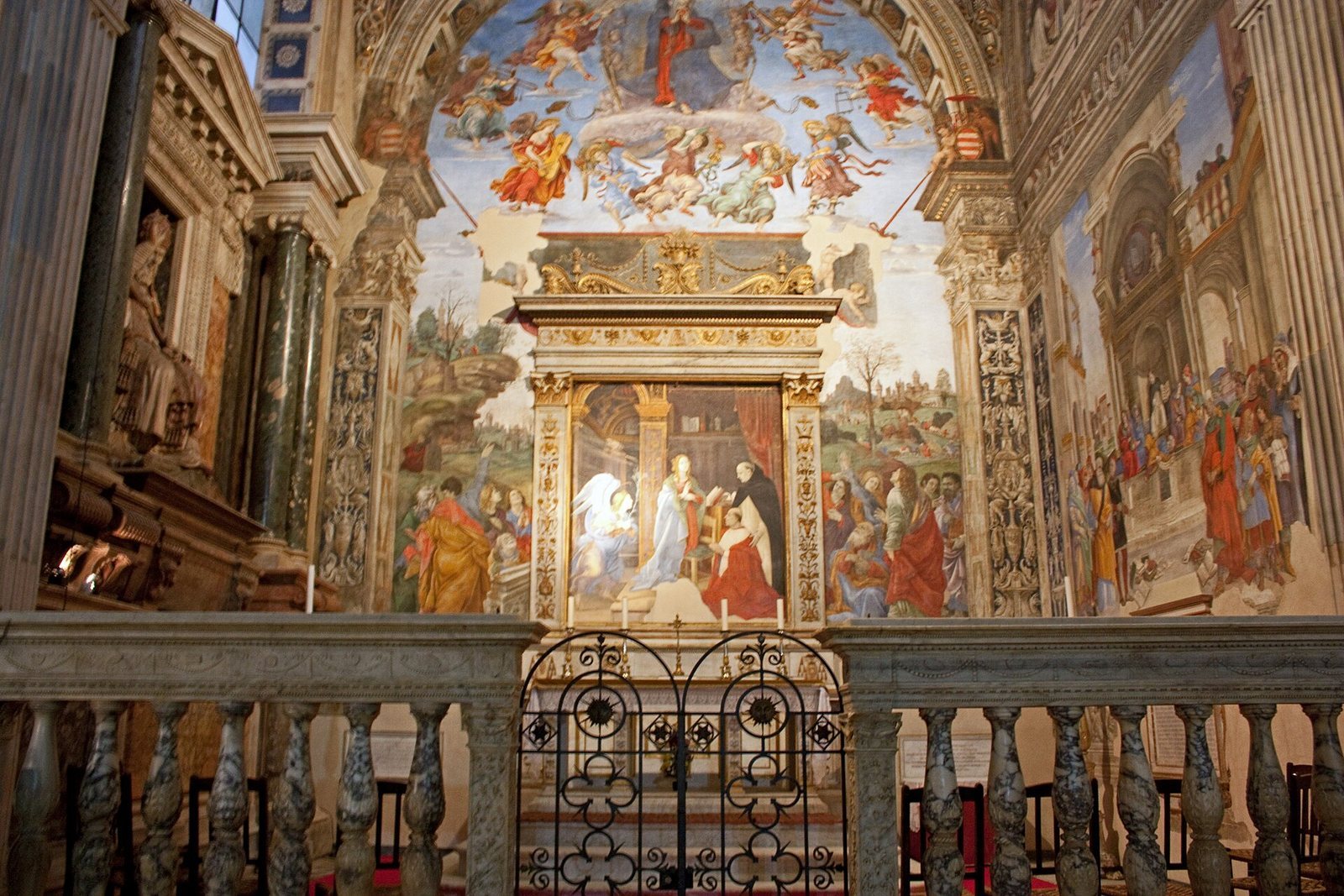
The chapel occupies the front of the church’s right crosswise arm. Its entrance, altar wall, ribbed ceiling, and painted side walls combine carved architectural features with frescoes that extend the appearance of the real interior. The principal painted subjects are the Annunciation and the Assumption of the Virgin.
Entrance portal
The entrance is framed as a triumphal arch. Massive fluted pilasters, flat supports projecting from the wall, have Corinthian capitals, and a broad entablature, the horizontal structure above them, spans the opening. The arch bears a dedication to the Virgin Mary of the Annunciation and Saint Thomas Aquinas. Mino da Fiesole, Andrea del Verrocchio, and Giuliano da Maiano have been credited with the portal’s execution; the childlike figures on the entablature are attributed to Verrocchio. A small inscription on the keystone names Cardinal Carafa, while elaborate ornament covers the architectural elements.
Altar wall
The Annunciation
Above the altar, Lippi arranged the frescoed scene of the Annunciation, the Christian episode in which Gabriel tells Mary that she will bear Jesus. He blended painted architecture with the chapel’s real framing to create an illusion of deep space, using perspective, lighting, and naturalistic settings to distinguish earthly and spiritual realms. Thomas Aquinas presents the kneeling Carafa to Mary. She looks toward Gabriel, who arrives amid rays of light and the dove of the Holy Spirit, while also turning to bless the cardinal.
Mary sits at a reading desk with open books. Behind a raised curtain, a niche holds a shelf of books and a glass carafe with an olive branch, a visual play on the name Oliviero Carafa. At the left, a barrel-vaulted vestibule, or entrance space with a curved ceiling, bears Carafa’s arms at its center. Its form recalls the adjoining burial chamber and may also evoke Carafa’s palace.
The Assumption
The Assumption, the belief that Mary was taken bodily into heaven, fills the altar composition’s other principal scene. The apostle Peter leans on a stone coffin at the left, while Paul kneels at the right and looks upward. Thomas, also at the left, points toward Mary despite not having been present at the event. Behind the apostles, a colorful procession of people and exotic animals emerges from a fortified city. It may allude to Carafa’s triumphant return from his 1472 command of the papal fleet against the Turks. A giraffe in the procession may recall one Lippi had seen in Florence after Lorenzo de’ Medici received one.
Mary rises on a cloud supported by three torch-bearing angels, with cherubim swinging incense nearby. Golden radiance and an almond-shaped halo of blue cherubim surround her. Angels hold Carafa’s coat of arms, linking the heavenly scene to the earthly one. Other angels play instruments including a bagpipe, psaltery, or stringed instrument, triangle, drums or tambourines, and trombone. These instruments were associated with contemporary military music and have also been read as references to Carafa’s naval success. The incense burners recall those in Sandro Botticelli’s Punishment of the Rebels in the Sistine Chapel.
Frame and painted architecture
Two carved pilasters with Corinthian capitals and ornamental motifs frame the altar fresco. Their decoration reflects the renewed attention given in the 1480s to paintings from the Domus Aurea, the palace complex built for the Roman emperor Nero. Above the pilasters, a frieze, a horizontal decorative band, carries angels, garlands, and palmettes. A broad stucco band above it is embellished with curling forms, vases, and male masks, and topped by a fruit basket. Together, these elements emphasize the division between the earthly and spiritual parts of the composition. Installation of a tabernacle damaged the lower part of the altarpiece.
Ribbed vault
Sibyls and painted decoration
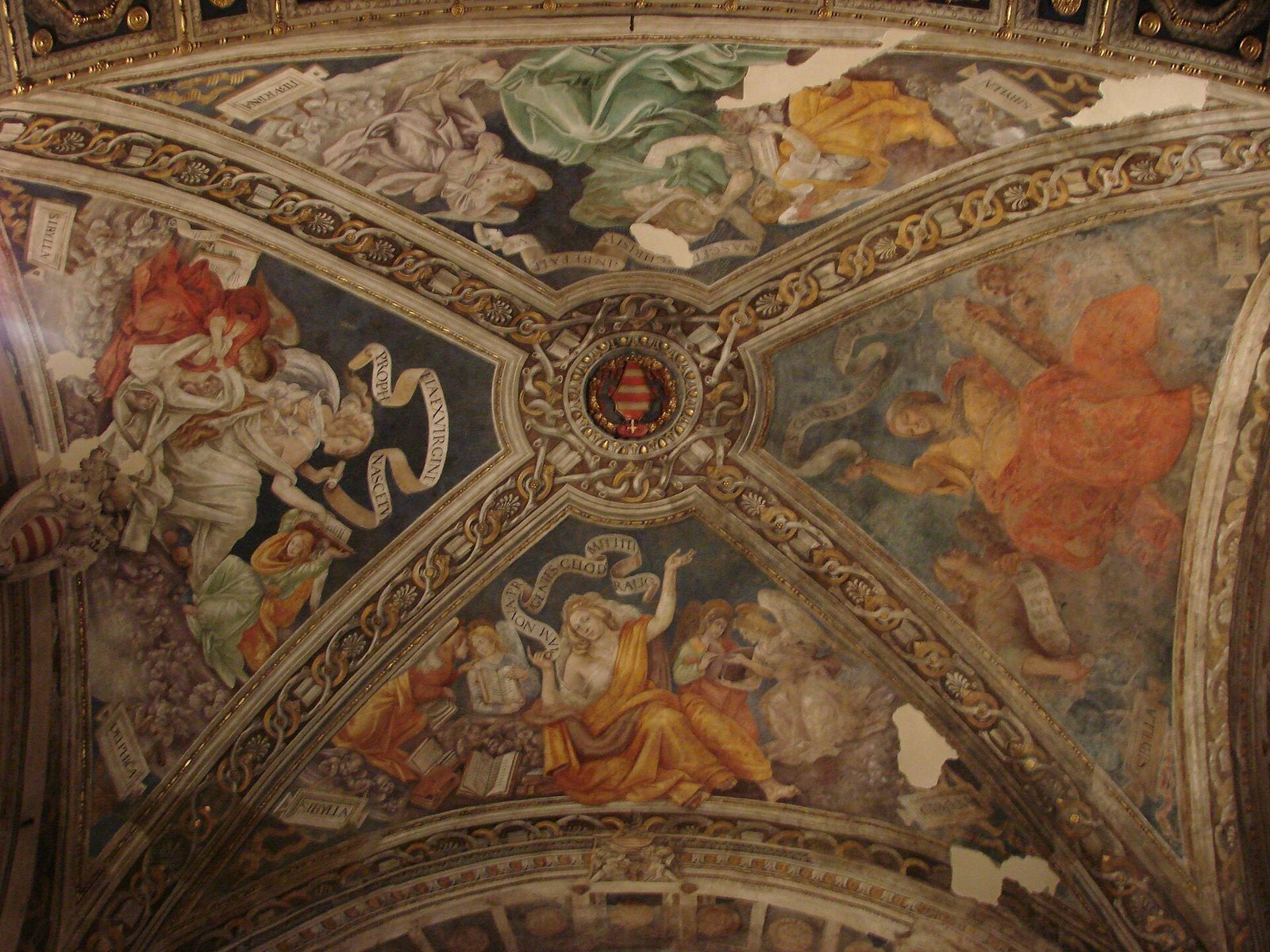
The ribbed vault, a ceiling supported by intersecting ribs, is divided into four sections containing the Cumaean, Libyan, Tiburtine, and Delphic Sibyls. Sibyls were prophetic women in ancient tradition who were also treated in Christian art as witnesses to divine wisdom. Their names appear on plaques, and each holds a scroll bearing passages from Thomas Aquinas’s writings. Angels beside them read or write in books. At the meeting point of the ribs, a medallion displays Carafa’s arms.
Intertwined branches, diamond rings, books, and palmettes continue along the ribs. The rings refer to the Medici, and the books allude to Carafa’s substantial library. The decoration’s Medici emblems have been interpreted as thanks for Lorenzo de’ Medici’s recommendation of Lippi and his role in restoring peace after the 1485 revolt of Neapolitan nobles known as the Barons’ Conspiracy. The Cumaean Sibyl’s partly exposed breast has been connected with medieval theology, which compared prophetic wisdom to a mother’s milk. Lippi’s upward-looking view of the figures was innovative among Florentine painters and may have been influenced by Melozzo da Forlì’s Ascension of Christ, known today through fragments in the Vatican Museums and the Quirinal Palace. The design is attributed to Lippi, although Raffaellino del Garbo has also been proposed.
Right wall paintings
Triumph of Saint Thomas
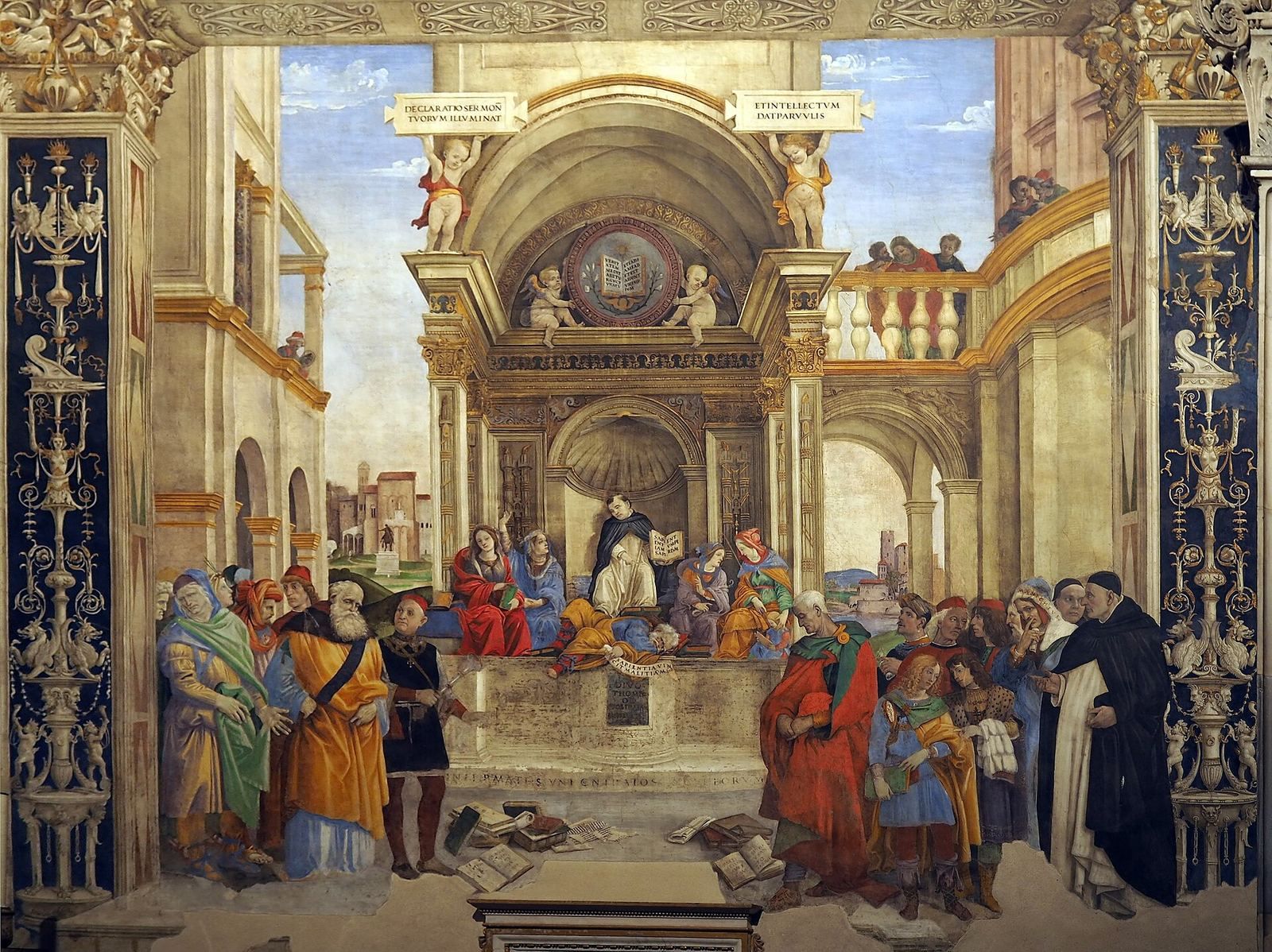
The right wall’s central rectangular scene, titled either The Triumph of Saint Thomas or Saint Thomas in the Chair, places Thomas in a niche within a spacious architectural setting. A vaulted pavilion and round arch open through a series of arches onto a terrace that continues toward another building. Groups of figures stand symmetrically below the niche. Thomas holds an open book inscribed Sapientiam sapientum perdam, meaning “I will destroy the wisdom of the wise.” Beside him are personifications of Philosophy, Theology, Dialectic, marked by a serpent, and Grammar, who teaches a child while holding a switch.
A figure covered by books lies at Thomas’s feet and has been interpreted as the philosopher Averroes or as a personification of sin, vice, or heresy. Its banner reads Sapientia vincit malitiam, or “Wisdom conquers wickedness.” Golden inscriptions identify figures in the foreground as heretics, including Arius, Sabellius, Mani, and Eutyches. Books on the ground are shown as destined for burning. A Dominican friar at the right has been identified as Gioacchino Torriani, a head of the order. On the left, the papal military commander Niccolò Orsini, also known as Niccolò di Pitigliano, appears ready to carry out Thomas’s judgment.
Lunette and episodes from Thomas’s life
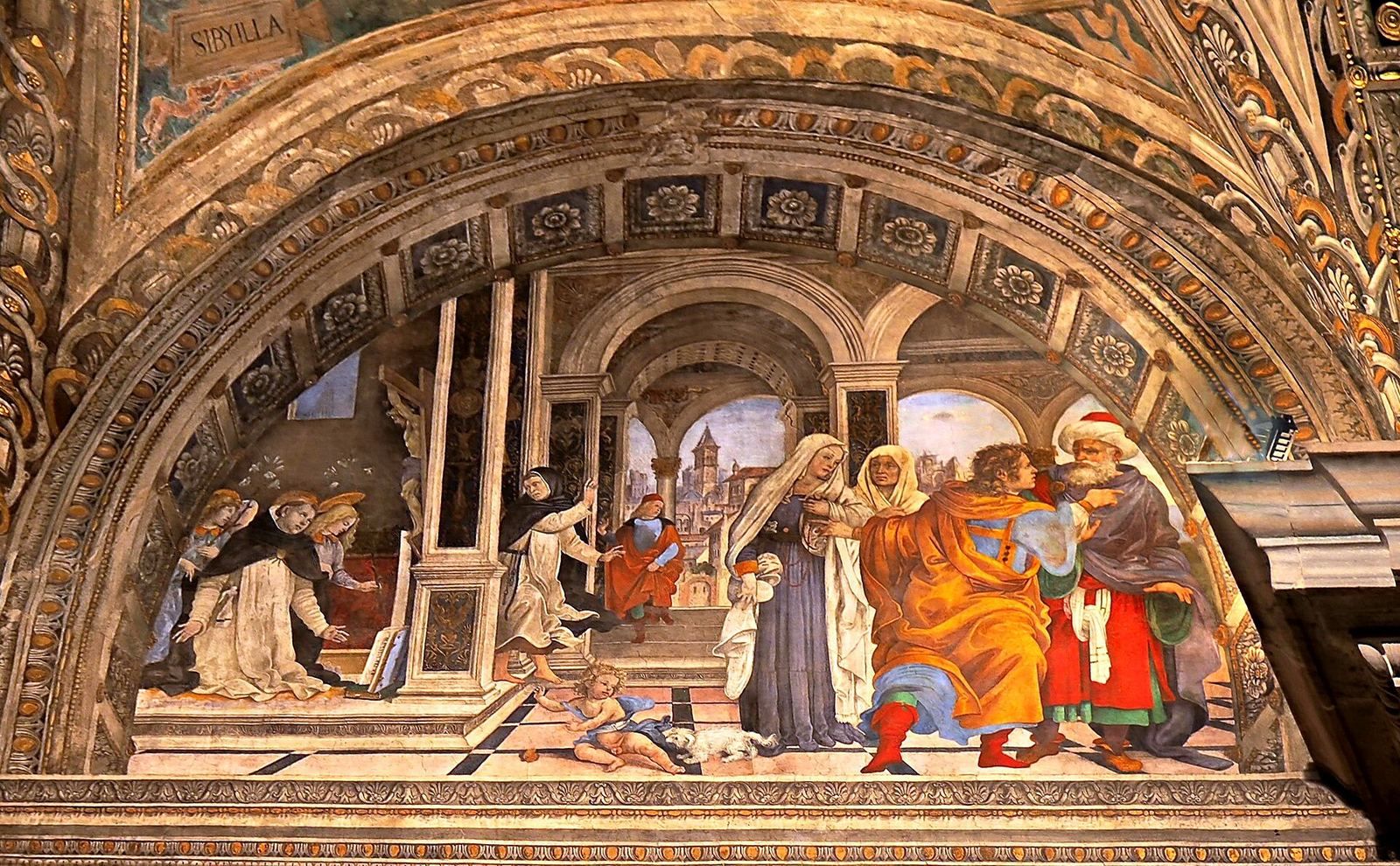
A lunette, a crescent-shaped panel above the larger scene, contains episodes from Thomas’s life. In one, he kneels before a crucifix as Christ praises his writings with the words Bene scripsisti de me Thoma, “You have written well of me, Thomas.” A frightened monk flees through a door. The scene also refers to a story in which Thomas resisted a prostitute sent by his family to draw him away from monastic life. Two angels then gave him a belt of chastity; they carry white lilies, and one lifts his cloak to show the belt.
Other figures in the lunette have received different interpretations. A small dog pulling at a child’s clothing may represent the Devil threatening the child’s purity. A woman in monastic dress with a rosary at her belt may personify the Church, while a red-clad man descending steps may represent Christ and the child the clergy. Another reading sees members of Thomas’s family. A yellow-clad man points toward a turbaned figure, and a woman behind them may represent the Synagogue. A loggia, or open-sided gallery, and a view of a city form the background at the right.
Painted buildings and frieze
The painted buildings around the central scene supply its architectural setting. A view of Rome on the left includes the equestrian statue of Marcus Aurelius, which then stood at the Lateran and was believed to depict Constantine. A fragmentary frieze on the right wall includes objects associated with Carafa’s church activities. The painted architecture also incorporates candelabra-like ornament, angels holding Carafa’s arms, and a Roman ship carrying an olive branch. The ship refers to Carafa’s command of the papal fleet and was copied from a Roman relief once at San Lorenzo fuori le Mura, now in the Capitoline Museums.
Left wall and adjoining room
Paul IV’s monument
Paul IV’s funerary monument dominates the chapel’s left wall. The monument’s construction destroyed Lippi’s frescoes of the Vices and Virtues, described by Vasari.
Paintings in the adjoining room
Raffaellino del Garbo painted frescoes in the small room adjoining the chapel. Their subjects include Virginia, the legendary Roman maiden whose story concerns chastity, along with other scenes on the same theme.