Chapel of St James in Padua: A Late Gothic Chapel in the Basilica of St Anthony
Site at a Glance
- Popularity
- Medium
- Country
- Italy
- Primary era
- Medieval
- Eras represented
- Medieval, Early Modern, Modern
- Civilizations
- Austrian Empire, Habsburg, Holy Roman Empire, Italian, Venetian
- Site type
- Religious
- Remains
- Chapel
On this page12 sections
History
Commission and decoration
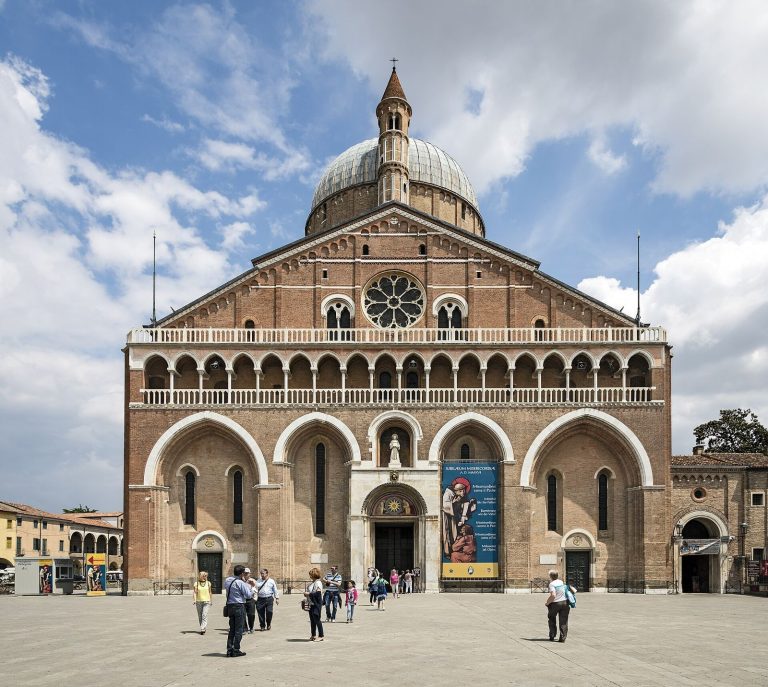
The Chapel of St James, also known as the Chapel of St Felix, is a late Gothic chapel inside the Basilica of St Anthony in Padua, Italy. On 12 February 1372, Lombardo della Seta drew up a contract between Bonifacio Lupi, a fourteenth-century Italian nobleman and patron, and Andriolo de Santi, an architect active in the Veneto. The new chapel was planned over an earlier Chapel of St Michael, built in 1292 along the right side of the nave opposite the Chapel of St Anthony. It was dedicated to St James, one of Jesus’s apostles.
The reason for the dedication is uncertain. St James was not Lupi’s namesake, and the detailed cycle of the saint’s life had no precedent. One possible explanation links Lupi to Queen Lupa, regarded as an ancestor of his family. Another is that he belonged to the Order of the Militia of St James, a medieval military-religious order. A confraternity, or lay association organized around religious practice, existed in Padua. In 1343, Bishop Ildebrandino Conti granted an indulgence, a church remission of spiritual penalties, to Padua citizens who helped members of the Militia. This may point to the confraternity’s presence in the city, and the chapel’s decoration may have celebrated it as well as expressing personal devotion.
Tomb slabs found beneath the floor included one belonging to Bartolomea degli Scrovegni, the sister of Enrico degli Scrovegni and wife of Marsilio II da Carrara. The slab has prompted the possibility that the chapel belonged to the da Carrara or Scrovegni family, but it does not establish that connection as certain.
The chapel was scheduled for handover in 1376, when work on its painted decoration began. Scaffolding was lowered in stages during 1376 and 1377, and the first payment to a painter, whose name is unknown, was made in 1377. The sequence suggests that the lower sections were painted after the upper ones, although later restoration has made the order of the plaster layers difficult to discern. In 1379, Altichiero received a final payment of 792 ducats, a medieval currency. The amount suggests that he was the principal painter or possibly directed the work. Rainaldino di Francia received 190 ducats for the altar figures, while another artist made the pedestal. The wall paintings are attributed to Altichiero and Jacopo Avanzi.
Rededication and restoration
In 1503, relics of Pope Felix II, a fourth-century bishop of Rome traditionally identified as a pope, were transferred to the chapel. Its dedication then changed from St James to Felix, giving rise to the alternative name Chapel of St Felix.
The paintings were restored in 1659, and the marble was cleaned in 1661. Further restoration took place in the eighteenth century. A thorough restoration in 1999 removed additions made during the eighteenth and nineteenth centuries.
Remains
The chapel has a rectangular plan aligned parallel to the nave. Its architectural forms, sculpture, and painted surfaces are closely integrated across the interior.
Architectural framework and sculpture
Entrance arches and statues
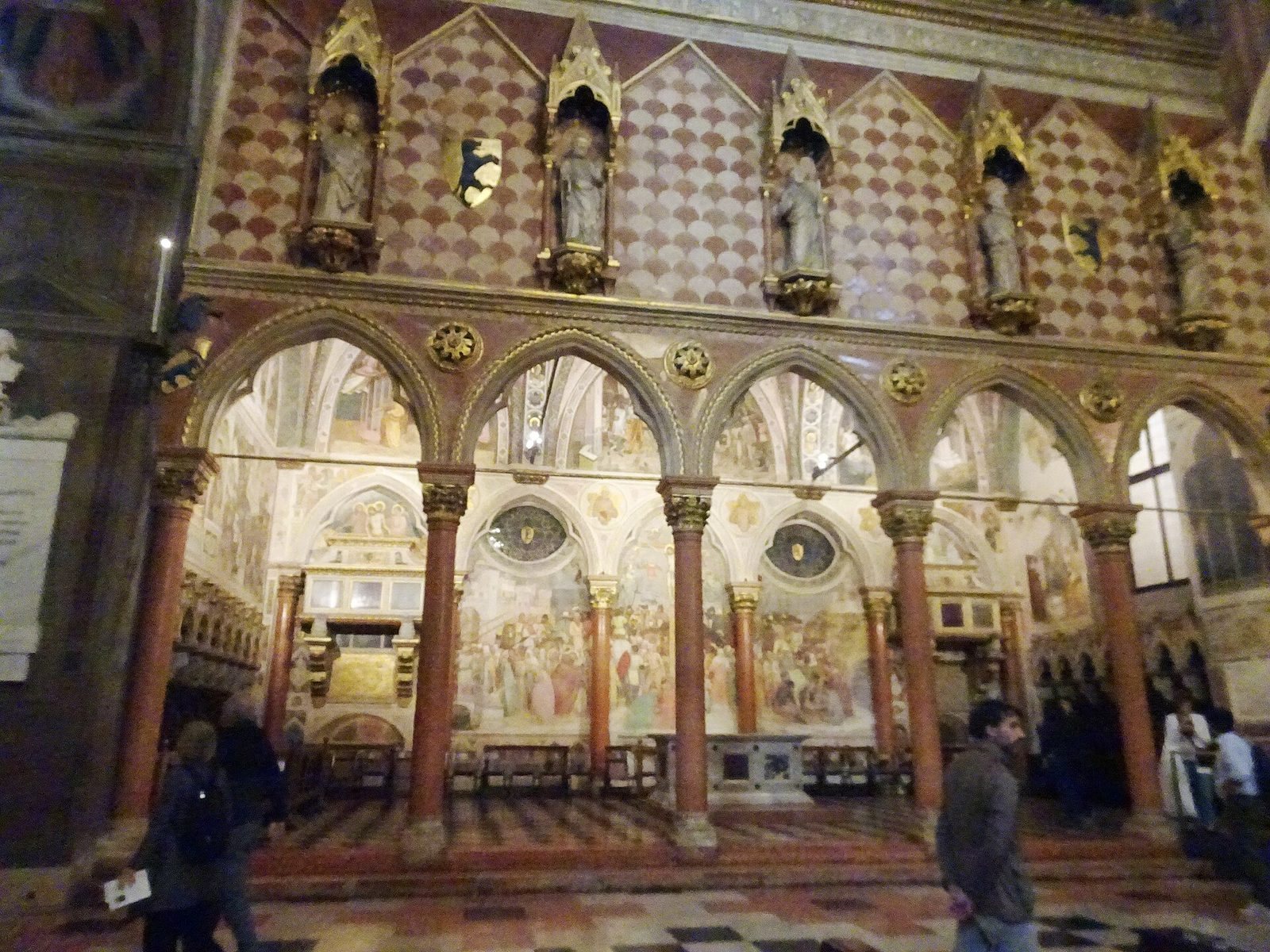
Five pointed arches open between the chapel and the nave, resting on red columns with gilded capitals, or decorated column tops. A white-and-red marble design shaped like a shield appears on the wall facing the nave. Above each arch, a small shrine-like structure holds a statue of a saint: Martin, Peter, James, Paul, or John the Baptist. The combination of solid and open forms and the white-and-red palette recalls Venetian architecture of the period.
Interior and tomb monuments
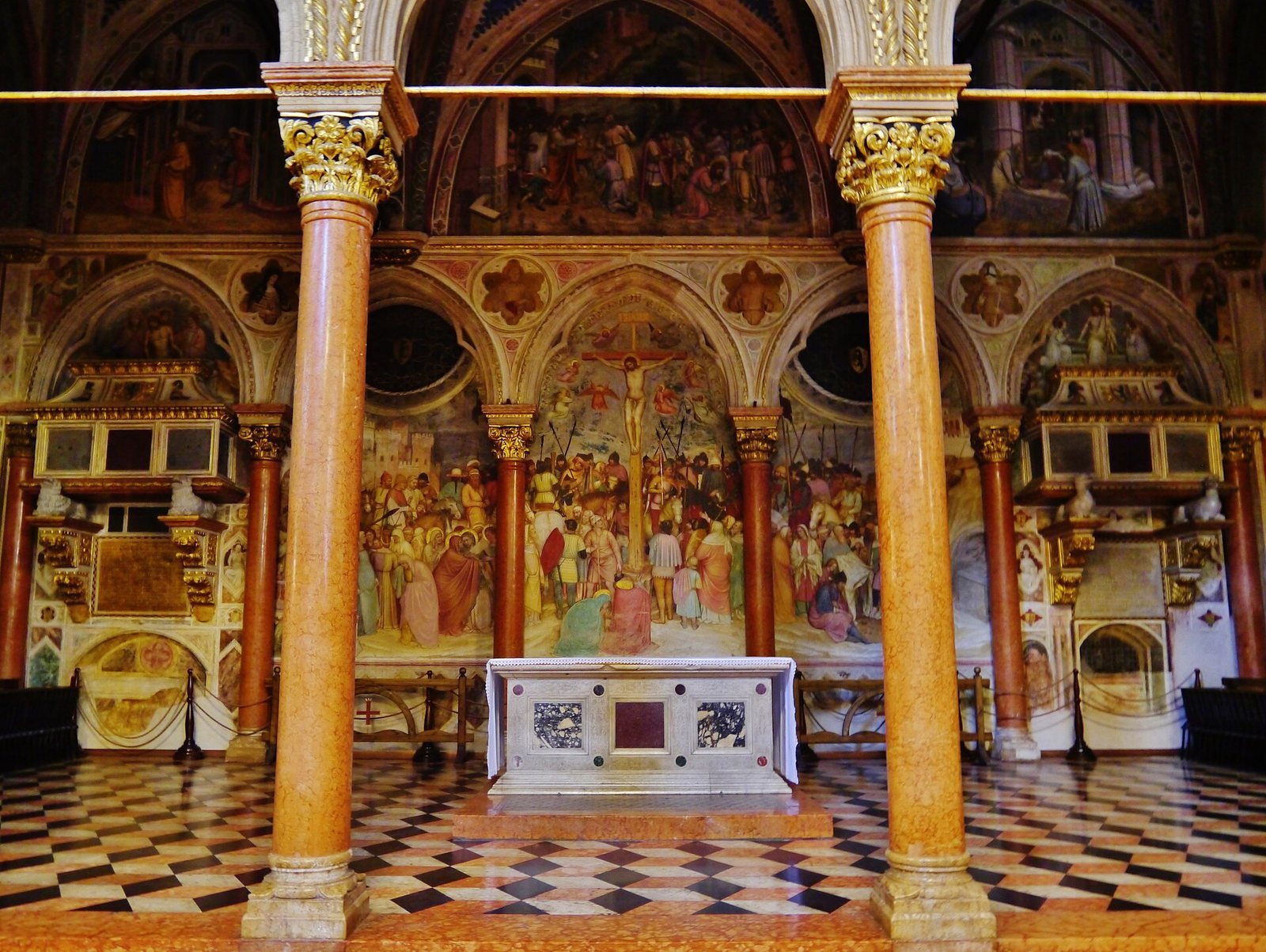
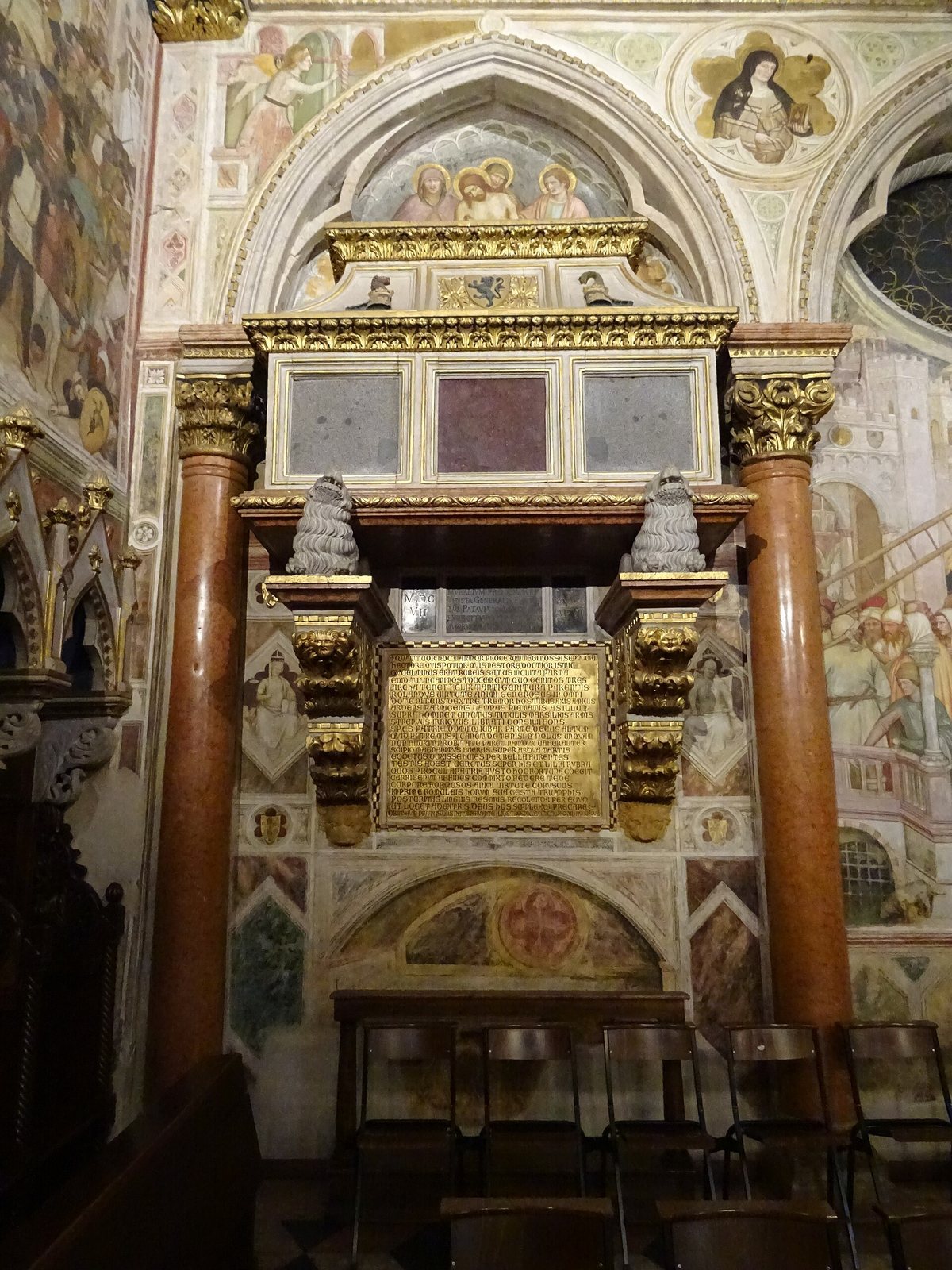
Three groin vaults, ceilings formed where two barrel vaults meet, cover the chapel. At the rear, five pointed arches echo the entrance arrangement. Two tomb monuments stand on this wall. One is supported by lions and contains the remains of Guglielmo de Rossi; the other rests on wolves and holds the remains of Bonifacio Lupi.
Altar
Rainaldino di Francia was commissioned to make the altar in 1379. It originally bore five white-marble statues, and another artist made its pedestal. The altar was altered in 1503 and reduced to its present form in 1962.
Painted decoration
Vaults and crossing arches
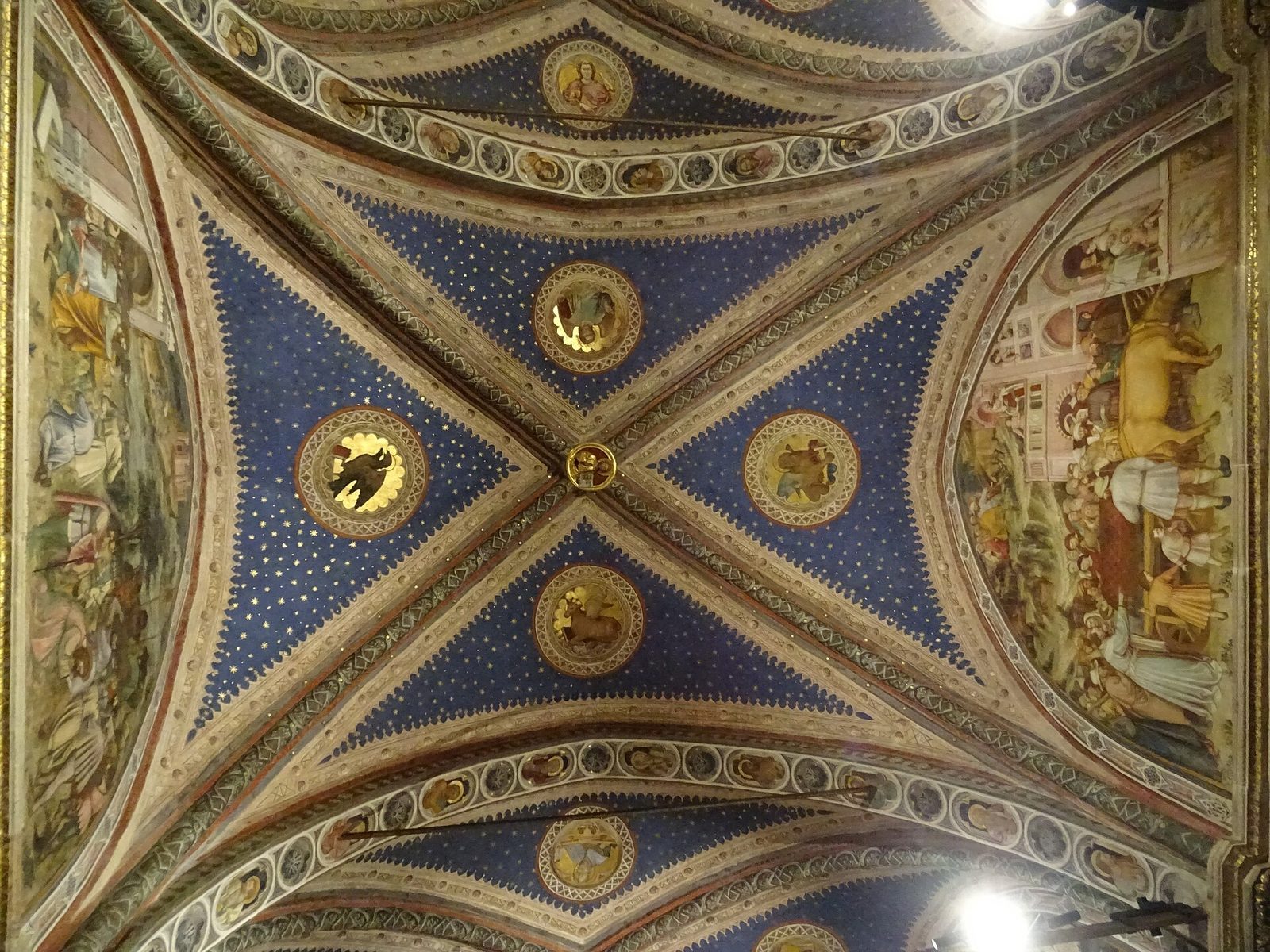
The three vaults are painted blue and dotted with stars. At the centre of each is a gold-ground roundel, or circular painted panel. They contain, respectively, busts of prophets, symbols of the Evangelists, and figures of the Doctors of the Church. The Evangelists are traditionally identified as the authors of the four canonical Gospels; the Doctors are theologians whose teachings the Catholic Church recognizes as authoritative. The two arches between the vaults carry busts of prophets and apostles within medallions with several lobes.
Scenes from the life of St James
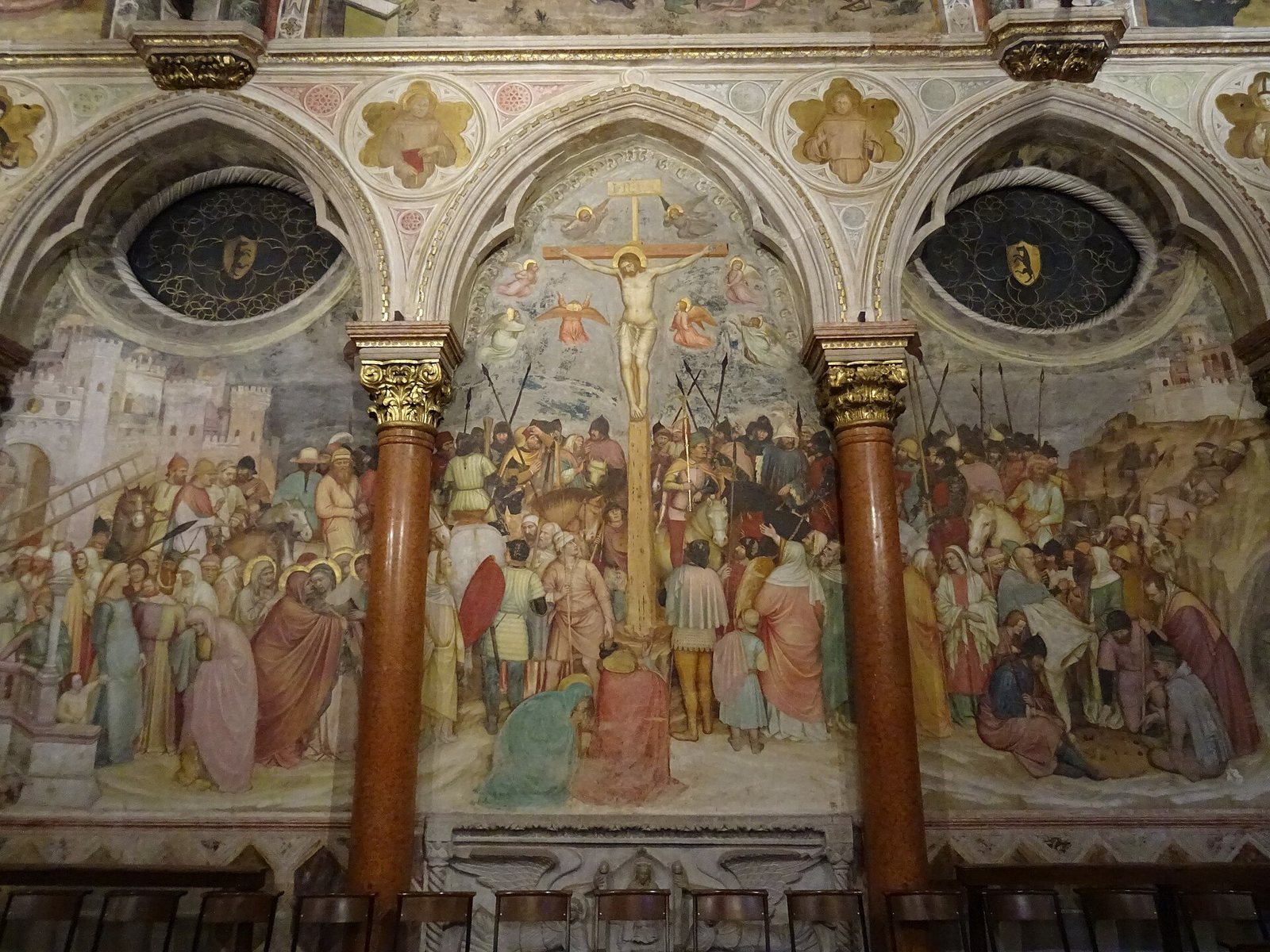
The upper wall band contains seven lunettes, or semicircular wall panels, and two half-lunettes. They show episodes from St James’s life as told in the Golden Legend, a medieval collection of saints’ lives compiled by the thirteenth-century Dominican friar Jacopo da Varagine. Below, the left wall depicts an episode associated with the Spanish devotion to St James. A Crucifixion occupies the central wall, while the right wall shows the Madonna enthroned with donors. A floor slab found below the chapel is now beneath the Crucifixion.
Other painted figures
Four large roundels in the spaces between the arches and their surrounding frames contain portraits of ten saints. Above the choir stalls on the left wall, busts of nine male and female saints appear within trefoil arcades, which have three-lobed arches. The corresponding figures on the right wall are later reworkings, as are angels along the angled sides of a window with one main opening. The painting of St Christopher on the right-hand pillar was already badly damaged by 1857 and was later replaced with decorative elements; the original figure no longer survives. Many details once painted onto dry plaster in five lunettes and the Crucifixion are also no longer preserved.