Ezzelini Castle: A Medieval Fortress on Col Bastia
Site at a Glance
- Popularity
- Medium
- Country
- Italy
- Primary era
- Medieval
- Eras represented
- Medieval
- Civilizations
- Holy Roman Empire, Venetian
- Site type
- Military
- Remains
- Castle
On this page7 sections
History
Ezzelini Castle was a medieval fortress on Col Bastia in Italy. It became the principal residence of the Da Romano family after their earlier castle at Onara was destroyed. Contemporary testimony described the stronghold as virtually impregnable.
Da Romano residence
During his campaign in Italy, Holy Roman Emperor Conrad II granted the castle to the Da Romano family. Ecelo, regarded as the family’s progenitor, received the lands of Romano, Onara, and Godego as a reward for his loyalty. After the destruction of their castle at Onara, the family made Ezzelini Castle its principal residence. Whether the fortress was destroyed following the Ezzelini’s defeat is uncertain, and there is no proof that it was destroyed after Ezzelino III da Romano died.
Regional conflicts and abandonment
In 1329, during the rule of the Scaligeri, Verona’s ruling dynasty, the castle belonged to Captain Dal Verme, who was castellan, the officer responsible for a fortress, at San Zenone. Forces of the Republic of Venice occupied it in 1339 after conquering the Veneto. In 1370, the castle structures on Col Bastia were rebuilt or at least strengthened. The Carraresi, Padua’s ruling family, besieged and burned the castle in 1379.
Venice regained the foothill region in 1388. The castle was abandoned because it no longer suited newer defensive methods, and it may have been destroyed again. By 1402 it was in an advanced state of ruin.
Later fortifications and accounts
Other fortifications may have been built on the hill in later periods. The eighteenth-century historian Giambattista Verci may have seen masonry that survived from the castle, but his description may also have incorporated features of later defenses into his account of the Ezzelinian stronghold.
Remains
Hilltop setting and surviving fabric
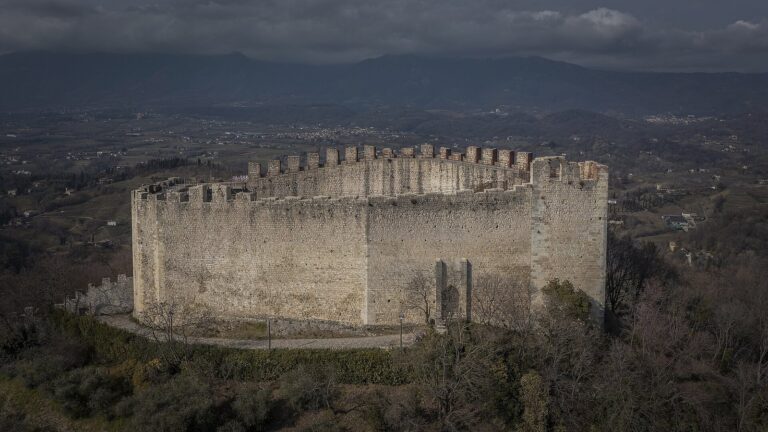
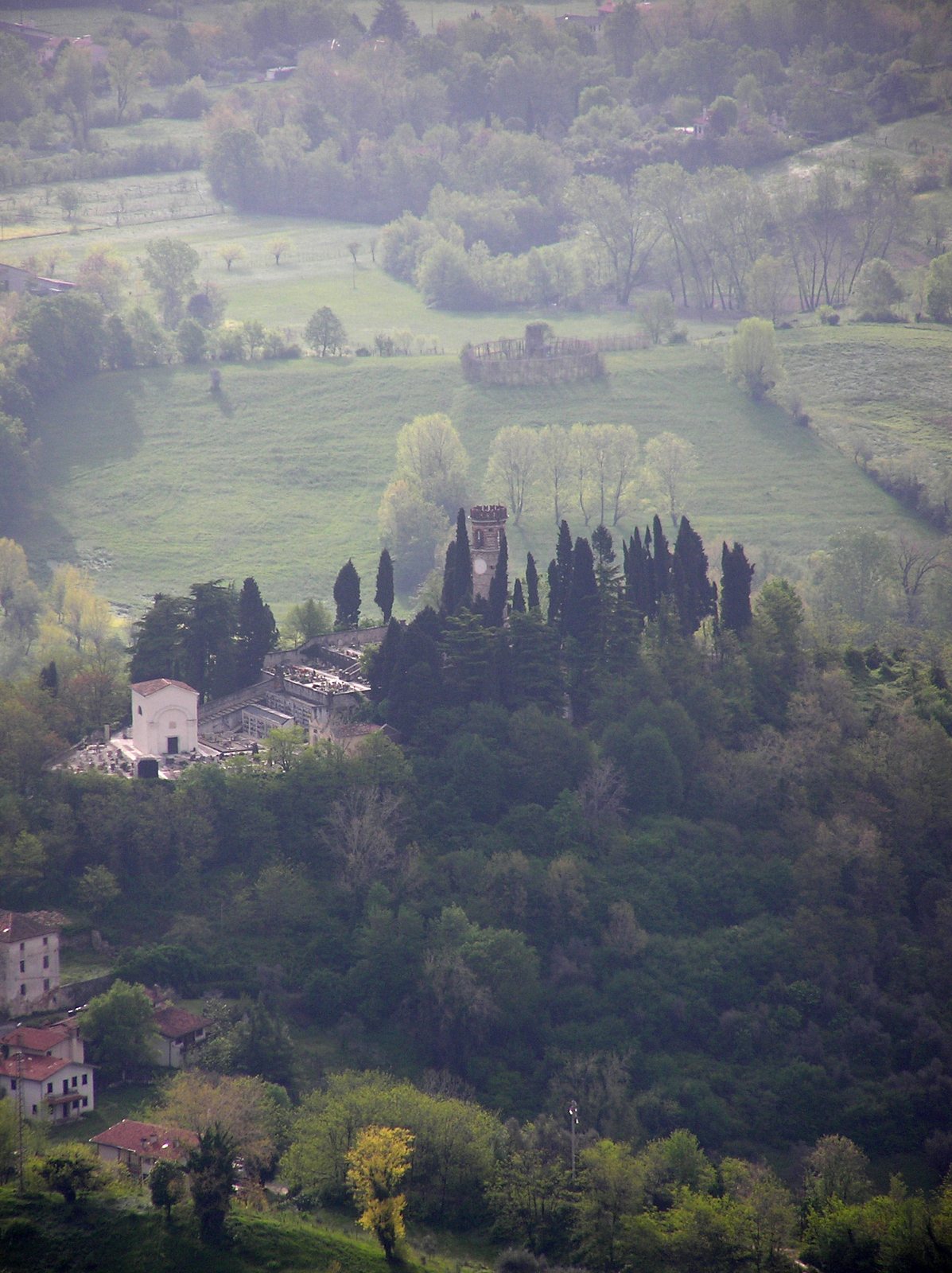
Ezzelini Castle stood within a walled enclosure on Col Bastia, as shown on a fifteenth-century map, and fragments of its masonry remain across the hill. At the northern edge of the town, the hill slopes gently to the south and drops into steep ravines to the north, where the access path runs. Its position overlooks much of the largely flat surrounding area. The hill retains roughly its eighteenth-century character, and its summit contains a cemetery, a bell tower, and a monument to Dante Alighieri. Wall remains can be seen along the avenue leading uphill, within the foundations of a tower, and below the monument. Pebbles and bricks from the castle are also found just beneath the grass.
Depictions of the castle
A fifteenth-century map of the Veneto, the only known depiction apart from eighteenth-century images of the ruins, labels the castle “Roman.” Its schematic plan shows a walled enclosure with four corner towers, one larger than the others. The larger tower is shown as an entrance, with a high arch and a portcullis, a heavy gate lowered vertically, at its base. Its windows suggest several floors, and a roof gallery with alternating raised sections and gaps tops the tower. Eighteenth-century images depict the castle as a ruin.