Palazzo d’Ayala Valva: An Eighteenth-Century Residence and Political Meeting Place in Taranto
Site at a Glance
- Popularity
- Medium
- Country
- Italy
- Primary era
- Early Modern
- Eras represented
- Early Modern, Modern
- Civilizations
- Kingdom of Naples
- Site type
- Domestic
- Remains
- Elite Residence
On this page8 sections
History
Eighteenth-century origins
Palazzo d’Ayala Valva is an eighteenth-century palace in Taranto’s Old City, Italy, built by Don Ignazio Marrese as his residence and a refined setting for receiving the king’s ministers, officers, and their subordinates. It was regarded as the most prestigious palace in the Old City. The Marrese family was of French origin and acquired the nickname “Marrese mullets” because the palace overlooked an area used for mullet fishing.
The d’Ayala family, of Spanish origin, held the titles of Counts of Fuenselida and Marquises of Valva. In 1697, the chronicler De Morales described the family as one of the most illustrious and powerful in the Kingdom of Naples. The palace is also referred to as the residence of the late Luigi Carducci, a member of the d’Ayala family. In 1800, the family acquired the building and substantially altered it, replacing much of its eighteenth-century character with Renaissance features.
The Carbonari and political unrest
During the nineteenth century, the palace became a center of political and social activity, particularly during the Carbonari conspiracy. The Carbonari were a clandestine movement in Italy associated with revolutionary and constitutional causes. In 1820, the palace hosted the movement’s Grand Master, Nicola Galeota, and other members, including Vincenzo Luccarelli, Raffaele Fabiano, Giuseppe De Nistri, Canon Baffi, Giovanni Catapano, Giuseppe Leo, and the Cimino brothers. They supported a constitutional government against the Bourbon monarchy, which ruled the Kingdom of Naples. Taranto’s Carbonari were among the monarchy’s most determined opponents.
After the Battle of Rieti and the end of constitutional government in 1821, Austrian troops entered Italy and constitutional forces were defeated. The Bourbon regime regained control of the Kingdom. Although the revolts were repressed, political factions in Taranto began to reconcile, and the palace became associated with the city’s unsettled post-revolutionary politics.
Protection and municipal plans
In 1981, the Monuments Superintendency, a public heritage-protection authority, placed the palace under artistic-heritage protection. The municipality expropriated it the following year, intending to consolidate the structure, restore the interiors, and establish the Alfredo Majorano Ethnographic Museum there.
Remains
Layout and exterior
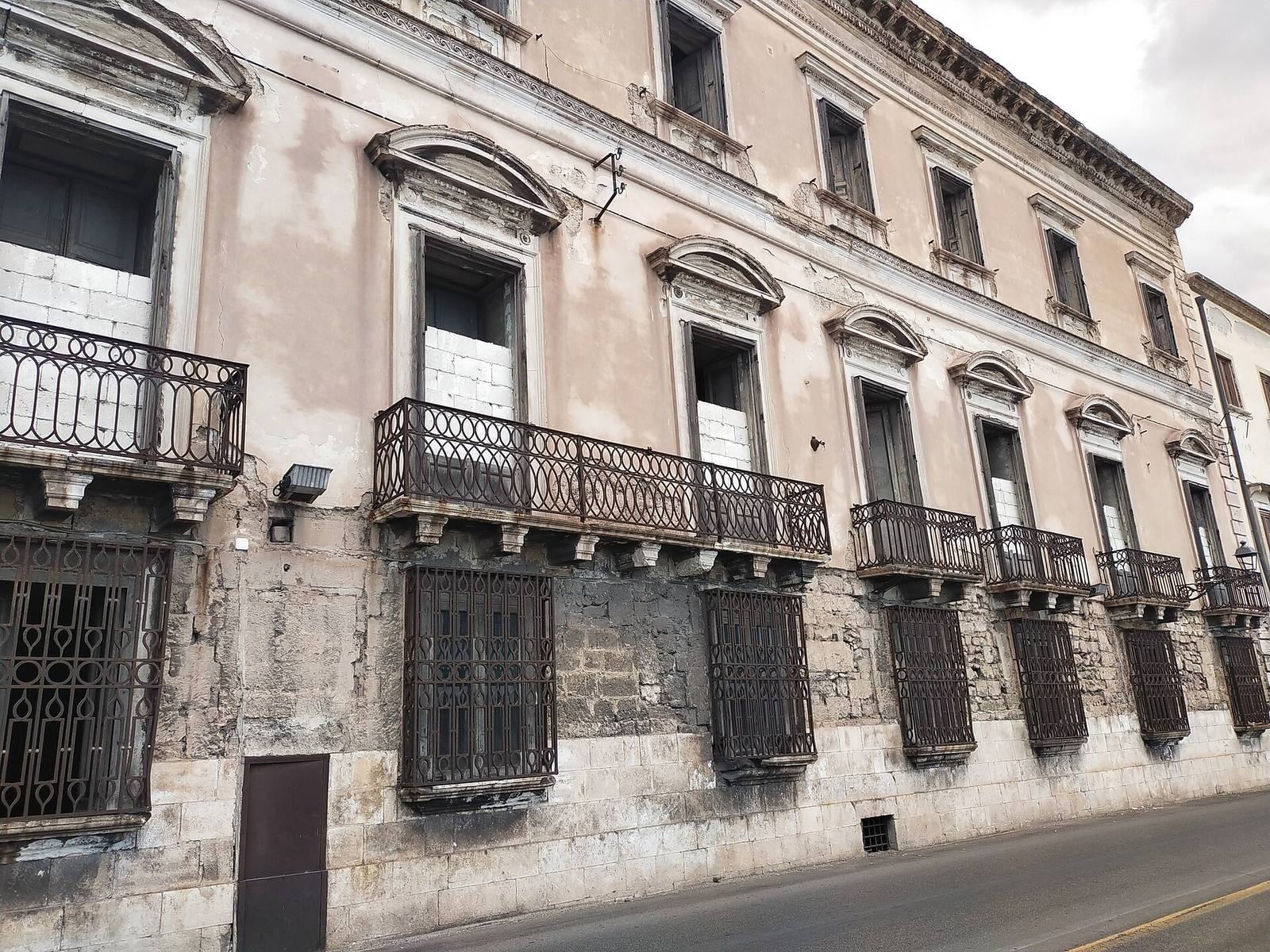
The palace stands on the Ringhiera di Laybac, has an entrance on Via Paisiello, and overlooks the Mar Grande near the large, pentagonal Bastione Marrese. Its two exterior elevations differ, apparently responding to the distinct settings they face. The building has three floors above ground and three underground. The cellar level comprises the Bastione Marrese, which connects with the palace.
Rooms and decoration
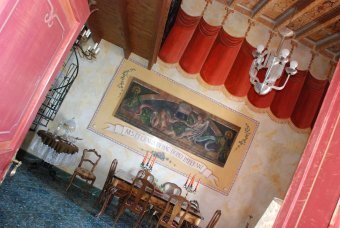
The lower floors accommodated a carriage house, stables, warehouses, cisterns, and servants. The upper floors contained 30 decorated rooms, with frescoes and paintings including St Francis Aiding the Sick by the painter Michele Ragolia. Painted wooden ceilings remain in the central hall, porcelain room, coats-of-arms room, and small mirror room. The palace also has a finely decorated floor of majolica, a glazed and decorated ceramic, and a grand staircase arranged in a pincer shape. The staircase is made of mazaro, a local building stone, and topped by a marble statue.
Present condition
The palace is in severe disrepair and abandoned. Its entrance has been bricked up after repeated thefts, while its windows remain open. Painted wooden ceilings are visible through some of them.