Burkersdorf Manor House: A Baroque Estate in Thuringia
Site at a Glance
- Popularity
- Medium
- Country
- Germany
- Primary era
- Early Modern
- Eras represented
- Medieval, Early Modern
- Civilizations
- Holy Roman Empire
- Site type
- Domestic
- Remains
- Manor House
On this page7 sections
History
Burkersdorf Manor House is a Baroque residence in Burkersdorf, within the municipality of Harth-Pöllnitz in Thuringia, Germany. The manor is first mentioned in 1205, while its present form developed from a renewal around 1730 built on the foundations of a medieval predecessor. Its history reflects successive changes in ownership and the local rights attached to the estate.
Medieval estate and early owners
In 1320, half of the estate was transferred to the monastery at Weida, now the town church. Konrad von Neumark held the manor in 1392, and the von der Pfordten family held it from 1420 to 1483; Gerhard von der Pforten is named in 1422. A Roeder held it in 1445, followed by the Roder family from 1483. Roder holders included Heinrich in 1485 and 1498, Hans from 1527 to 1537, Oswald and Stolanius in 1551, Oswald again from 1557 and between 1570 and 1576, and Hans Georg Joachim in 1578 and 1591.
Hans Balthasar Roder sold the manor to Jakob von Grünthal in 1603. Jakob held hereditary, feudal, and judicial rights there, and founded Nonnendorf on the estate’s land. From 1603 to 1605, he granted his relative Bernhard von Pöllnitz high-court rights over the village and its lands. These rights gave Bernhard authority to administer higher-level justice, but he did not own the manor. Heinrich von Wobeser held the estate in 1608, followed by Heinrich and Hans Georg von Volgstedt, named in 1616. Christoph von Raschau bought it from the von Volgstedt family in 1618 and held it in 1624.
Baroque renewal and later proprietors
The von Seydewitz family held the estate in 1699, and Baron Adam Gottlob von Meußbach held it in 1703. In 1721, Baroness Agnes von Meußebach, born von Etzdorf of the Nimritz branch, was an heir to her half-brother Georg Christoph von Carlowitz. She was the widow of Christian von Meußebach and a granddaughter of Christoph von Raschau. Around 1730, Hans Carl von Carlowitz and his wife Susanne Sabine von Seydewitz renewed the residence in Baroque form on the medieval foundations. Hans Carl held the estate in 1737; his sons Georg Karl and Moritz Karl held it from 1742 to 1771.
After 1780, the estate was held by Major General Wilhelm Gerlach Adolph von Schwarzenfels, from whom the von Tümpling family acquired it. Baron Ferdinand Alexander von Seckendorff, a chamberlain and Privy Councillor, owned it in 1797 and 1818 and still possessed it in 1835.
The von der Goltz family and modern use
Klara Weiß, who became Klara von der Goltz in 1882, was an owner in 1914 and the wife of Baron Oskar von der Goltz. Oskar, a lieutenant general, became owner of the 150-hectare estate in 1923 and held it until his death in 1933. His son Konrad, formerly a district administrator in East Prussia, owned it from 1933 to 1938. Konrad’s widow, Baroness Hannah von der Goltz, née von Barby, held the property until the family was expropriated in 1949.
The house served several state purposes until 1994, most recently as a retirement and nursing home. It is now in private use and owned by Alexander von Kienlin.
Remains
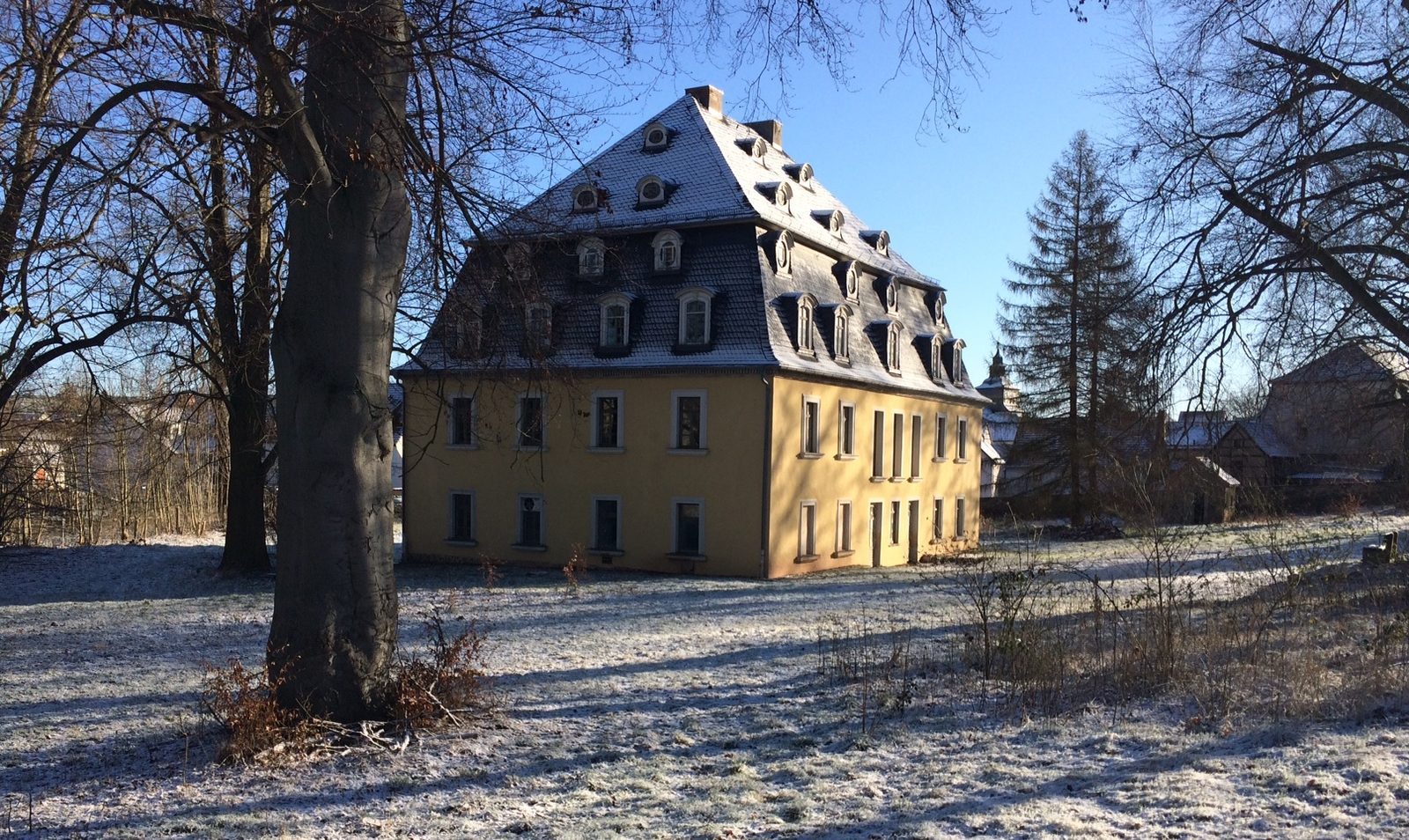
The manor house
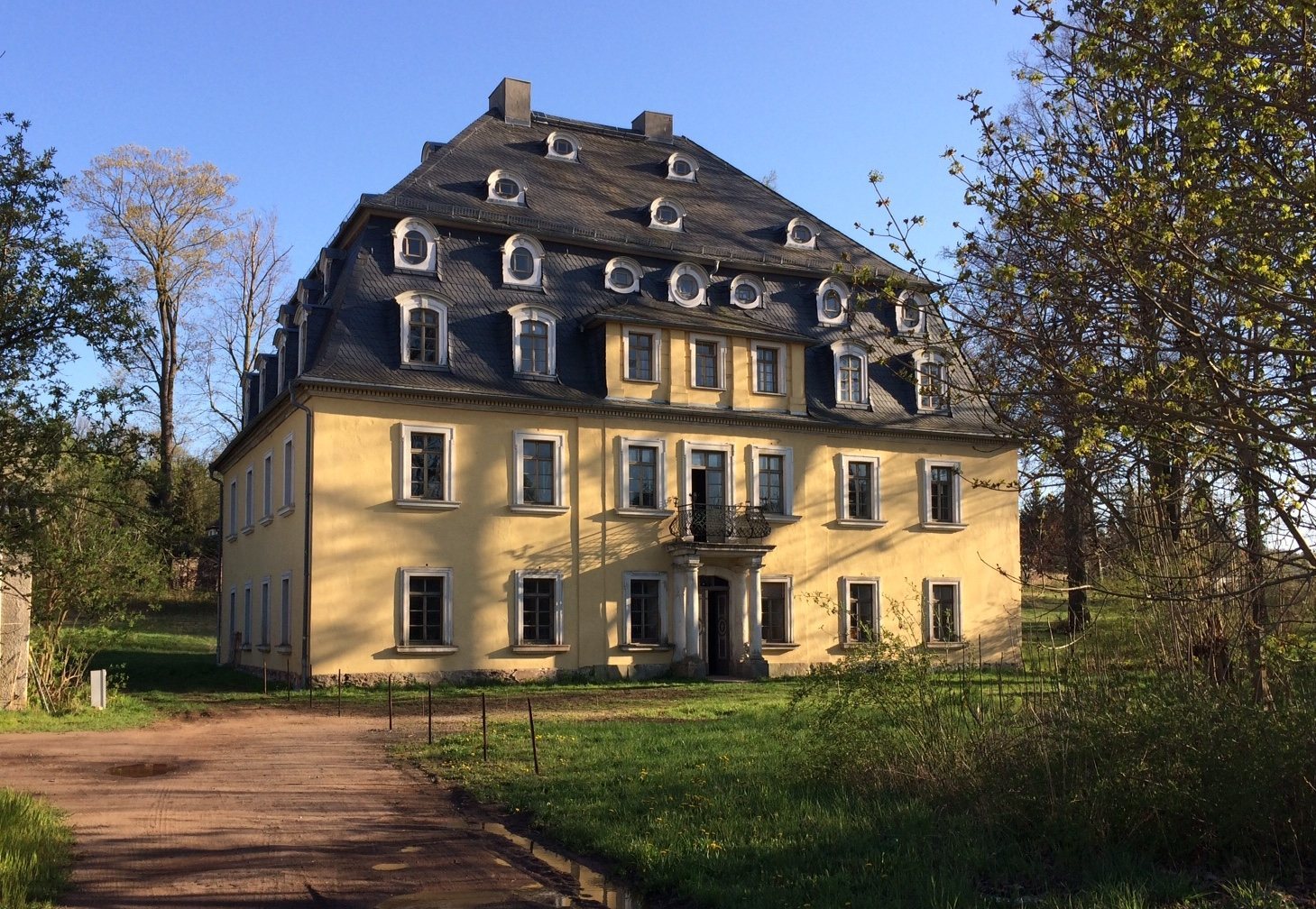
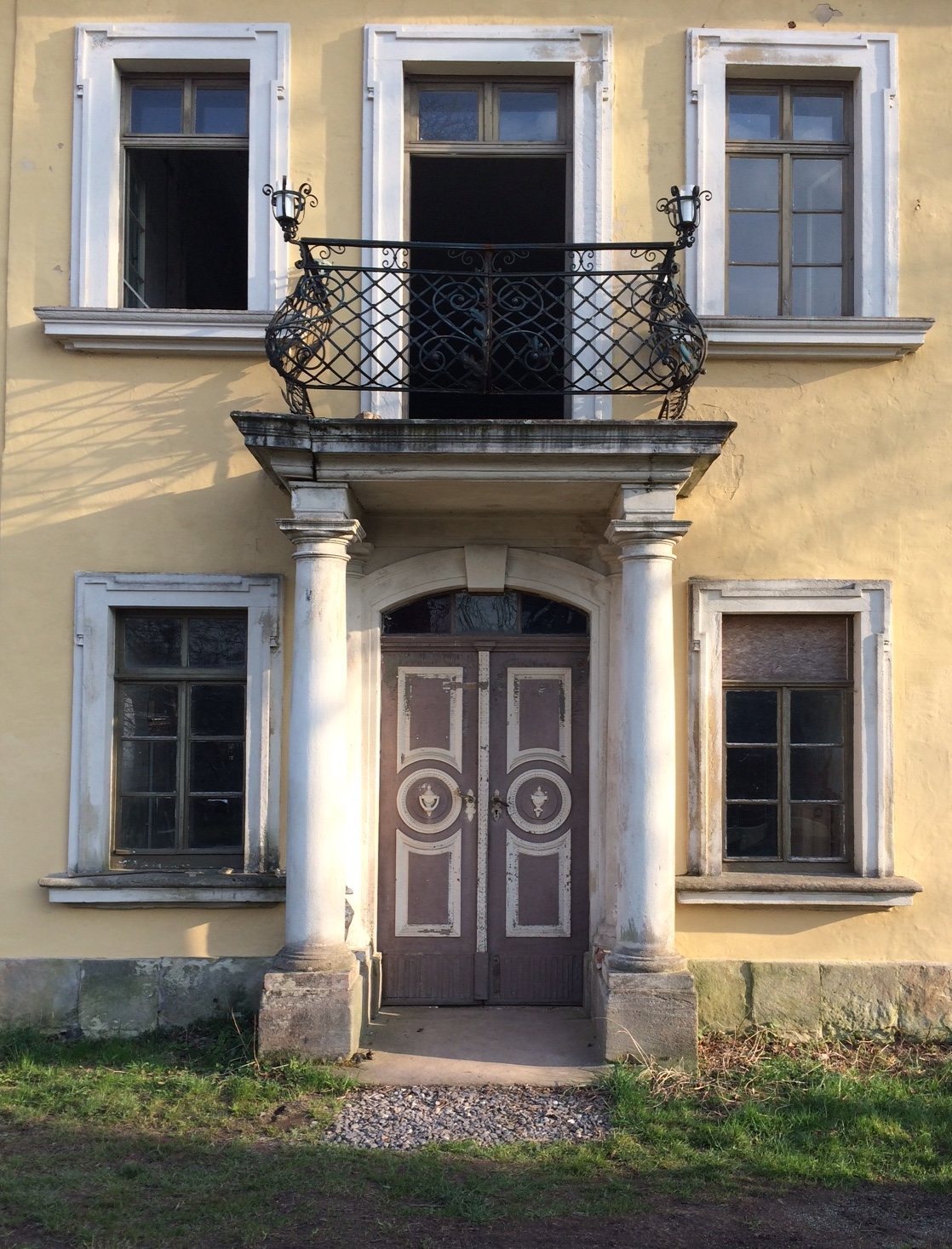
The surviving house is a rectangular, plastered building with two storeys and a four-storey hipped mansard roof. A mansard roof has two slopes on each side, with the lower slope steeper than the upper one. On the north side, a three-part central projection contains an Early Classicist portal, a feature of a European architectural style. Its original wooden door remains in place. Above the entrance, a raised terrace rests on two Tuscan columns, a plain classical design. Slate covers the roof, whose four rows of dormers vary in form.
Service courtyard and park
The service courtyard lay north of the house. A park enclosed by a rubble-stone wall extends along the south and west sides of the residence. Its remnants include a relatively large pond and old trees.