Merdeka Palace: Indonesia’s Presidential and State Ceremonial Palace
Site at a Glance
- Popularity
- Very High
- Country
- Indonesia
- Primary era
- Modern
- Eras represented
- Modern
- Civilizations
- Dutch
- Site type
- Domestic
- Remains
- Palace
On this page14 sections
History
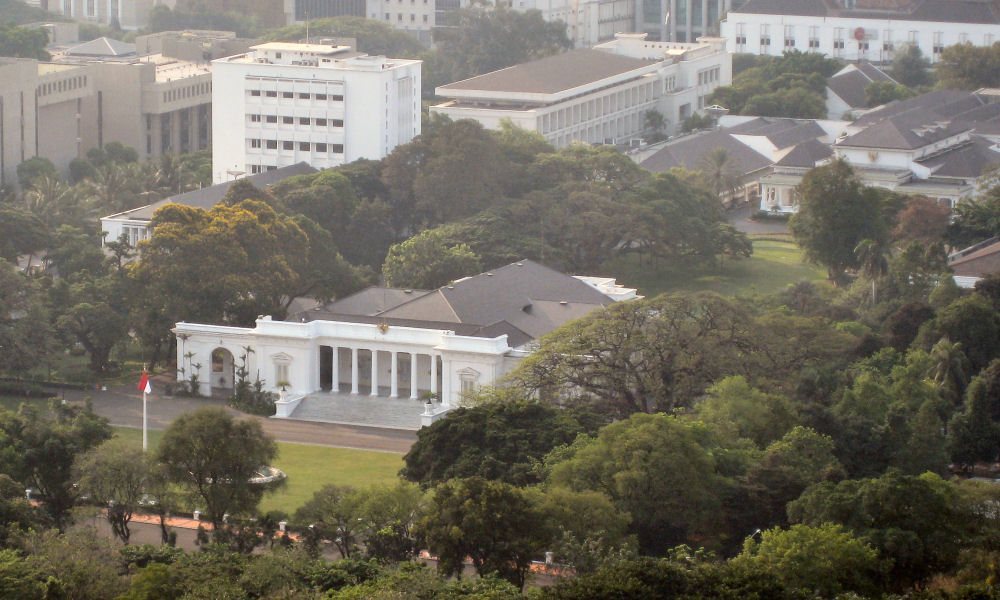
Merdeka Palace is a presidential and state ceremonial palace facing Merdeka Square in Central Jakarta, Indonesia. Completed in 1879 in the Indies Empire style, it was built for the Dutch East Indies governor-general and later became the setting for Indonesia’s 1949 transfer of sovereignty.
Construction and colonial residence
Governor-General Pieter Mijer commissioned a new palace in 1869 because Rijswijk Palace, now Istana Negara, was considered too small for administrative work such as large receptions and conferences. Construction began on 23 March 1873 under Governor-General James Loudon. Architect Jacobus Bartholomeus Drossaers designed the building, which was built by the Department of Public Works and Drossaers & Company. It was completed during Governor-General Johan Wilhelm van Lansberge’s tenure.
Van Lansberge moved into the palace in April 1877, becoming its first resident, and it served as the official home of the governor-general and his family. It was first called Hôtel Koningsplein, later Paleis te Koningsplein, and was also known as Istana Gambir. Governor-General Tjarda van Starkenborgh Stachouwer was the last Dutch governor-general to live there. Colonial events at the palace included tea dances and music evenings, while audiences for rulers and regular monthly audiences continued at Rijswijk Palace.
Occupation and transfer of sovereignty
During the Japanese occupation of the Dutch East Indies from 1942 to 1945, three Japanese commanders lived in Merdeka Palace. The Japanese garrison’s army commander resided in the Rijswijk Palace compound.
The Indonesian National Revolution, the struggle that ended with Dutch recognition of Indonesian independence, culminated in a sovereignty-transfer ceremony at the palace on 27 December 1949. A ceremony took place at the same time at the Palace on the Dam in Amsterdam. As crowds gathered, the Dutch flag was replaced by the Indonesian flag and people called out the word merdeka, meaning independence. Tony Lovink, the Dutch Crown’s high commissioner, was the last representative of Dutch authority to leave the palace. The name Istana Merdeka, or Palace of Independence, became associated with the building after the ceremony and was made official at 5:55 p.m. on 28 December.
Presidential use after independence
President Sukarno and his family arrived from Yogyakarta on 27 December 1949. He became the first Indonesian president to reside in the palace, and its first annual Independence Day ceremony was held there in 1950. After independence, the grounds grew into a larger presidential complex that included Istana Negara, Wisma Negara, the State Secretariat, and Bina Graha. Several colonial buildings and residences in Weltevreden were demolished to make way for the expansion.
During Suharto’s presidency, Sukarno’s bedroom became the Regalia Room, while the room used by Sukarno’s wife, Fatmawati, became the president’s bedroom. An old wooden building known as the Sanggar was replaced by Puri Bhakti Renatama, a museum for artifacts, artworks, and gifts from foreign envoys. Suharto also built Bina Graha on the palace grounds for use as his office. When Megawati became president, Puri Bhakti Renatama became her office and its collection was moved to Bina Graha. She restored the palace’s furnishings and decorations to their Sukarno-era appearance, removing Suharto’s carved Jepara furniture except for pieces in the Jepara Room.
The palace continues to host Independence Day observances, cabinet meetings, and state banquets. Its administrative work shifted to Istana Negara and the State Secretariat, while presidential offices and private quarters remained at Merdeka Palace. Later presidents used it as a residence to different degrees: Suharto preferred his home on Jalan Cendana and used the palace and Bina Graha as offices; Abdurrahman Wahid and Megawati used it as their official residence; Susilo Bambang Yudhoyono stayed there at times but often preferred his home in Puri Cikeas; and Joko Widodo preferred to live at Istana Bogor.
Remains
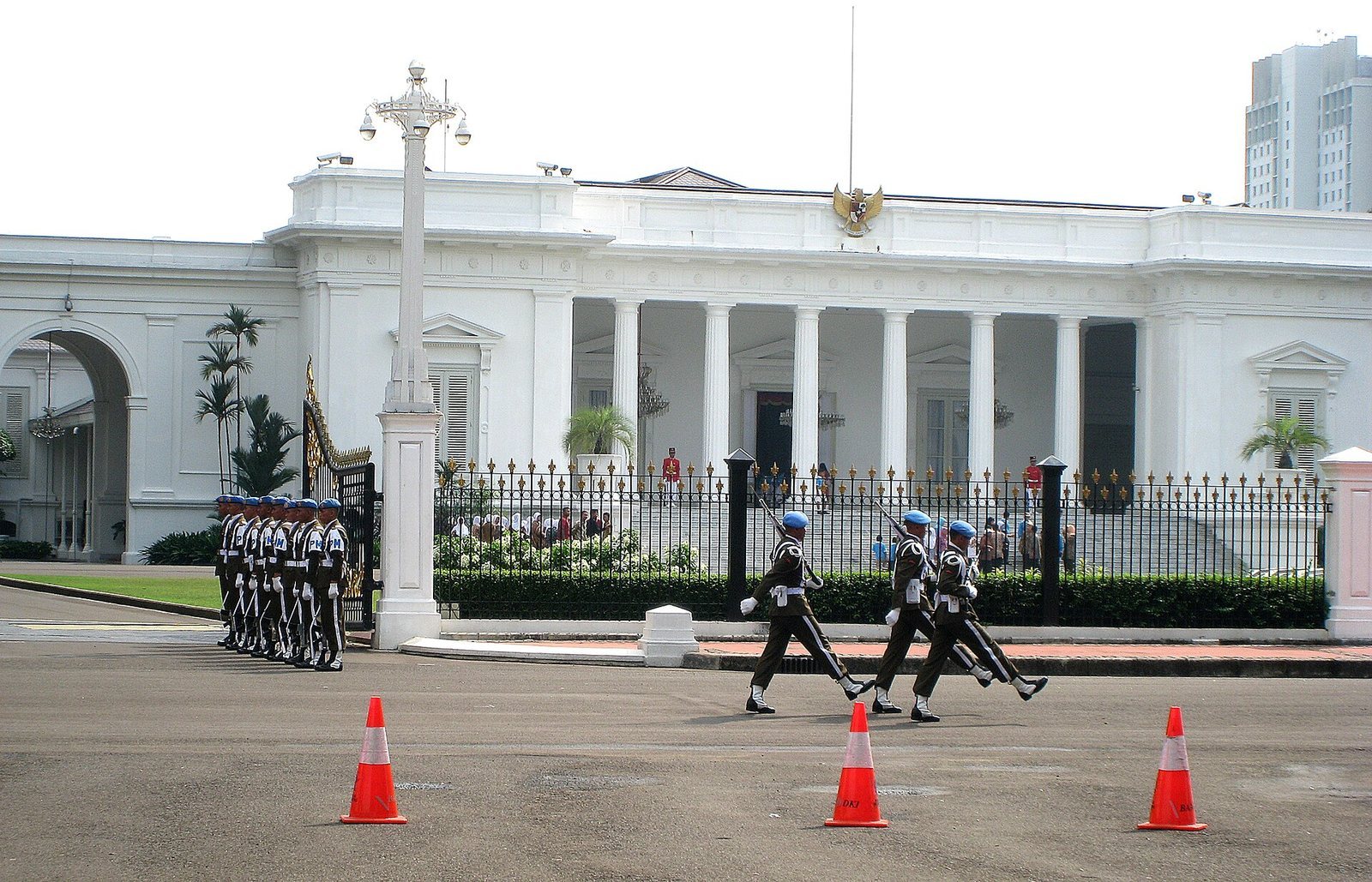
The palace faces Merdeka Square from the north and occupies the southern part of the former Rijswijk Palace grounds. It forms part of a 6.8-hectare presidential complex that also contains Istana Negara, Wisma Negara, the State Secretariat, and Bina Graha. The palace is described as Neo-Palladian, drawing on classical forms associated with Renaissance architect Andrea Palladio, and neoclassical. It is also classed as Indies Empire style, a Dutch colonial adaptation of European neoclassical design to tropical conditions.
Exterior and grounds
Main building and entrance
The main building is described as having retained its original form since its completion in 1879, although its rooms and furnishings have changed. A broad flight of steps rises to a deep, wide entrance portico, or roofed porch, supported by six Doric columns with plain capitals. An ornamental gate stands on either side of the front, making the building appear wider.
Front lawn and courtyard
A 17-metre flagpole and a fountain stand on the front lawn. The veranda serves as a ceremonial platform for the president and dignitaries during Independence Day observances. In the courtyard, a small octagonal gazebo first served as a colonial music pavilion and later as a school for the children of Sukarno and palace staff.
Interior rooms and collections
Credential Hall
The Credential Hall provides an entrance to the palace and is used for diplomatic events, including the reception of state guests and ambassadors. Its furnishings date from the colonial period, and paintings and ceramic works decorate the room.
Jepara Room
Formerly Sukarno’s study, the Jepara Room contains carved wooden furniture and ornaments from Jepara, a town in Central Java.
Raden Saleh Room
Located in front of the Jepara Room, the Raden Saleh Room formerly served as the First Lady’s office and living room. Megawati kept five paintings by the nineteenth-century Indonesian painter Raden Saleh there.
Reception Room
The palace’s largest room contains two paintings by twentieth-century Indonesian artist Basuki Abdullah. On the eastern wall, “Pergiwa Pergiwati” depicts a subject from the ancient Indian epic the Mahabharata. A painting of the Javanese traditional story of Jaka Tarub hangs on the western wall.
Regalia Room
Also called the Heirloom Flag Room, the Regalia Room stores the Bendera Pusaka, or Heirloom Flag, the first Indonesian flag raised during the declaration of independence on 17 August 1945.