Fort Aventure: A French Blocking Fort at Pont-Saint-Vincent
Site at a Glance
- Popularity
- Medium
- Country
- France
- Primary era
- Modern
- Eras represented
- Modern
- Civilizations
- French
- Site type
- Military
- Remains
- Fort
On this page15 sections
History
Fort Aventure, the later leisure-park name of Fort Pont-Saint-Vincent, is a French military fort between Pont-Saint-Vincent and Bainville-sur-Madon, about 15 kilometres south of Nancy. Built from 1878 to 1881 as a detached blocking fort, meaning a standalone position intended to impede an invading force, it formed part of the Séré de Rivières system, France’s network of fortifications developed after the Franco-German War of 1870.
Construction and strategic role
After the war, the border between France and Germany ran through Lorraine, and the fort was intended to help defend an invasion route through the 59-kilometre-wide Charmes Gap. Five isolated forts were assigned to obstruct an advance and control railway lines: Manonviller, Frouard, Pont-Saint-Vincent, Pagny-la-Blanche-Côte and Bourlémont. The gap lay between the Chanot work near Toul and Fort Dogneville near Épinal.
Fort Pont-Saint-Vincent commanded the road linking Chalon-sur-Saône with Sarreguemines and the railway running from Nancy toward Mirecourt and Langres. Along with Fort Frouard to the north, it extended Toul’s defensive perimeter westward to include the Haye Forest. Field defenses raised during mobilization were intended to protect Nancy.
Garrison, renaming and modernization
The fort held 816 men in 1881. Two years later, its ramparts carried 18 guns and four mortars, with eight more guns assigned to defend the flanks. In 1887, War Minister Georges Boulanger ordered a brief change of name to Fort Pélissier, honoring Marshal Aimable Pélissier, whose command during the 1854-55 siege of Sevastopol had brought him renown. Boulanger’s successor, Théophile Ferron, revoked the order on October 13, restoring the fort’s official name.
The development of high-explosive artillery shells in the 1880s prompted major strengthening and reorganization between 1893 and 1912. A barbed-wire perimeter followed in 1903. In 1910, the fort gained a connection to the civilian electricity network and generators.
Service in the world wars
During France’s 1914 mobilization, 1,090 troops were stationed at the fort. They included two companies of the 169th Infantry Regiment, an artillery battery from the 6th Foot Artillery Regiment and an engineering detachment. Fighting did not reach the fort. In 1915, guns mounted on fixed fortress carriages were sent to the front. At the end of the First World War, the site became a depot for equipment belonging to the United States Expeditionary Force.
In June 1940, the fort’s artillery turrets fired on German columns approaching the bridges over the Moselle. The German Army removed the fort’s armored fittings in 1943.
Army training and leisure use
From 1971, the French Army used the site as a commando training center attached to the 26th Infantry Regiment. Its courses lasted three weeks. The fort was renovated in 1980 and abandoned in 1996. A group of enthusiasts bought it in 1999 and turned it into Fort de l’Aventure, France’s first leisure park established within a fort. The site is privately owned.
Remains
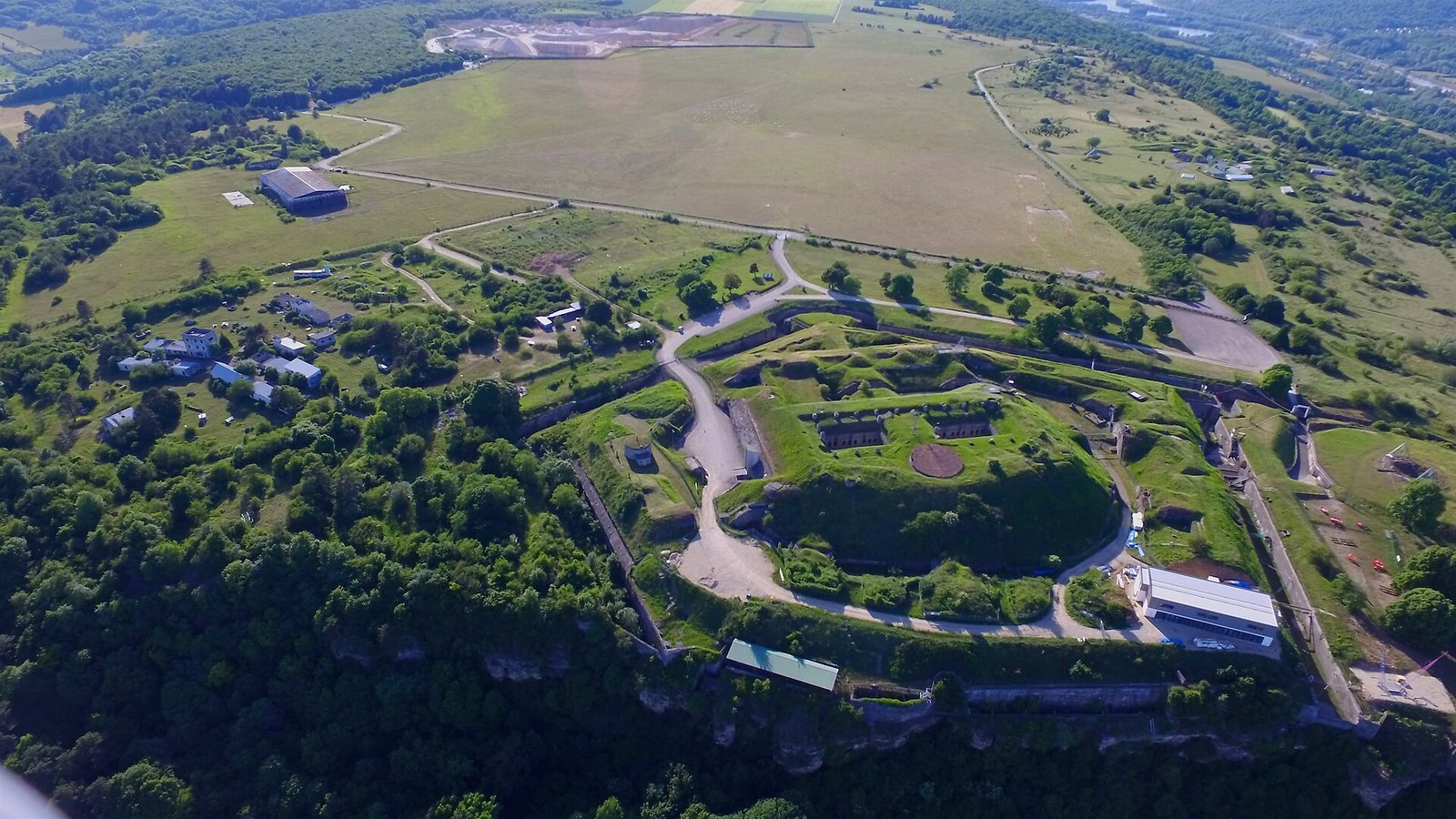
The fort stands on a plateau at an elevation of 420 metres, overlooking Neuves-Maisons and the built-up area around the confluence of the Madon and Moselle. Its pentagonal layout has a ditch along four sides, with the fort set against an escarpment. The fortified area grew from 4.3 hectares to 5.6 hectares during expansion; the leisure-park grounds cover 70,000 square metres.
Core fortifications
Ditch defenses
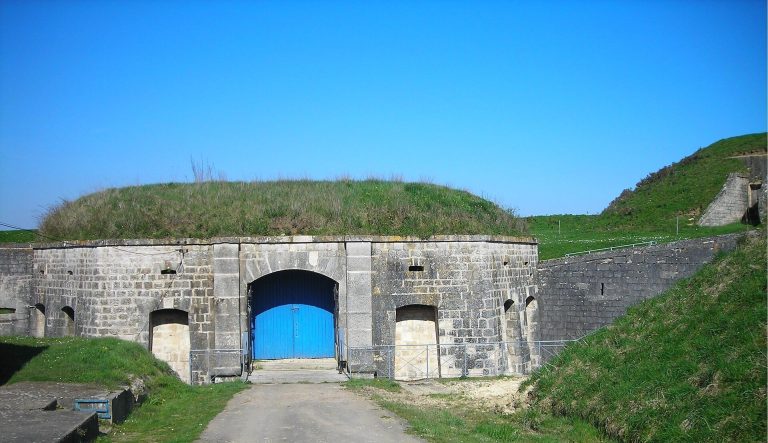
Two single caponiers and one double caponier defended the ditch. Caponiers are protected structures designed to fire along a fort’s ditch.
Barracks and artillery positions
A two-storey masonry barracks, covered with earth, occupied the fort’s center. A cast-iron Mougin Model 1876 gun turret mounted above it held two 155 mm guns. Artillery platforms surrounded the barracks, divided by 19 raised shelter traverses, earthworks that separated gun positions and offered protection.
Later concrete and armored works
Expansion of 1893-1896
The first modernization phase covered the communication galleries with concrete and added two concrete barracks, an underground shelter cut into the rock and a rock-cut magazine. Expansion to the northeast, on the former Sainte-Barbe battery site, enlarged the fort. The projecting section had a double concrete gun chamber built into the outer ditch wall, as well as a retractable steel Galopin Model 1890 turret armed with two 155 mm guns. The former positions of both artillery turrets remain as large pits.
Searchlights and observation posts
Between 1910 and 1912, a searchlight turret, two searchlight chambers and five armored observation posts were added for night defense. A 1908 program had specified the searchlight turret. Generators installed in 1910 supplied lighting and ventilation and allowed the turrets to turn rapidly.
Outlying batteries
North-West of Saint-Jean battery
This battery had seven firing platforms, four shelter traverses, a magazine cut into the rock and a ditch defended by a double caponier. In 1914, it carried four 120 mm De Bange guns, French artillery pieces designed by Charles de Bange.
Other associated batteries
The Sainte-Barbe, de la Chapelle and Bainville batteries were built with the fort to cover blind angles. Together with the North-West of Saint-Jean battery, they formed its outlying artillery defenses.