Ruat Castle: A Defensive Stronghold of the Arcachon Basin
Site at a Glance
- Popularity
- Medium
- Country
- France
- Primary era
- Medieval
- Eras represented
- Medieval, Modern
- Civilizations
- Duchy of Aquitaine, English, French
- Site type
- Military
- Remains
- Castle
On this page5 sections
History
Ruat Castle in France began as part of the defensive system around the Arcachon Basin, between the castles of La Teste and Certes. These fortifications belonged to the captals of Buch, the lords of the territory surrounding the basin. The castle’s history reflects the changing fortunes of local families and the development of the surrounding lordship.
Medieval origins and changing lordship
In 1300, Rufat I d’Artiguemal became a vassal of Pierre-Amanieu de Bordeaux, captal of Buch. A vassal held land from a superior lord in return for obligations. Rufat received a small fief, or estate held under such obligations, comprising the castle of Techys and nearby lands, in return for loyalty and a gold spearhead. The name Ruat is traced to Rufat, a name associated with red or bristly hair. Its later form reflects a Gascon pronunciation in which “f” shifted to an aspirated “h.”
In 1425, marriage brought the estate to the Casteja family, who altered the castle and remained vassals of the captal of Buch. The defense of the Eyre estuary was separate from the castle, about 400 metres to its south beside the marshes. In 1453, Jean de Foix-Candale, captal of Buch, surrendered at the Battle of Castillon, the final battle of the Hundred Years’ War between the French and English crowns. Charles VII confiscated the captals’ possessions, but Louis XI later restored them for diplomatic reasons.
Returning from exile in 1468, Jean de Foix-Candale found much of the lordship of Buch depopulated. He offered ownership of the Grande Montagne to anyone who would make the land productive, while reserving rights of use for himself and the inhabitants of La Teste, Gujan, and Cazaux. A succession division in 1500 created the captalat of Certes, the territory held by a captal, which included Le Teich.
The Amanieu de Ruat family
Jean Castaing, a merchant from La Teste known as “le Broy,” or “the handsome one,” bought the barony of Audenge in 1620 and the Ruat estate in 1628. His daughter Jeanne married Pierre Damanieu, captain of the castle of Certes. Pierre II succeeded Jean Castaing and became captain-commander for the king in the captalat of Buch and neighbouring areas. During the Fronde, a series of uprisings and civil conflicts in seventeenth-century France, he helped free La Teste Castle and bombarded Certes to suppress insurgents. Certes then belonged to the Marquis de Civrac. The king ennobled Pierre II in 1654, when he adopted the name Amanieu de Ruat. In 1675, the marquis’s son and members of his household murdered him.
In 1713, Jean-Baptiste Amanieu de Ruat, baron of Audenge and a councillor of the Parliament of Bordeaux, bought the captalat of Buch from its last holder. After continued disputes with the lord of Certes, he agreed to a territorial reorganization in 1730. He surrendered the barony of Audenge and regained the parish of Le Teich, with the Eyre serving as the boundary between their territories. He was buried in 1739 in the Ruat chapel at the church of Le Teich, alongside his father, two wives, and two children.
The Amanieu de Ruat family sought to hold back shifting coastal sands by planting pines. They also arranged for the heathland of Le Teich to be drained and planted by the Compagnie Nézer. These efforts preceded later work in the Landes associated with Brémontier and Chambrelent.
Revolution and nineteenth-century changes
The French Revolution, which began in 1789 and ended the monarchy, left the family with the Ruat estate and its rights in a customary-use forest, where people held traditional rights to use forest resources. After leaving prison, François Amanieu de Ruat, the last captal, found the estate largely destroyed and its income gone. His son-in-law, Charles de Labat, baron of Lauzac and mayor of Le Teich, put the estate up for sale.
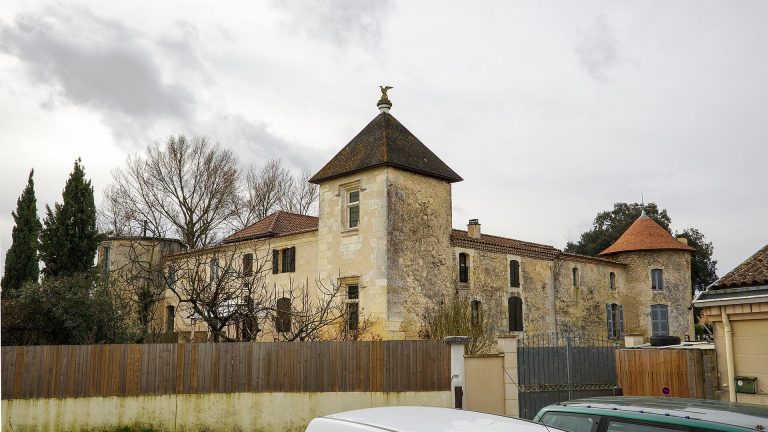
Adrien Festugière, an owner of ironworks, bought the castle in 1846 and remodeled part of it in 1847, establishing its present appearance. His daughter Marie, a lady-in-waiting to Princess Mathilde, married Charles Espinasse. Espinasse later became a general, a military aide to Napoleon III, and interior minister. Their son Jules grew up with the Prince Imperial, who visited Ruat with his mother, Empress Eugénie. Espinasse had Lamothe railway station built on his land to receive the Emperor. It was the first stop on the Bordeaux–Arcachon line. In 1857, Napoleon III ordered the planting of the Landes plateau, drawing on the Amanieu family’s earlier work. The main gate was kept closed in the Emperor’s honor.
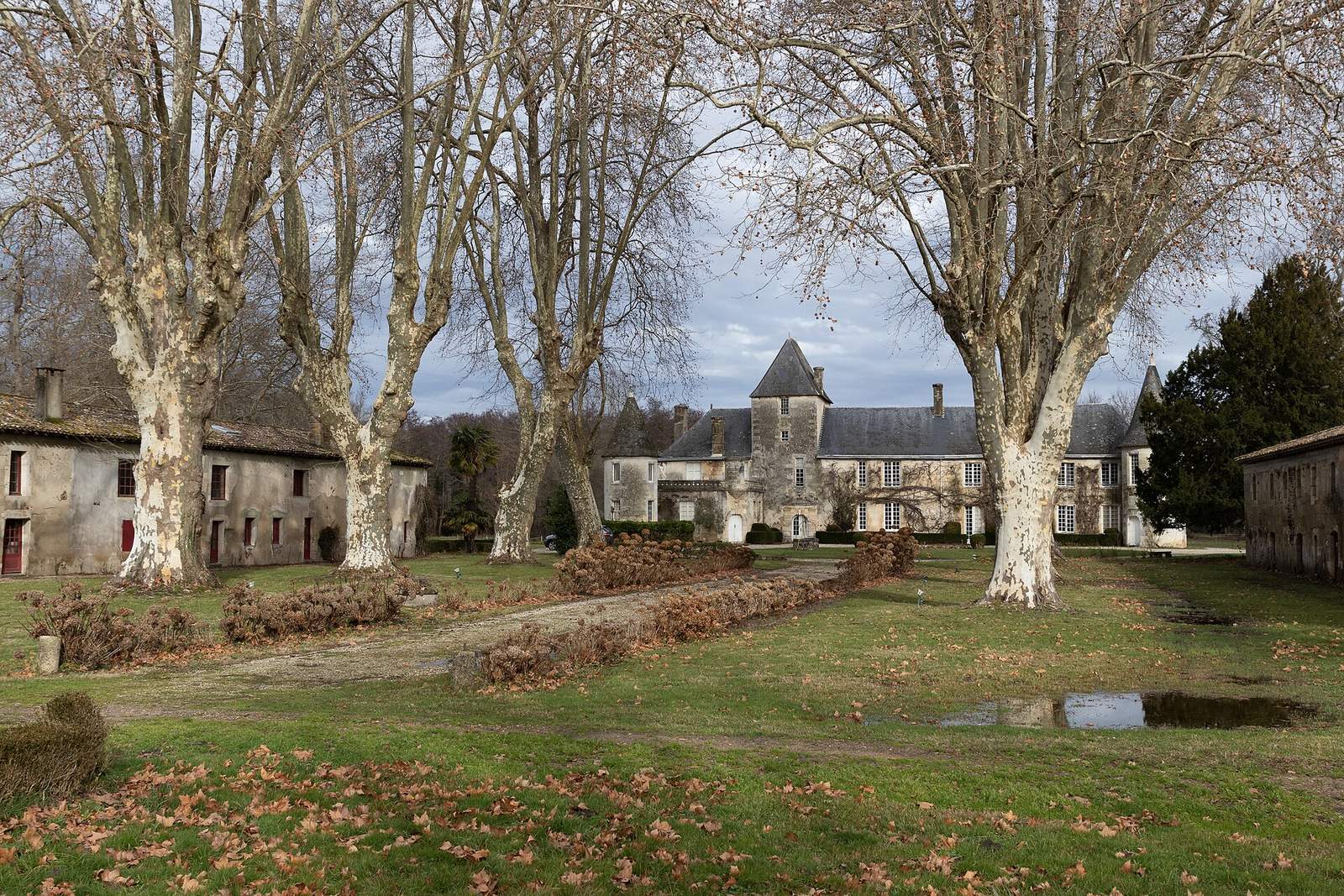
The estate remained with the Espinasse family before passing to the Fontenilliat family. Substantial renovation of the castle and outbuildings has taken place since the early 2000s. Since 1970, the castle’s façades and roofs have been registered as historic monuments; the round tower with machicolations is excluded from that registration.
Remains
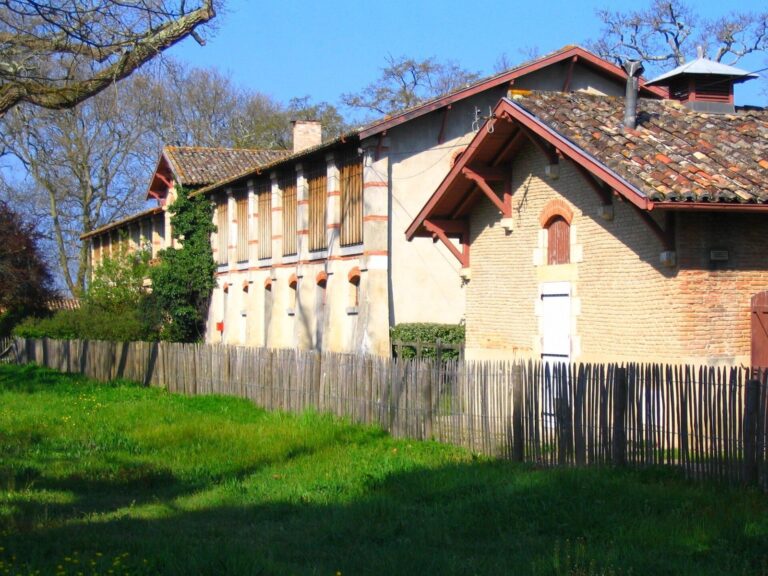
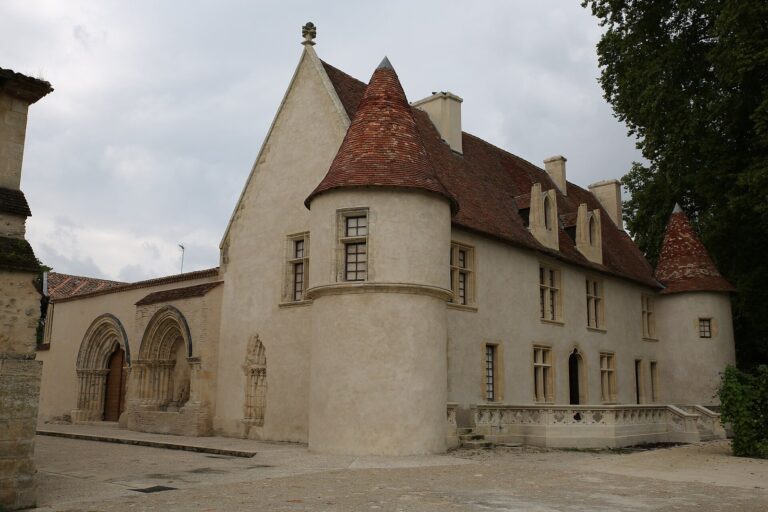
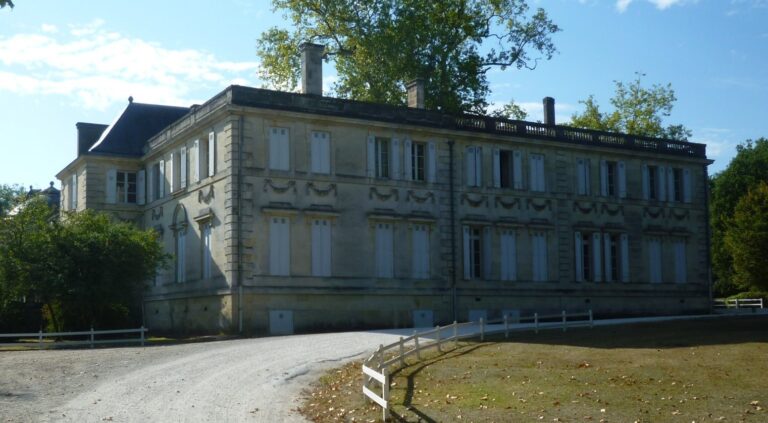
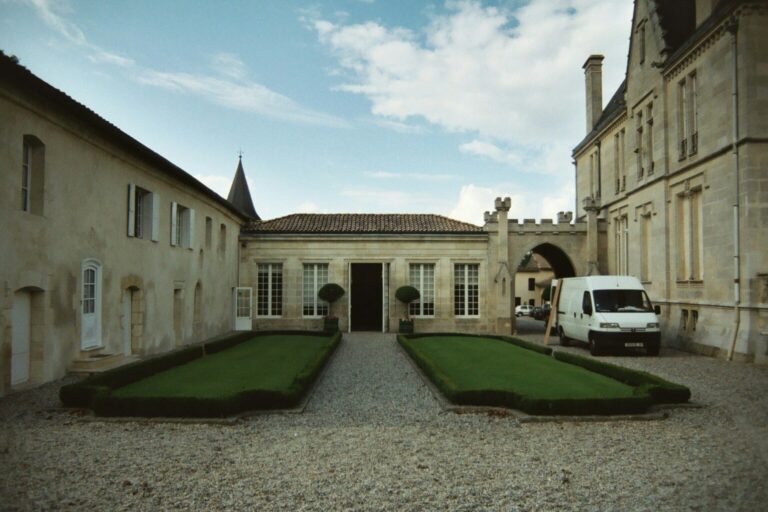
The estate includes the castle, its main gate, and outbuildings. The castle has building phases extending from the fifteenth through the nineteenth centuries, and its foundations date to the fifteenth century. A round tower has machicolations, projecting openings through which defenders could attack people below.