Cittadella: The Historic Fortress of Gozo, Malta
Site at a Glance
- Popularity
- Very High
- Country
- Malta
- Primary era
- Early Modern
- Eras represented
- Bronze Age, Classical, Medieval, Early Modern, Modern
- Civilizations
- British, Crown of Aragon, Crusader, Knights Hospitaller, Roman
- Site type
- Military
- Remains
- Citadel
On this page20 sections
History
The Cittadella is a historic fortress on a promontory above Victoria, on the island of Gozo, Malta. Its site was occupied in prehistoric times and later formed the high, fortified centre, or acropolis, of the ancient settlement of Gaulos. The citadel developed from an ancient stronghold into a medieval refuge and, under the Order of St John, a gunpowder-era fortress.
Prehistoric and ancient settlement
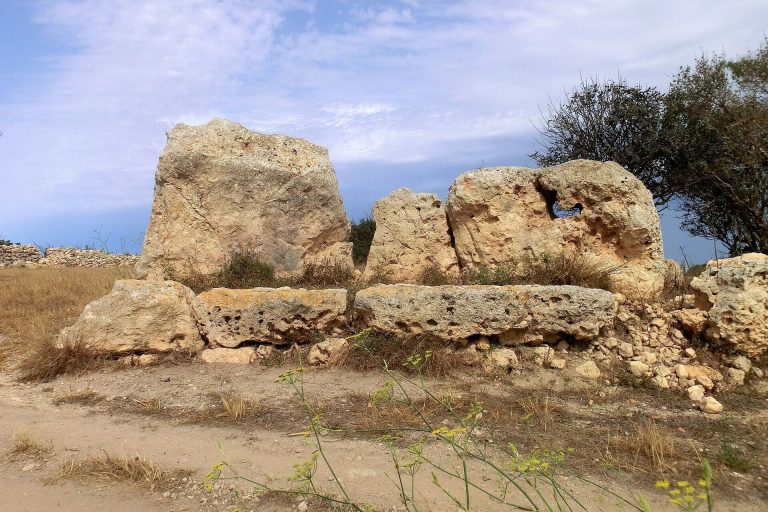
Occupation of the site reaches back to Malta’s Bronze Age, including the periods known as the Tarxien Cemetery and Borġ in-Nadur phases. Ceramics point to earlier prehistoric settlement, and occupation during the Stone Age is considered likely, though evidence for the Neolithic period is limited. Bronze Age silos discovered outside the citadel in the nineteenth century suggest that settlement may once have extended beyond its present boundaries.
In Phoenician and Roman times, the area around present-day Victoria was Gozo’s principal settlement, called Gaulos or Glauconis Civitas. Its acropolis occupied the Cittadella site, while a fortified town extended into what is now part of Victoria. A temple to Juno, a major goddess in Roman religion, is traditionally associated with the site of the present cathedral.
Medieval castle and growing town
After the Roman town was abandoned during the medieval period, its acropolis became a castle and a place of refuge for Gozo’s inhabitants. The first known reference to the island’s castle dates to 1241. Genoese forces sacked it in 1274, and a survey of its defences was ordered two years later. By then, about a third of Gozo’s population lived in or near the Cittadella, and islanders were required to spend the night within its walls. Noblemen representing the Count of Malta lived there by the late thirteenth century.
A testament of 1299 called the fortress castri Gaudisii, meaning castle of Gozo. By the mid-fourteenth century it was also described as a terra, or town. The local administrative council, known as the Università, was established there in 1350; despite its name, it was a governing body rather than an educational institution.
As the Cittadella became too confined for the growing population, the suburb of Rabat developed from the fifteenth century over the site of the former Roman town. Malta and Gozo were then ruled by the Crown of Aragon, a monarchy that joined Aragon with other territories at different times. Its authorities strengthened the Cittadella’s defences and enclosed Rabat behind walls with three gates: Putirjal, Bieb il-Għajn, and Bieb il-Għarb.
Rule of the Order of St John
In 1530, Holy Roman Emperor and King of Spain Charles V transferred Malta and Gozo to the Order of St John, a Catholic religious and military order. The Cittadella remained a medieval castle and served as shelter during attacks by Ottoman forces and corsairs from the North African coast. In July 1551, an Ottoman force estimated at about 10,000, led by Admiral Sinan Pasha, besieged the fortress. Governor Galatian de Sesse offered surrender terms, but the offer was rejected. The castle fell within days and was sacked.
Of the 5,000 to 6,000 Gozitans who had sought refuge inside, most were captured and enslaved. A monk and 40 elderly people were spared, while about 300 people escaped over the walls. The attack left the castle in ruins. It was rebuilt soon afterward, though its defences were not initially brought up to date.
The Cittadella escaped damage during the Great Siege of Malta in 1565, the Ottoman assault on the island that year. Although proposals were made to demolish the fortress and move its inhabitants to Sicily, it helped maintain communication between the besieged town of Birgu and Christian ships, and relayed Ottoman movements to the Order. Grand Master Jean Parisot de Valette and military engineer Francesco Laparelli visited to consider modernizing the defences, but no work followed while the Order concentrated on building Valletta. Corsairs attacked the Cittadella again in 1583.
Reconstruction and military decline
A major rebuilding programme began in 1599 under military engineer Giovanni Rinaldini and architect Vittorio Cassar. Completed around 1622, the work transformed the southern defences into a bastioned fortress designed for gunpowder artillery. Parts of the northern walls were also rebuilt, while retaining a medieval character. The walls around Rabat were probably demolished during the project.
Gozo’s inhabitants had to remain inside the Cittadella between dusk and dawn until the curfew was lifted on 15 April 1637. The fortress continued as the island’s only fortified refuge until Fort Chambray was built in the mid-eighteenth century. Its defences soon drew criticism. In the 1640s, plans to demolish it and construct a new fortress at Marsalforn went as far as preparing mines beneath the bastions, but the demolition was abandoned. Engineer Antonio Maurizio Valperga proposed rebuilding Rabat’s wall and strengthening the Cittadella, but money was unavailable.
Many houses inside the fortress were ruined or in poor condition by the early eighteenth century. Following an attack on Gozo in 1708, engineer Louis François d’Aubigné de Tigné revived proposals for changes in 1715, but these also lacked funding.
French rule and the British period
French forces invaded Malta on 10 June 1798. Troops led by General Jean Reynier landed near Ramla, and part of the 95th Demi-Brigade advanced on the Cittadella, which surrendered by nightfall. During the Gozitan uprising on 3 September, the French garrison retreated inside the fortress. It capitulated on 28 October after negotiations. The following day the British transferred control to the Gozitans, who formed a provisional government led by priest and political leader Saverio Cassar. For a short period, Gozo was administered as the independent state La Nazione Gozitana, or the Gozitan Nation.
During construction of the Gozo Aqueduct in 1839–1843, a reservoir was made in the Cittadella’s ditch, with a commemorative obelisk erected nearby. A road linking it-Tokk and the fortress followed in 1854. In 1856, the Royal Malta Fencible Regiment moved its Gozo headquarters from the Cittadella to Fort Chambray. The British decommissioned the fortress’s defences on 1 April 1868. During the Second World War, air-raid shelters were cut beneath the bastions.
Conservation
The Cittadella has been on Malta’s tentative list of UNESCO World Heritage Sites since 1998. Plans for restoration were drawn up in 2006, and work to stabilize the fortifications and their underlying bedrock began in 2008. A further project, carried out from 2014 to 2016, restored principal building façades, cleaned and consolidated ruins, and rehabilitated the ditch.
Remains
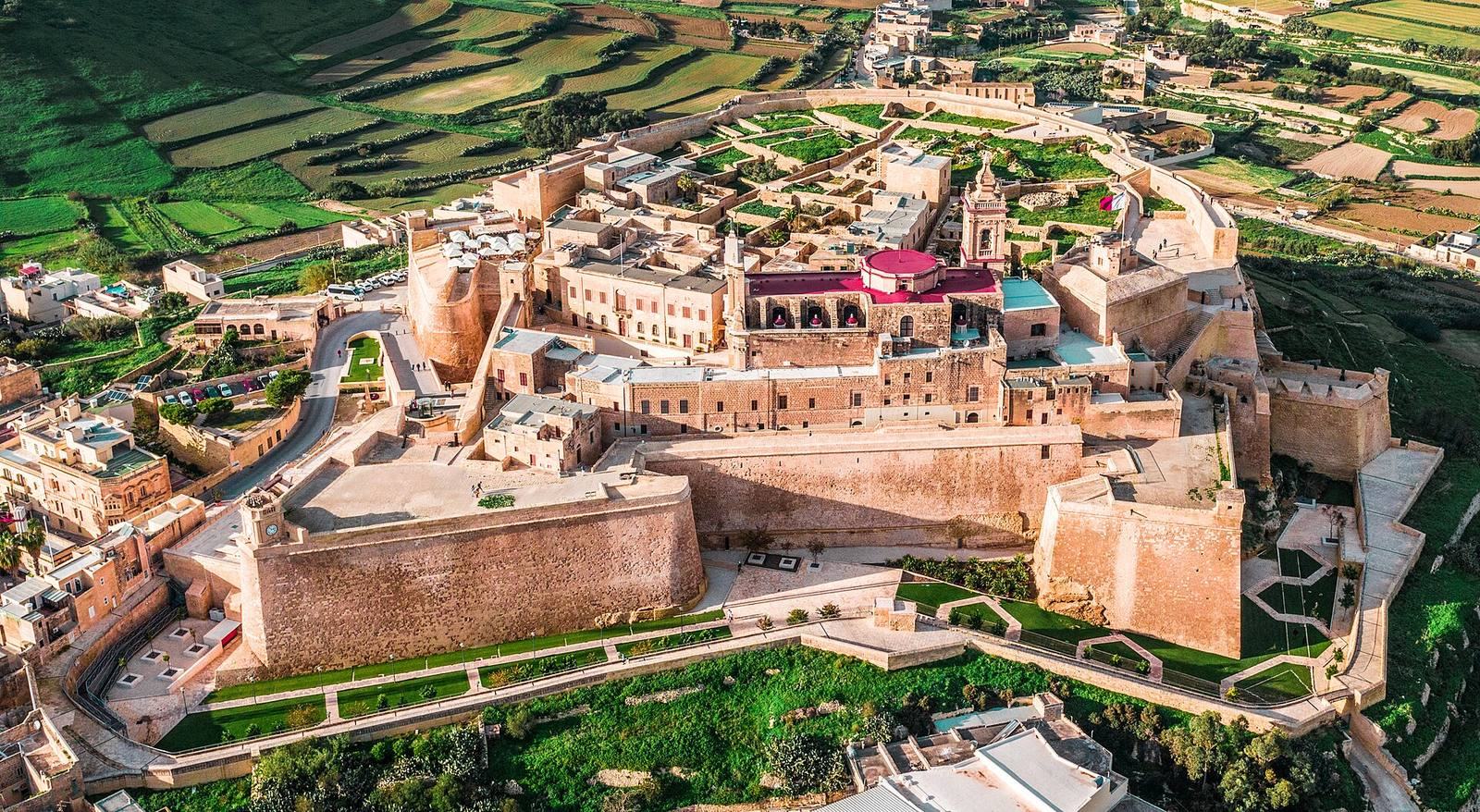
The fortress stands on a naturally defensible promontory overlooking Victoria, with views across the surrounding countryside and much of Gozo’s coastline. Its defences combine a curved enclosure following the plateau’s northern edge with a southern line of projecting fortifications joined by curtain walls, meaning defensive walls that link fortified sections.
Fortifications
Northern enclosure
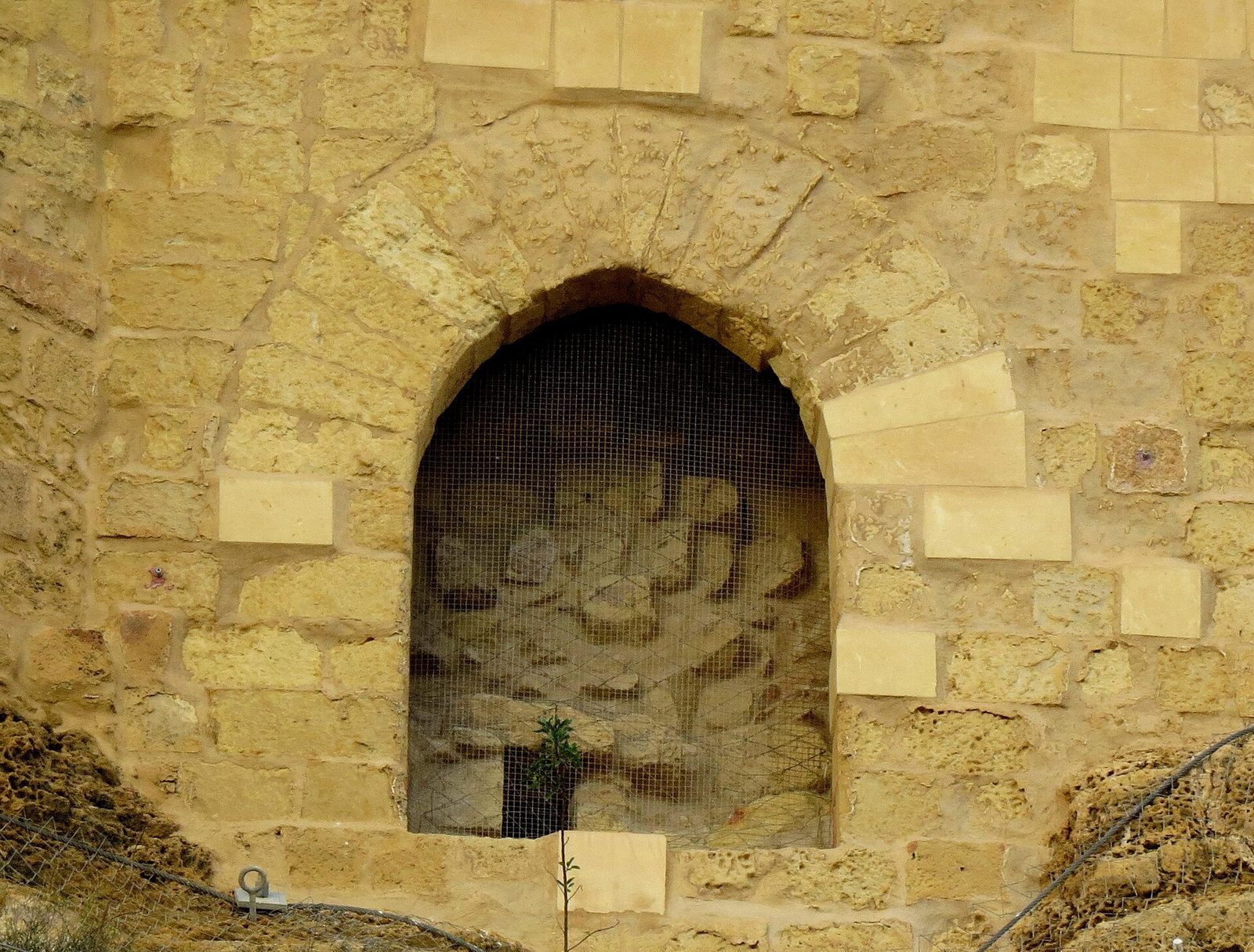
The northern walls were first built in the fifteenth century, though substantial portions were rebuilt during the period of the Order of St John or later. They follow the natural edge of the plateau and retain a largely medieval character. Along this circuit are a collapsed medieval wall tower, a blocked sally port, or small defenders’ exit, and a lookout post. The walls also contain blocked windows, while masonry facings support hollows in the cliff below.
Southern bastions and curtain walls
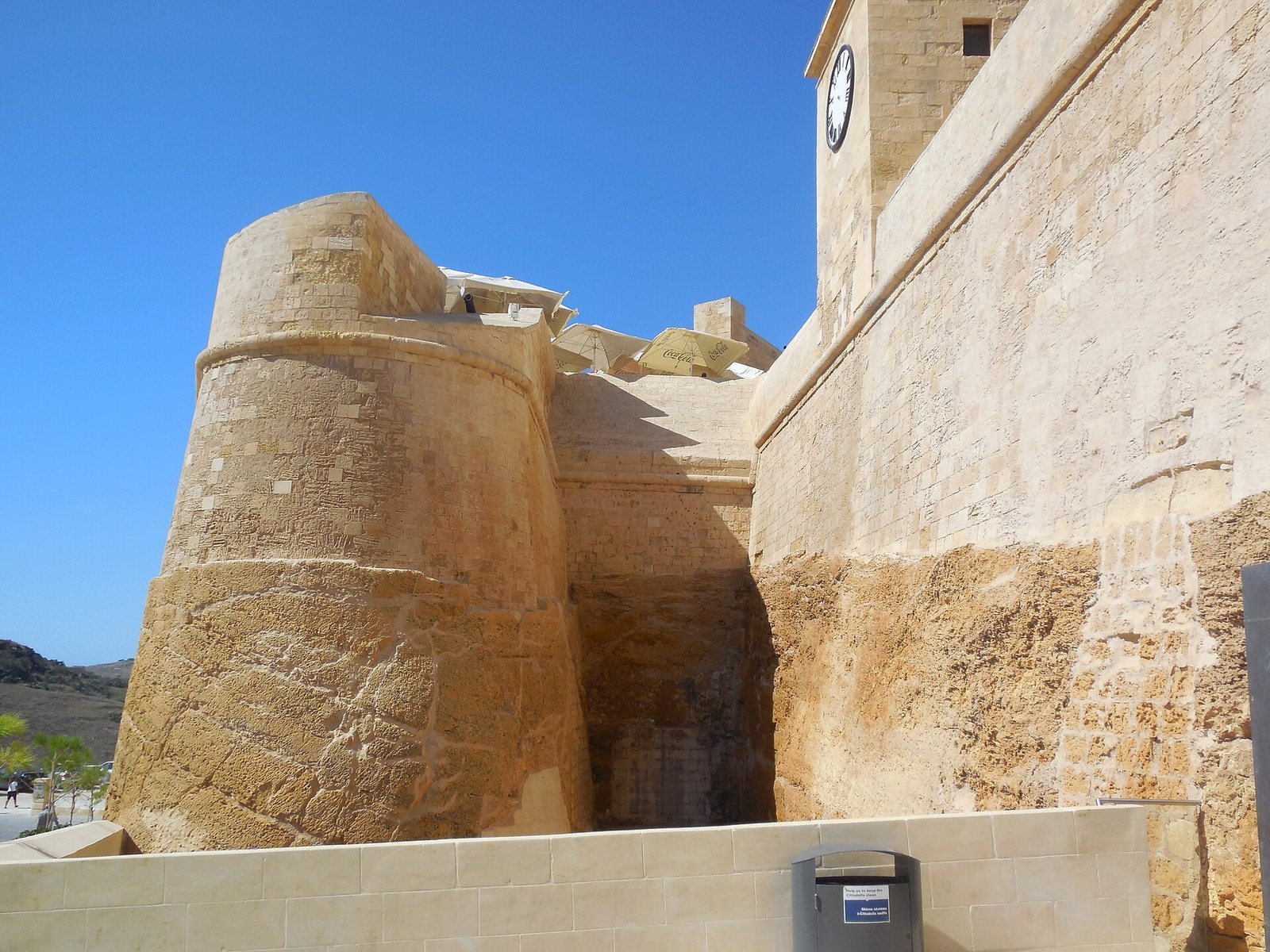
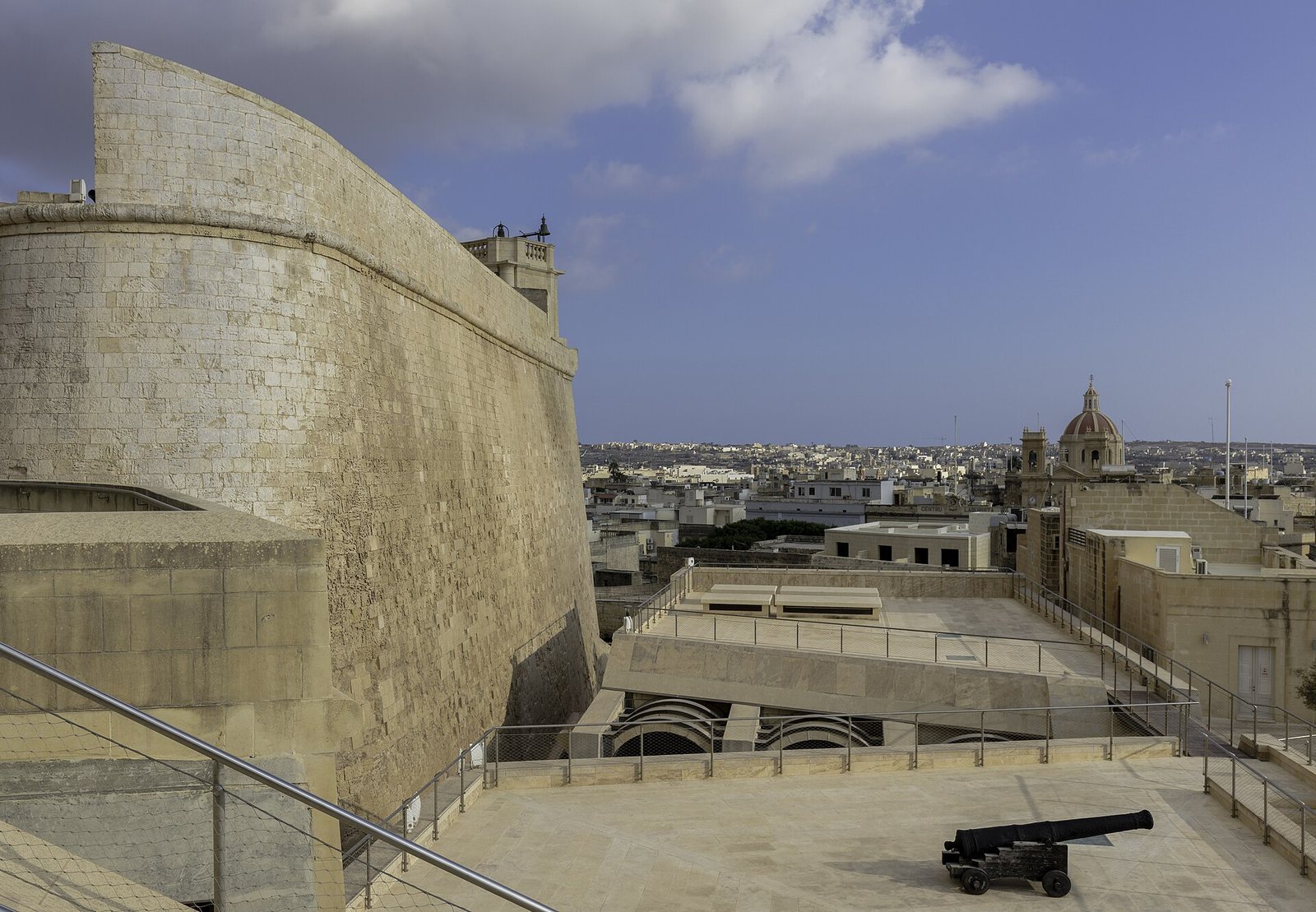
The southern defences are arranged around St Michael’s Bastion, a large, arrowhead-shaped projection at the city’s southern end. St Martin’s and St John’s Demi-Bastions, partial projections from the defensive line, stand at its western and eastern ends. Each has a flat-roofed watch post at its outer point. St Michael’s also had a watch post, replaced by a clock tower in 1858. A small gunpowder store stands where St John’s Demi-Bastion meets the older enclosure.
Curtain walls connect these projecting defences. Between St Martin’s Demi-Bastion and St Michael’s Bastion, the wall contains the Main Gate, a modern arched opening, and a clock tower. St Philip’s Curtain, between St Michael’s and St John’s, has narrow openings in its upper part leading into a series of magazines. These rooms, now used as craft shops, support a walkway along the ramparts.
Artillery platforms and outer works
St Martin’s Cavalier, a raised artillery platform within the defences, lies between the northern enclosure and St Martin’s Demi-Bastion. It is partly intact, although its upper portions have been removed. St John’s Cavalier, near St John’s Demi-Bastion and behind the cathedral, was completed in 1614. A separate room built on its roof in 1701 served as a gunpowder store.
At the easternmost end of the fortress, below the walls near St John’s Demi-Bastion, stands the pentagonal Low Battery. A ditch borders the southern perimeter. It once extended between St Martin’s Demi-Bastion and the Low Battery, but nineteenth-century alterations changed its starting point to St Michael’s Bastion. A protected passage, or covertway, runs along the ditch with a widened area where troops could assemble. Beyond it, the steep outer slope has been built up. A small triangular outwork near the city entrance has lost most of its original stonework and now forms a garden.
Ancient remains and the cathedral
Evidence of Gaulos
Walls that may have formed part of the Punic-Roman fortifications of Gaulos have been found beyond the Cittadella. Large stretches came to light during building work in Main Gate Street, south of the fortress, in 1969, and further remains were found nearby in 2017. A second-century AD Latin inscription, carved on a limestone block from Gaulos, was reused in the Cittadella’s Main Gate.
Cathedral of the Assumption
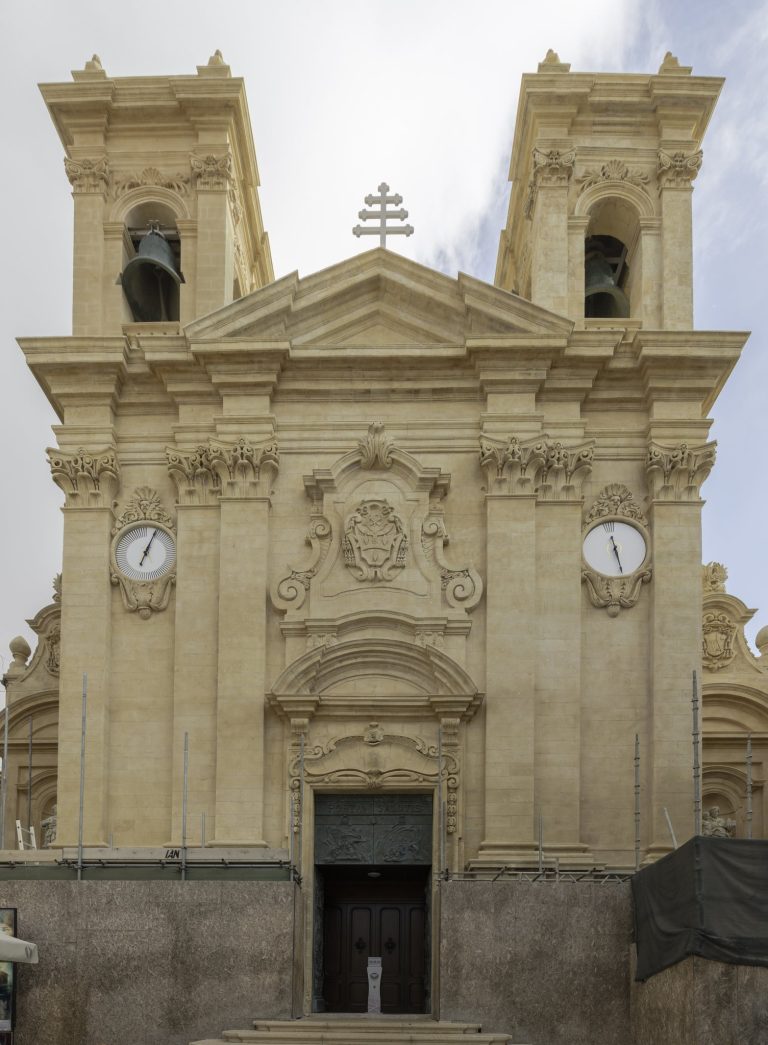
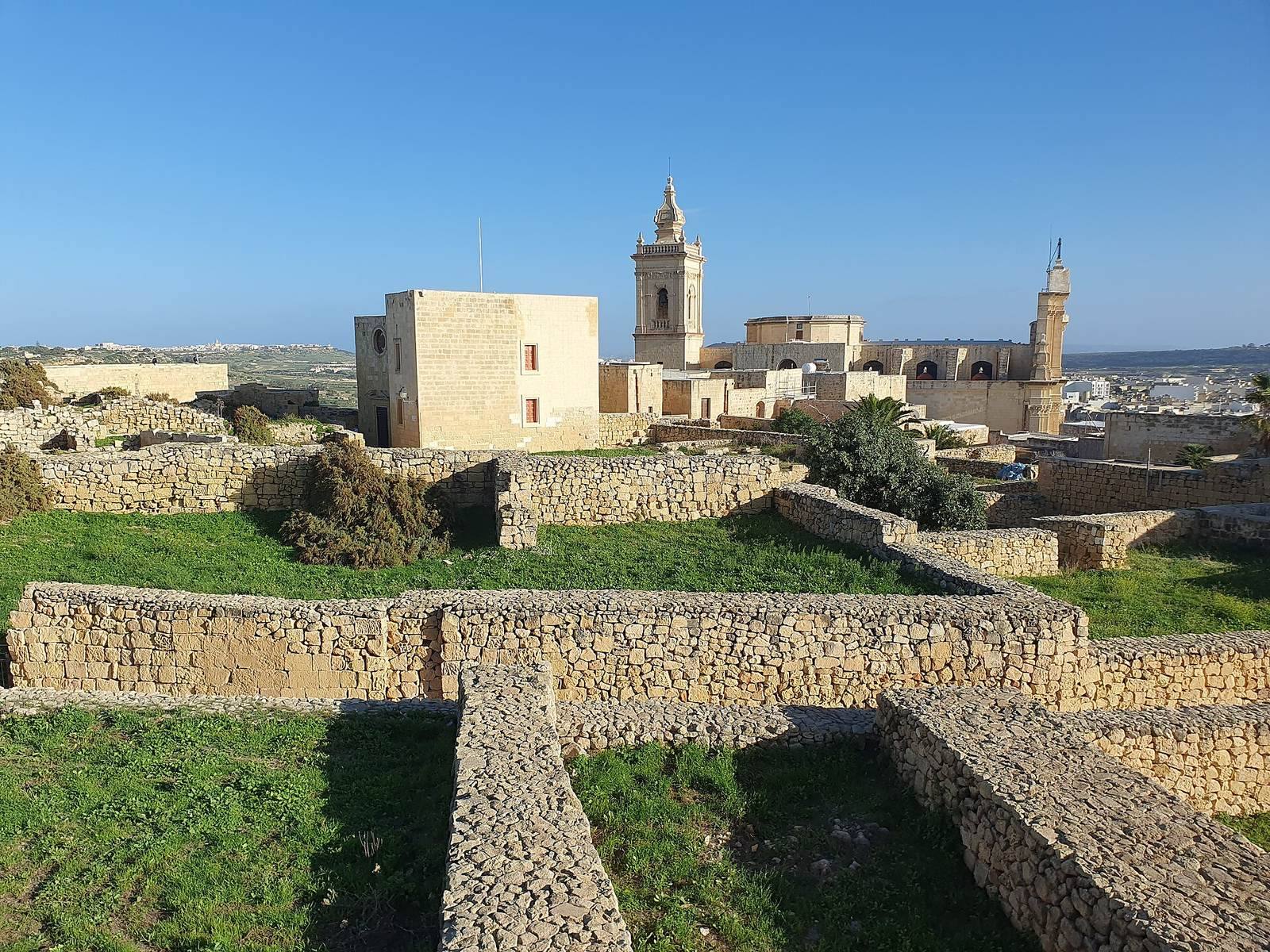
The Cathedral of the Assumption is a Baroque building constructed between 1697 and 1711 to designs by Maltese architect Lorenzo Gafà. It serves as the seat of the Roman Catholic Diocese of Gozo, the church jurisdiction administered by a bishop. Roman temple remains were uncovered during the cathedral’s construction, and some survive beneath it. The site is traditionally associated with a temple to Juno.
The cathedral’s ceiling carries an illusionistic painting by Sicilian artist Antonio Manuele. It depicts the interior of a dome that was never built. A small building behind the cathedral houses its museum.
Chapels
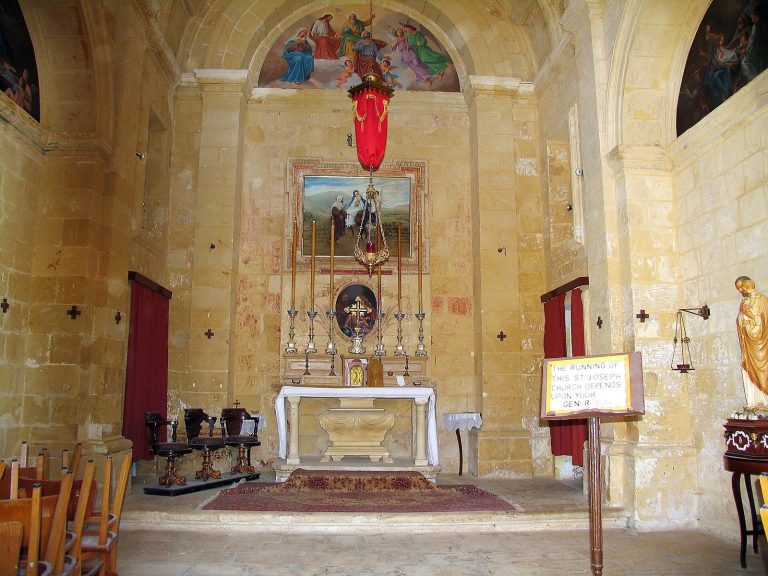
The Chapel of St Joseph, also known as the chapel on the bastions, was originally built around the eleventh century and dedicated to Nicholas of Bari. The present building dates to 1625. It may have been designed by Vittorio Cassar and may incorporate parts of the earlier chapel.
The Chapel of St Barbara, also called the chapel within the walls, is attached to the cathedral and dates to the early seventeenth century. It occupies the site of a chapel to John the Baptist, which was deconsecrated in 1575. The site was granted to the Confraternity of St Barbara in 1598. Vittorio Cassar is buried in the chapel.
Square, civic buildings, and houses
Cathedral Square and palaces
Cathedral Square, known locally as Pjazza tal-Katidral, contains the Law Courts, which occupy two buildings. One was built as a courthouse; the other is the former Governor’s Palace, dating to the early seventeenth century. The Bishop’s Palace stands opposite the former Governor’s Palace. A residential palace built by Bishop Baldassare Cagliares in 1620 adjoins the Chapel of St Joseph. A wall fountain commemorates the city’s naming as Victoria in 1887, in honour of Queen Victoria of Great Britain.
Old Prison
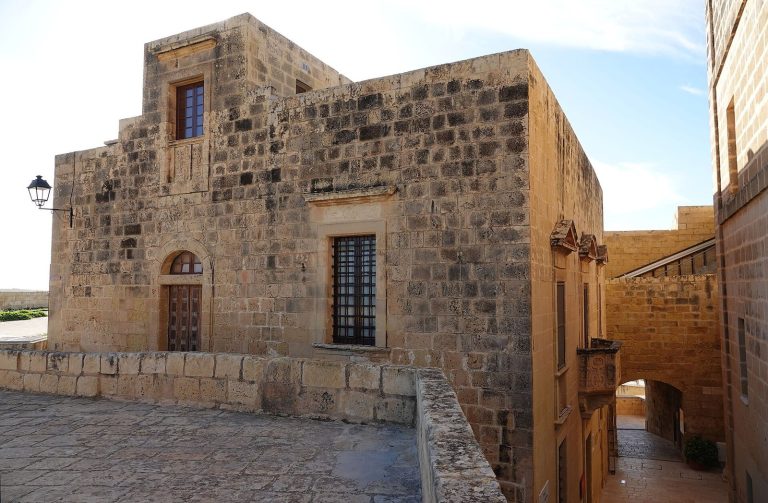
Behind the Law Courts, the Old Prison served as a prison from the sixteenth century until 1962. Its well-preserved cells and exhibitions occupy the former prison building.
Museums
The Gozo Nature Museum occupies a group of seventeenth-century houses that were sometimes used as an inn. Its subjects include the island’s geography, geology, and natural science. The Gozo Museum of Archaeology, which covers Gozitan history from prehistory to the medieval period, is housed in a seventeenth-century building formerly called Casa Bondi. Gran Castello Historic House, devoted to Gozitan folklore, occupies a group of early sixteenth-century houses. Heritage Malta runs these museums and the Old Prison.