Khotyn Fortress: A Medieval Frontier Stronghold in Ukraine
Site at a Glance
- Rating
- 4.8
- Popularity
- High
- Country
- Ukraine
- Primary era
- Medieval
- External website
- Open
- Eras represented
- Medieval, Early Modern, Modern
- Civilizations
- Ottoman, Principality of Moldavia, Russian
- Site type
- Military
- Remains
- Castle
On this page14 sections
History
Khotyn Fortress is a medieval fortified stronghold in Khotyn, Ukraine, whose earliest defenses were built by Slavic communities on the Dniester in the eighth or ninth century. Rising on a rocky promontory, it guarded a major river crossing and routes connecting Kyiv and Scandinavia with Podolia, Moldavia, Wallachia, and the Genoese and Greek colonies of the Black Sea. The fortress later became a princely residence, customs center, and military frontier post.
Early Slavic and Rus foundations
The first fortification was a small wooden stronghold with simple defenses on the landward side. After Vladimir the Great, the grand prince of Kyiv, incorporated the lands of the White Croats and Tivertsians into Kievan Rus, new defenses were built around the turn of the tenth and eleventh centuries. Kievan Rus was the medieval East Slavic state centered on Kyiv. The settlement served as a center of princely authority and a residence for governors.
An earthen rampart, wooden palisades, and a ditch cut across the rocky promontory protected the crossing, nearby inhabitants, and the southwestern frontier of Kievan Rus from raids. From the eleventh through the thirteenth century, Khotyn and its surrounding territory successively belonged to the principalities of Terebovlia and Halych and to the Galician-Volhynian principality, a western successor to Kievan Rus that controlled parts of present-day Ukraine.
The date of the first stone fortress remains uncertain. One interpretation places its construction in the 1240s or 1250s, when Daniel of Galicia strengthened fortresses against the Mongols. Another places it after 1259, when Mongol demands led Daniel and his brother Vasilko Romanovich to destroy earlier defenses. Analysis of the oldest mortar has also been used to propose stone construction as early as the twelfth century or the first half of the thirteenth century.
Moldavian administration and expansion
During the thirteenth and fourteenth centuries, the stronghold was repeatedly enlarged and rebuilt. Daniel of Galicia and his son Lev are associated with the replacement of timber-and-earth defenses by stone fortifications during the 1250s and 1260s. Control later passed among Hungarian, Polish, and Moldavian powers. Moldavian control was established after 1375.
Khotyn became part of the medieval Moldavian principality, a state between the Carpathians, the Dniester, and the lower Danube. It served as the center of Khotyn district, administered by a local governor or castellan, and was a residence of Moldavian rulers from the fourteenth to the sixteenth century. The fortress also controlled customs and commerce. A major annual fair brought about 10,000 gold coins into the Moldavian treasury, and a document of 1408 identifies Khotyn as a customs point.
Alexander the Good strengthened the fortress after 1400. Following succession disputes, Poland occupied it in 1436, but Moldavia recovered it in 1455. Stephen the Great, the fifteenth-century ruler of Moldavia known for military campaigns and fortress construction, recovered Khotyn from Poland after a two-year siege under the peace of 4 April 1459. He then directed a substantial enlargement and reconstruction of the fortress during the second half of the fifteenth century. Under Moldavian rule, Khotyn became one of the principal defenses of the northern frontier, and its garrison resisted an Ottoman attack led by Sultan Mehmed II in 1476.
Polish, Moldavian, and Ottoman rivalry
Polish forces under Jan Tarnowski captured Khotyn in 1538, destroying three towers and part of the western wall. The damaged sections were rebuilt between 1540 and 1544, principally under Petru Rareș, the Moldavian ruler associated with the reconstruction. In 1561 the fortress was granted to the Polish nobleman Albert Laski by the Moldavian ruler Jacob Heraclid. Two years later, Dmitro Vyshnevetsky and 500 Zaporozhian Cossacks captured it for a time before it was recovered with Ottoman assistance.
In 1600, the Moldavian ruler Ieremia Movila and members of his family and entourage, including Simion Movila and the former Transylvanian ruler Sigismund Bathory, took refuge at Khotyn under Polish protection. Polish forces occupied the fortress again in 1615 and 1620. The garrison was withdrawn under the 1617 Treaty of Busza, but Khotyn remained a focus of rivalry among Poland, Moldavia, and the Ottoman Empire.
In September and October 1621, Polish-Lithuanian, Moldavian, and Cossack forces commanded by Jan Karol Chodkiewicz and Petro Sahaidachnyi resisted the Ottoman army of Sultan Osman II at the Battle of Khotyn. The peace treaty signed on 8 October halted the Ottoman advance into Poland and restored the Dniester as the frontier. Khotyn returned nominally to Moldavia while remaining under Ottoman control.
Bohdan Khmelnytsky occupied the fortress briefly in spring 1650. A Turkish garrison from Khotyn later fought with Moldavian forces at the Battle of Zhvanets in 1653. In November 1673, Polish-Lithuanian and Cossack forces under Jan Sobieski defeated the Ottoman defenders and occupied the fortress. Ottoman forces recovered it in August 1674, and Polish forces occupied it again in 1684.
Ottoman frontier stronghold
The Treaty of Karlowitz in 1699 transferred Khotyn from the Polish-Lithuanian Commonwealth to Moldavia under Ottoman protection. The Ottomans occupied it again in 1711 and made it the center of Khotyn district, or rayah, in 1715. A rayah was an Ottoman administrative district. Between 1711 and 1718, with assistance from French engineers, the Ottomans transformed Khotyn into a major frontier stronghold and garrison, surrounding the older Moldavian fortress with bastioned defenses.
Russian forces captured Khotyn in 1739, 1769, 1788, and 1807, although the fortress was returned to Ottoman control after periods of Austrian and Russian occupation. The siege of 1788 by Austrian and Russian forces lasted four months and eight days. It ended on 19 September with the surrender of the Ottoman commander Osman Pasha.
Russian rule and modern preservation
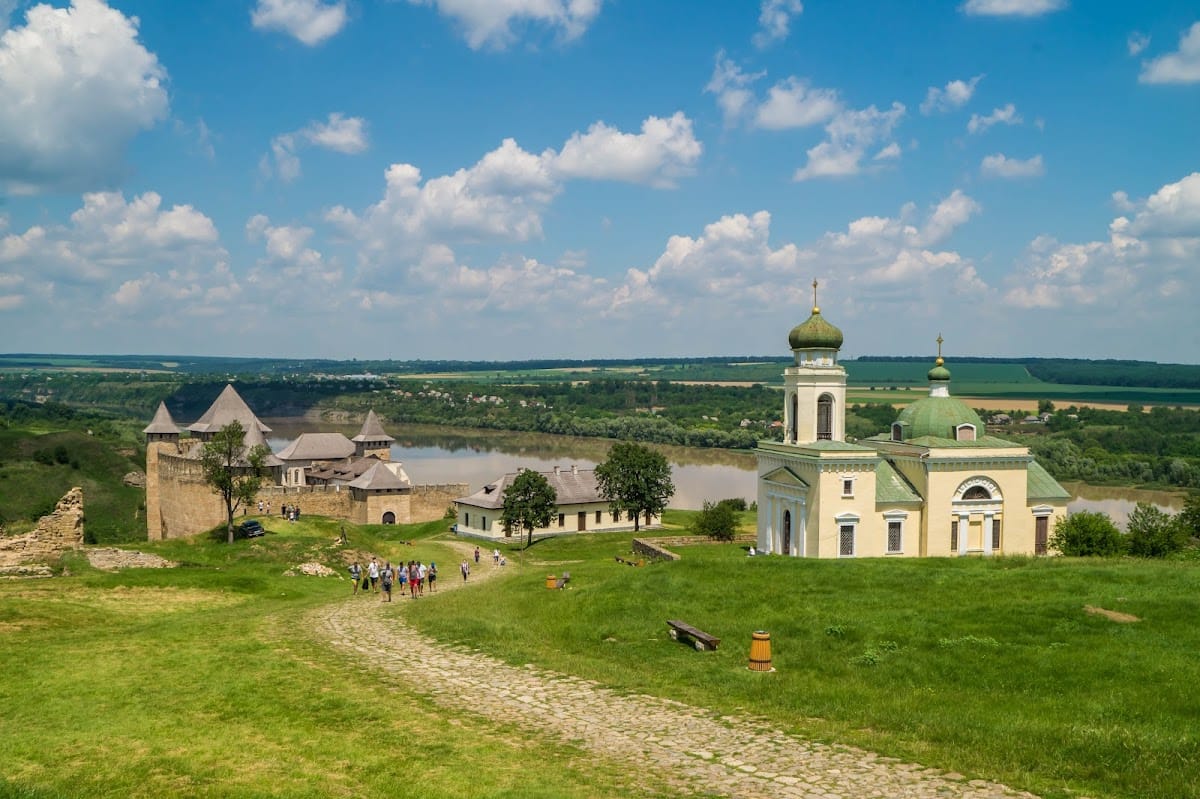
Under the Treaty of Bucharest in 1812, Khotyn and the territory between the Dniester and Prut became part of the Russian Empire. Military authorities repaired and altered the fortress during the first half of the nineteenth century, but its strategic value declined. Its status as a military installation was abolished in 1856. A Church of Saint Alexander Nevsky was built within the outer fortifications in 1832.
During the twentieth century, the region passed through Romanian, Soviet, and Ukrainian administration amid the upheavals of the First World War, the Russian Civil War, the 1919 Khotyn uprising, the Second World War, and the Soviet reoccupation of 1944. Soviet authorities restored the fortress between 1975 and 1980. The complex, dating from the thirteenth to eighteenth centuries, was placed under architectural protection on 24 August 1963 for scientific and museum-display use. A State Historical and Architectural Reserve was established on 12 October 2000 and transferred to Ukraine’s Ministry of Culture in 2011.
Khotyn Fortress was included among the “Seven Wonders of Ukraine” through a nationwide Ukrainian campaign. On 17 April 2026, part of the outer masonry layer of a large defensive wall collapsed. Severe winter frost and prolonged spring rain were identified as probable causes. The damaged area was fenced off, access was restricted, and documentation and restoration preparations began. No injuries were reported.
Remains
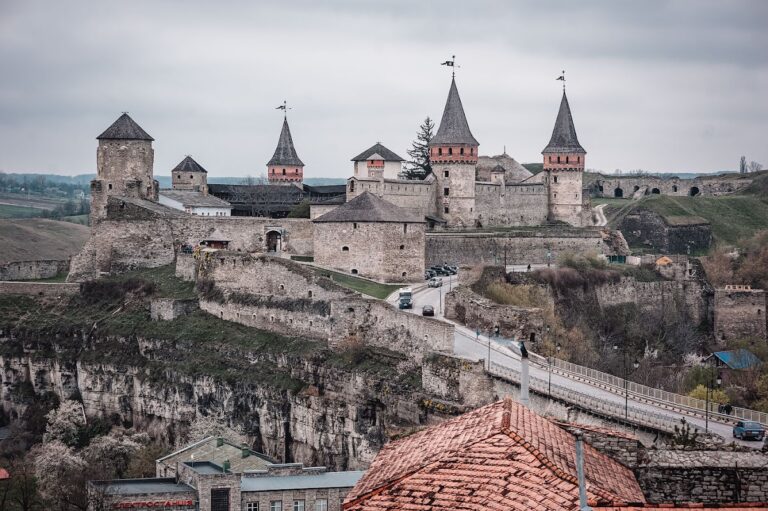
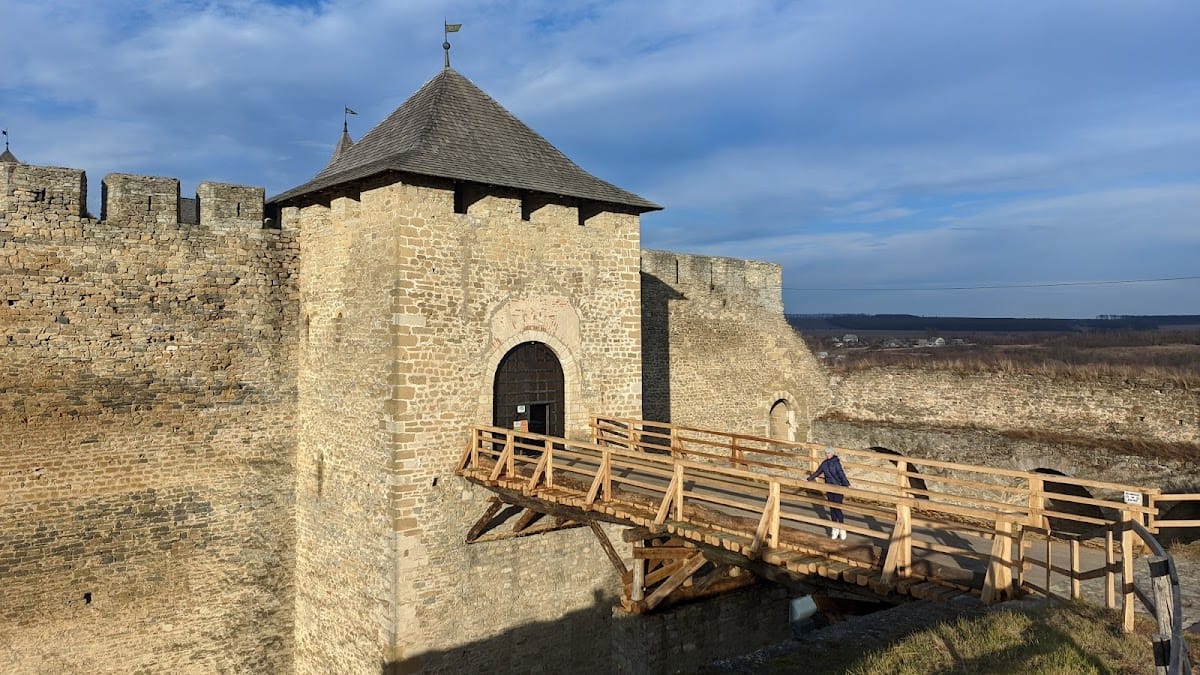
The principal fortress occupies a steep rocky elevation beside the Dniester, on a natural hill set within a small depression surrounded by a ridge of hills. Its irregular plan is approximately trapezoidal, with a curved western side, and measures about 145 by 60 metres. A defensive ditch encircles the complex and is crossed by a bridge. The inner fortress is built mainly from rough quarry stones laid in regular courses, with red bricks forming ornamental bands and geometric motifs in the walls and interior buildings.
Early citadel and Moldavian fortress
Early stone citadel
The first stone citadel occupied the northern part of the present courtyard, roughly between the North Tower and the Commandant’s Palace, and covered no more than about two hectares. A wall enclosed it, while a roughly triangular ditch, about six metres wide, strengthened its defenses. Fragments of this early wall survive within the eastern curtain wall. The main early defensive structure may have been a tower on the site of the present square North Tower, either incorporated into the first circuit or originally standing as a separate keep to which walls were later attached.
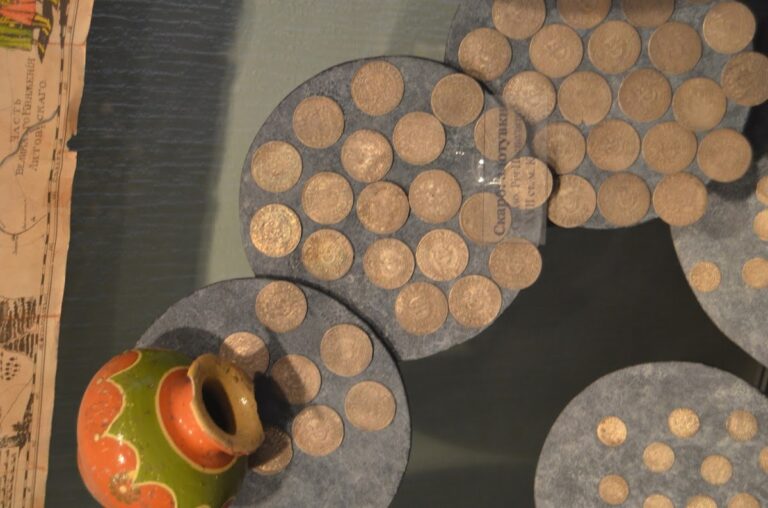
Archaeological investigations have revealed a thirteenth-century stone wall and a large hoard of coins dating from the first half of that century. Excavations also uncovered barracks associated with the later Moldavian fortress, adding evidence for the changing organization of the garrison.
Stephen the Great’s reconstruction
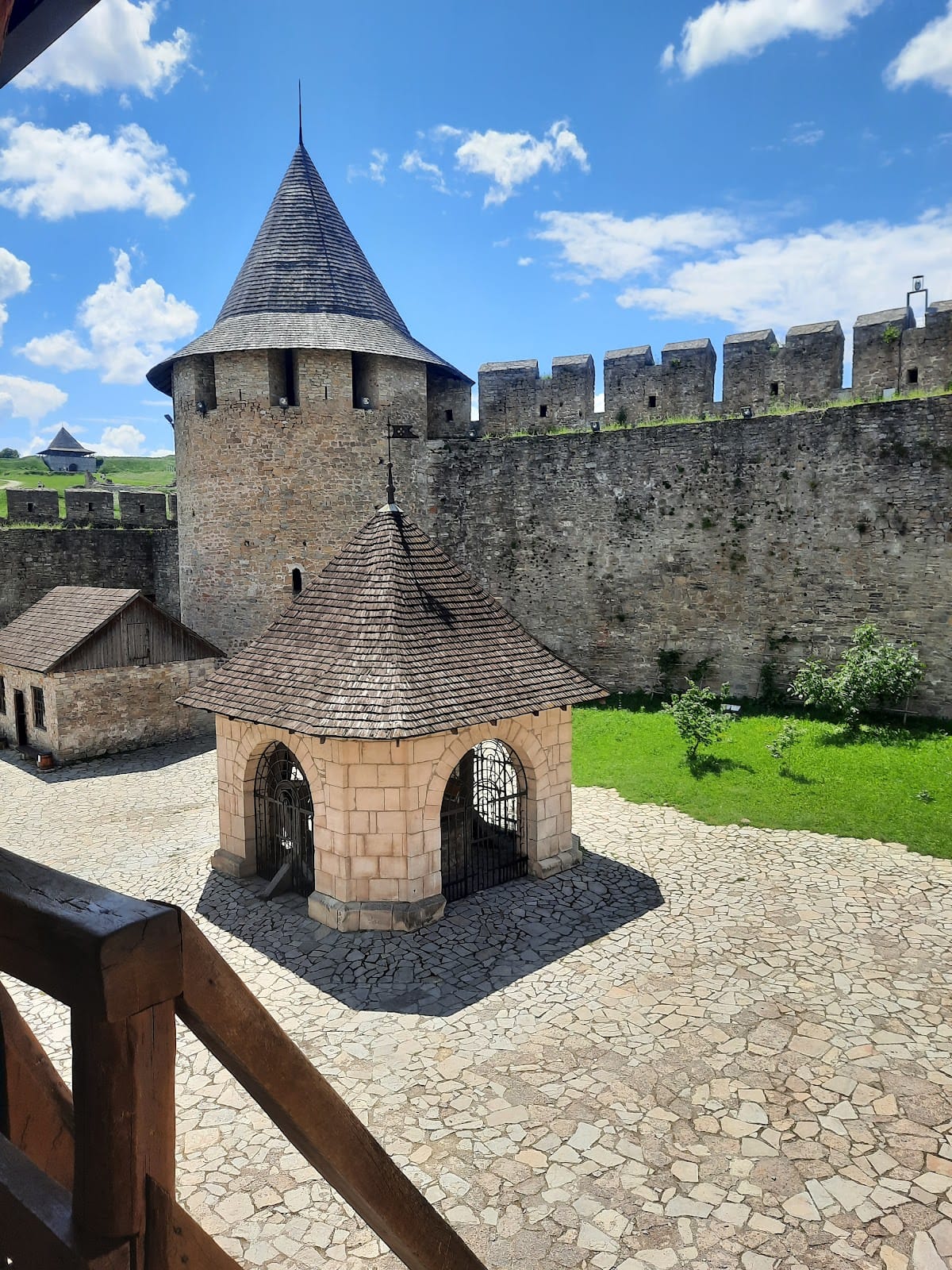
Stephen the Great’s reconstruction raised the courtyard by about 10 metres and divided it into a princely court and a soldiers’ court. The complex included deep cellars for provisions, a two-storey princely residence with deep basements, barracks, and a well. Five towers with shingle roofs define the main fortress. The southern gate tower and two cylindrical towers are associated with the fifteenth-century reconstruction, while the rectangular North Tower and eastern tower are earlier structures reused within the later circuit.
The western walls are the thickest, while those facing the Dniester are thinner. Firing openings pierce parts of the defenses and are less common on the river-facing side. The major Moldavian walls are approximately 5 to 6 metres thick and reach up to 40 metres in height. The highest towers rise about 25 metres.
Church of the Dormition
On the eastern side stands a chapel dedicated to the Dormition of the Mother of God. Its nave has a semicylindrical vault, an open porch, Gothic window and door surrounds with rosettes, Gothic windows, buttresses, and a massive wooden door set in a Gothic portal. Paintings were added during the period of Petru Rareș. In 1493, Stephen the Great donated a Gospel book made by the deacon Teodor Marișescul. The manuscript had silver fittings, hand-executed miniatures, and calligraphy.
Ottoman outer defenses
Bastioned enclosure
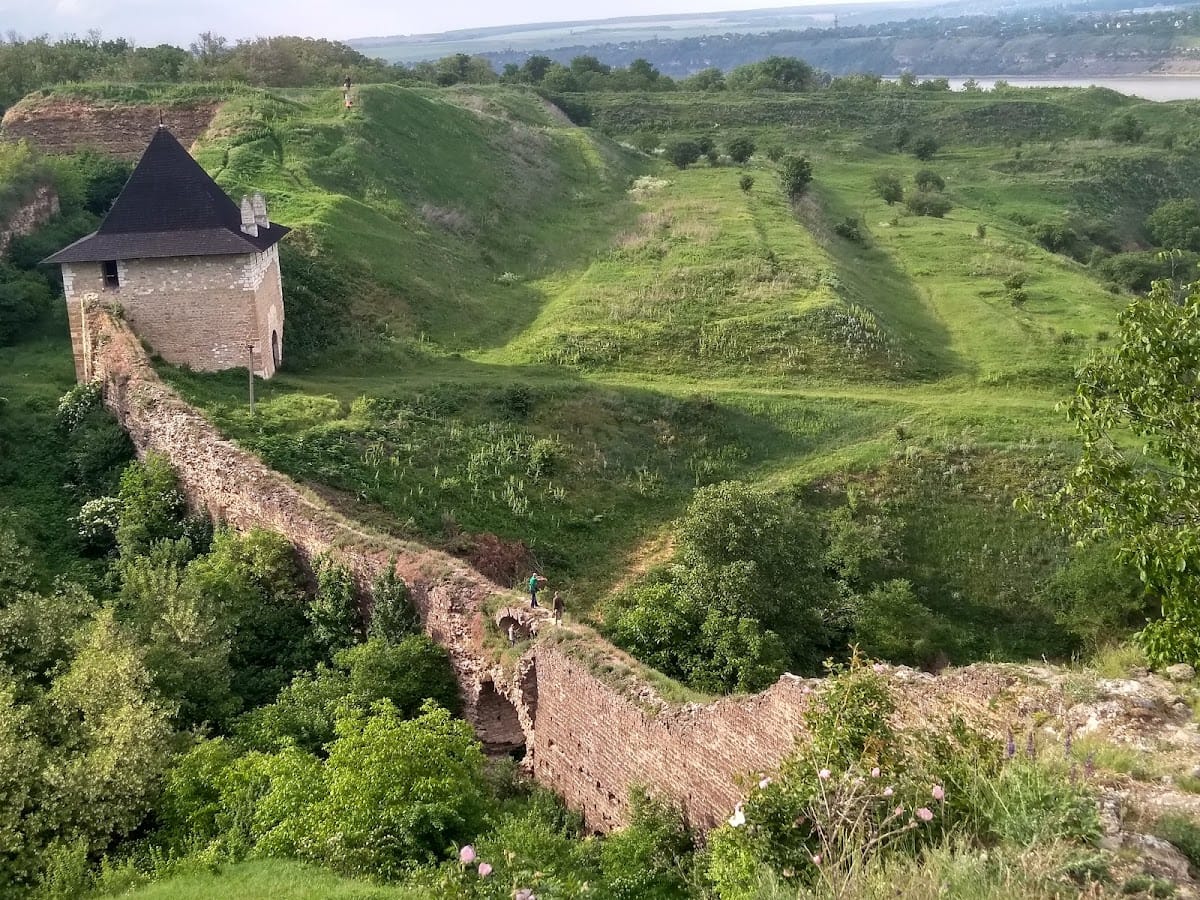
An eighteenth-century Ottoman fortification surrounds the Moldavian fortress on every side. It consists of powerful earth ramparts, broad ditches lined with stone, three towers, and six artillery bastions. A bastion is a projecting section of a rampart designed to allow flanking fire along the walls. Two of the towers serve as gates on the southern and western sides. A third stands near the northwestern tower of the inner fortress beside the Dniester.
Religious buildings
The outer Ottoman enclosure contains the Church of Saint Alexander Nevsky, built in 1832, and the ruins of a Turkish mosque on its southern side. Together with the inner chapel and the surviving towers, walls, ditches, and court buildings, these structures reflect the fortress’s successive Moldavian, Ottoman, and Russian phases.