Royal Pantheon: Medieval Burial Place of the Kingdom of León
Site at a Glance
- Popularity
- High
- Country
- Spain
- Primary era
- Medieval
- Eras represented
- Medieval
- Civilizations
- Kingdom of León
- Site type
- Burial
- Remains
- Tomb
On this page8 sections
History
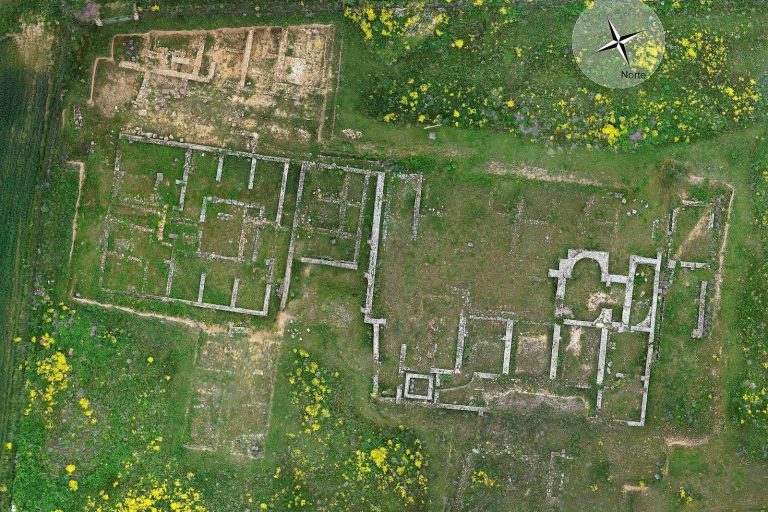
The Royal Pantheon is a medieval royal burial chamber at the foot of the Basilica of San Isidoro de León in Spain. Ferdinand I of León founded it for the royal family of the Kingdom of León, a medieval Christian kingdom in northwestern Iberia. The pantheon became the burial place of most of the kingdom’s kings and queens.
Origins and royal burials
Ferdinand I and his wife, Queen Sancha of León, chose burial at the monastery then called San Juan Bautista. Their decision followed the wishes of Sancha’s father, King Alfonso V, who had ordered royal remains scattered across León to be gathered at the monastery and buried together. Sancha also held authority inherited from her brother, Bermudo III.
Kings buried in the pantheon included Alfonso IV, Ramiro II, Ordoño III, Ordoño IV, Sancho I, Ramiro III, Bermudo II, Alfonso V, Bermudo III, Ferdinand I, and García of Galicia. Sancho Garcés III, king of Navarre and Ferdinand’s father, is also associated with the burials, although he may instead have been buried at the Monastery of San Salvador de Oña.
The queens included Urraca I of León, daughter and successor of Alfonso VI, and Sancha of León, as well as Onneca Sánchez of Pamplona, Sancha Gómez, Elvira García, Elvira Menéndez, Jimena Sánchez, Zaida, Urraca of Portugal, and Teresa Fernández de Traba. Other royal family members buried there included the princesses Urraca of Zamora and Elvira of Toro, Sancha Raimúndez, Estefanía Alfonso, Fernando of León, García Fernández of León, Leonor of León, and María of Castile.
The monastery of San Isidoro
At Ferdinand’s request, relics of Isidore of Seville were brought to the monastery in 1063, and it took the name San Isidoro. Isidore was a seventh-century archbishop and scholar. Relics are bodily remains or personal objects venerated for their religious association.
Occupation and study of the royal remains
During the Peninsular War, an early nineteenth-century conflict involving France, Spain, and Portugal, with Britain also participating, Napoleonic troops occupied the basilica. They used the temple as a hay barn, removed the royal remains from the stone tombs, and turned the tombs into watering troughs for their horses. The disturbance mixed the remains so thoroughly that individual kings could no longer be distinguished. A study of the royal remains still there followed in 1997.
Remains
The chamber and its decoration
Plan and tombs
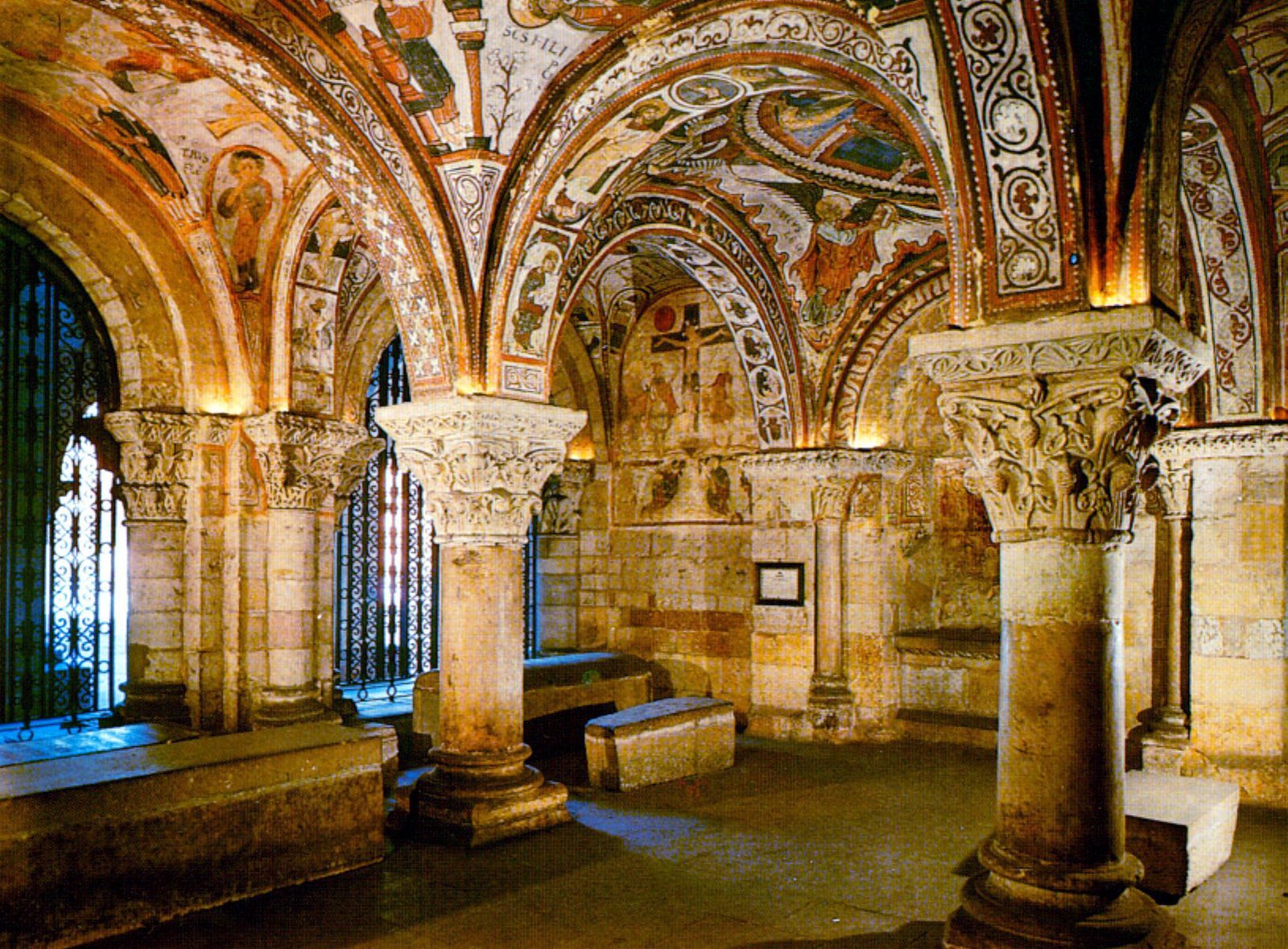
At the foot of the Basilica of San Isidoro de León, the pantheon forms a rectangular chamber with a portico, measuring approximately eight metres on each side. Two sturdy columns support seven arches, which divide the interior into three aisles. Stone tombs hold the remains of kings of León and other members of the royal family.
Painted cycles
The walls and six vaulted ceilings carry a painted program arranged in three cycles of Christian imagery. The sequence begins on the south wall, moves clockwise, and finishes at the doorway into the church. The Christmas cycle depicts the Annunciation, Visitation, Epiphany, Nativity, the announcement to the shepherds, Flight into Egypt, Circumcision, and Massacre of the Innocents.
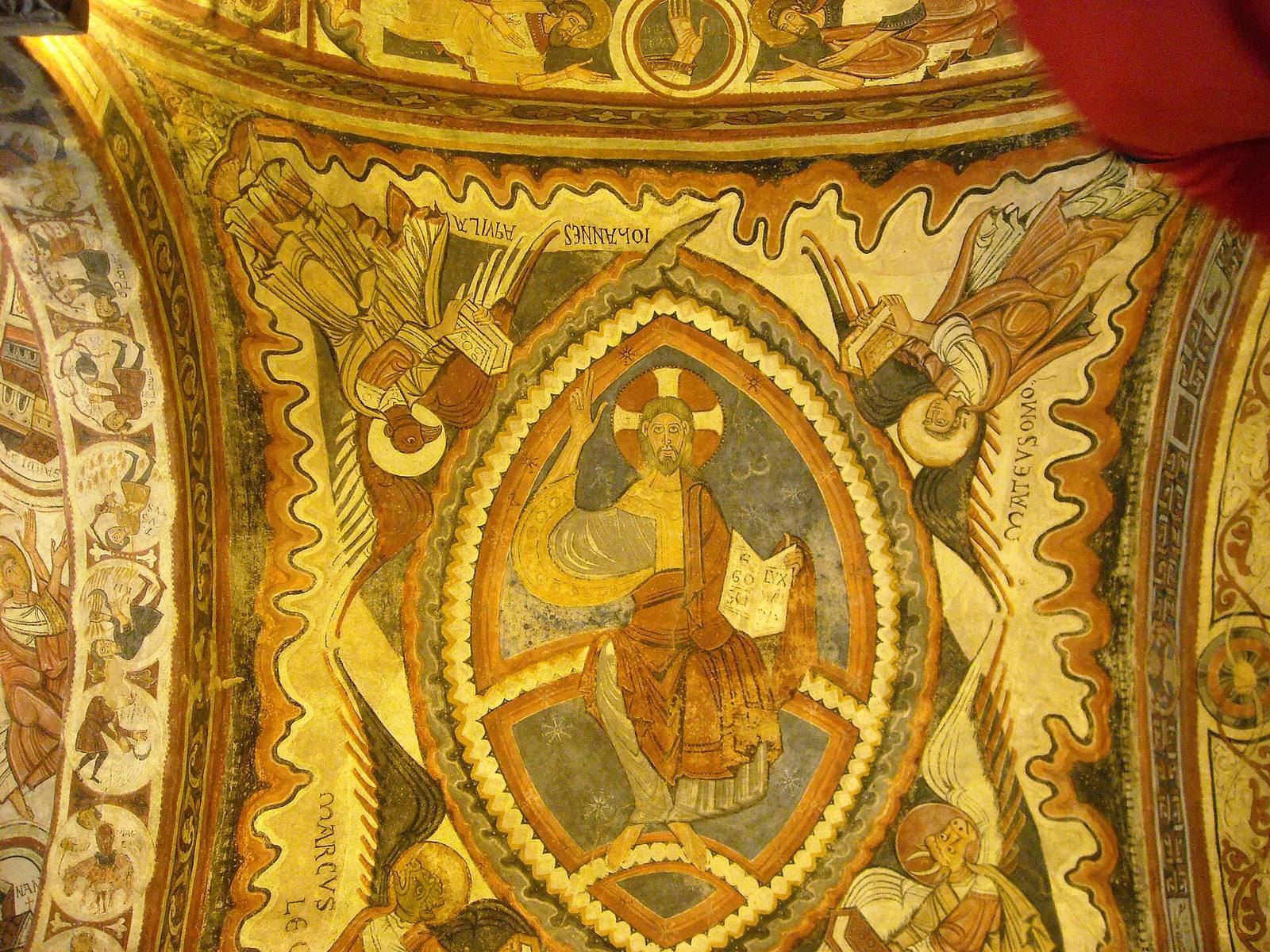
The Passion cycle shows the Last Supper, episodes from the Passion, and the Crucifixion. The Resurrection cycle includes Christ’s glory as described in the Book of Revelation, Christ in Majesty, an image of Christ in glory and authority, and a scene described as the enthronement of the year. Zodiac signs and an agricultural calendar also appear. One interpretation reads this imagery as a metaphor for the passage of time rather than as a practical guide to farming.
The mural cycle is regarded as one of the high points of Spanish Romanesque art, a medieval European artistic and architectural style. The paintings were long classified as Franco-Romanesque, a label for Romanesque art associated with French influence. Some interpretations point to pale backgrounds, a limited range of basic colours on smooth surfaces, and forceful, rough painting as evidence of that influence. The style’s development accompanied the decline of Byzantine elements, elaborate symbolism, and rich costume, alongside the emergence of large-scale narrative cycles in Spain.