St. Nicolai Church in Vejle: The City’s Oldest Church
Site at a Glance
- Rating
- 5
- Popularity
- Very Low
- Country
- Denmark
- Primary era
- Modern
- External website
- Open
- Eras represented
- Medieval, Early Modern, Modern
- Civilizations
- Danish
- Site type
- Religious
- Remains
- Church
On this page13 sections
History
St. Nicolai Church in Vejle, Denmark, is the city’s oldest church. Its earliest predecessor is generally dated to the first half of the 13th century and was built in the late Romanesque style. The church remained Vejle’s only parish church until 1907 and belongs to the Evangelical Lutheran Church of Denmark.
Medieval origins and expansion
The church first appears in a surviving record of a synod held in Vejle in March 1256, chaired by Jakob Erlandsen, Archbishop of Lund. This document is also the earliest surviving written reference to Vejle. The medieval church had two lengthwise aisles and a small tower.
In 1491 the church took the name it bears today. This followed a practice in port towns of dedicating churches to Saint Nicholas of Myra, an early Christian bishop traditionally regarded as a protector of sailors. Around 1518, by which time the church was Protestant, a crosswise transept was added with chapels dedicated to the Holy Cross and the Trinity.
Damage, burials, and rebuilding
Vejle remained poor until industrialization began in Denmark, and fires, plague, and warfare affected the church, especially during the 16th and 17th centuries. Wallenstein’s troops seriously damaged it during the Thirty Years’ War, the European conflict of 1618 to 1648. A major restoration followed in 1744. The church’s relatively modest furnishings reflect these difficult circumstances; most surviving pieces date from the first half of the 19th century and were donated by wealthier local residents.
For centuries, mayors and town elders, along with their wives, were buried inside the church. In 1839, street construction required the churchyard graves to be removed and reburied at a new burial ground on Jernbanegade, a few hundred metres away. In 1862, gravestones inside the church were taken up from the floor and placed in the apse wall. The family tomb of Kai de la Mare, who died in 1703, remained intact.
Nineteenth- and twentieth-century changes
In 1835, human remains now known as the Haraldskær Woman were found. They were first identified as either Sigrid, a semi-legendary Viking princess, or Gunnhild, a legendary Norwegian queen. The remains are a bog body, naturally preserved in peat. These early identifications were not secure.
The church was rebuilt in 1855–56, and its brick bell tower was erected in 1887–88. The church underwent a complete renovation in 1965–66. Its organ was also repeatedly altered and eventually replaced, while the church’s association with seafaring continued in the form of a model sailing ship donated in 1938.
Remains
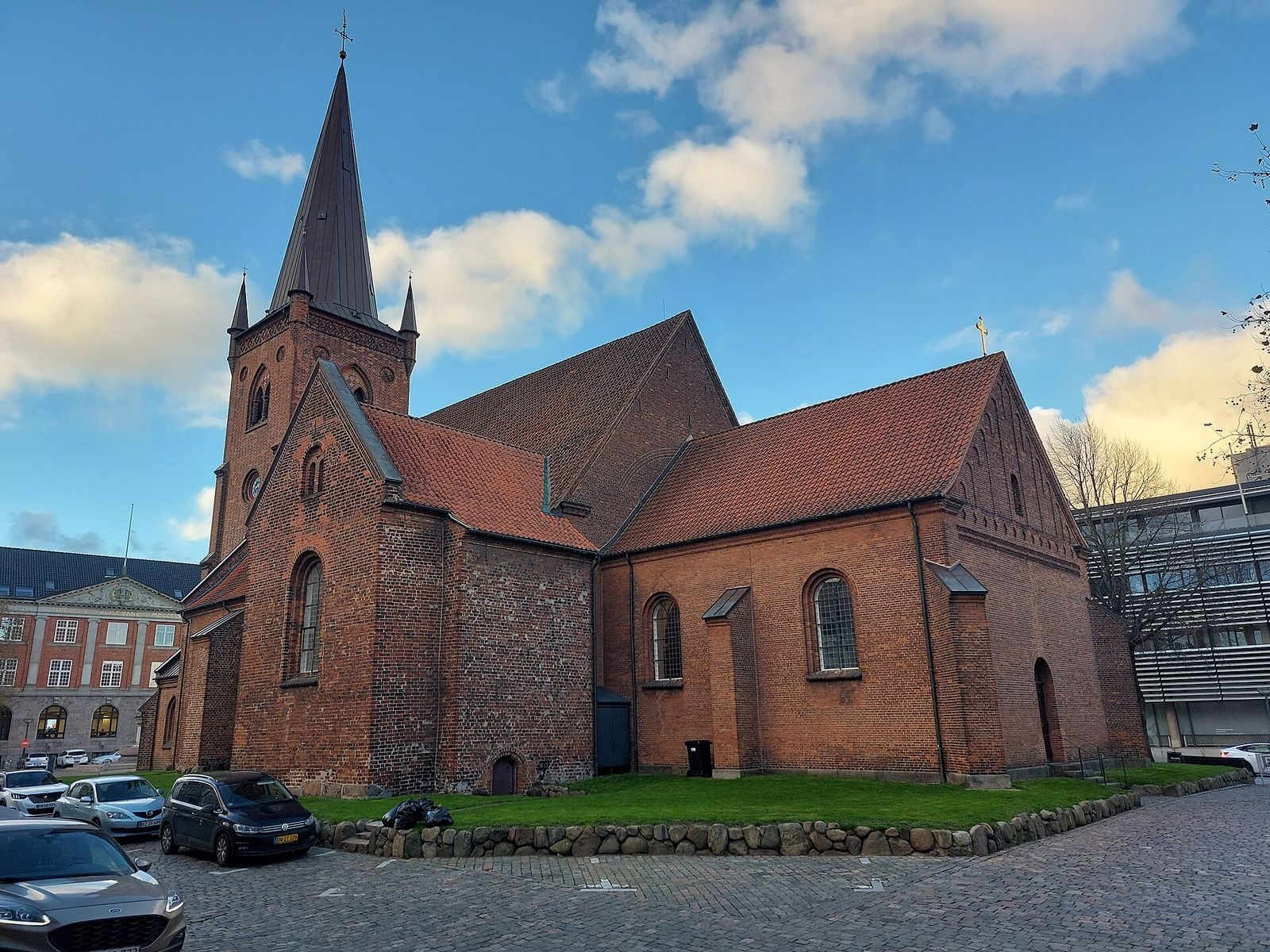
The present church is a red-brick, three-aisled hall church, meaning its aisles are of similar height. It is aligned approximately east to west and has a transept, the crosswise section intersecting the main body. The building is largely a 19th-century example of historicist architecture, which draws on earlier styles.
Exterior and structure
Tower and bells
The brick tower rises above the main entrance at the west end and stands 27.3 metres high. A weathercock measuring 1.3 metres in length crowns it. The tower contains a clock dating to 1889 and bells, as well as a carillon of 48 tuned bells added in the second half of the 1970s.
Medieval masonry and north wall
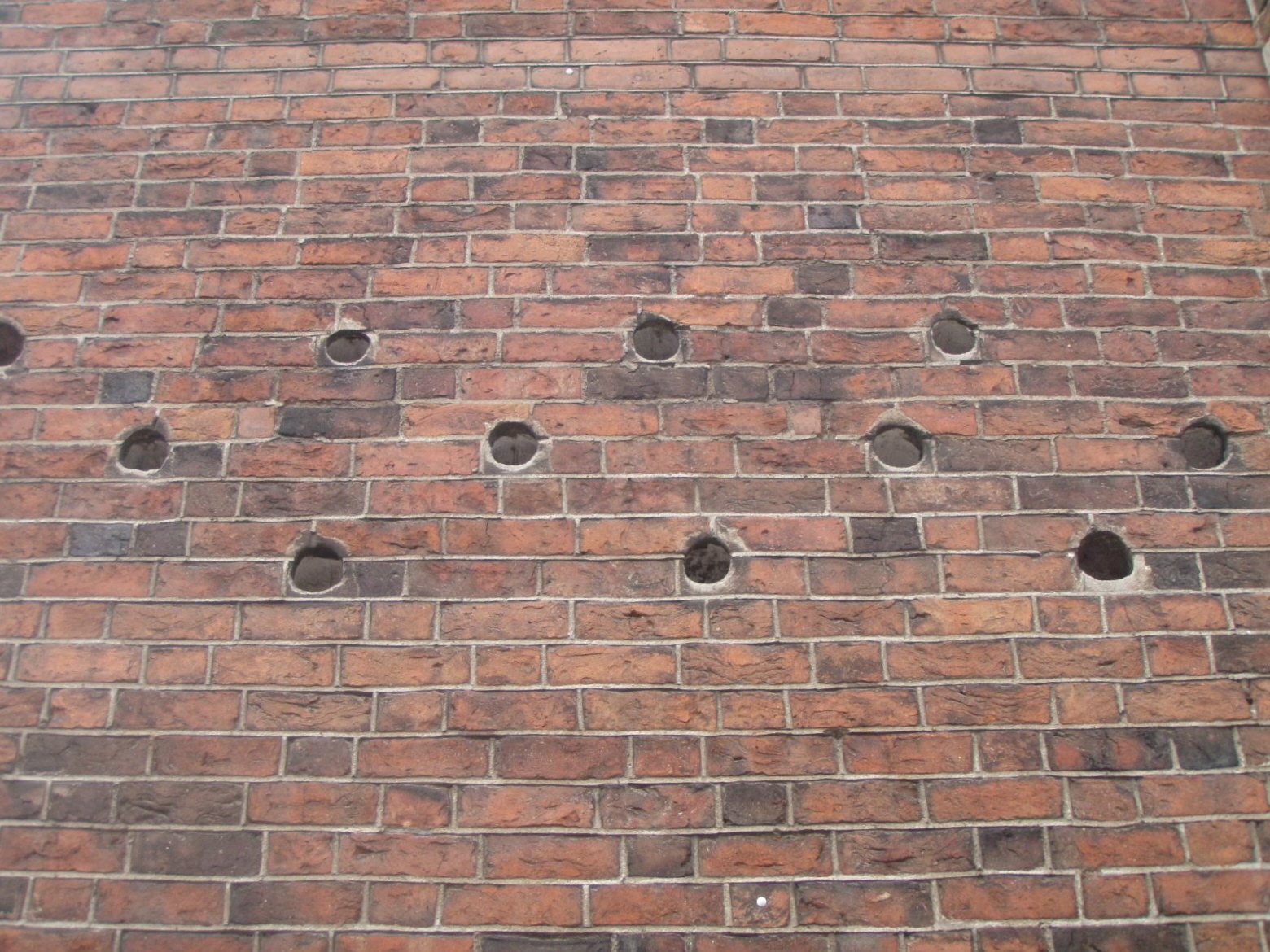
The oldest surviving building fabric is at the nave’s northwest end. On the unplastered north exterior, the brickwork preserves outlines of Gothic windows that were later blocked up, along with the former entrance used by women. Changes in the masonry across the building reveal successive alterations. Twenty-three round cavities, each about 15 centimetres across, form a diamond pattern in the northern brick wall. They contain skulls of uncertain origin, dated to around 1630. Local tradition identifies them as the remains of robbers beheaded in nearby Nørreskov forest.
Statue outside the church
A statue of Anders Sørensen Vedel stands in front of the church. Vedel was a Danish clergyman and historian.
Interior memorials and furnishings
Kai de la Mare’s tomb and the Haraldskær Woman
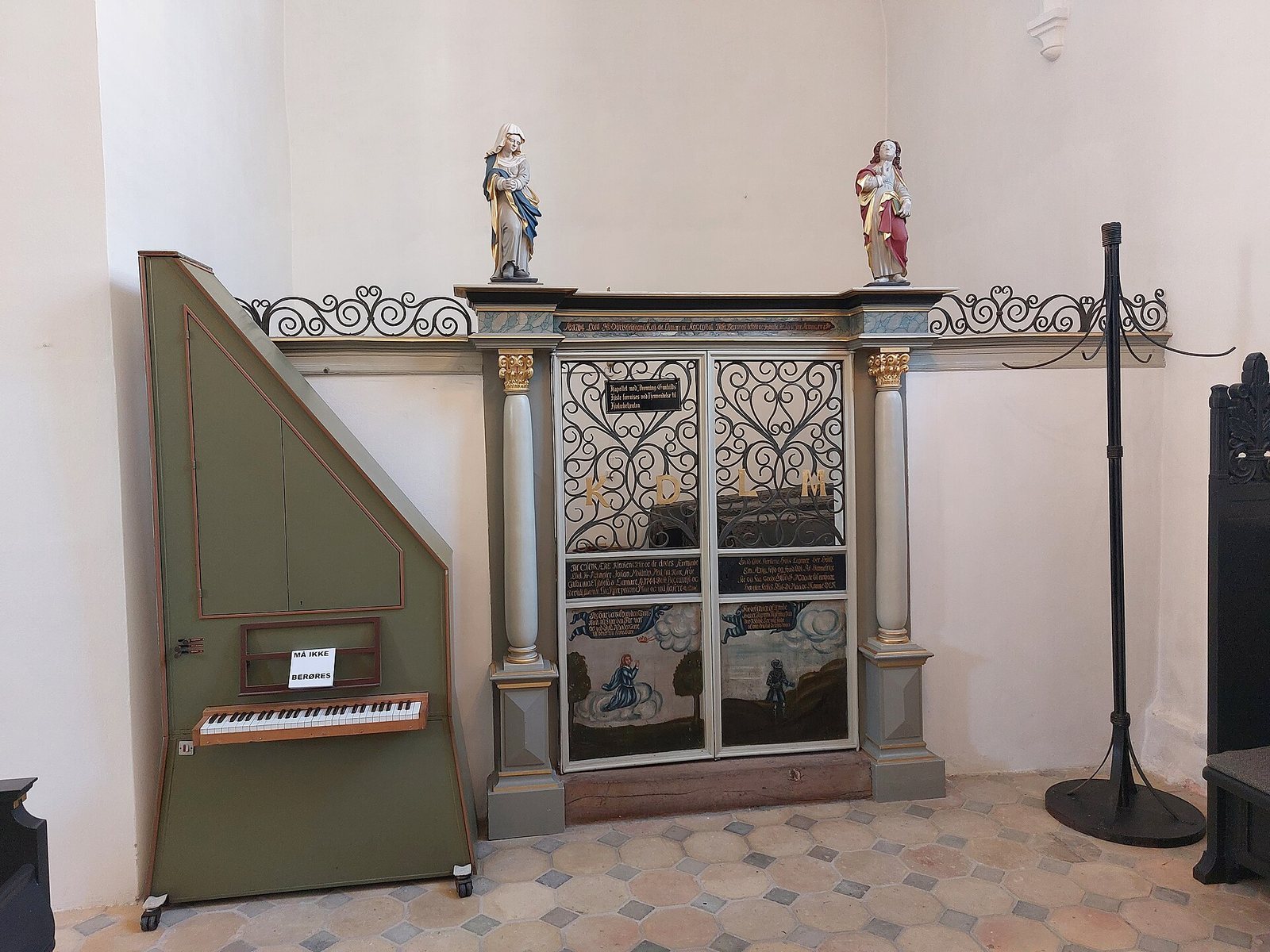
The intact family tomb of Kai de la Mare lies in the Holy Cross choir in the north transept. It contains three coffins associated with de la Mare and his wives, as well as coffins holding an unidentified person from the 17th century and the Haraldskær Woman. Her remains are displayed in the north transept in an oak coffin beneath glass.
Altar, pulpit, and baptismal font
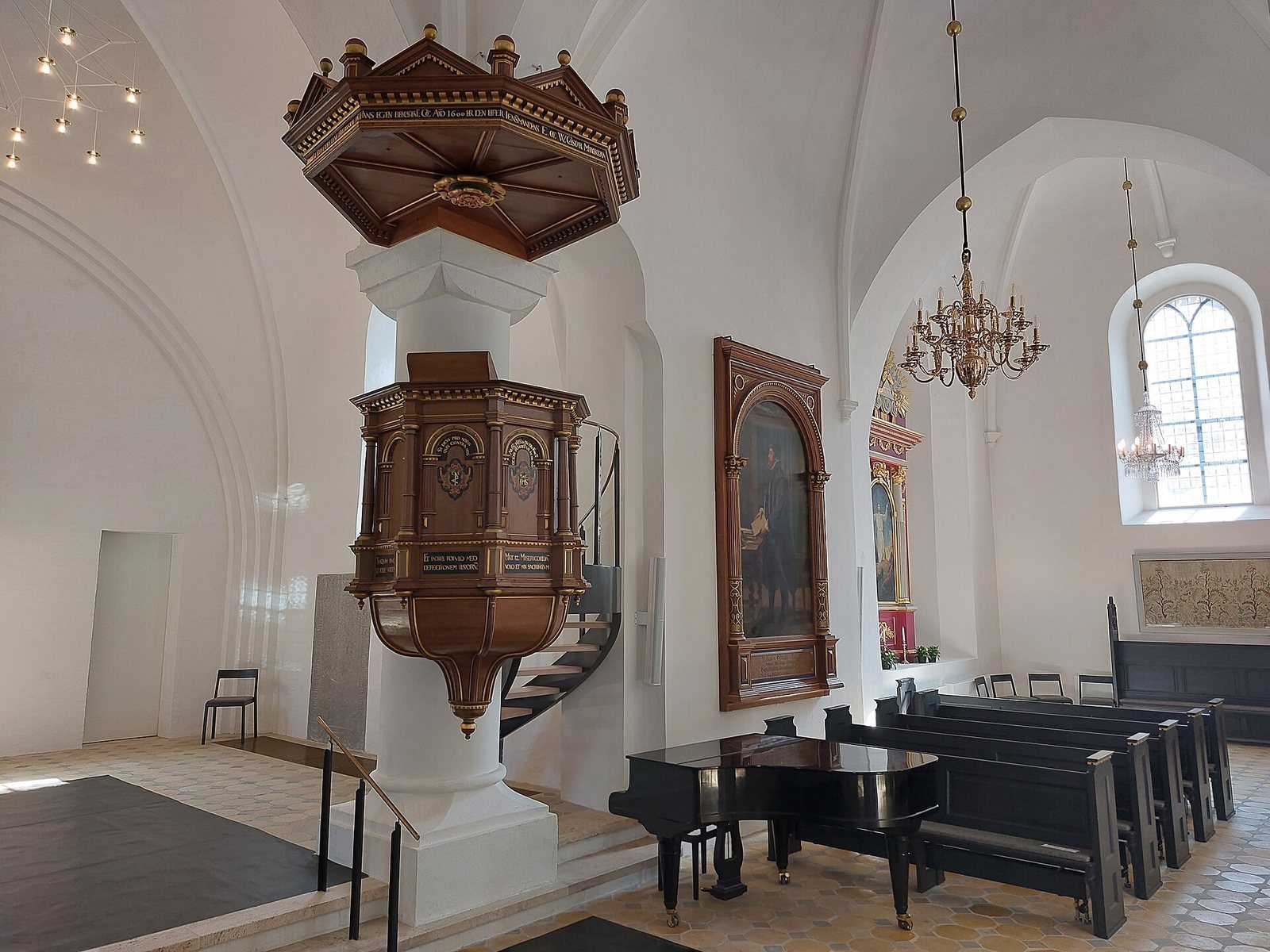
The altar, completed in 1791 by woodcarver Jens Hjernøes, is a three-panel artwork known as a triptych. Its central panel copies a Resurrection scene at Bayeux Cathedral in Normandy. The Renaissance pulpit dates to 1576 and has been restored to its original condition. The stone baptismal font was made in the Netherlands around 1625, while its pedestal dates to the 12th century.
Organ and ship model
A Marcussen & Søn organ with 16 stops, two keyboards, and a pedalboard was installed in 1862. A. C. Zachariasen & Søn enlarged it to 24 stops in 1910. Frobenius Orgelbyggeri restored and expanded the instrument in 1925 and 1942; the latter work brought it to 40 stops and added a section positioned behind the player. In 1969 Frobenius removed the old organ works and installed a new 30-stop instrument, Opus 605, in adapted older cases. The current organ has mechanical controls and sliding wind boards. A model of the sailing ship Dorthea Marie was given anonymously in 1938 as an act of religious devotion.