Pierre aux Fées, Saint-Micaud: A Carved Prehistoric Menhir in France
Site at a Glance
- Popularity
- Very Low
- Country
- France
- Primary era
- Stone Age
- Eras represented
- Stone Age
- Civilizations
- Unclassified
- Site type
- Civic
- Remains
- Megalithic Monument
On this page8 sections
History
Pierre aux Fées, also known as the Menhir of Saint-Micaud, is a menhir, a large upright stone erected as a prehistoric monument, in Saint-Micaud, France. Its history includes the loss of a neighboring standing stone, the burial and recovery of this one, and later interpretations of its carvings.
Two stones and their fate
An eighteenth-century map of France produced under the direction of the Cassini family shows two standing stones in Saint-Micaud, around five metres apart on a roughly north–south line. One was toppled in the early nineteenth century, deliberately broken, and reused in pieces in a building then being constructed.
The other stone fell during the night of 24–25 January 1871, after a thaw. Its landowner buried it in a trench three years later. In 1911, Victor Berthier began excavating and raising the stone. Local tradition held that it bore carvings; after uncovering several engravings, Berthier alerted the archaeologist Joseph Déchelette. On 28 February 1911, the menhir was moved and set upright again, with technical assistance from the industrialist Eugène Schneider.
Interpretations and traditions
Déchelette visited on 16 February 1911. He recognized a horned serpent and a thunderbolt associated with Jupiter, the principal Roman god linked with the sky and thunder. He interpreted the carvings as evidence of a Gallo-Roman cult, meaning a religious practice in Roman-period Gaul, dedicated to Magna Mater, the Roman name for the Great Mother goddess identified with Cybele. The menhir received French historic-monument classification during the 1920s.
Local stories offer different explanations for the two stones. One says they were a farmer and his wife turned to stone as punishment for failing to honor a solemn procession. Another links them to a Gallic leader’s victory at a nearby place later called Les Combats. The place-name is instead explained as a reshaping of combes, meaning a depression; the hamlet was called Les Combains until the eighteenth century.
Remains
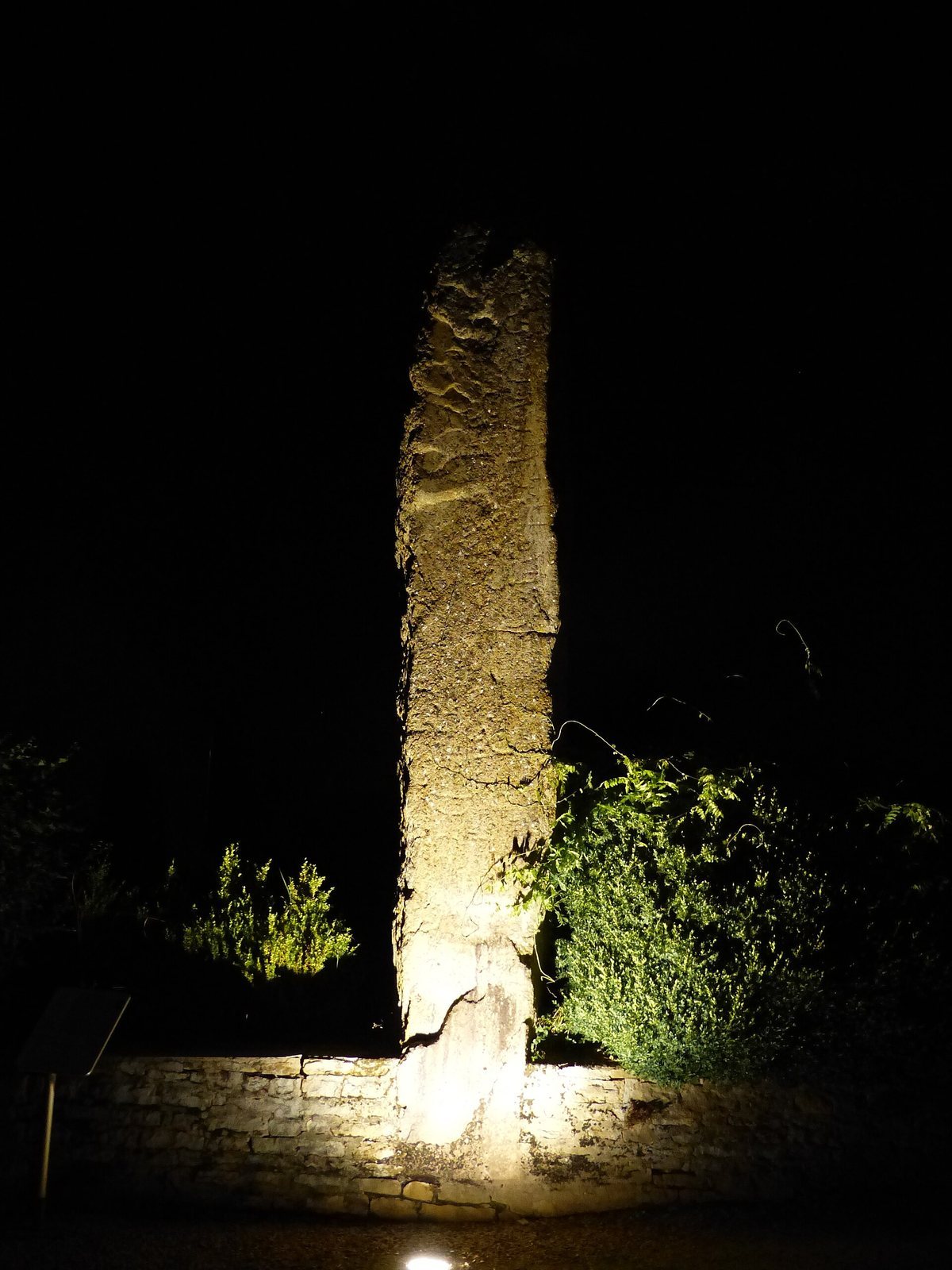
The menhir now stands beside a road, 37 metres west of its original position. It is about 6.35 metres high and weighs approximately 15 tonnes. It is described as the tallest standing menhir in Saône-et-Loire. The block is silicified arkose, a feldspar-rich sandstone hardened by silica, and probably projected naturally above ground before it was extracted. Three faces are eroded; the fourth was made more even by pecking, the shaping of stone through repeated blows, except at the top.
Carved signs
Serpentine design
A winding engraving, about 4.20 metres long, forms eight curves that become increasingly geometric and finish in a trident. A circle with appendages appears partway along it. Below are a crook-like mark, a U-shaped design, and several worn signs that can be seen in angled light. Shield-like and cross-shaped forms are also among the carvings.
Thunderbolt design
Another engraved design consists of two inverted tridents joined by a vertical line. The line supports a roughly rectangular shape topped with hooks. The complete arrangement has been interpreted as a highly stylized human figure.
Motifs and their dates
The carvings were made by pecking, a technique that predates the use of metal tools. Serpent-like, U-shaped, and crook motifs occur in Atlantic megalithic art, the prehistoric monument-building traditions of Atlantic Europe. These shared forms are dated to the Early Neolithic, the later part of the Stone Age before metal tools became widespread. The human-like sign is assigned to the Middle Neolithic. The circle with appendages is compared with an “object” motif on statue-menhirs, or carved standing stones, of the Rouergue group in southern France; that motif is dated to the Late Neolithic.