Megalithic Tombs of Pustow: Prehistoric Burial Chambers in Germany
Site at a Glance
- Popularity
- Very Low
- Country
- Germany
- Primary era
- Stone Age
- Eras represented
- Stone Age
- Civilizations
- Unclassified
- Site type
- Burial
- Remains
- Necropolis
On this page8 sections
History
The Megalithic Tombs of Pustow are a group of prehistoric burial chambers in Sassen-Trantow, Germany. The four tombs date to between 3500 and 2800 BC and are associated with the Funnelbeaker culture, a prehistoric group named for characteristic pottery forms. A dolmen is a chamber tomb built from upright stones, often with large stones forming its roof. The group comprises two great dolmens, a larger chamber type, an extended dolmen with a longer chamber, and a primeval dolmen, an early and generally small form.
People of the Globular Amphora culture, another prehistoric group named for its characteristic pottery, later reused the extended dolmen. Archaeologist Ewald Schuldt excavated the tombs in 1968. Three are identified by catalogue numbers 534, 537, and 538; the primeval dolmen has no such number. Other dolmens in the surrounding area remain unexcavated.
Remains
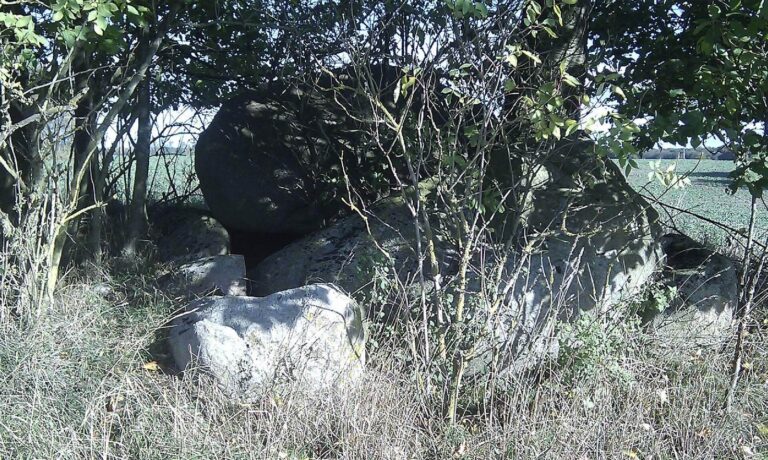
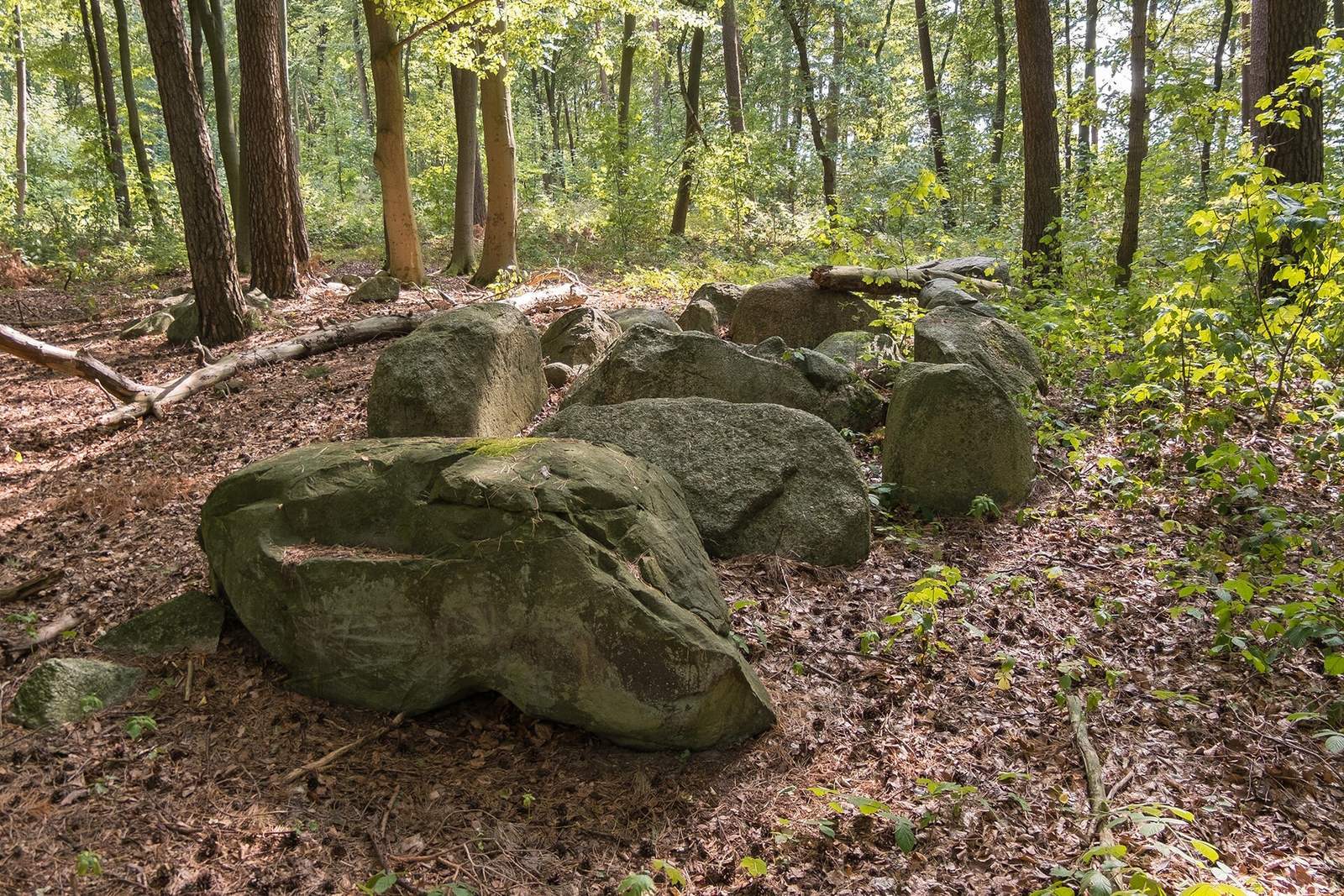
The chambers lie west and east of Pustow, with all four aligned roughly northwest–southeast. The western pair are in woodland or beside its edge; the eastern pair occupy field settings, one amid bushes and the other among trees. Upright stones form the chambers, while surviving roof stones preserve parts of their construction.
Great dolmens
Great dolmen 534
This partly preserved chamber stands in woodland west of Pustow. It is trapezoidal, 1.4 metres high and 5.8 metres long, narrowing in width from 2.3 to 1.7 metres. Ten side stones and the northern end stone survive, along with one of the four roof stones. Four internal compartments divide the chamber. Its smoothed clay floor is reddened by fire.
Great dolmen 537
East of Pustow, this partly preserved chamber stands in a field among bushes. It measures 1.4 metres high and 5.6 metres long, and narrows from 2 metres to 1.5 metres in width. Four side stones and the northern end stone remain. Its floor combines red-sandstone slabs and smoothed clay, with evidence of reddening by fire.
Excavated objects included 32 pottery fragments, eight amber beads, two shaped like double axes, and four arrowheads with crosswise blades. The finds also comprised four pots with defined shoulders, a hollow chisel, a stone hammer, a blade scraper, a barrel-shaped pot, a vessel shaped like two cones joined at their bases, a tall pot, and a bowl.
Other chamber types
Extended dolmen 538
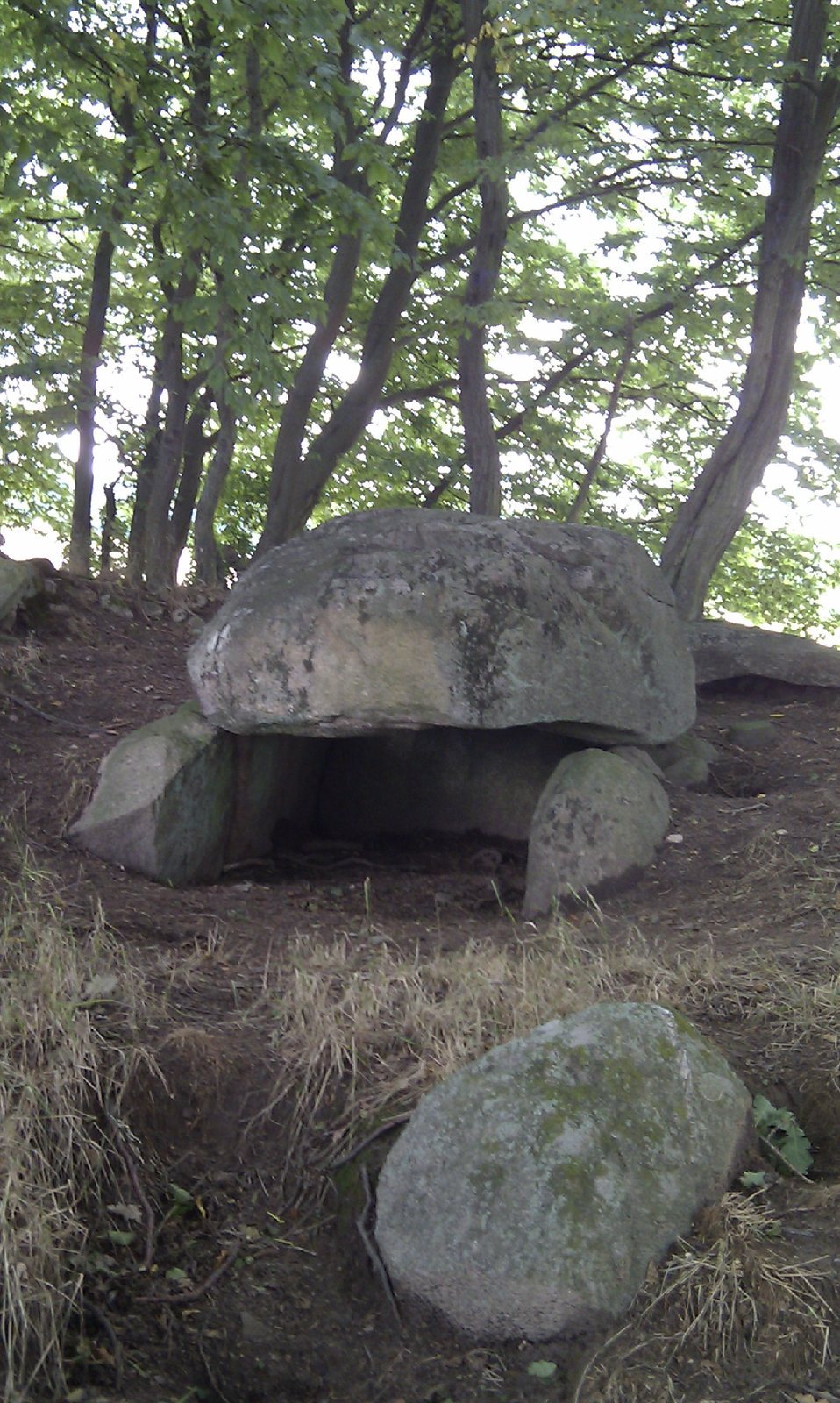
This well-preserved chamber lies east of Pustow among trees in a field, within the remains of an oval mound. It is 1.6 metres high, 2.6 metres long, and 1.4 metres wide. A roof stone measuring about 2.8 by 2.2 metres rests on the chamber. Two side stones line each long side, and an end stone closes the short side; the southern entrance survives in fragments. Finds associated with later reuse included human and animal bones, among them a skull, and two arrowheads with narrow attachment projections.
Primeval dolmen
Near the woodland edge west of Pustow, this chamber lies within the remains of a cobble mound. It measures 1.2 metres high, 2.4 metres long, and 1.2 metres wide. Five supporting stones and a small remnant of the entrance survive. The clay floor is reddened by fire. Its arrangement may represent an early dolmen entered from above. Finds included cremated remains, 21 pottery fragments, and one arrowhead with a crosswise blade.