Drev Old Church: A Medieval Parish Church in Sweden
Site at a Glance
- Popularity
- Low
- Country
- Sweden
- Primary era
- Medieval
- Eras represented
- Medieval, Early Modern, Modern
- Civilizations
- Swedish
- Site type
- Religious
- Remains
- Church
On this page12 sections
History
Medieval foundation and parish use
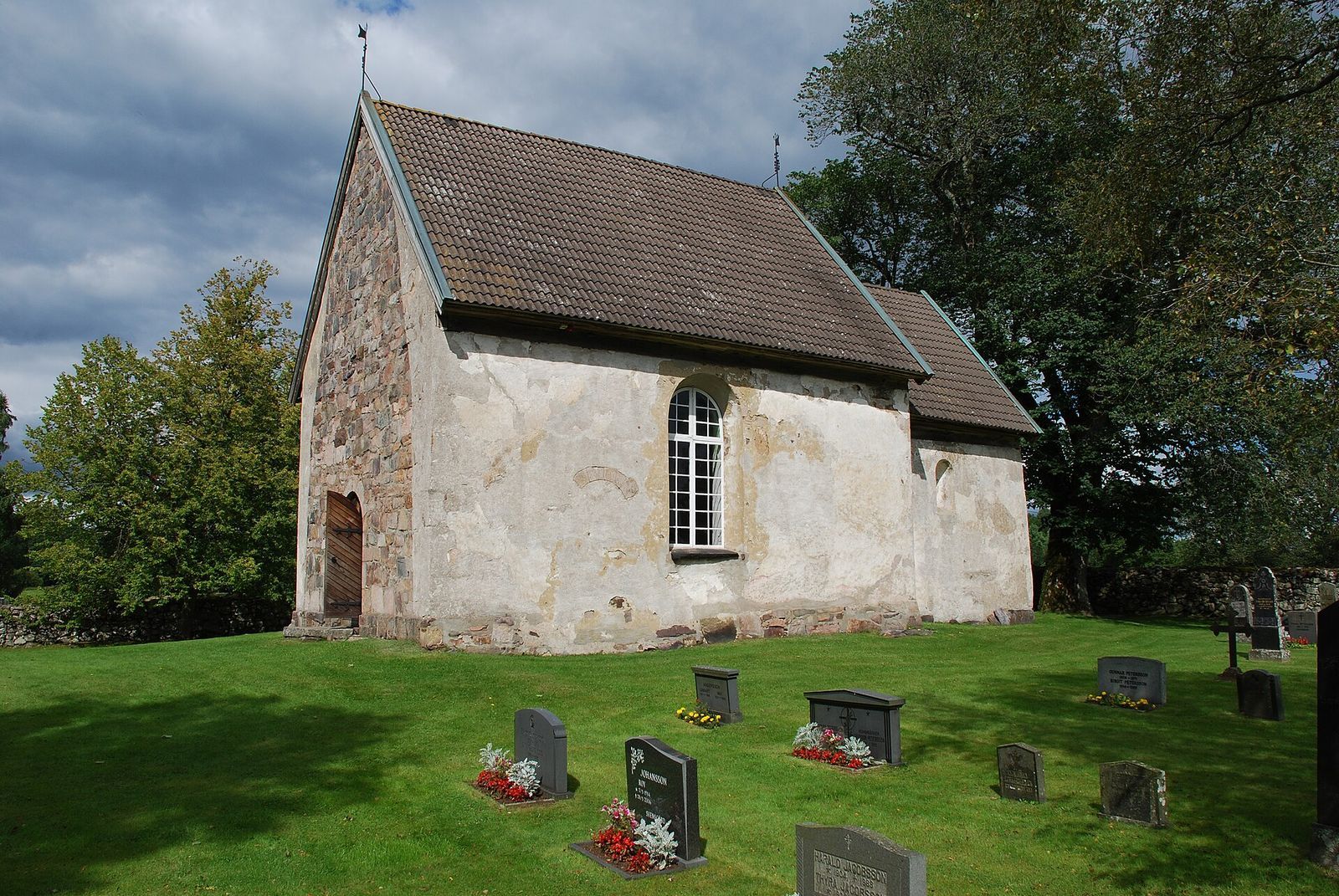
Drev Old Church stands at Gamla Kyrka near Braås in Sweden. Built and consecrated around 1170 in the Romanesque style, it is the oldest surviving church in Kronoberg. The building is made of gray stone. It belongs to Drev parish in Växjö Diocese, a regional church jurisdiction, and serves as a parish church for Sjösås parish in the Lutheran Church of Sweden.
After its consecration, the church served as a parish church until 1868, when a shared church for Drev and Hornaryd was completed.
Abandonment and restoration
During a visitation in 1831, Bishop Esaias Tegnér declared the church unfit for use. It was abandoned and deteriorated for many years. Its sacristy, porch, and wooden bell tower, built in the 18th century, were dismantled and sold. Two bells were saved as the building fell into disuse. They are now in Drev–Hornaryd church, and the smaller bears an inscription in runes, characters used in historical Germanic writing systems.
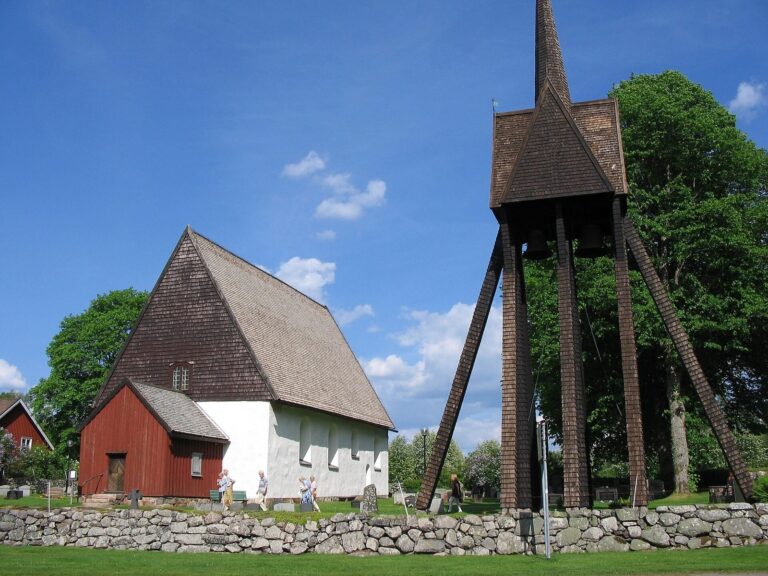
An effort to restore the church began in the early 20th century, with work carried out during the 1940s and 1950s. The restoration preserved an example of Värend’s medieval churches; Värend is a historic region of Småland. After the church returned to use, a separate bell tower was erected in 1958.
Remains
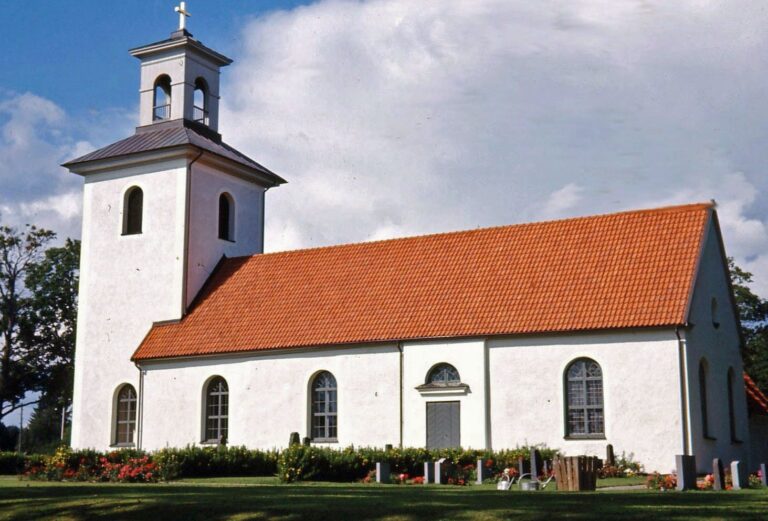
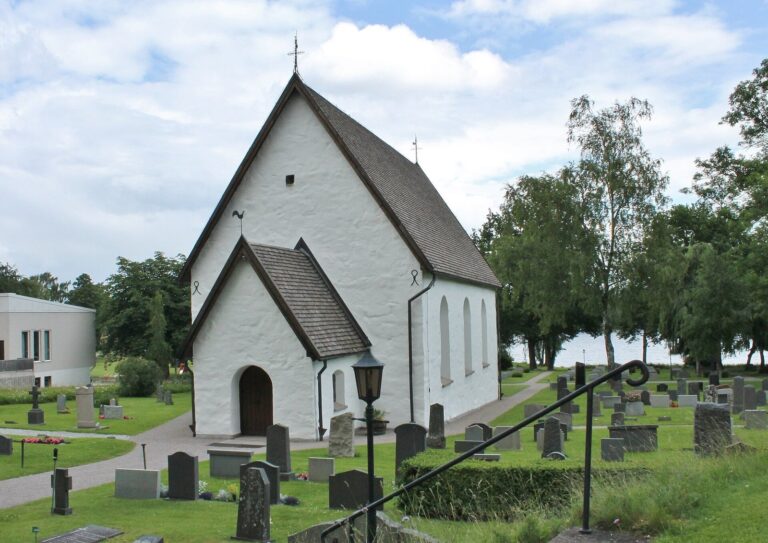
Beside the northeastern shore of Drevsjön, the gray-stone church has a rectangular nave, the main body of the building, ending in a choir, the area around the altar, and an apse, a projecting space at the end. Its Romanesque design is a medieval architectural style.
Churchyard and nearby features
Bell tower
The present bell tower stands north of the churchyard, across the road from the church. It is a freestanding structure erected in 1958, distinct from the wooden tower that once belonged to the church.
Grave monuments
Two grave slabs bearing 18th-century inscriptions stand beside one of the church walls. Older grave monuments are also preserved in the churchyard.
Interior
Wall paintings
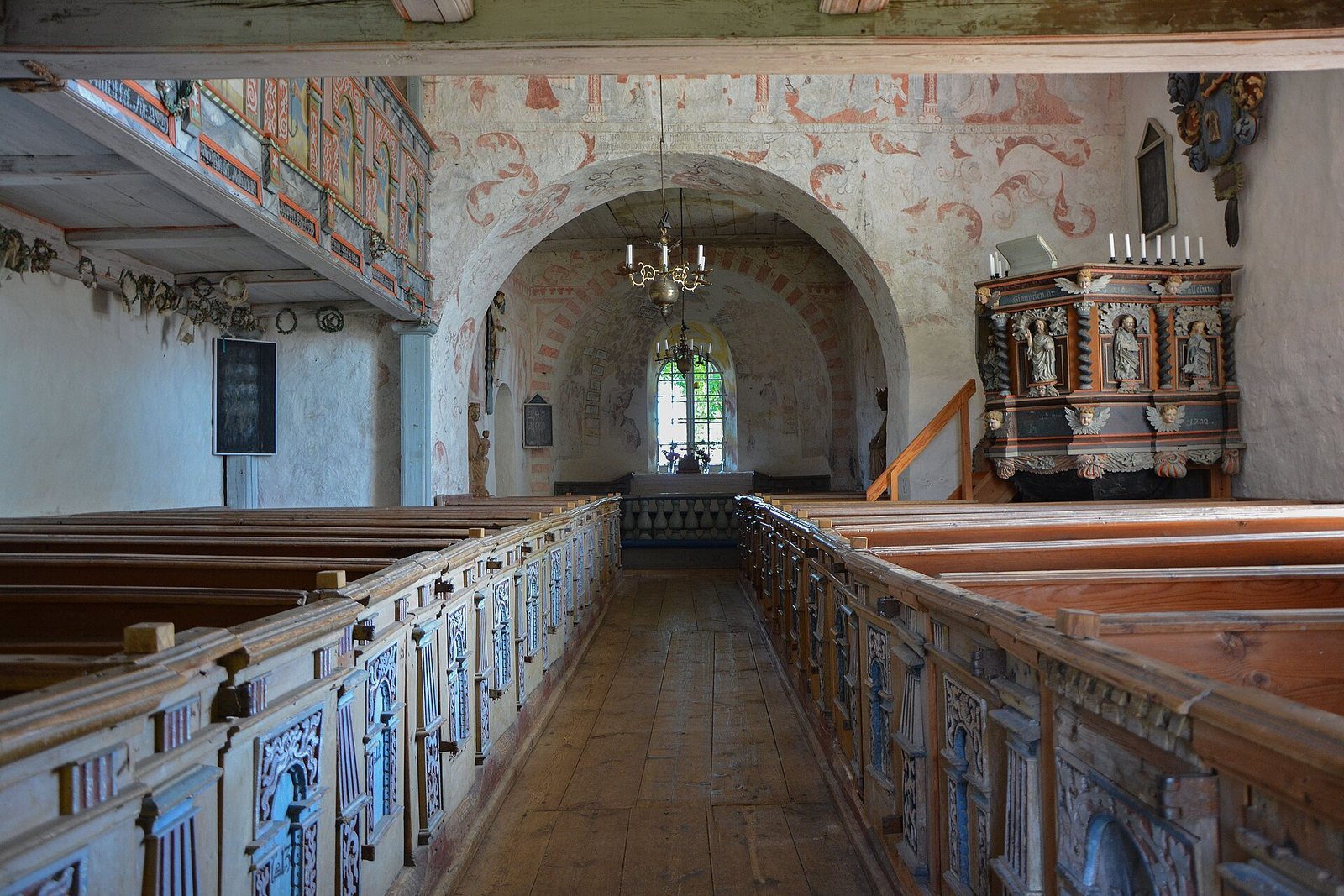
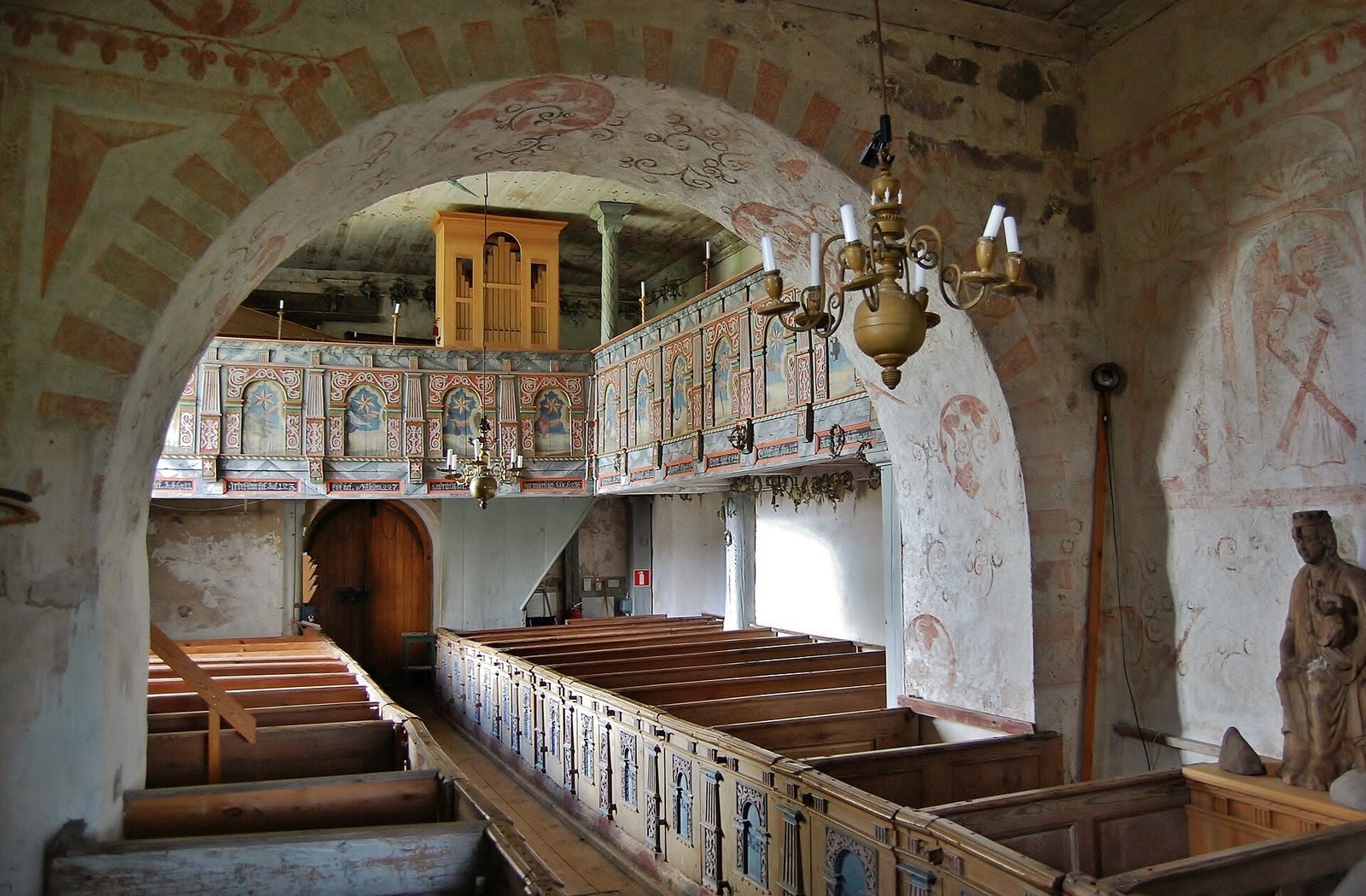
Paintings dating from 1624–26 decorate the wall at the division between the nave and choir. They show five scenes from the Passion, the suffering and death of Jesus, as well as Saint George fighting a dragon. A horizontal band of images of the apostles runs along the choir walls. In the apse, part of an earlier layer of 17th-century paintings is covered by a later decoration created in 1751 by painter Johan Christian Zschotzscher. Its motifs include two trees and lists of rulers and bishops.
Zschotzscher also painted the ceiling and galleries in 1751. Their decoration includes an outstretched hand of God against a landscape, accompanied by a serpent for prudence, an anchor for hope, and a cross for faith.
Altar and seating
The masonry altar contains a compartment for relics, and the altar rail has turned balusters, posts shaped on a lathe. Enclosed pews made in 1652 remain in the church.
Crucifix and medieval images
A crucifix from the first half of the 13th century was renovated in 1665. Other medieval images include a 13th-century figure of Mary and a sculpture of Saint Olaf, the Scandinavian name for Olaf II Haraldsson, a Norwegian king venerated as a saint. An ornament from a medieval altarpiece dedicated to Saint Olaf depicts his burial.
Pulpit, galleries, and furnishings
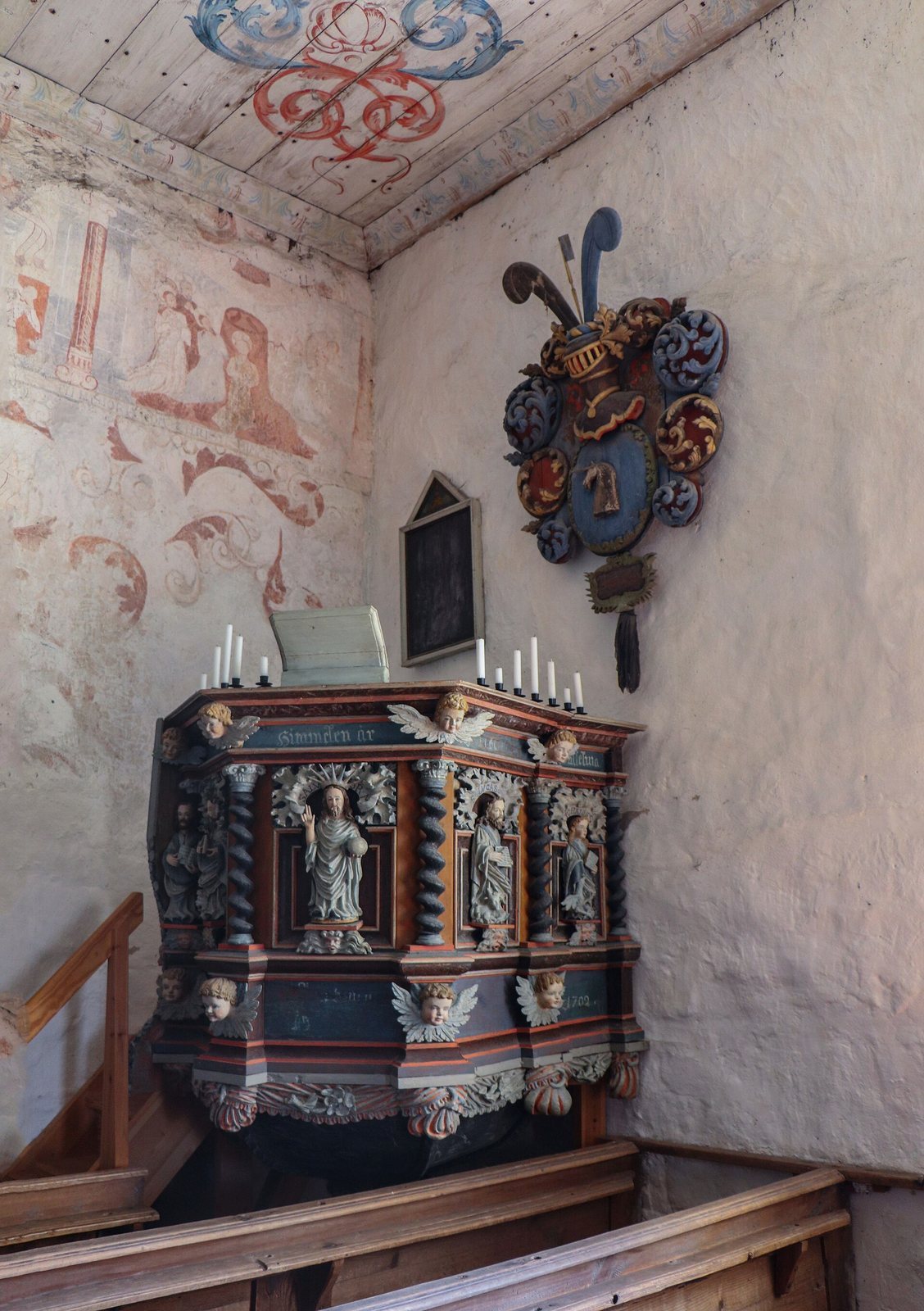
The pulpit dates from 1702. Its panels show Christ holding a globe as the Savior of the World, together with Matthew, Mark, Luke, and John, the traditional authors of the four Gospels. Two galleries were built in 1697, with the northern one intended for women and the western one for men. A brass chandelier was donated in 1758. Beside the pulpit hangs a funeral banner for Johan Enhörning, who died in 1707, and an organ is also among the church’s interior furnishings.