Castello Ursino: A Hohenstaufen Royal Castle in Catania



Site at a Glance
- Rating
- 4.4
- Popularity
- High
- Country
- Italy
- Primary era
- Medieval
- External website
- Open
- Eras represented
- Medieval, Early Modern, Modern
- Civilizations
- Kingdom of Sicily, Kingdom of the Two Sicilies, Spanish
- Site type
- Military
- Remains
- Castle
On this page17 sections
History
Castello Ursino, also known as Castello Svevo di Catania, is a Hohenstaufen royal castle in Catania, Italy, built between 1239 and 1250 for Frederick II of Hohenstaufen. Designed under the direction of the military architect Riccardo da Lentini, it combined a royal residence with a fortified stronghold and formed part of Frederick’s coastal defensive system in eastern Sicily.
Foundation under Frederick II
The castle stands in one of Catania’s oldest inhabited areas, associated with the first phase of the Greek city of Katane. A proposed Norman predecessor called the Tower of Don Lorenzo has no archaeological remains on the site, and the idea that a Norman building stood here is generally considered unsupported. Castello Ursino was therefore a new royal foundation rather than a confirmed Norman reconstruction.
Frederick II conceived the building as both an imperial residence and a military installation. It belonged to a wider chain of coastal fortifications that included the castles of Maniace at Syracuse and Augusta. Its construction also reinforced royal authority after local lords had sought greater independence. In 1220, Frederick had ordered the destruction of castles that were not under royal control, and Castello Ursino was intended to embody the restored power of the crown. In its own period, it was regarded as impregnable.
The name Ursino is traditionally translated from Sicilian as “Bear Castle.” Other explanations derive it from the proposed Latin phrase Castrum Sinus, meaning “castle of the gulf,” or connect it with the Ursino family, which may have occupied the castle during the thirteenth century. The original explanation of the name remains uncertain.
The Sicilian Vespers and the Aragonese court
The castle became a political center during the Sicilian Vespers, the late-thirteenth-century wars and struggles that separated Sicily from the Angevin Kingdom of Naples and brought the island under Aragonese rule. In 1295, the Sicilian Parliament met at Castello Ursino, declared James II of Aragon deposed as king of Sicily, and elected Frederick III under the independent title of King of Trinacria.
French troops commanded by Robert of Anjou captured the castle in 1296, but Aragonese forces recovered it later that year. Frederick III began living there in 1296, turning the castle into the center of the Aragonese court. His successors Peter II, Louis, Frederick IV, and Maria of Sicily also occupied it. In 1337, the Parliament Hall served as the funeral chamber of Frederick III. Eleven years later, John of Aragon and Joanna I of Anjou signed the Peace of Catania in the castle, ending the wars associated with the Sicilian Vespers.
Castello Ursino remained the royal residence of the Aragonese rulers of Sicily until 1415. That year it accommodated Queen Blanche of Evreux, heiress of the Kingdom of Navarre and wife of Martin I, who also held court there. The castle was the scene of a dramatic episode in 1379, when Maria of Sicily was abducted by Guglielmo Raimondo III Moncada on the night of 23 January. The abduction was intended to prevent her marriage to Gian Galeazzo Visconti.
Parliamentary and military changes
Martin I ordered the buildings around the castle to be cleared in 1405 to create a military parade ground. The work included the demolition of the Dominican convent of San Domenico, founded in 1313. In 1416, Alfonso V gathered the island’s barons and prelates in the Parliament Hall to swear allegiance to him. Political proceedings continued there until 30 August, while Catania still functioned as the capital of the Kingdom of Sicily. In 1434, Alfonso signed at the castle the act granting the foundation of the University of Catania.
The first Parliament of the Aragonese-Castilian period met at Castello Ursino in 1460 under the presidency of the viceroy Giovanni Lopes Ximenes de Urrea. The viceroy Don Ferdinando de Acuna died there in 1494 and was buried in Catania Cathedral. From the sixteenth century, gunpowder weapons reduced the castle’s military effectiveness. It became the residence of the castellan and, for a time, the viceroy, while part of the complex was converted into a prison.
During the reign of Charles V, the Habsburg ruler who was both Holy Roman Emperor and king of Spain, major alterations incorporated the castle into a modern defensive system. The Bastion of San Giorgio was added to the south and the Bastion of Santa Croce to the northeast. The interior was also adapted for contemporary military purposes.
Lava, earthquake, and later use
Mount Etna began erupting on 11 March 1669, and the lava reached the castle on 16 April. It did not destroy the principal structures, but it filled the moat, covered the bastions, raised the surrounding ground, and shifted the coastline several hundred metres away. Until about the middle of the sixteenth century, the southern side had faced the Ionian Sea across a broad sandy shore.
The earthquake of 1693 caused structural damage and collapses, definitively weakening the castle’s military role. Restoration at the beginning of the eighteenth century allowed it to remain in military use. Piedmontese troops occupied it in 1714, followed later by Bourbon troops, and the building was also known as Forte Ferdinandeo.
Castello Ursino remained a prison until 1838. The Bourbon government then restored it as a fortification and added new buildings that increasingly concealed the original Hohenstaufen structure. Its prison use from the sixteenth to the nineteenth century left extensive graffiti by inmates on the walls and architectural surfaces.
Restoration and museum
The city of Catania acquired the castle in 1932 and began a major restoration. The Museo Civico di Catania opened there on 20 October 1934, and further restoration was completed in November 2009. The castle is recognized as an Italian cultural property and is used as a museum. Its historical spaces have also hosted temporary exhibitions, theatrical events, concerts, and civil ceremonies.
The museum’s principal collections include material associated with the Paterno Castello family of Biscari and the Benedictine monastery, together with objects from Catania and the wider Sicilian region dating from the Classical period onward. The museum therefore preserves not only the castle’s political and military history but also a broad record of Sicilian art and archaeology.
Remains
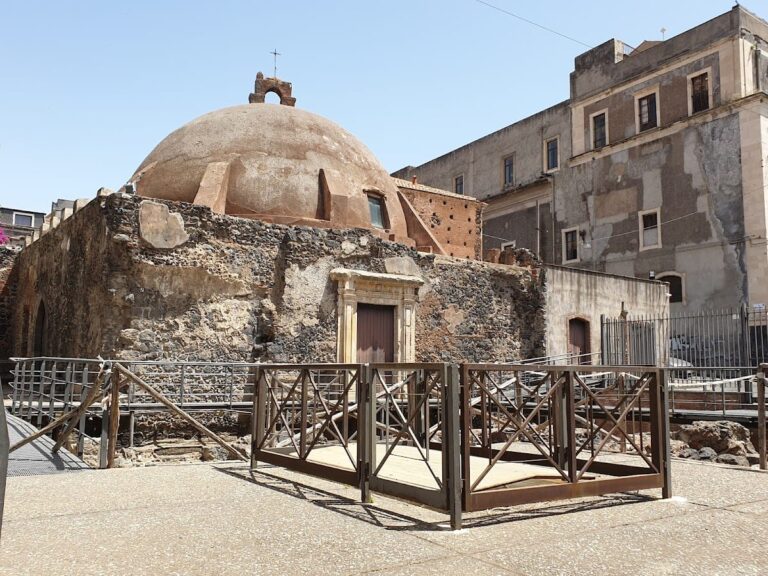
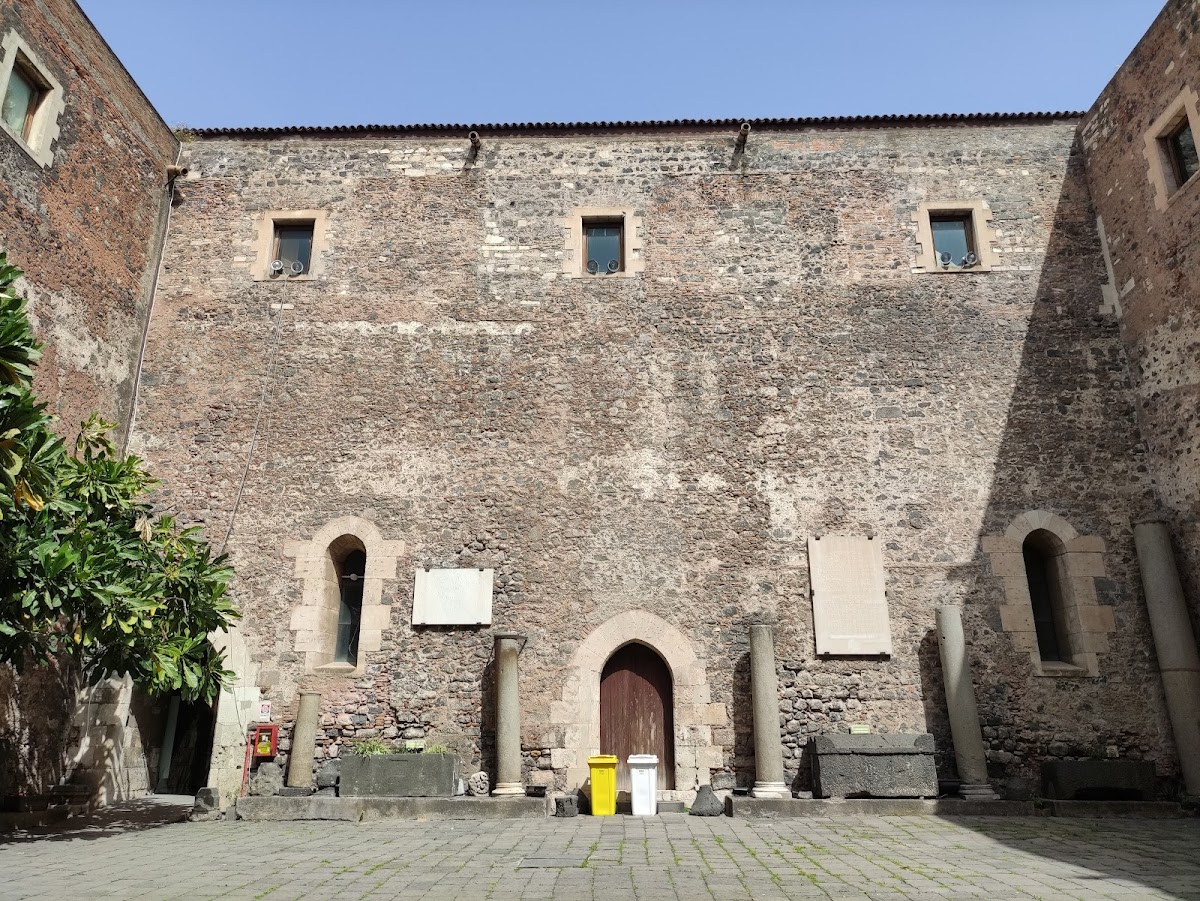
Castello Ursino has a square or rectangular plan measuring about 50 metres on each side. Four large circular towers occupy the corners, while an open inner courtyard forms the center. The walls are built of lava stone in opus incertum, a masonry technique using irregular stones set in mortar, and are approximately 2.50 metres thick. The original base had sloping battered walls, which archaeological excavations have exposed in the southern moat.
Outer defenses and changing setting
Corner towers and walls
The four corner towers are each slightly more than 10 metres in diameter and reach a maximum height of about 30 metres. Two surviving intermediate semicircular towers, originally four, measure about 7 metres across. The first design probably did not include battlements, which were uncommon in Frederick II’s castles. Battlements were likely added during later alterations and rebuilding of the upper parts of some towers.
Northern entrance
The principal entrance on the north was protected by a drawbridge and defensive walls. Their surviving remains can be seen in the moat before the entrance. Four windows on this side were added later, because the original design minimized openings on the most vulnerable face. A later battered base provided additional strength.
Above the entrance, a niche holds a sculpture of a Hohenstaufen eagle grasping a hare. The animal has sometimes been mistaken for a lamb. In the sixteenth century, a semicylindrical tower open on its western side concealed the entrance. Only its foundation wall survives.
Southern and eastern sides
The southern side has lost its intermediate tower and contains many later windows. It also has a secondary entrance known as the “false gate.” A probably wooden-and-stone slide led from it toward a landing place by the sea beyond the bastion. Later alterations and the lava flow of 1669 make it impossible to establish precisely where walls connecting the castle with the sea were intended to run.
The eastern side has likewise lost its intermediate semicircular tower. A Renaissance window there is decorated with a pentagram carved in lava stone. Restoration has exposed parts of the sixteenth-century bastions, a well-preserved sentry box, and the original battered bases of the corner towers.
The castle originally stood on a cliff overlooking the sea but now lies about one kilometre inland. The 1669 lava flow raised the ground around it by approximately ten metres and filled or buried the moat and bastions. The building, once surrounded by open land and later by convents and a military parade ground, is now enclosed by the urban fabric of Catania’s historic center.
Courtyard and interior structure
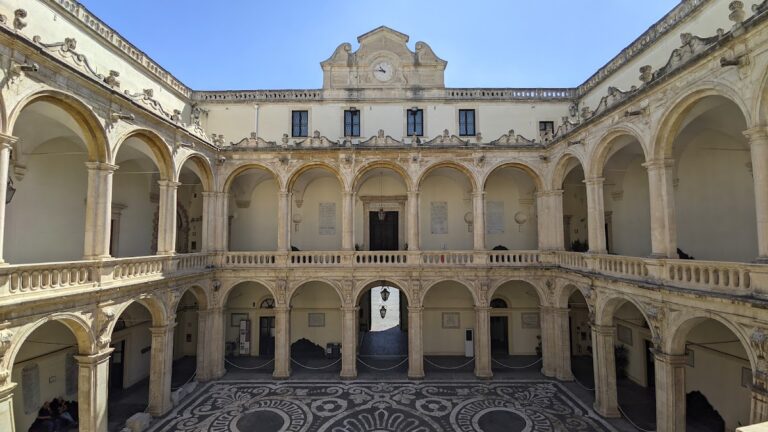
The inner courtyard survives with an external Gothic-style staircase added during the Renaissance. Four large halls once surrounded the court. Each was flanked by smaller rooms that provided access to the corner towers. The large halls were divided into three bays covered by ribbed cross vaults, whose ribs sprang from semicolumns with capitals decorated with foliage. Spiral staircases inside the northern and southern semicircular towers connected the lower and upper floors.
The arrangement expresses the building’s dual purpose. As a palatium, meaning a royal or imperial residence, it provided rooms and halls for the court. As a castrum, or fortified military stronghold, it incorporated massive walls, towers, controlled entrances, and defensive spaces.
Prison graffiti
Later prison alterations divided the large ground-floor halls with new walls and floors into smaller cells known as dammusi. Hundreds of inmate graffiti cover the walls and the jambs of doors and windows in the ground-floor rooms, except on the northern side, and also cover the inner courtyard.
The drawings include coats of arms, frontal heads and faces, a battlemented tower, and four carefully rendered three-masted ships of types used in the sixteenth and seventeenth centuries. Religious imagery includes crosses and instruments associated with the Passion. The courtyard contains a large cross with Solomon’s knots at its ends, together with a ladder, sponge, pincers, and hammer.
The inscriptions give names and dates, with the oldest dated 1526. One reads “I came imprisoned.” Other texts describe alleged crimes, claims of innocence, conspiracies, betrayals, prison sentences, and reflections on imprisonment. Most are in Sicilian, with some Latin, Spanish, and mixed Sicilian-Latin writing. A courtyard inscription states, “The world is a wheel.”
Museum collections
Ground-floor archaeology
The ground-floor museum rooms contain Jewish inscriptions and inscriptions from the medieval senate house where the decision to expel Catania’s Jewish population was taken in 1492. They include a copy of the Julia Fiorentina inscription from the Louvre, a medieval keystone, a sixteenth-century cannon, Roman mosaic fragments showing the months, and a sixteenth-century inscription referring to a castellan from Toledo.
The rooms also display a statue of Ignazio Paterno Castello, Prince of Biscari, by Antonio Cali, shown with a copy of his book Journey through the Antiquities of Sicily. One room, named for the castle’s former salt-storage function, contains a mosaic with a head interpreted as an allegory of Africa and a bust of an Egyptian woman. Another is named for its large collection of weapons.
Galleries on this floor contain finds from Catania’s Roman theatre, including a colossal headless statue, a torso of Hermes, and a plinth found by Biscari in 1770. The plinth shows a trophy crowned by two Victories and flanked by two barbarian prisoners. Other Roman and ancient works include mosaic fragments, a statue of Hercules, a plaster copy of the sarcophagus of Constance of Aragon, and a putti mosaic from the Achillian Baths bearing the words “Enjoy your stay.”
Further works include a third-century AD frieze fragment showing Apollo and Artemis in a gigantomachy, a mythological battle between the Olympian gods and the Giants; a male torso dedicated to Jupiter; Hercules in a lionskin; a resting Hercules of the Farnese type holding an apple of the Hesperides; a dolphin-decorated plinth; Bellerophon from the second century AD; a second-century Hercules in a lionskin; and a first-century Apollo with a cithara, an ancient stringed instrument.
Clay works include Aphrodite, a small dog fighting a cockerel, a nymph on a rock, and a prehistoric head. A colossal ram is especially notable, while a fragment of a cavalryman, probably from a historiated column and found near the Carlo V Gate, is identified as the room’s most important work.
About 2,000 bronze figurines are displayed on the ground floor. Of these, 1,600 come from the Benedictine collection and the remainder from the Biscari collection. They date from the Archaic, Siceliot, Greek, Etruscan-Italic, and Hellenistic periods.
The ground floor also contains a marble relief of Demeter and Kore dated to 420 BC, found on Montevergine Hill in 1930, and Greek vases including a red-figure krater, a vessel for mixing wine and water, depicting Perseus and Medusa from excavations at Camarina. The permanent exhibition Voci di Pietra brings together inscriptions and sculpture, including the inscription of Aurelius Samohil, an Attic rhyton used for pouring liquids, an Attic krater with a symposium scene, a black-figure Attic lekythos, Polyphemus and Ulysses from the second century AD, and Wrestlers from the second century AD.
First-floor art
The first floor contains two funerary reliefs, one commemorating a sixteenth-century recipient of the Order of the Golden Fleece, a prestigious chivalric order founded by the Burgundian ruling house, and the other showing a sleeping figure. Byzantine icons stand alongside a Limoges enamel plaque of the Crucifixion, an enamel work of the Virgin in Glory, and El Greco’s Portrait of a Gentleman, which has been restored.
Other works include a fifteenth-century painting of the Madonna with Saint Lucy and Saint John; sections of a polyptych by Antonello de Saliba from Santa Maria di Gesu; Saint Onuphrius by Bernazzano; a seventeenth-century chess set from the Benedictine collection; and The Last Supper by Luis de Morales. The sections of the polyptych comprise the Madonna and Child, Saint Anthony, Saint Francis of Assisi, and the Resurrection.
A gallery devoted mainly to seventeenth- and eighteenth-century art includes four paintings by Matthias Stomer from the collection donated to Catania by Giovan Battista Finocchiaro in 1826: The Death of Cato, The Crucifixion of Saint Peter, The Suicide of Seneca, and Christ Mocked. It also contains works by Pietro Novelli, including Saint Christopher, Saint John the Baptist, Madonna and Child with Saint Louis of France, and The Good Samaritan.
The same gallery holds the only surviving copy of Caravaggio’s Nativity with Saint Francis and Saint Lawrence. The original was stolen by the Mafia and has not been recovered. Don Gaspare Orioles da Paolo Geraci made the copy in 1627. Other paintings include Christ at the Column by Mario Minniti, Penitent Mary Magdalene from the school of Giovanni Lanfranco, Saint Luke Painting the Virgin Mary by Mattia Preti, and Saint Catherine in Ecstasy, attributed at different times to Giulio Cesare Procaccini and Pier Francesco Mazzucchelli.
Further works include Prophet, Saint Francis with a Crucifix, and Lament over the Dead Christ by Jusepe de Ribera and his school; Mary Magdalene by Andrea Vaccaro; Three Kings by Simone de Wobreck; and Saint Januarius, attributed to Francesco Solimena. Another room contains eighteenth-century works, including oil sketches by Marcello Leopardi, Mariano Rossi’s The Martyrdom of Saint Agatha, still lifes by Aniello Ascione, naval battle scenes, Giuseppe Bonino’s Woman Selling Fish from 1760, a classically styled Kneeling Aphrodite, and works attributed to Guglielmo Borremans.
This room also contains wax sculptures of Saint Agatha before Quintianus and Saint Agatha Crowned in Prison, a door sculpture in the style of the Gagini family, Portrait of Prior Placido Scammacca, and small paintings by Michele Rocca, The Birth of Venus and The Birth of Adonis. A room dedicated mainly to Michele Rapisardi displays The Sicilian Vespers, Head of Mad Ophelia, a self-portrait, and a study for The Sicilian Vespers. It also includes works by Natale Attanasio and Bernardo Celentano.
Second-floor collections
The second floor contains nineteenth-century portraits by Rapisarda, Giuseppe Rapisardi, Giuseppe Sciuti, Natale Attanasio, Calcedonio Reina, Francesco Lojacono, Pasquale Liotta, Domenico Morelli, Alessandro Abate, Antonino Gandolfo, and Giuseppe Gandolfo. Examples include Gandolfo’s Portrait of the Sister-in-Law and Forced Music, Reina’s Love and Death, Liotta Cristaldi’s The Effect of Hashish and The Nightmare of Elizabeth I of England, Lojacono’s Fisherman, Morelli’s The Death of Tasso, Induno’s Woman Cooking, Rapisardi’s Happy Hours and Venus on a Green Couch, and Giuseppe Rapisardi’s Family Portrait.
The floor also displays eighteenth-century Chinese vases, violins made by Andrea Amati, Caltagirone ceramics, seventeenth-century bronze statuettes of Venus and Vulcan, and an eighteenth-century bronze Perseus. A separate listing identifies another Perseus statuette as dating from the sixteenth century.
A large second-floor room is used for temporary exhibitions and contains sculptures, bas-reliefs, and inscriptions from the Certosa di Nuovaluce, together with an urn from the Gaginian school. An adjacent room contains part of the numismatic collection and the complete Sebastiano Ittar collection, including Ittar’s engravings of monuments and works of art in Catania.