Church of Santa Margherita in Trastevere: A Roman Catholic Church in Rome
Site at a Glance
- Popularity
- Medium
- Country
- Italy
- Primary era
- Early Modern
- Eras represented
- Medieval, Early Modern
- Civilizations
- Papal States
- Site type
- Religious
- Remains
- Church
On this page8 sections
History
The Church of Santa Margherita in Trastevere is a Roman Catholic church on Piazza di Sant’Apollonia in Rome, Italy. It was first built in 1288 during the papacy of Nicholas IV. The church is dedicated to Saint Margaret of Antioch, venerated as a Christian martyr, and Saint Emidius of Ascoli, a bishop and martyr. It belongs to the parish of Santa Maria in Trastevere in the Diocese of Rome. The church was also called Santa Elisabetta and Santa Margherita della Scala, and was formerly dedicated to Saint Emidius as well as Saint Margaret.
Sixteenth-century rebuilding and convent
In 1564, the Roman noblewoman Giulia Colonna arranged for the church to be rebuilt and sponsored an adjoining convent for women of the Third Order of St. Francis, a Franciscan branch for people outside cloistered communities. The women, known as bizzoche, followed a Franciscan religious life without living in enclosure. Records from a visit to Rome during Pope Alexander VII’s papacy, from 1655 to 1667, confirm this arrangement.
Rebuilding after the choir collapse
On July 16, 1678, during Vespers, the evening prayer service, beams supporting the choir gave way. Cardinal Girolamo Gastaldi, a senior Catholic Church official, commissioned a rebuilding designed and directed by Carlo Fontana, an Italian Baroque architect. The work was carried out in 1680, and the church was consecrated again in 1683.
Convent closure and later administration
During the Napoleonic occupation of Rome in the early nineteenth century, the convent was looted and was not re-established. By the end of that century, its buildings had been converted into private apartments. The church was restored in 1893 and administered by the Confraternity of Saint Emidius until 1996. Since February 2, 1997, it has been entrusted to a priest of the Vicariate of Rome and cared for by the Diocese of Rome’s secular, or non-monastic, clergy.
Remains
Exterior and orientation
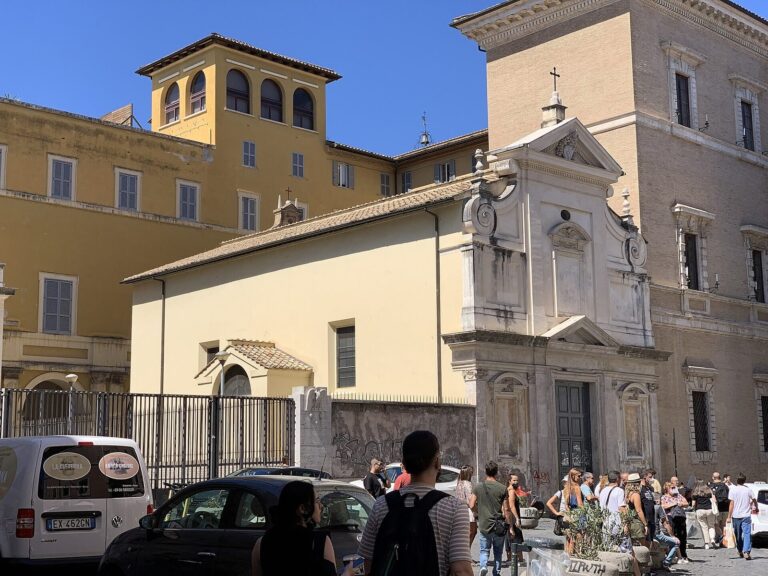
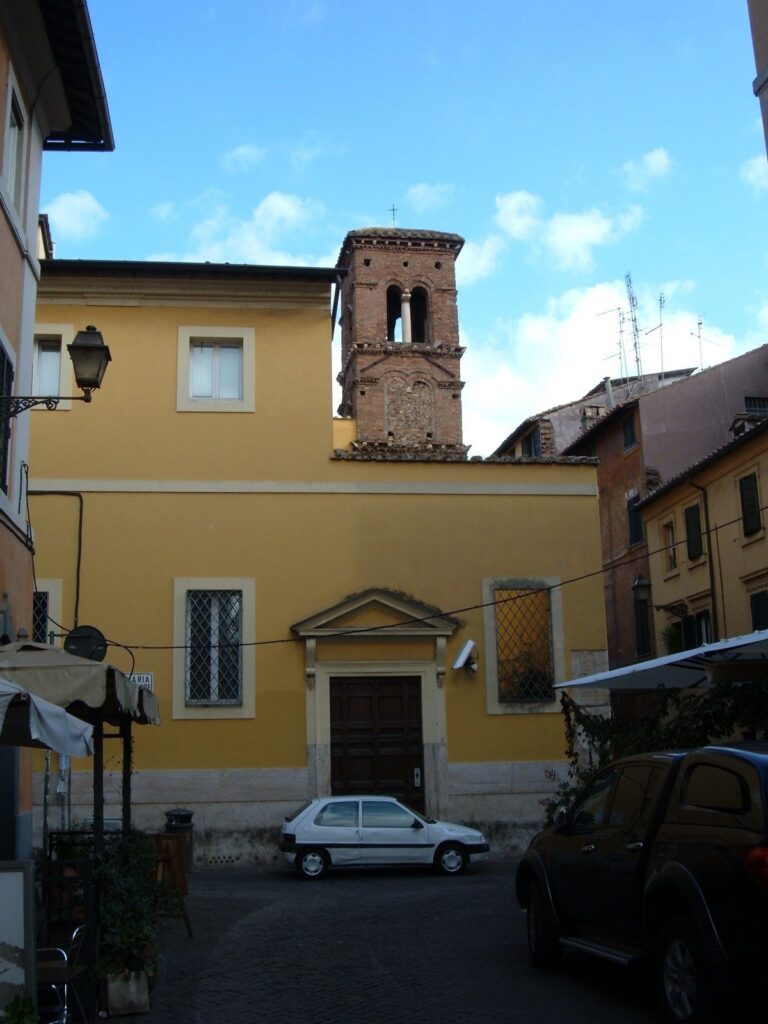
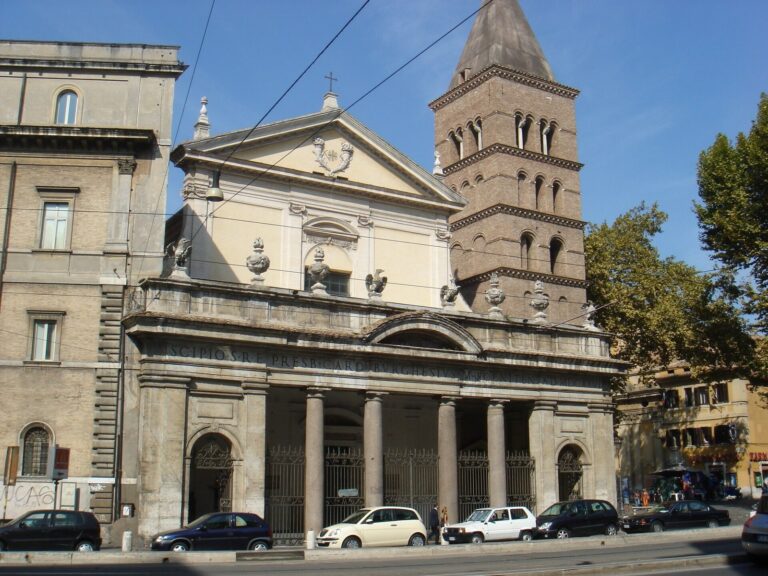
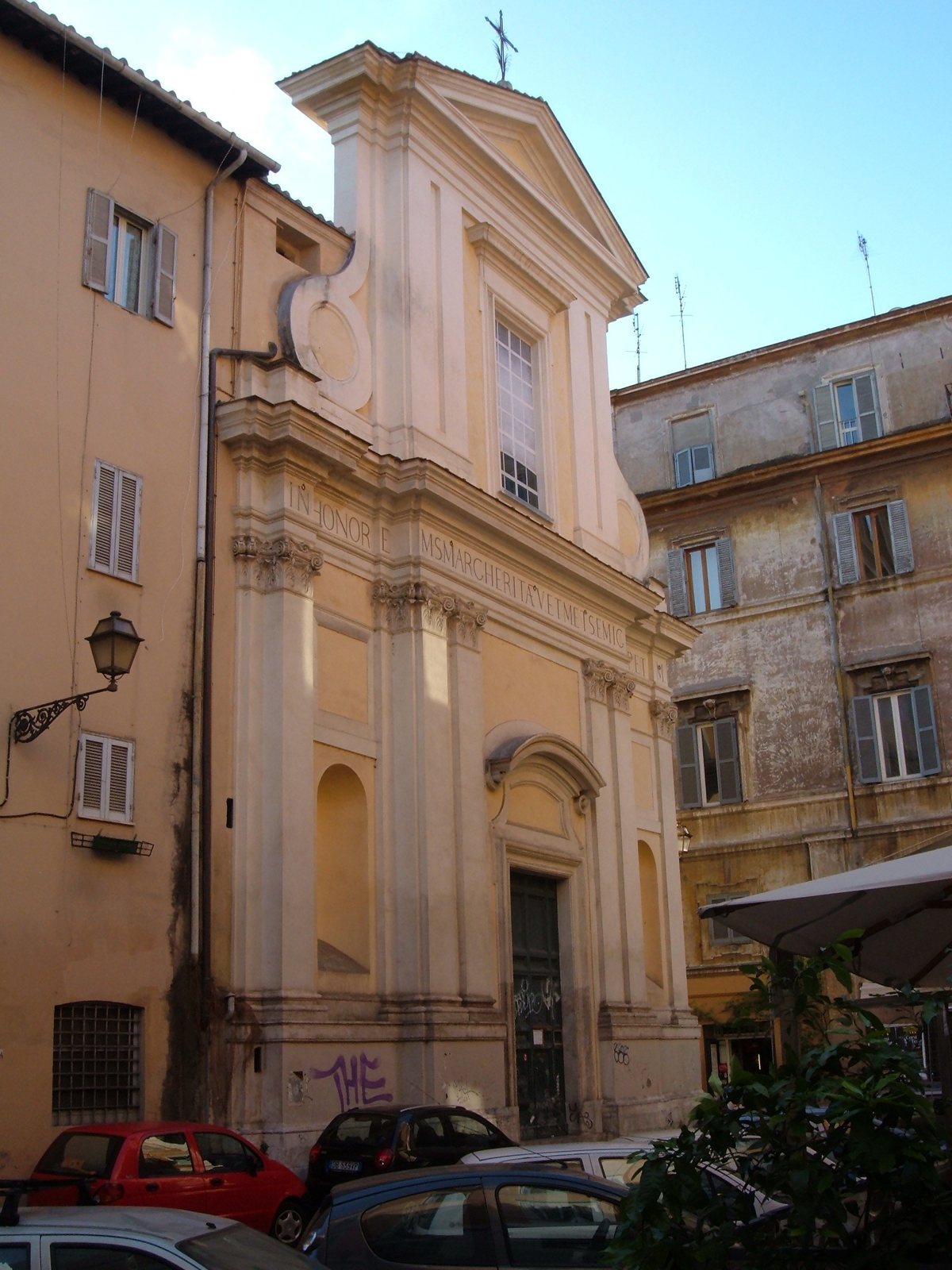
The present church is larger than its predecessor and has a different orientation. The earlier building faced the narrow Via della Lungaretta. The current façade has two levels, with a cross and palm branches above the upper one, a Christian symbol of victory. An inscription names Saint Margaret, virgin and martyr, and Saint Emidius, bishop and martyr. At the lower level, the main entrance is topped by a semicircular pediment and flanked by two empty niches, divided by flat supports with foliage-decorated capitals.
Interior and paintings
The interior has one main hall, three side chapels, a continuous arched ceiling, and a semicircular sanctuary at the far end. The marble-decorated high altar has a painting by Giacinto Brandi depicting Saint Margaret. Two oval paintings by Giuseppe Ghezzi flank the altar and show the martyrdoms of Saint Margaret and Saint Apollonia, an early Christian martyr. One chapel on the right contains a painting of Saint Emidius. The chapel on the left holds Giovanni Battista Gaulli’s depiction of the Immaculate Conception with Saints Francis and Clare.
Roman structures beneath the church
Roman structures lie beneath the church. They came to light during restoration work directed in 1996 by architect Giuliano Sacchi.