Kong Svends Høj: A Neolithic Passage Grave in Denmark
Site at a Glance
- Popularity
- Low
- Country
- Denmark
- Primary era
- Stone Age
- Eras represented
- Stone Age
- Civilizations
- Unclassified
- Site type
- Burial
- Remains
- Burial Mound
On this page7 sections
History
Neolithic construction
Kong Svends Høj is a Neolithic passage grave on northwestern Lolland, Denmark. Built around 3200 BC by people of the Funnel Beaker culture, a Neolithic culture of northern and central Europe, it is a tomb in which a passage leads to a burial chamber. It is the sole survivor of a group of eight and among Denmark’s largest and best-known passage graves.
Excavation and protection
In 1780, Count Christian Ditlev Frederik Reventlow, who owned Pederstrup and nearby land, excavated and surveyed the mound with Friedrich Münter, then a theology student. Their work produced a written report. Münter later founded the Antiquities Commission and the National Museum, and became bishop of Copenhagen. A watercolor of the mound by Ole Jørgen Rawert dates to 1820. In 1876, historian and archaeologist Conrad Engelhardt carried out a smaller excavation, while Magnus Petersen made a drawing of the mound. The monument was protected in 1924.
The National Museum excavated the mound in 1941–42 under archaeologists Thorkild Ramskou and Julis Raklev; the entrance was located in 1942. The work cleared earth from the chamber, removed trees and bushes from the mound, and raised several fallen stones. Further excavations followed in 1973 and 1991. The 1991 work, undertaken by the National Museum and the Forest and Nature Agency, also included restoration of the mound and the raising of kerbstones.
Remains
Mound and stone setting
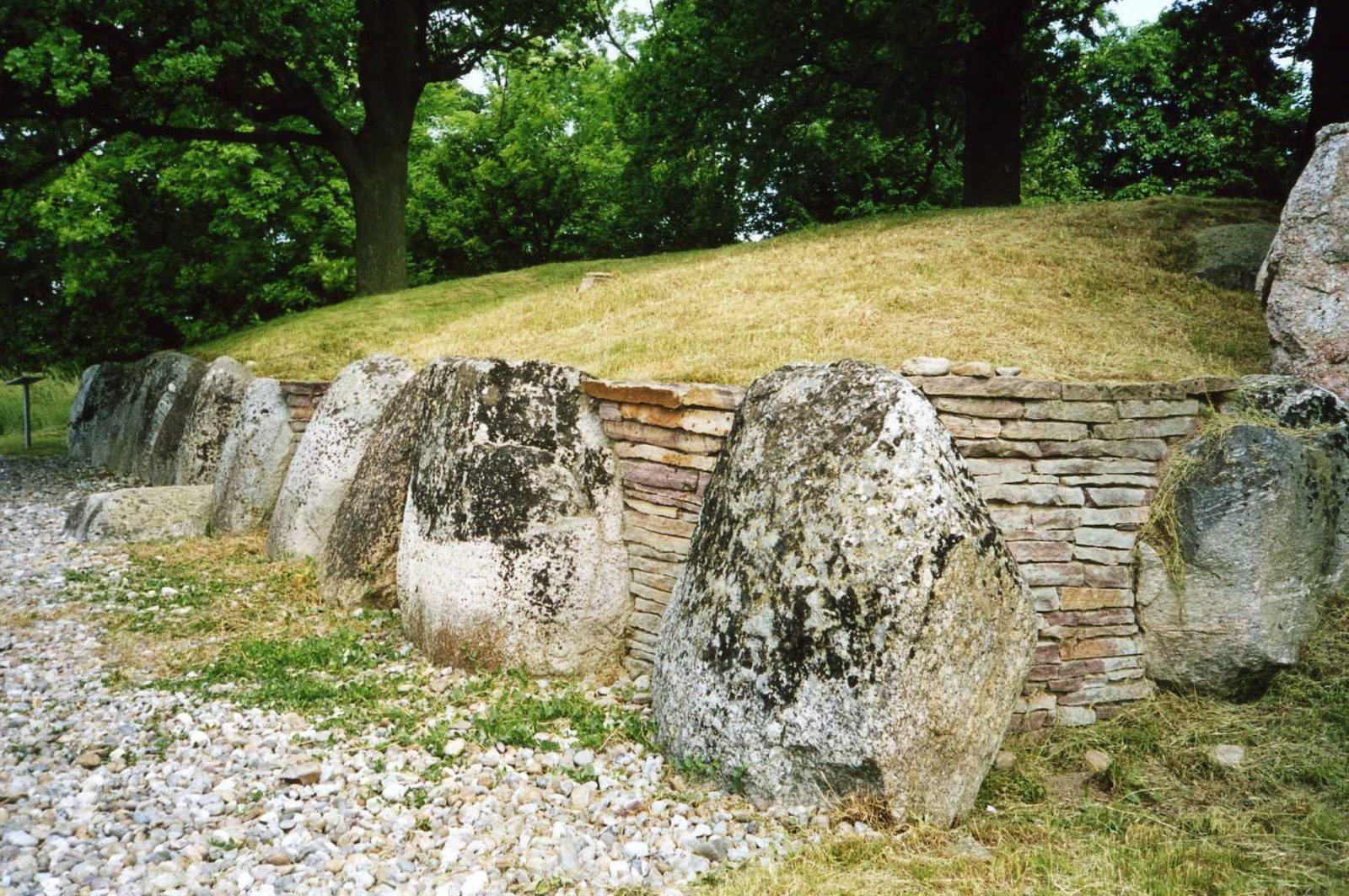
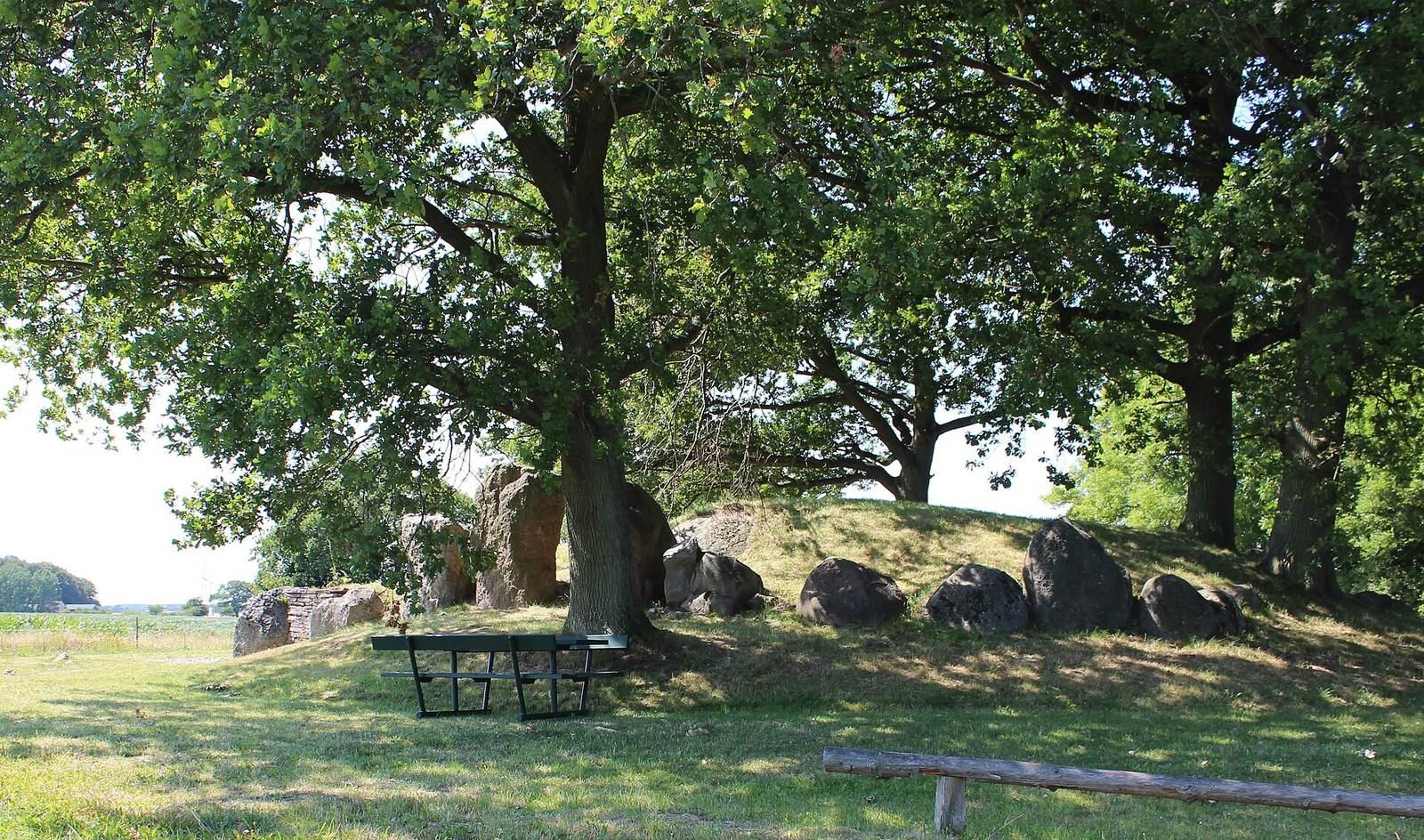
The monument lies just north of Pederstrup, east of Horslunde and south of Road 289. Its rectangular mound measures about 21 metres long and 15 metres wide, unlike the round form usual for passage-grave mounds. This elongated type, known as a long barrow, is characteristic of Lolland and Langeland. Forty-two large kerbstones, stones set around a mound’s edge, encircle it. They generally stand about 1.6 metres high; stones near the middle exceed 2 metres, and the largest approach 4 metres. The sides curve slightly inward, while the taller central stones create a roughly roof-shaped outline. Two projecting guard stones, large blocks set out from a facade, once flanked the northwestern front. Some stones are reddish granite, porphyry, with large crystals in a finer groundmass, and pegmatite, an exceptionally coarse-grained igneous rock.
Burial chamber
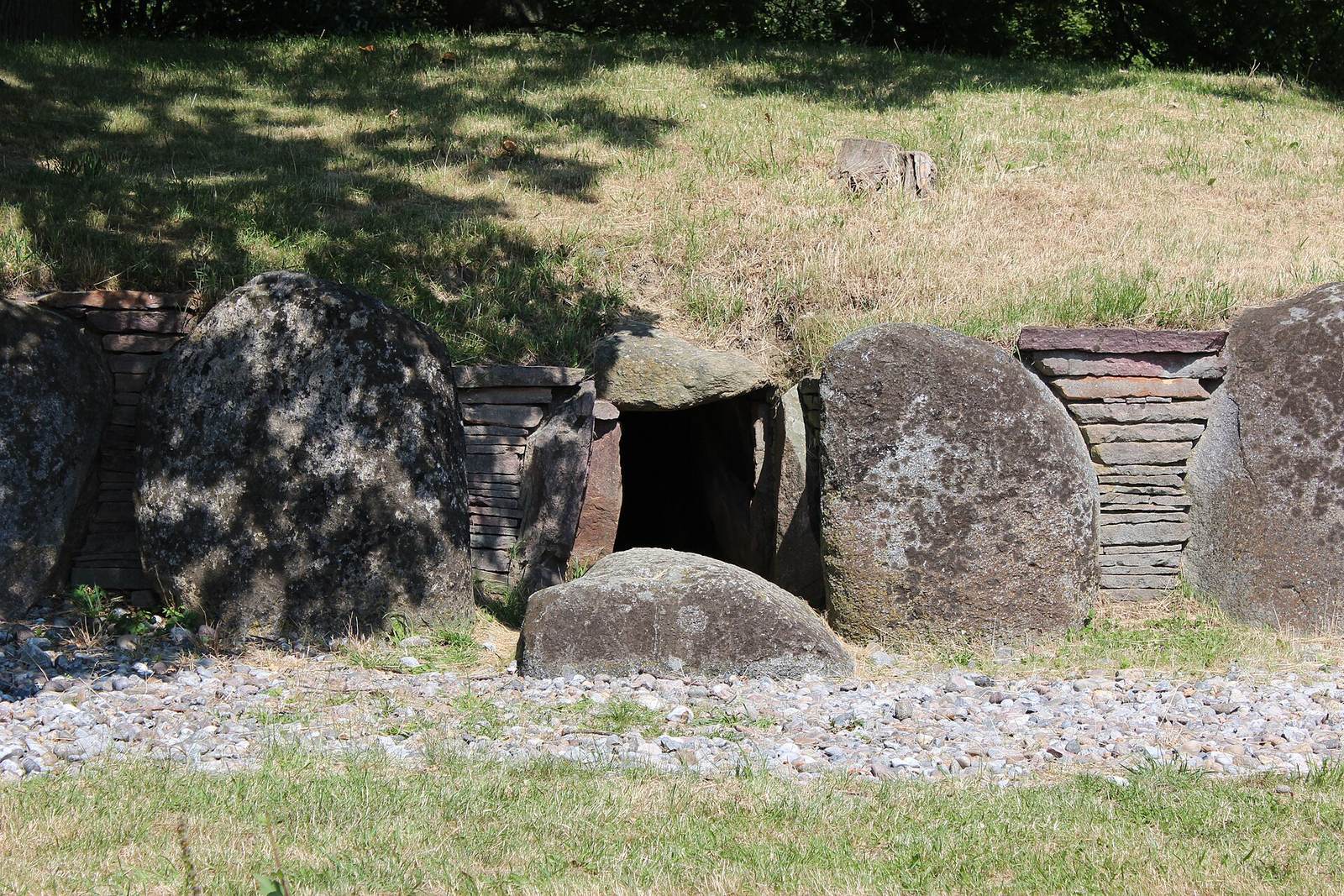
The chamber is about 12.5 metres long and approximately 2 metres wide, with a slightly trapezoidal plan. Upright stones support capstones across its roof. At least ten pairs of supports were formed by splitting larger stones and setting the two halves opposite one another. The entrance is on the western side, an unusual position for a passage grave, whose entrance is more commonly on the east. Inside, white-burnt flint covers sandstone slabs on the floor. Marks from an ard, an early plough, beneath the floor indicate that the tomb was built over agricultural land.
Excavated finds
The 1780 excavation yielded mainly animal and human bones, along with a few amber beads. Engelhardt’s work in 1876 recovered further fragments of amber beads. Excavation in 1991 uncovered remains of 35 to 40 clay vessels, placed on both sides of the entrance, and 15 flint knives. The vessels were probably food offerings for the deceased.