D54 (Havelte 2): A Passage Grave at Havelterberg, Netherlands
Site at a Glance
- Popularity
- Low
- Country
- Netherlands
- Primary era
- Stone Age
- Eras represented
- Stone Age
- Civilizations
- Unclassified
- Site type
- Burial
- Remains
- Tomb
On this page4 sections
History
D54, also known as Havelte 2, is a passage grave in Darp on the Havelterberg in Drenthe, Netherlands. A passage grave is a burial chamber reached through a passage. D54’s construction is dated to between 3400 and 3100 BCE and attributed to the western group of the Funnel Beaker culture, a prehistoric culture associated with distinctive funnel-shaped pottery.
Early records and archaeological surveys
The tomb entered written and visual records in 1732, when antiquarian Andries Schoemaker mentioned it and draughtsman Cornelis Pronk made a drawing. A French military-engineering map produced between 1811 and 1813 showed D54 alongside D53, labeling the pair as ancient Hun burials covered with large granite stones. During the nineteenth century, the Dutch state bought D54 from Havelte’s local communal organization for landholding and management.
Leonhardt Johannes Friedrich Janssen visited the tomb in 1847. The following year, he included it in the first overview of Dutch megalithic tombs, with building descriptions and schematic plans. Janssen was curator of Dutch antiquities at the National Museum of Antiquities in Leiden. In 1874, his successor Willem Pleyte and photographer Jan Goedeljee systematically photographed Drenthe’s tombs; Pleyte also made lithographs based on the photographs. Three years later, museum director Conrad Leemans traveled to Drenthe, with Jan Ernst Henric Hooft van Iddekinge preparing tomb plans for his journey. Leemans’s report was not published.
From 1904 to 1906, physician and amateur archaeologist Willem Johannes de Wilde recorded surviving Dutch megalithic tombs through plans, photographs, and detailed descriptions. Albert Egges van Giffen documented D54 in 1918 for his atlas of Dutch tombs.
Wartime concealment and later recording
Around 1942, artist J. Dijkstra painted D54 and D53 together in a watercolor that was used as a school chart. During the Second World War, German forces built an airfield and covered D54 with sand to prevent Allied forces from using it as a landmark. The mound was excavated again after the war. The tomb was restored in 1955, 1966, and 1995, and became a Dutch national monument in 1997.
In 2017, photographs of D54 were used for photogrammetry, a method of measuring and recording a subject in three dimensions. The work formed part of a three-dimensional atlas of surviving Dutch megalithic tombs, involving the province of Drenthe and the University of Groningen.
Remains
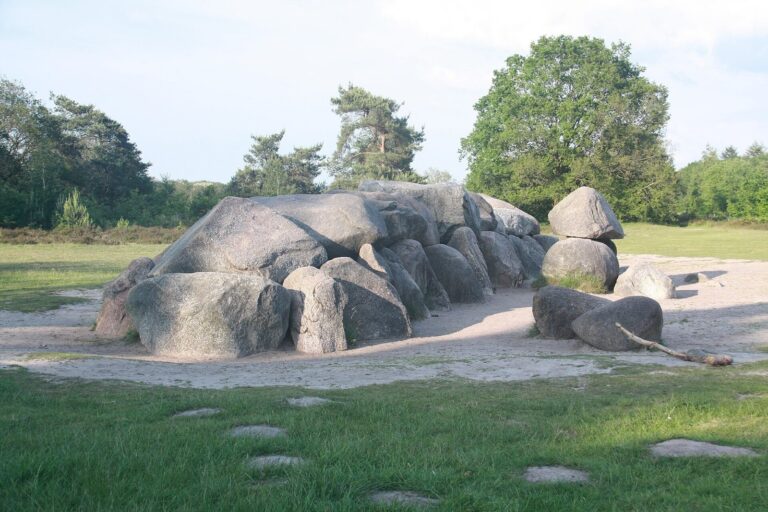
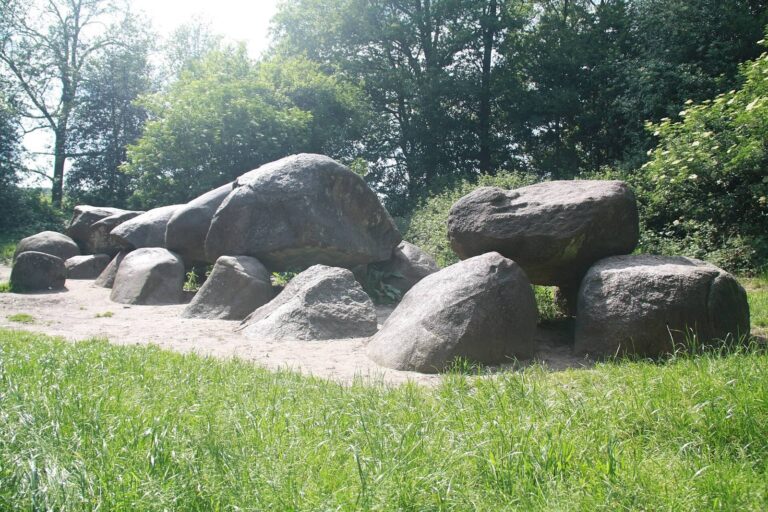
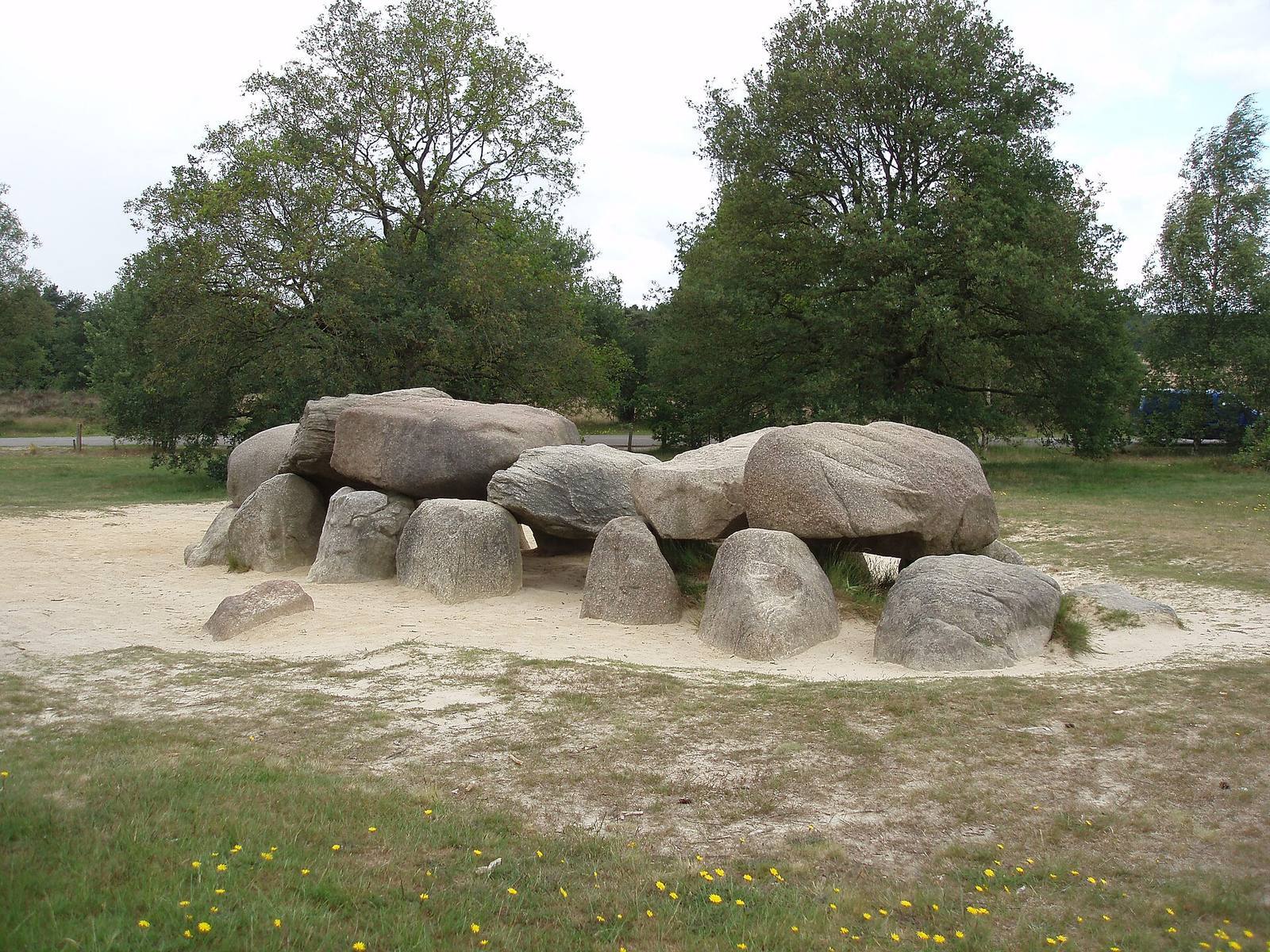
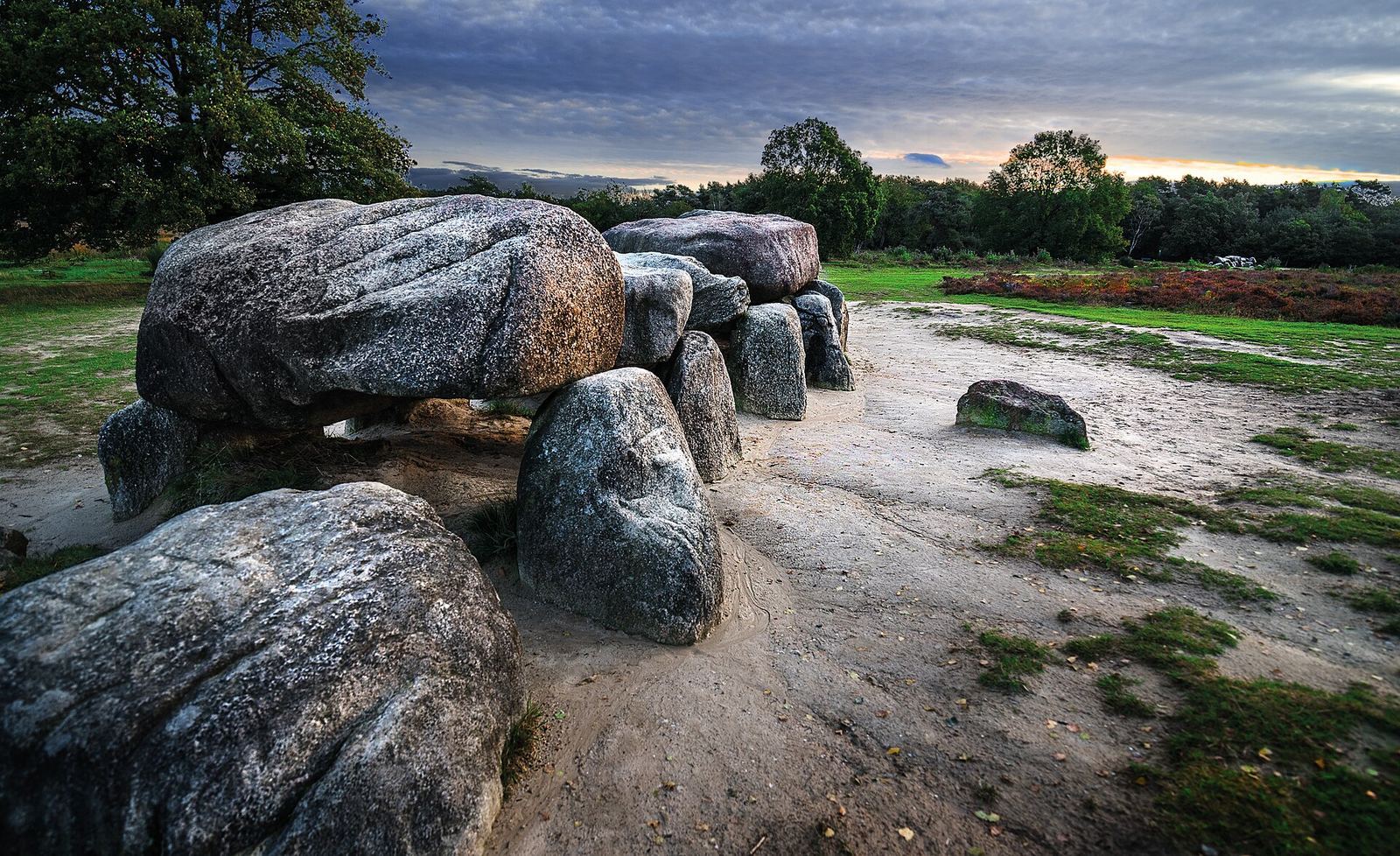
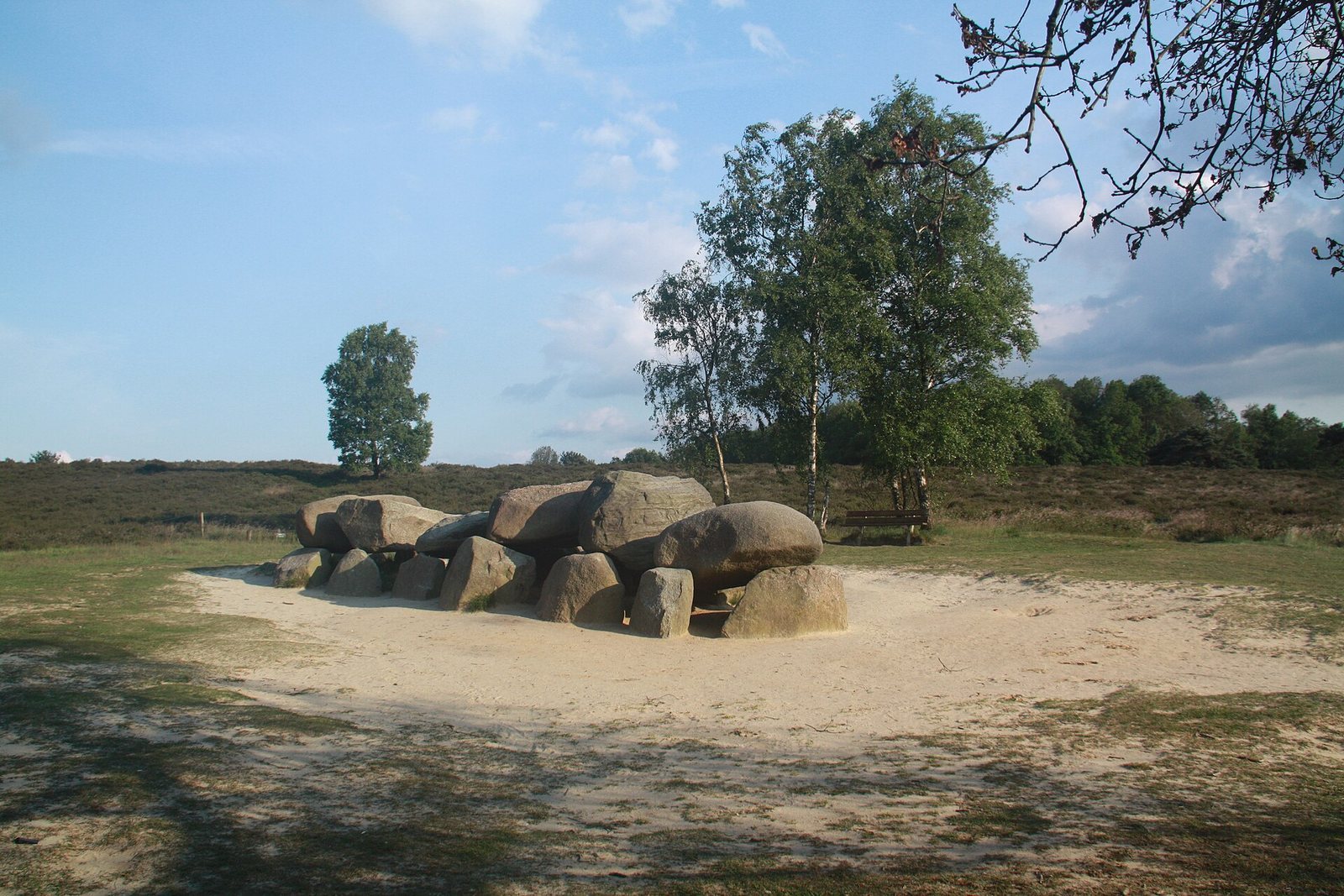
D54 is an elongated stone tomb, 12.7 metres long and 3.3 metres wide, aligned approximately east-southeast to west-northwest. It stands in a small sandy clearing surrounded by grass, south of Hunebeddenweg. The larger tomb D53 lies across the road, about 150 to 200 metres away.
The burial chamber’s fourteen support stones form seven pairs along its long sides. Six capstones remain, four resting fully on the supports. The entrance is on the southern long side, between the fourth and fifth support stones when counted from the west, and faces southeast. A western side stone survives from a passage that was probably formed by a pair of stones.