Dolmen d’Arreganyats: A Prehistoric Burial Tomb in Girona, Spain
Site at a Glance
- Popularity
- Very Low
- Country
- Spain
- Primary era
- Stone Age
- Eras represented
- Stone Age
- Civilizations
- Unclassified
- Site type
- Burial
- Remains
- Tomb
On this page9 sections
History
Dating and prehistoric use
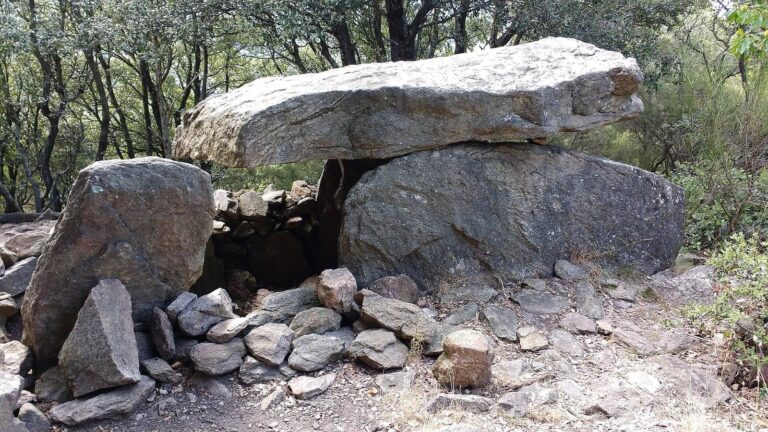
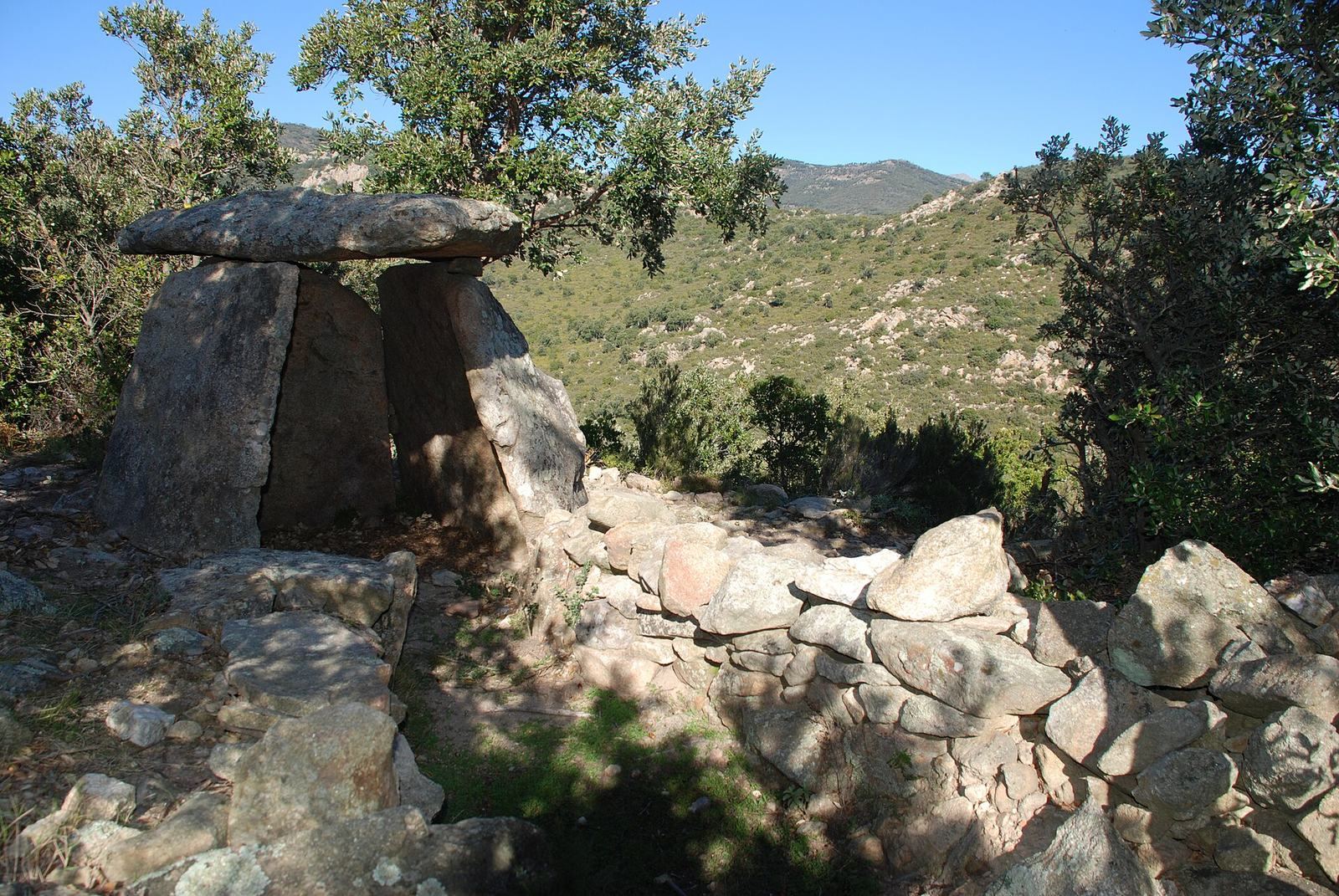
The Dolmen d’Arreganyats is a prehistoric tomb built from large stone slabs near Espolla in Girona, Spain. Dated to about 3450 BCE, it belongs to the Dolmens of Espolla group and is among the region’s earliest megalithic monuments. A radiocarbon measurement of charcoal associates it with the first phase of corridor tombs, burial structures with a passage leading into a chamber, in Alt Empordà and Roussillon during the first half of the fourth millennium BCE. A broader proposed construction date spans 3500 to 2500 BCE, covering the Middle and Late Neolithic.
The tomb held burials in the Late Neolithic, a prehistoric period associated with farming and stone tools. It was reused for burials in several episodes during the Early Bronze Age, when bronze became widely used for tools and objects.
Study and restoration
Salvador Sanpere i Miquel first mentioned the dolmen in 1881. In 1912, archaeologist and geologist Manuel Cazurro i Ruiz published a plan, a description, and a photograph. Pere Bosch i Gimpera and Lluís Pericot i Garcia carried out the first archaeological investigations between 1915 and 1920. They revised the plan and front section and classified the monument as a corridor tomb.
Joan Ruiz i Solanes undertook restoration work in 1970. Excavations begun in 1979 by Josep Tarrús i Galter, Júlia Chinchilla i Sánchez, Josep Castells i Camp, and Rosó Vilardell i Pascual led to findings published in 1982 and 1983. GESEART carried out further restoration in 1986, followed by an intervention in 1988 by Sara Aliaga, Oriol Mercadal, and Josep Anton Molina. In 1989, Tarrús and Chinchilla directed work to excavate the mound, take samples, and redraw the monument to include its passage. Tarrús directed an emergency intervention and restoration in 1995.
Remains
The tomb comprises a trapezoidal chamber, a passage, and a circular mound of rubble and earth. Nine granite supporting stones and a roof slab form the chamber, while the passage walls are built from slate and granite fitted together without mortar. The entrance faces southeast, and the monument slopes gently from northwest to southeast.
Setting and mound
The dolmen stands at about 350 m elevation in the Verna area, around 3.5 km from the center of Espolla. It is set on gently sloping, granitic ground among cork-oak woodland and sparse shrubs. The circular mound surrounding the tomb is made of earth and rubble.
Chamber and passage
Burial chamber
The chamber measures 2.55 m long, 1.6 m wide, and 1.5 m high internally. Its nine granite supports carry a trapezoidal roof slab with a rectangular cross-section. Dressing marks appear on the slab’s inner face, and its edges have been pecked. A single end slab is firmly set and tilts slightly forward. The roof slab has been repositioned at its original location, and the monument is in good condition.
Passage
The passage is 2.55 m long and about 0.80 to 0.90 m wide. Its surviving height reaches 0.70 m, while its original maximum height is thought to have been about 1 m. Its walls are made of dry-stone masonry using slate and granite.
Finds
Objects found inside the tomb include pottery fragments, pieces of copper or bronze, and a brown, lance-shaped flint arrowhead. The recovered materials are held at the Archaeological Museum of Barcelona, the Archaeological Museum of Girona, and a private collection in Figueres.