Dolmen von Kampen: Neolithic Tombs on Sylt, Germany
Site at a Glance
- Popularity
- Very Low
- Country
- Germany
- Primary era
- Stone Age
- Eras represented
- Stone Age
- Civilizations
- Unclassified
- Site type
- Burial
- Remains
- Tomb
On this page6 sections
History
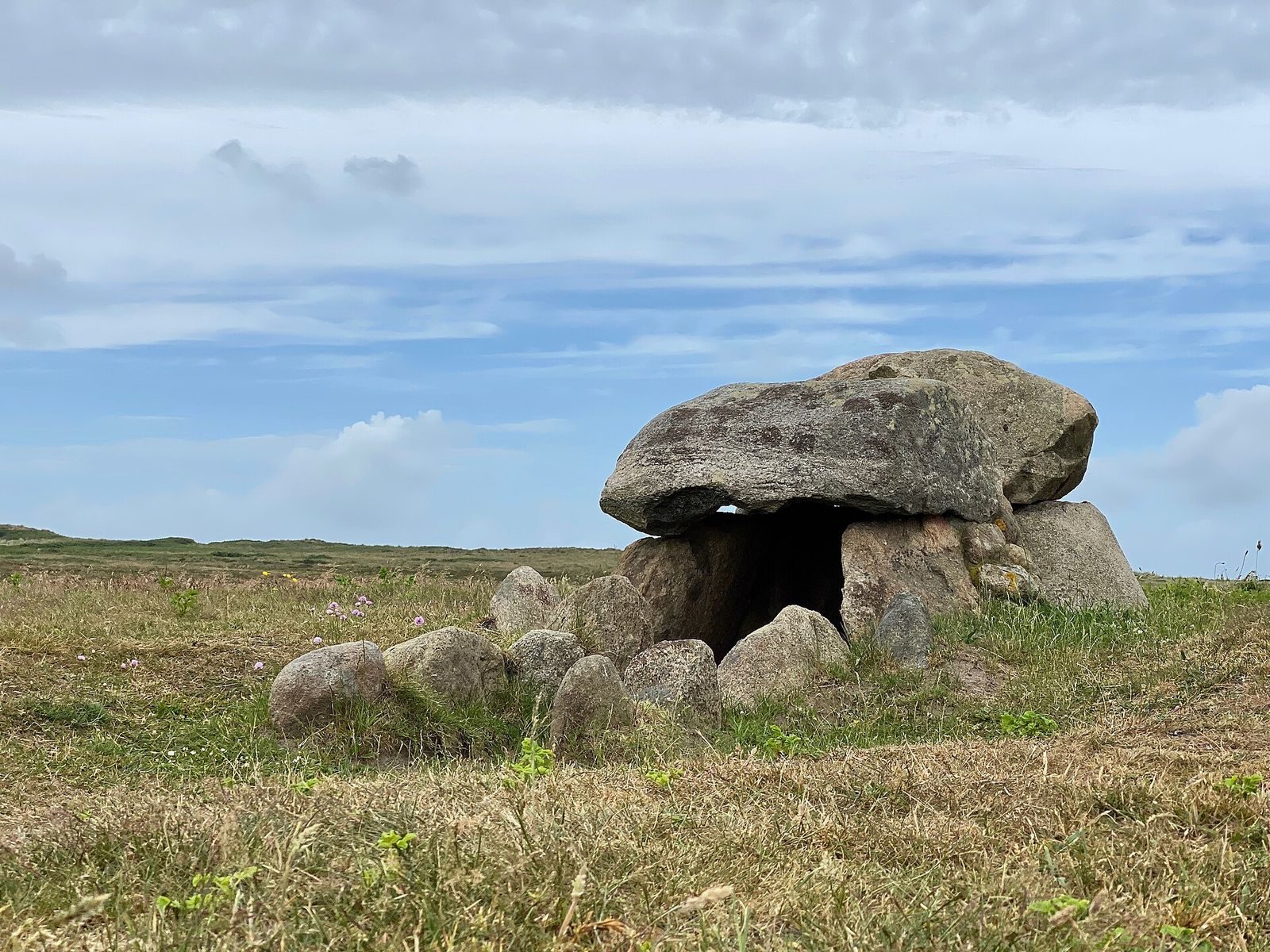
Dolmen von Kampen is a group of Neolithic tombs on Sylt, Germany. Its two principal stone-chamber tombs, or dolmens, date to about 3500–2800 BC and are associated with the Funnel Beaker culture, a northern European Neolithic culture named for its distinctive funnel-shaped pottery. Both tombs lay beneath dunes.
The tombs are catalogued as Sprockhoff nos. 2 and 3, identifiers from a catalogue associated with German archaeologist and prehistorian Ernst Sprockhoff. Road construction cut into no. 2, which Karl Kersten excavated in 1939. Wind partly exposed no. 3 before Gottfried Schäfer excavated it in 1957.
Remains
The remains comprise two rectangular stone chambers set within different kinds of mound, with a smaller oval passage grave to their south. No. 2 lies north of Kampen, while no. 3 stands on the Rotes Kliff. Their construction uses large stones alongside smaller stones and clay, arranged differently around each chamber.
The tombs
Sprockhoff no. 2
This rectangular dolmen is described as Germany’s northernmost megalithic complex. Its chamber lies within an elongated mound 6.25 m wide. The surviving mound is 0.6 m high, with stones ranging from fist-sized to roughly twice that size. Closely spaced boundary boulders stand 0.6–1 m high.
The chamber measures about 2 by 1 m internally. Two supporting stones line each long side, with a large stone at the west end and a half-height entrance stone at the east. A slab leaned into the entrance opening to close the remaining gap. Thin slabs up to about 0.7 m long found in the upper chamber may have served as roof covering. Small slabs and clay sealed gaps between the five supports. Yellow sand inside the chamber contained a circular burnt patch about 0.4 m across and several burnt flint pieces. Other finds included two funnel-shaped beakers, one broken, a flint axe, a small amber bead, and a bronze fragment.
Sprockhoff no. 3
This rectangular dolmen stands within a low, domed circular mound, 10 m across and 1 m high. A broad ring of stones, from head-sized to about twice that size, surrounds the mound, whose surface is covered with rounded stones ranging from fist-sized to head-sized. The yellowish-grey sandy fill has horizontal bands of darker material.
The chamber was built in a pit near the mound’s centre, an arrangement interpreted as indicating an early date. It is 3.1 m long, with three large supports along each side that lean markedly inward. The chamber narrows from 1.10 m wide at the bottom to 0.3–0.5 m at the top. At one narrow end, a large slab leans diagonally against the chamber in place of a support; a fragment of another large slab above it may have formed part of the covering. The construction in this area is rough, and the supports vary in height and have sloping upper edges.
An upright stone blocks half the entrance side, and a low threshold stone lies in the remaining opening. A somewhat irregular passage, about 1.4 m long and 0.5 m wide, extends from the entrance and is formed by two or three supports. Stone slabs and clay seal the gaps between supports, particularly where the passage meets the chamber. At the rear, large, thin slabs set in clay form the floor. Elsewhere the floor is firm reddish-brown clay mixed with small granite fragments; the passage has a clay floor without this grit. Rounded stones set in clay pack the outside of all the supports.
The chamber fill was fine, light-coloured sand crossed by dark bands and charcoal at different levels, with several head-sized stones. Burial remains on the floor included slight traces of an uncremated body near the rear. A small clay bowl and amber remains probably belonged to this burial. Finds near the chamber’s middle included a flint blade, four small pieces of amber, and pottery fragments. More pottery fragments and slight amber remains lay northwest of the centre, 0.45 m above the floor. Near the narrow end, a two-knobbed pot set 0.3 m above the floor held white sand and some cremated human remains. Pottery fragments, including pieces of several funnel-shaped beakers, came from within and in front of the outer passage and may have originated in the chamber. Other objects came from among the ring stones and from the chamber fill.
Southern oval passage grave
A small oval tomb lies south of the two dolmens. It is classified as a passage grave, a tomb whose chamber is reached through a passage. Its two roof slabs distinguish it from a dolmen form with a single roof slab.