Church of Santa María del Manzano, Hondarribia: A Catholic Parish Church
Site at a Glance
- Popularity
- Medium
- Country
- Spain
- Primary era
- Early Modern
- Eras represented
- Medieval, Early Modern, Modern
- Civilizations
- Crown of Castile, Spanish
- Site type
- Religious
- Remains
- Fortified Church
On this page18 sections
History
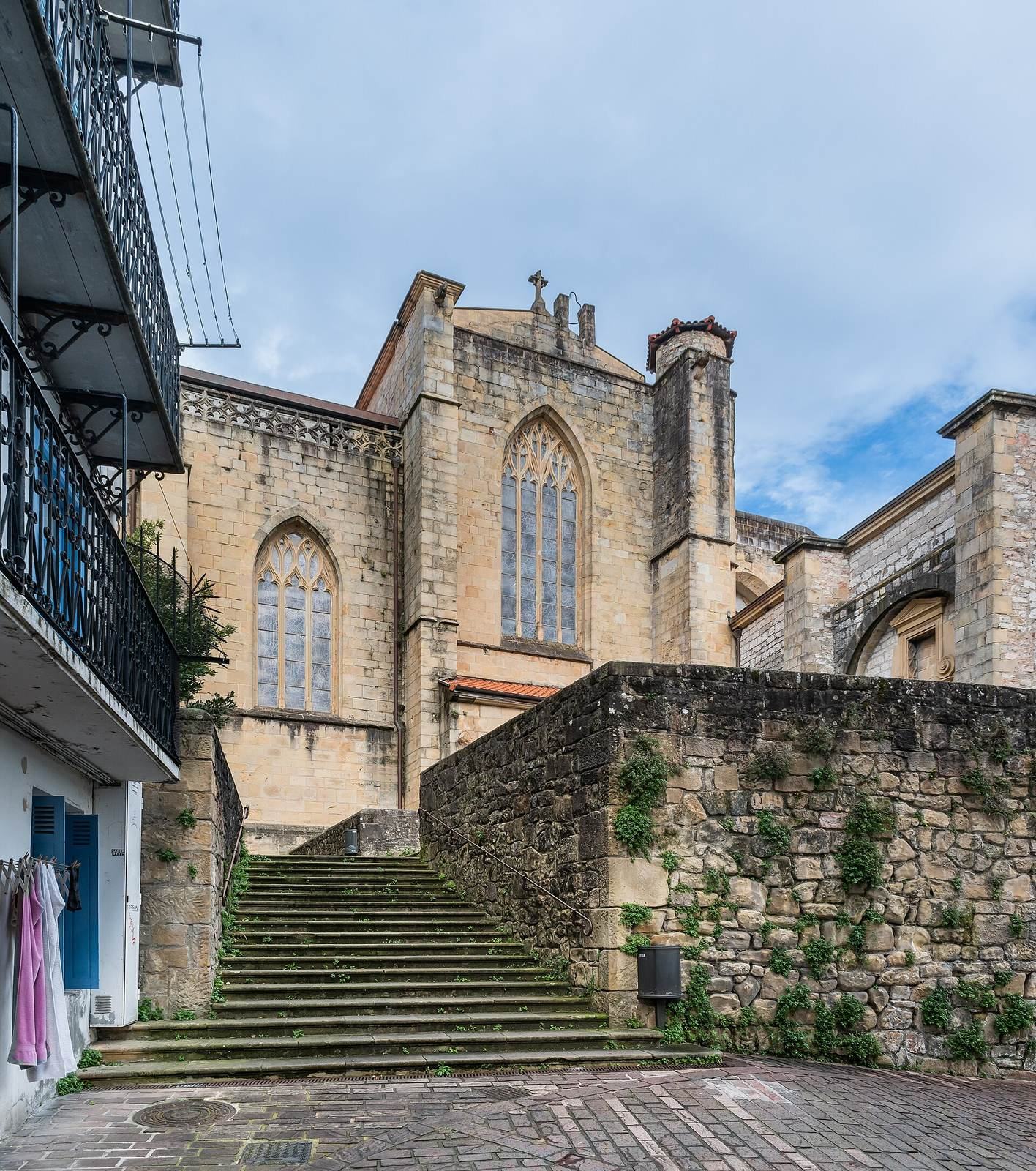
The Church of Santa María del Manzano is a Catholic parish church in Hondarribia, Spain, dedicated to Santa María de la Asunción y del Manzano and belonging to the Diocese of San Sebastián, a church district overseen by a bishop. Construction began on 27 July 1474, on the site of an earlier church, probably Romanesque, within the medieval walled town. Its design reflects a transition toward the Renaissance hall-church form associated with the Basque Country.
Construction amid conflict
Work began during the political and military upheaval surrounding Castile’s conquest of the Kingdom of Navarre. Progress was constrained by the church’s place within a fortified town. The growing transept, the crosswise part of a church that intersects its main body, obstructed military activity at the castle, while building materials were redirected to strengthen and modernize Hondarribia’s defenses.
English forces established themselves in the region in the early sixteenth century to pressure Navarre. The Navarrese capture of Hondarribia in 1522 further delayed construction. Master stonemason Esteban Albizuri directed the work until his death in 1531, after which his son Juan Perez Albizuri took over. The first building phase was completed, and the church was consecrated in 1549 by Joanes de Gauna, Bishop of Bayonne.
Construction also faced opposition from Juan Zarautz Ganboa, Gipuzkoa’s captain-general, a senior military commander with regional authority. He halted the work because the main altar blocked the castle’s view across much of the Bidasoa River. After he became captain-general of the border region, he authorized building to resume. In recognition, Hondarribia’s people placed the Zarautz and Ganboa family arms in the main chapel and gave him the right to burial in the church’s sanctuary.
Later building and changes
On 29 May 1566, work began on a Renaissance entrance to replace an earlier Gothic doorway. The sacristy was begun in 1605, but construction was interrupted during the 1638 siege of Hondarribia. The sacristy and two rooms beside it date to the early eighteenth century. In the 1760s, architect Francisco de Ibero oversaw construction of the Baroque bell tower. The west-end choir gallery was built around the same period, bringing the church close to its present form.
The principal altarpiece, a decorated structure behind or above an altar, was made by Iriarte in the late sixteenth century. It was subsequently replaced first by a Neoclassical altarpiece and later by the present Neo-Gothic one. The church was used for burials until 1810. Burial areas included an upper ground toward the town breach, a lower ground near the sacristy, and spaces inside the building.
Restoration and protection
A restoration in 1910 removed openwork in the walls and small oval openings added in the Baroque period. During work between 1910 and 1914, floorboards were lifted and human remains were transferred to Domingotxoenea cemetery. Later changes included repairs to the sacristy, alterations to side entrances, and removal of the exterior cemetery to create a large square on the south side. The church is protected in Spain as an Asset of Cultural Interest, a formal heritage designation, and forms part of the Historic-Artistic Ensemble of Hondarribia’s old town. It is also recognized as outstanding Basque built heritage.
Remains
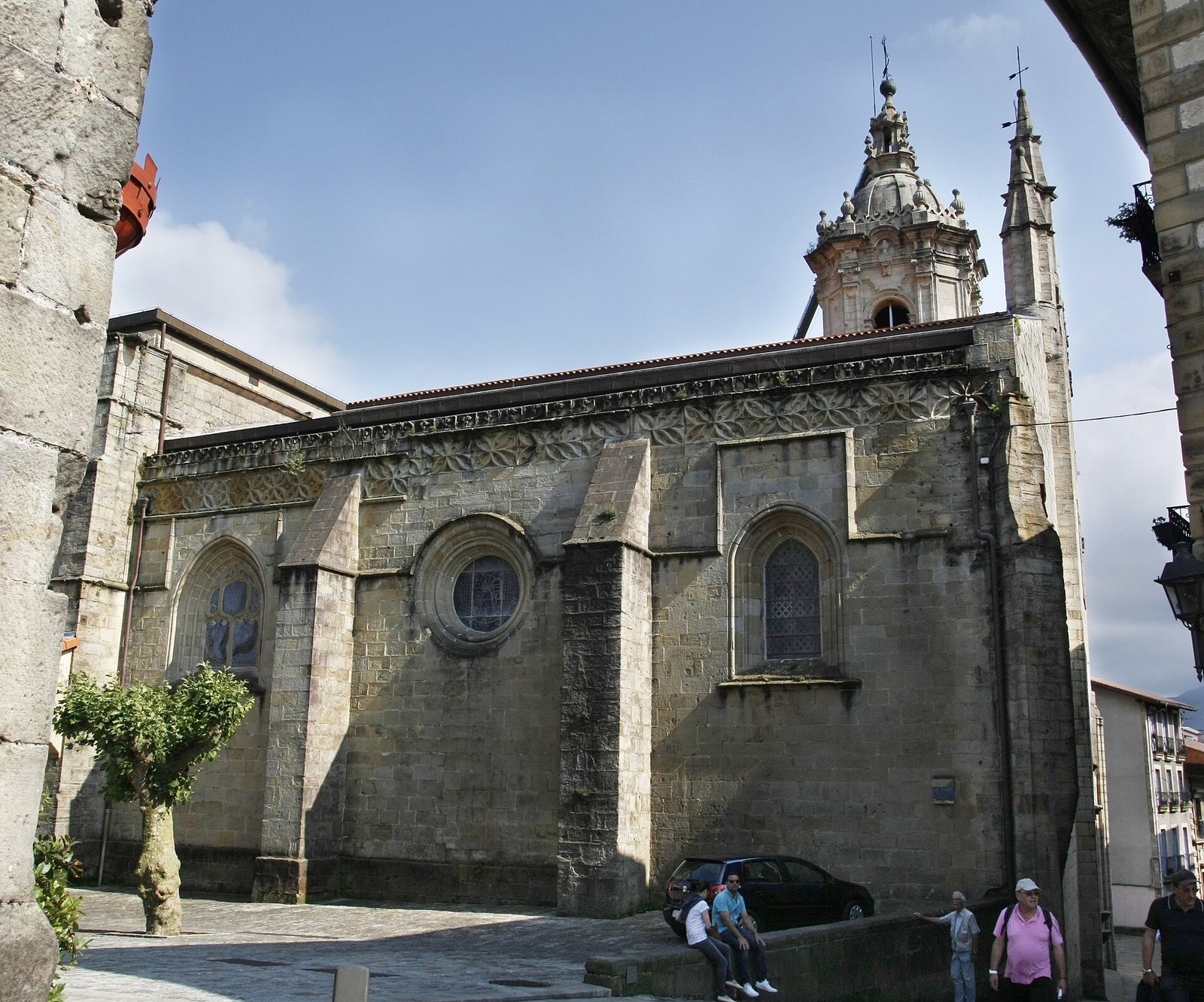
The church stands at the highest point of Hondarribia’s old town and has a cruciform plan, with a transept and three naves. Its interior measures 44 by 28 metres. Built into the medieval defensive walls, it retains a covered walk around the apse, the sanctuary end of the church. A tower house south of the building predates the church; it was incorporated into the structure and extends into the south aisle at the west end.
Interior structure and chapels
Naves and supports
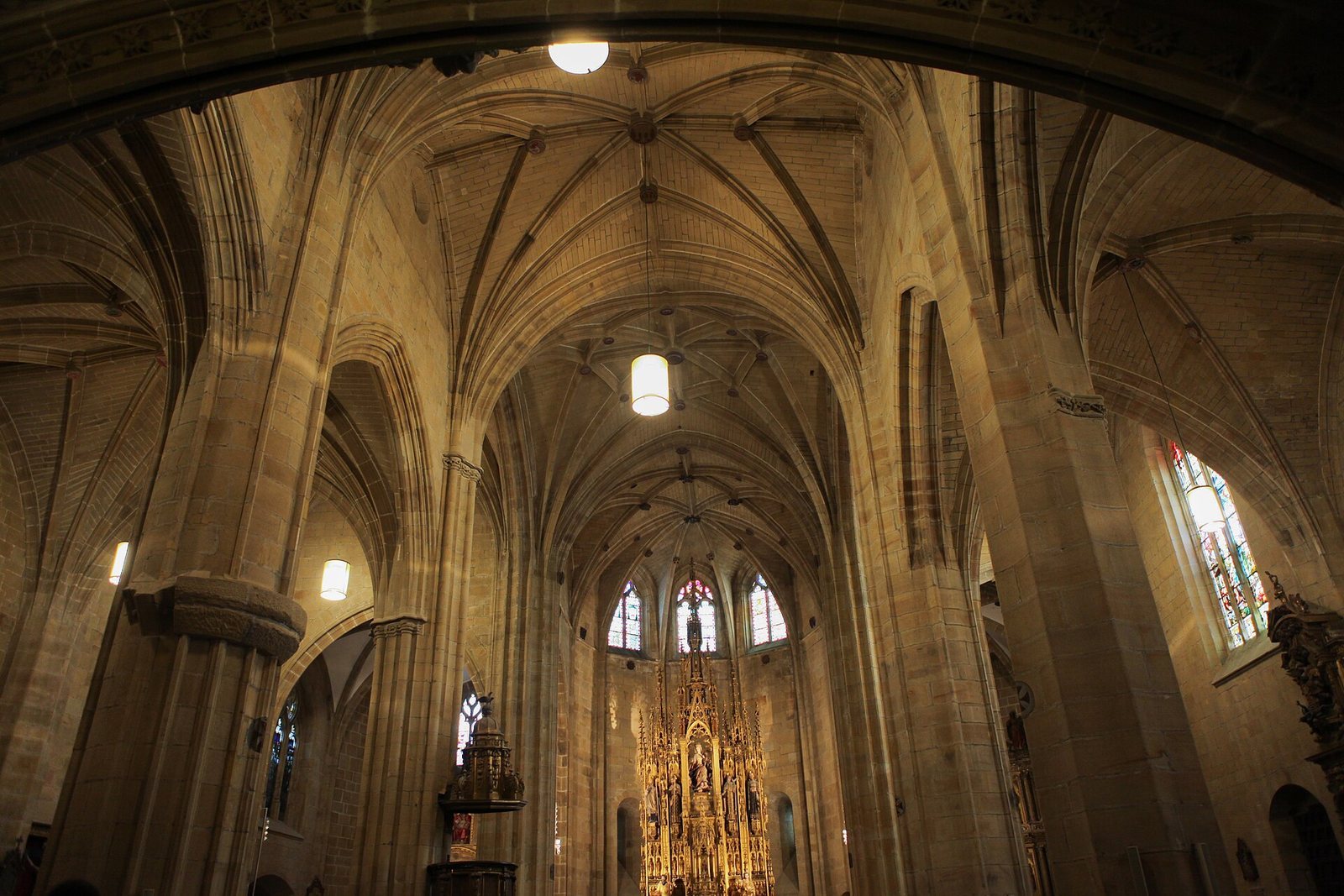
Eight pillars with cylindrical cores divide the three naves. The side naves are nearly as high as the central one, though they remain lower, producing a layout that approaches the hall-church form, in which side naves stand close in height to the central nave. The arrangement reflects the transition toward a Renaissance design characteristic of the Basque Country.
Vaults and choir gallery
The naves have ribbed vaults with varied patterns, including ribs that meet at angles. Beneath the choir gallery, a star-patterned vault has slender ribs and carvings of plants and animals. The arch supporting the gallery is also elaborately decorated. Its two supports differ in size and plan: the one on the left when facing the altar is more substantial, carrying the organ’s weight.
Chapels
A small chapel on the left side of the church is dedicated to Our Lady of Guadalupe and dates to the second half of the sixteenth century. The baptismal chapel dates to 1577. An inscription there associates its construction with the Brotherhood of Saint Peter and its chief steward, Sabat de Izaguirre.
Entrances and bell tower
Doorways
The oldest entrance is on the north side, beneath a protective porch. Three moulded bands follow the curve of its lowered arch, which is topped by an ogee arch with an S-shaped double curve. Ball ornaments and pinnacles decorate the upper portion. The entrance on Calle Mayor has a semicircular arch, with an image of the Assumption in the tympanum, the area above the doorway enclosed by the arch.
Bell tower
The bell tower rises from the thick walls of the former tower house. Its square base bears Hondarribia’s coat of arms and ends in a stone railing. Above it, a richly ornamented stage has cut-off corners; the tower is crowned by a dome with a lantern, a decorative ball, and a wrought-iron cross.
Sacristy and passages
The sacristy includes an underground passage that served as a refuge during sieges. A raised passage on the east façade leads toward the castle. Beside the sacristy, a spiral staircase gives access to this passage and to the vaults.
Altarpiece and heraldry
The present main altarpiece is Neo-Gothic. In the main chapel, carved arms of the Zarautz and Ganboa families appear on the arches and walls, reflecting the families’ association with the church’s construction.
Windows and stained glass
The town’s religious vows
The central apse has three tall lower windows with semicircular arches and three upper windows containing stained glass scenes connected with Hondarribia’s history. A window near the entrance depicts the 1620 oath by the Gipuzkoa General Assemblies, the province’s representative governing body, to defend publicly and privately the Immaculate Conception of Mary, the Catholic belief that Mary was preserved from original sin from the moment of her conception. Another window, in the right-hand nave beside the transept, portrays residents’ vow to Our Lady of Guadalupe, a Catholic title for the Virgin Mary, during the 1638 siege. Approved on 23 October 1911, it includes parish priest Auspicio Otaegi, municipal secretary Martin Etxeberria, and architect Jose Angel Fernandez-Casadevante.
Saint John of God
A window funded by the Congregation of Saint John of God depicts a story set in 1524. In the scene, Saint John of God falls from his horse while seeking supplies during a siege and sees the Virgin appear as a shepherdess. Although the window depicts him defending Hondarribia, Saint John of God never visited the town.
Apse and north-side windows
Three stained-glass windows in the apse show Hondarribia’s coat of arms, the arms of the two dioceses to which the town formerly belonged, and the Austrian coat of arms. Windows on the left side include circular and pointed forms; on the right are a circular window and newer stained-glass windows. Two renovated windows on the north façade depict Francis Xavier, a sixteenth-century Jesuit missionary, baptizing people in India and the marriage of Infanta Maria Theresa of Spain, an infanta being a Spanish royal princess who is not the heir apparent.