Village du Repos: A New Kingdom Rest Station for Royal-Tomb Workers in Egypt
Site at a Glance
- Popularity
- Very Low
- Country
- Egypt
- Primary era
- Bronze Age
- Eras represented
- Bronze Age, Modern
- Civilizations
- Egyptian
- Site type
- Domestic
- Remains
- House
On this page8 sections
History
New Kingdom station
Village du Repos, also called the Rest Station, served royal-tomb workers in Egypt’s Theban burial grounds during the New Kingdom, the era of the Eighteenth, Nineteenth, and Twentieth Dynasties. Crews from Deir el-Médineh, an Egyptian settlement associated with tomb builders, began work in the Valley of the Kings in the Eighteenth Dynasty, but the station was used during the Nineteenth and Twentieth. Workers could stay overnight during their ten-day work periods and rest during the hottest hours, avoiding the difficult journey of about half an hour to Deir el-Médineh. The station may have been used only when work was especially intense. It also functioned as a guard post controlling access to the Valley of the Kings. Its use ended when royal burials in the valley ceased.
Later use and archaeological investigation
Finds suggest that the site may have been reused in the Ptolemaic period, under the dynasty that ruled Egypt after Alexander the Great’s conquest, and later in the Coptic Christian and Arab periods. The Arab period in Egypt followed the seventh-century conquest.
Before excavation, worked flints from the pass prompted competing interpretations, including a Neolithic settlement, a Roman military occupation, and an early Christian hermitage. In 1935, the French Egyptologist Bernard Bruyère led an excavation for the French Institute of Oriental Archaeology. He cleared and recorded the remains, while objects and inscriptions in hieroglyphic and hieratic, a cursive form of ancient Egyptian writing, identified the settlement as a New Kingdom rest station. From 2008 to 2013, a University of Helsinki team led by Jaana Toivari-Viitala excavated the area, restored ruins, mapped the surroundings, and built a wall around the village. The work confirmed that the settlement stood on a site used in the Neolithic, an interpretation Bruyère had proposed in the 1930s.
Remains
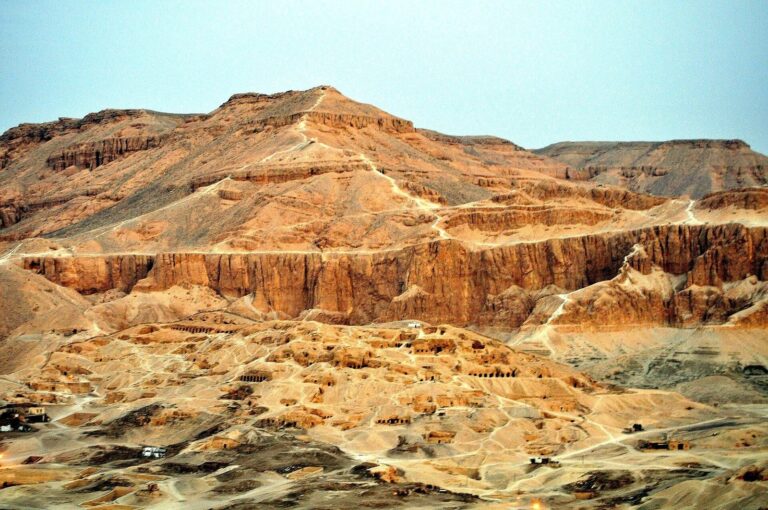
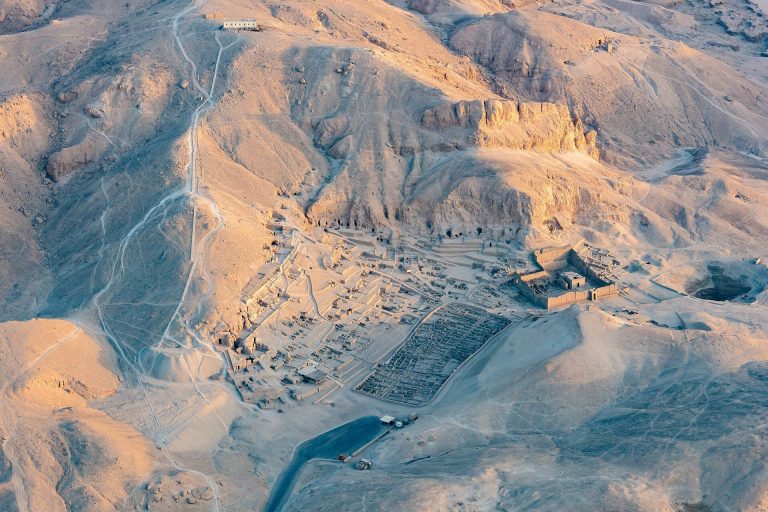
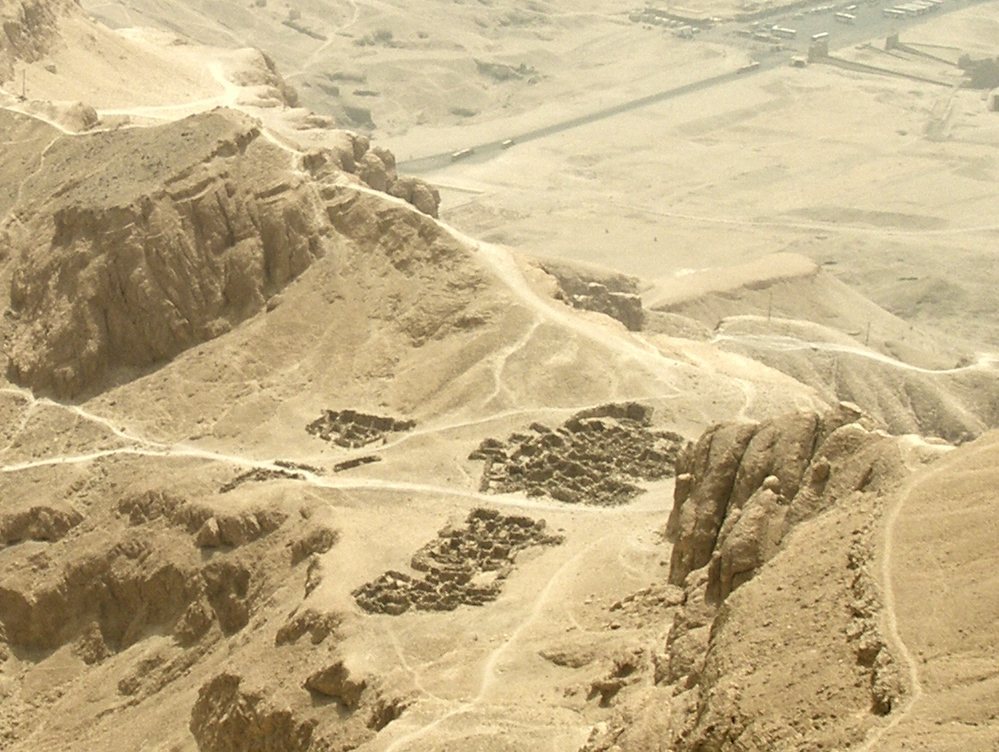
Village du Repos occupies a mountain pass on the west bank of the Nile, overlooking the Valley of the Kings to the north and the Valley of Colors to the southeast. The pass lies below a slope that rises to the Theban Mountain summit known as the Peak. A ridge path leads southwest toward Deir el-Médineh, another runs north to the Valley of the Kings, and a third goes west before curving south around the Peak. Ancient Egyptians called the pass “the field.” Three groups of dwellings were divided by the pass road, which served as the settlement’s central street. The huts were built from local mountain stone bonded with sandy mortar.
Dwellings
An early exploration counted 78 huts, though the village may have contained more during its pharaonic use. The dwellings adjoined one another, and their rooms and doorways followed irregular orientations rather than an apparent overall plan. Walls measured 35 to 50 centimetres thick. Each house was designed for one or two people and contained two cramped rooms: one held a limestone bench engraved with its occupant’s name, while the other had a stone bed or two beds set at right angles. A larger house was occupied by a scribe. The roofs probably stood no higher than two metres and may have been made from branches, perhaps strengthened with mortar.
Religious structures
Mountain chapel
South of the settlement, directly below the Peak, a chapel was built against the mountain slope. It was probably dedicated to Amun, a major ancient Egyptian god, in his Theban form known as “Amun of the Beautiful Meeting.” The chapel, and possibly the village as well, was called “the Beautiful Meeting.”
Worker-built shrines
About 200 metres from the village, near the path that curves west around the Peak, are roughly 200 small shrines built individually by workers from locally gathered stone. Dedicated to Amun, they are approximately cubic, with a central cavity for a stela, an upright stone slab that may bear an inscription or image. Each measures just under a metre across, and some have pyramidal tops. The Valley of the Kings tomb KV39 lies nearby; KV is the conventional prefix used in the valley’s tomb numbering system.