Dolmen de Llanera: A Neolithic Collective Burial Site in Spain
Site at a Glance
- Popularity
- Low
- Country
- Spain
- Primary era
- Stone Age
- Eras represented
- Stone Age, Bronze Age
- Civilizations
- Unclassified
- Site type
- Burial
- Remains
- Tomb
On this page7 sections
History
Dolmen de Llanera, in Lleida, Spain, is a collective burial site created by Neolithic communities in the form of a Catalan gallery grave, a type with a large rectangular chamber and a broad access passage. Radiocarbon dating places the monument in the Neolithic at about 2550 BC. It is broadly classified as Neolithic and Bronze Age; its cultural facies, an archaeological grouping within a culture, spans 3500 to 650 BC. The Bronze Age was a prehistoric period marked by the widespread use of bronze.
Neolithic burial and Chalcolithic reuse
The monument first served as a shared burial place in the Neolithic. It was used again for funerary practices throughout the Chalcolithic, or Copper Age, the period when megalithic construction reached its height in Catalonia. That peak of Catalan megalithism ended around 1500 BC.
Anthropological study of the burials estimates life expectancy at 26.4 years. The people associated with them lived in small communities, cultivated cereals, and relied mainly on raising cattle, sheep, and goats.
Later use and modern investigation
Finds point to possible renewed use of the monument as a dolmen in pre-Roman and Roman times. A third archaeological phase is dated to around the eighteenth century. More broadly, treasure seeking disturbed dolmens from the Iberian period, when ancient societies of the peninsula existed before and during Roman expansion, and continued in later times. This damage harmed megalithic monuments and made their interpretation more difficult.
Before its excavation, the monument was known as Torre dels Moros, meaning Tower of the Moors. It is also called Dolmen de la Vila de la Gola dels Bous. In 1916, Catalan archaeologist and priest Joan Serra Vilaró led the excavation while director of the Diocesan and Regional Museum of Solsona. The former district of Llanera became part of the municipality of Torà in 1968, and conservation and restoration work took place at the dolmen in 1974.
Remains
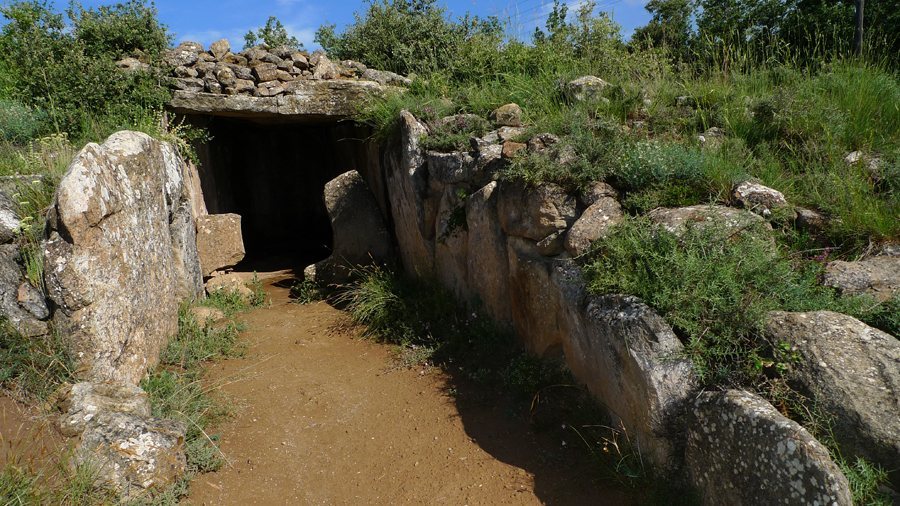
The monument stands at an elevation of 856 m near Vila de la Gola dels Bous, about 500 m east of its farmhouse and at the boundary with Llobera. A stone mound surrounds a covered gallery that contains an entrance passage and a central chamber.
Burial mound
The mound measures about 24 m across and is edged with upright slabs. The stones used in the monument reach about 2.45 by 2.20 m and are around 0.45 m thick; the lateral slabs are estimated to weigh about five tonnes.
Chamber and passage
The central chamber runs east to west and is formed by five closely fitted supporting slabs with several roof slabs. It measures about 4.6 m long, 1.9 m wide, and 1.75 m high. Its lateral-slab passage is about 5 m long, while the covered gallery as a whole measures 9 m in interior length, 1.9 m in width, and 2.3 m in height.
At the eastern, sunrise-facing entrance, a small chamber is divided from the passage by a perforated slab. A partly preserved opening in a slab gives access to the central chamber, and offerings for the dead were placed at the foot of the dividing stone.
Excavated finds
Excavations recovered ash, pre-Roman and Roman pottery, bone remains, and other materials. These finds are held in the collection of the Diocesan Museum of Solsona.