Karlsminde Longbarrow: A Neolithic Burial and Offering Monument

Site at a Glance
- Popularity
- Low
- Country
- Germany
- Primary era
- Stone Age
- Eras represented
- Stone Age
- Civilizations
- Unclassified
- Site type
- Burial
- Remains
- Burial Mound
On this page10 sections
History
Neolithic use
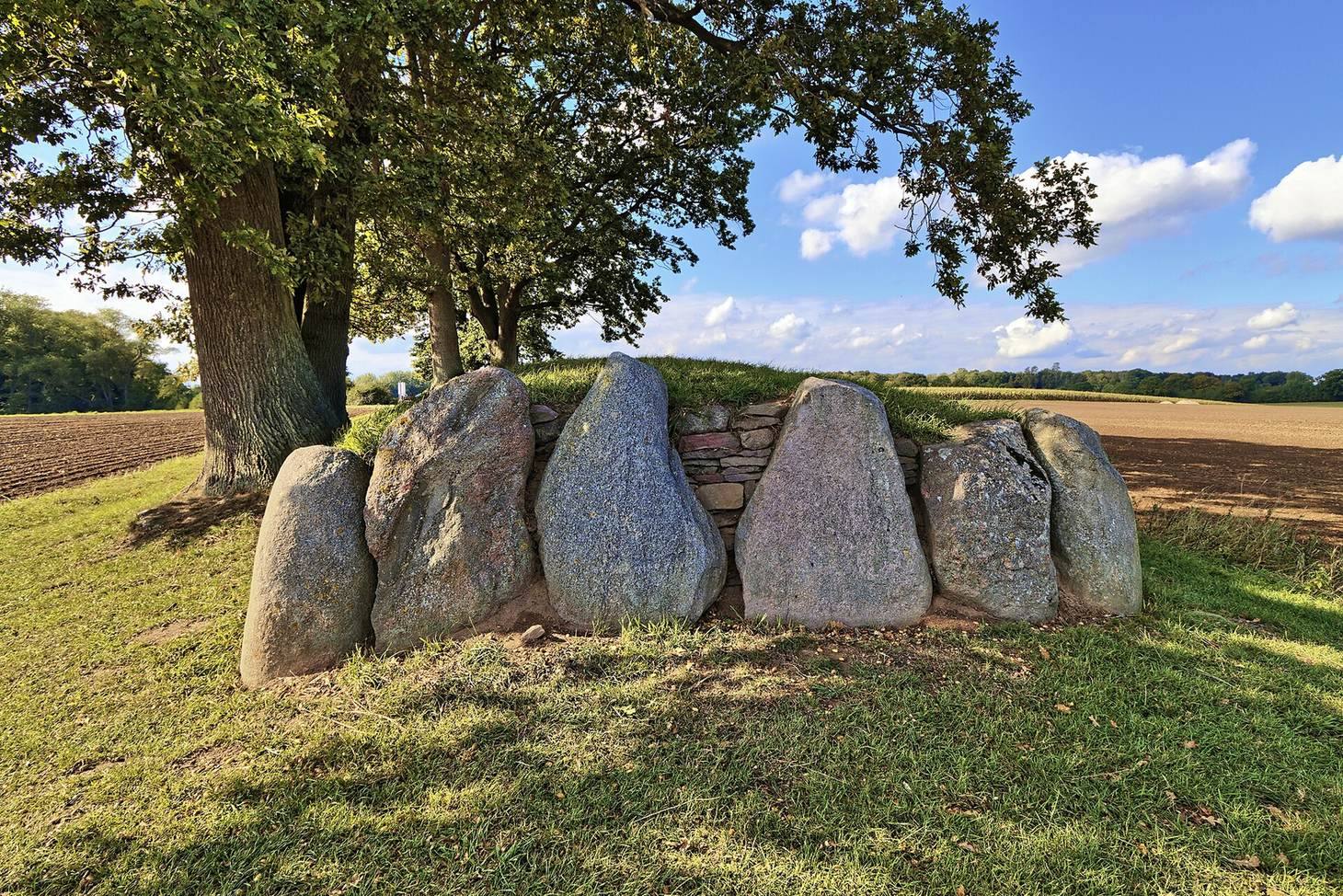
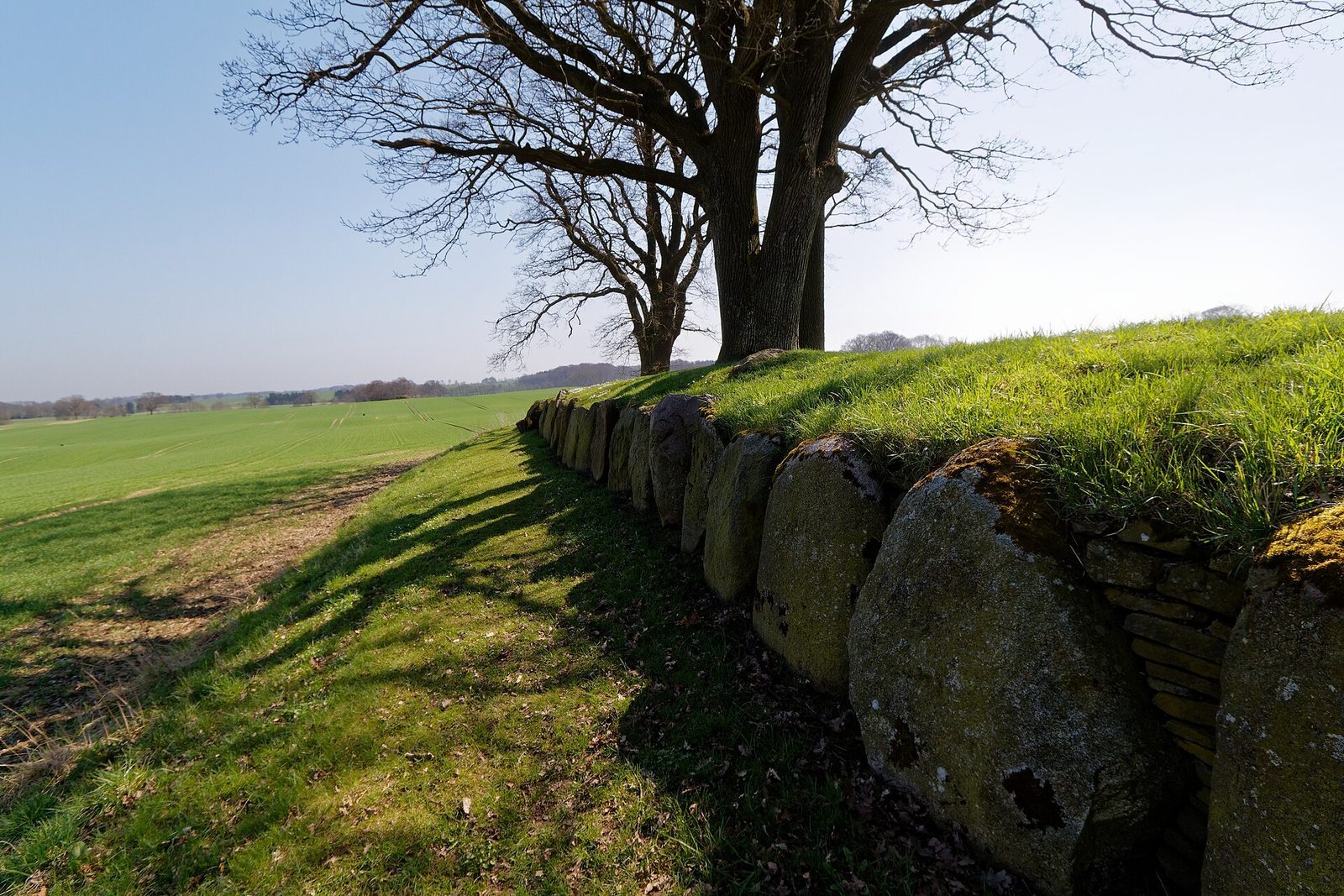
Karlsminde Longbarrow is a Neolithic megalithic burial monument at Karlsminde near Waabs, Germany, built by people of the Funnel Beaker culture between 3500 and 2800 BC. This culture was a northern and central European Neolithic tradition named for its characteristic pottery. A longbarrow is an elongated earthen burial mound, often bounded by stones. Karlsminde served both as a burial place and as a site for offerings. Pottery fragments found along its southern side have been interpreted as possible evidence of a particular offering practice.
Investigation and interpretation
From 1976 to 1978, the Working Group for Prehistory and Early History of the Eckernförde Local Heritage Association investigated and restored the monument under the supervision of the State Office for Prehistory and Early History in Schleswig. The work revealed the middle dolmen and showed that it had first stood within a round mound, later incorporated into the longbarrow. The monument is listed as Sprockhoff no. 66, a number in Ernst Sprockhoff’s catalogue of German megalithic tombs.
Remains
Layout and stone enclosure
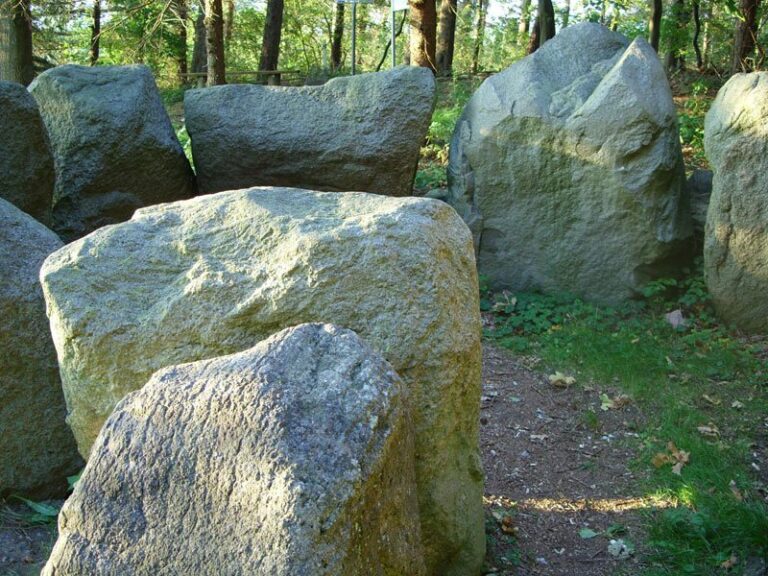
The longbarrow extends east to west and is enclosed by stones. Three rectangular dolmens, megalithic burial chambers made from upright stones and large covering stones, sit crosswise within it, each with an entrance facing south. After restoration, the enclosure measured 57 by 5.3 metres; the mound itself is 57 metres long, 6.5 metres wide and about 2 metres high. Its boundary comprised 108 stones, reaching up to 2.5 metres in height. Foundations helped establish the positions of stones that had fallen or disappeared. Several southern stones remain standing, while most surviving perimeter stones toppled outward and became covered by mound material. Clay-coated stonework survives between stones in better-preserved sections. One boundary stone bears a cup-shaped mark, and a pit dug to obtain marl, a clay-rich earth, disturbed the northwestern area.
Burial chambers
Western dolmen
The western chamber has two supporting stones along each long side, an end stone, a half-height entrance stone and two covering stones. The smaller covering stone split and slid into the chamber. The slightly trapezoidal interior measures 2.1 by 1.4 metres and is 1.1 metres high; its entrance area is angled slightly. A floor of stones ranging from fist-sized to roughly twice that size lay beneath burnt flint. Finds on the floor included five arrowheads, a flint knife and fragments of Funnel Beaker pottery.
Middle dolmen
The middle chamber is rectangular, with two supporting stones on each long side, an end stone and a half-height entrance stone. Its interior measures 2.2 by 1.15 metres and is 1.35 metres high. Stones found at the entrance may have blocked the opening. Curving floor paving was coated with clay bearing clear traces of burning, with a 5-centimetre layer of burnt flint above it. Firmly compacted clay lay beneath the upper soil; larger stone blocks were found higher in the fill. A fragment of an amber bead came from a corner, and a quernstone, used to grind grain by hand, was found just outside the entrance.
Eastern dolmen
The nearly square eastern chamber measures 2.1 by 2 metres inside and is 1.4 metres high. Its seven supporting stones include two split from a single block. Each long side has a larger and a smaller stone, with the larger stones to the north. Two end stones of roughly equal width stand on the north side. At the entrance, a half-width end stone occupies the western side beside a half-height entrance stone. A single covering stone, measuring 2.7 by 2.8 by 1 metre, rests over the chamber; broken sections leave it insecurely seated. Remains of stonework survive at the northeast corner. A thin clay floor coating bears traces of burning and lies beneath burnt flint, with sand at the base. The upper 1.15 metres of fill consists of loose humus, or organic-rich soil, above a firmer layer of humus and clay.
Finds and evidence of later activity
Quernstones lay beneath three gaps in the enclosure, and five more came from the mound fill. Outside the chambers, excavators found flint flakes and tools, including scrapers, drills and cores, as well as part of a polished axe on the north side. A destroyed stone setting along the southern boundary, between the middle and eastern chambers, contained fragments of a Late Bronze Age urn and cremated human remains. South of the eastern chamber, burnt flint and pottery included Neolithic and Bronze Age sherds, with most fragments dating to the Iron Age. Charcoal and burnt layers occurred in excavated earth across the site. In the area disturbed by the marl pit, seven pits beneath the topsoil contained finds from the Early Roman Imperial period, the early centuries of Roman imperial rule.