Megalithic Tombs near Diesdorf: Neolithic Burial Monuments in Germany
Site at a Glance
- Popularity
- Very Low
- Country
- Germany
- Primary era
- Stone Age
- Eras represented
- Stone Age
- Civilizations
- Unclassified
- Site type
- Burial
- Remains
- Necropolis
On this page14 sections
History
Neolithic burial ground
The Megalithic Tombs near Diesdorf are a group of Neolithic burial monuments in Germany, dating to about 3700–3350 BCE and associated with the Deeply Incised Pottery culture, named for the incised decoration on its pottery. Ten tombs belonged to the group. Three survive, while the other seven were destroyed during the nineteenth century.
Early records and nineteenth-century losses
Brandenburg historian Johann Christoph Bekmann mentioned the tombs in his 1751 history of Brandenburg and included illustrations of some of them. In 1843, regional historian and antiquarian Johann Friedrich Danneil carried out the first systematic survey of megalithic tombs in the Altmark, a historic region in what is now northern Saxony-Anhalt. He recorded eight tombs at Diesdorf.
In the early 1890s, prehistory researchers Eduard Krause and Otto Schoetensack revisited the group. Six tombs described by Danneil had since been destroyed. The researchers also identified one further surviving tomb and one additional destroyed tomb. One of the latter, KS 71, was destroyed in 1867.
Later survey and regional traditions
In 2003–04, the State Office for Heritage Management and Archaeology of Saxony-Anhalt, the Johann Friedrich Danneil Museum in Salzwedel, and the Young Archaeologists of the Altmark association jointly surveyed and measured the Altmark’s surviving megalithic tombs.
Local traditions link the monuments with buried wealth. One story tells of a giant king laid to rest in a tomb with immense treasure, which repeated searches failed to find. Another describes Robbers’ Hollow, or Rüverkule, an earthwork-enclosed pit where robbers hid and attacked travelers. The story may refer to a megalithic tomb from the time when its mound still covered the stones.
Remains
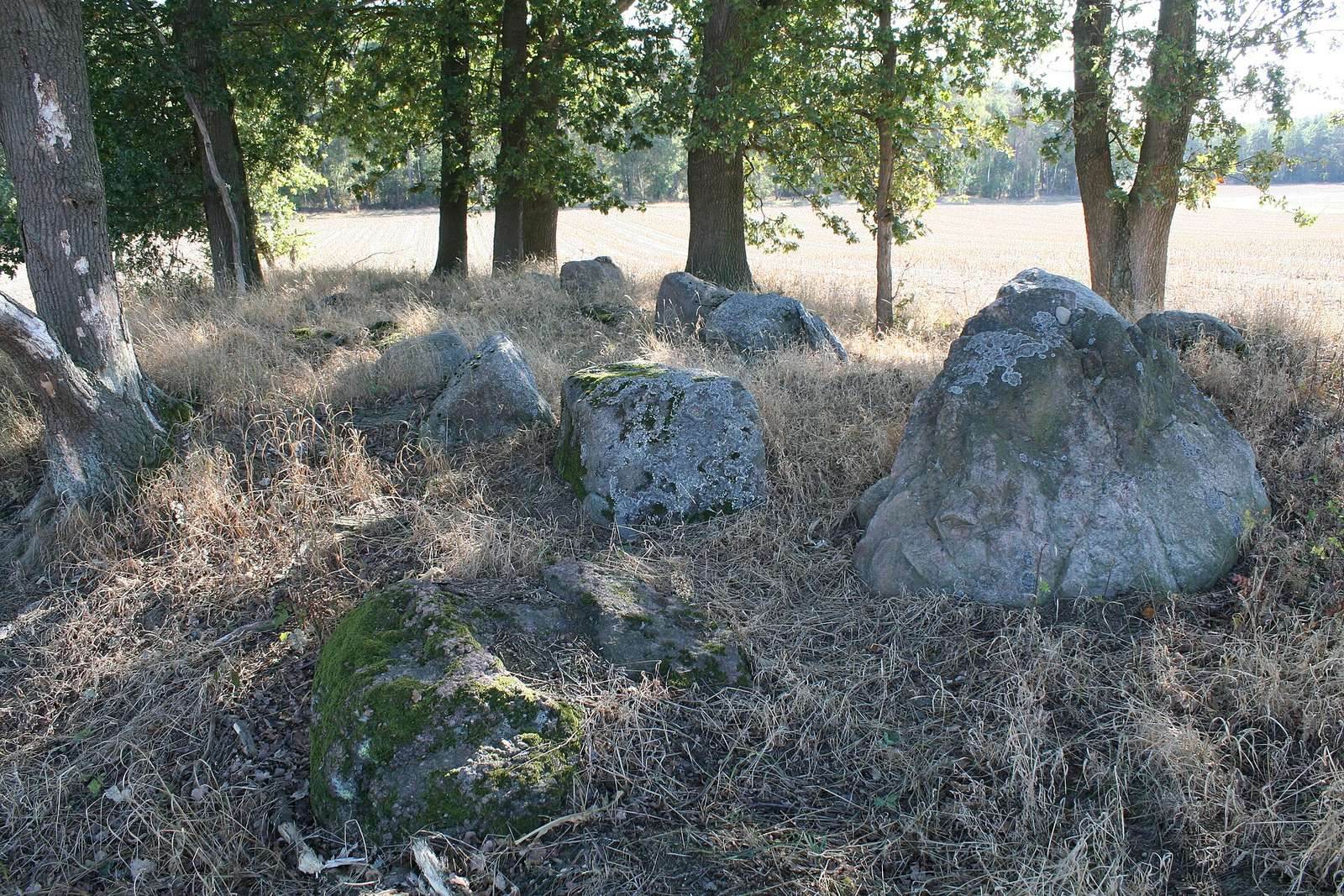
The surviving tombs lie southwest of Diesdorf, scattered across fields and woodland. Tomb 1 is about 900 m southwest of the village center, south of the road to Waddekath. Tomb 2 stands in a field about 1.3 km south-southwest of the center and 900 m southeast of Tomb 1. Tomb 3 is in a small wood about 1.6 km south-southwest of the center and 280 m south of Tomb 2. Nearby groups include the tombs at Schadewohl, about 1.1 km northwest of Tomb 1, and the tomb at Molmke, about 530 m southeast of Tomb 2. Three monuments survive at Schadewohl and two are destroyed; Molmke’s tomb is the sole survivor of at least ten originally.
Surviving tombs
Tomb 1
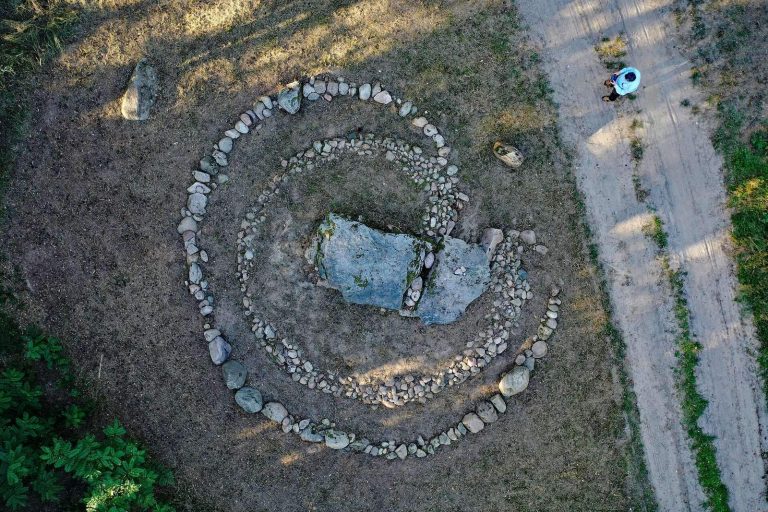
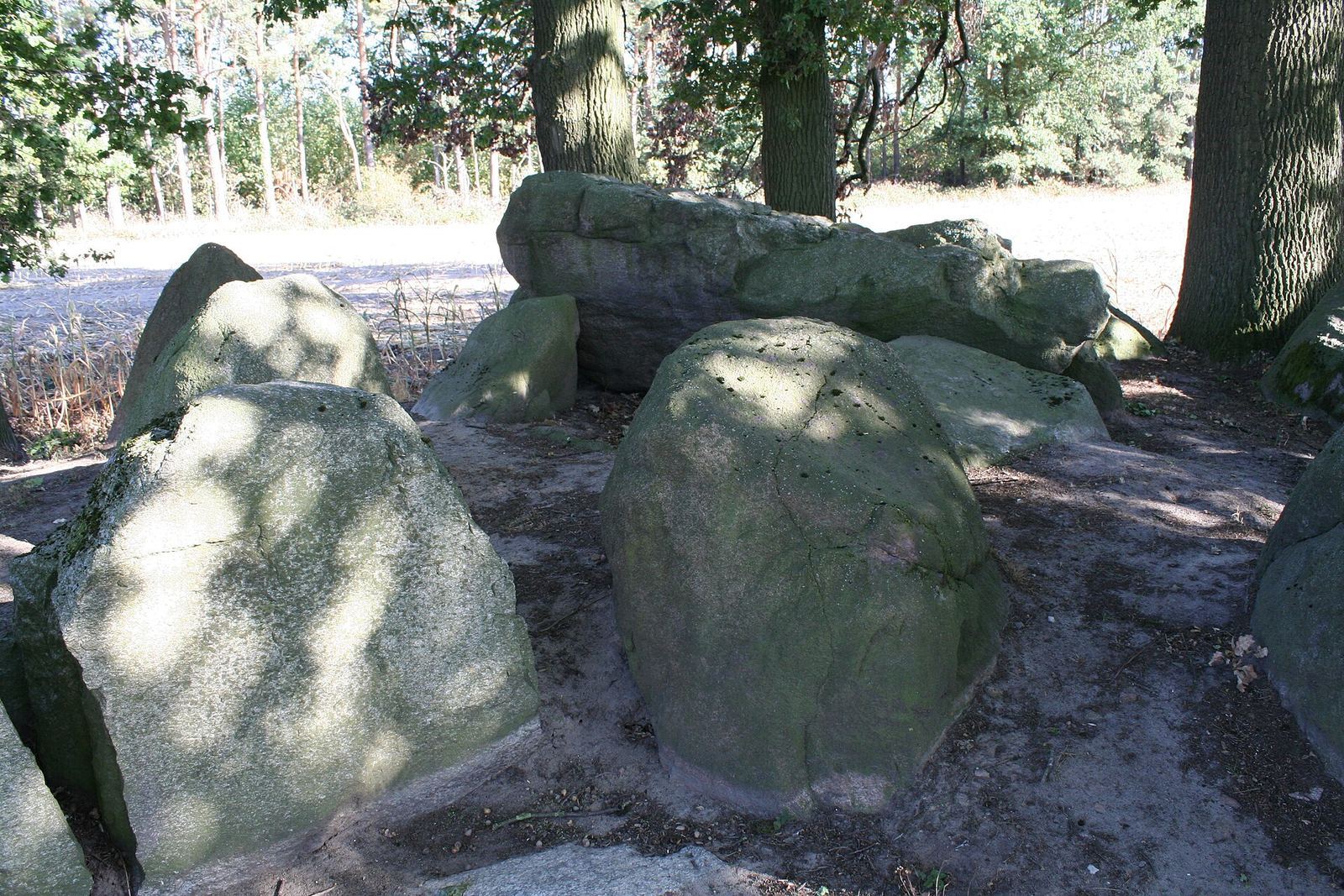
The classification of Tomb 1 is disputed. Hartmut Bock, Barbara Fritsch, and Lothar Mittag identify it as a great dolmen, a large megalithic burial chamber, while Hans-Jürgen Beier considers a passage grave, a chamber reached through a passage, more likely. An oval mound rises 1.5 m. The enclosure, probably oval originally, is aligned northwest to southeast and now consists of seven stones. It measures 7.8 m. The chamber follows the same alignment and is rectangular, with interior dimensions of 6.4 by 1.4 m.
Nine upright wall stones and four roof stones survive. A further roof stone may once have been present. The largest measures 3.1 by 1.4 m and has three small, cup-shaped hollows in a row. Most wall stones have fallen, one is broken, and the roof stones have subsided. Investigations around 1890 found a flint chisel near the tomb. Two axes, a stone hoe, and two flint axes were discovered there later.
Tomb 2
Tomb 2 is probably a passage grave. Its mound is elongated, and its enclosure, aligned north to south, now has eight stones. The original enclosure was probably rectangular or trapezoidal. Danneil measured it at 24.5 by 10.0 m in 1843. The central stone on its east side had been split into eight pieces using wooden wedges, and another stone has several wedge holes. A further split stone, northeast of the chamber, lies in at least 15 fragments and may have served as a guardian stone.
The rectangular chamber is also aligned north to south. It measures 9.3 m long and 1.8–2.0 m wide. Thirteen of its original 16 wall stones survive. Danneil counted four roof stones. Two parallel wall stones on the chamber’s west side may indicate the entrance.
Tomb 3
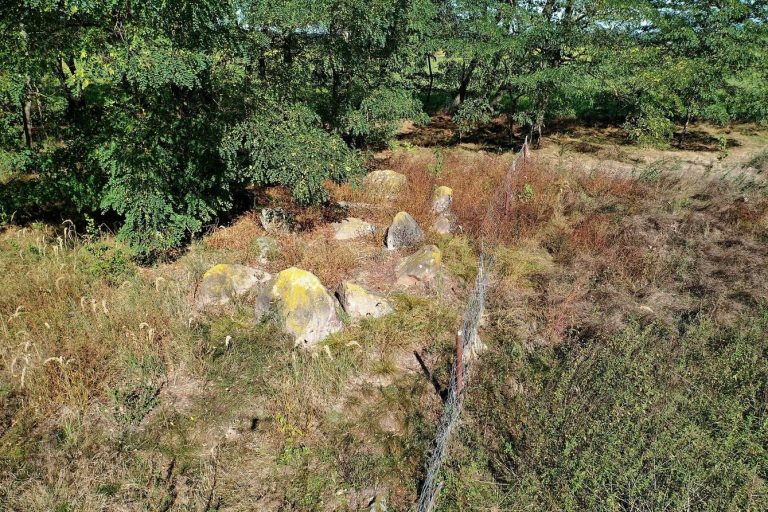
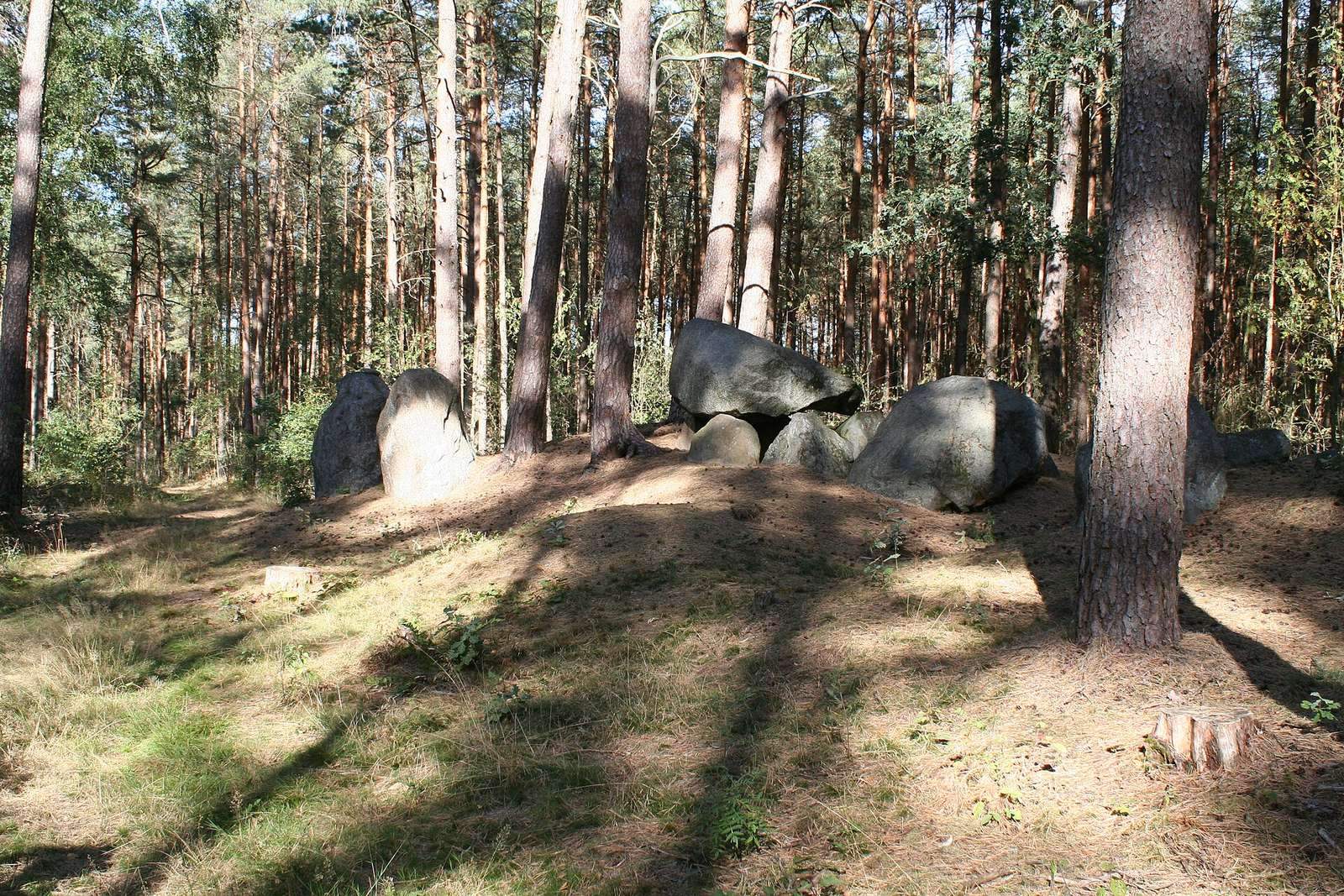
Bock, Fritsch, and Mittag classify Tomb 3 as a great dolmen, while Beier considers it a passage grave. Its elongated mound is now 1.5 m high and has spread well beyond the enclosure. The enclosure, aligned north-northwest to south-southeast, now consists of three stones and was probably rectangular or trapezoidal.
The chamber shares the enclosure’s alignment and is trapezoidal. It is at least 8.7 m long, 1.5–1.7 m wide, and 1.0 m high. Ten wall stones and three of what were probably six original roof stones survive; the wall stones have very flat inner faces. The largest roof stone measures 2.6 by 1.8 by 1.2 m, and two have cup-shaped hollows. A groove on the inner face of the northwest end-wall stone is 60 cm long, 2 cm wide, and 2 cm deep. A gap between two wall stones at the chamber’s northwest corner may mark the entrance. A flint axe was found inside during cleaning work in the 1980s.
Tombs described before their destruction
Nineteenth-century survey records preserve details of several tombs that were later destroyed. They describe their former positions, dimensions, enclosures, chambers, and roof stones.
KS 62 and KS 63
KS 62 stood near the boundary with Schadewohl, about 300 m from the destroyed tomb Schadewohl 5. Its chamber measured 7.5 by 3.5 m. During Danneil’s investigation, two roof stones, each 2.5 m long, were still in place. About 75 m east, KS 63 had an elongated mound measuring 12 by 8.2 m. Danneil found its stone enclosure preserved along one long side, while a single stone stood on the other. Two roof stones, 2.8 m and 2 m long, almost entirely covered its chamber.
KS 64 and KS 65
KS 64 stood southwest of Diesdorf at the foot of Molmker Berg, close to Tomb 2. Its elongated mound measured 11.3 by 7.8 m, and part of its enclosure survived when Danneil surveyed it. He recorded a roof stone measuring 2.8 by 1.25 m. KS 65 lay about 75 m southeast of KS 64. Its mound probably ran east to west and measured 8.2 by 5.3 m. Three roof stones, each 2.2 m long, covered its chamber. It was probably a great dolmen or passage grave.
KS 68 and KS 69
KS 68 stood about 450 m south of Tomb 3. Its large, north-south elongated mound measured 42 by 7 m. During Danneil’s survey, the enclosure remained well preserved, with stones rising as much as 2.2 m above ground. Two guardian stones, prominent stones at enclosure corners or ends, marked the northern end and measured 3.8 m and 3.1 m high. Six roof stones covered the chamber. The three largest measured 2.7 by 1.7 by 1.25 m, 2.7 by 1 by 0.5 m, and 2.8 by 1.7 by 0.9 m. Beier considered the tomb probably a passage grave. KS 69 lay about 375 m south of KS 68 and 1.1 km north of Lindhof. Its chamber, probably aligned north to south, measured 5.4 by 2.2 m. Danneil noted a roof stone at its southern end.
KS 71
KS 71 stood immediately beside Tomb 1. Several flint axes came to light when the ground at its location was ploughed after the tomb’s destruction.