Eckerö Church: A Medieval Parish Church in Åland, Finland
Site at a Glance
- Popularity
- Medium
- Country
- Finland
- Primary era
- Medieval
- Eras represented
- Medieval, Early Modern, Modern
- Civilizations
- Grand Duchy of Finland, Russian, Swedish
- Site type
- Religious
- Remains
- Church
On this page18 sections
History
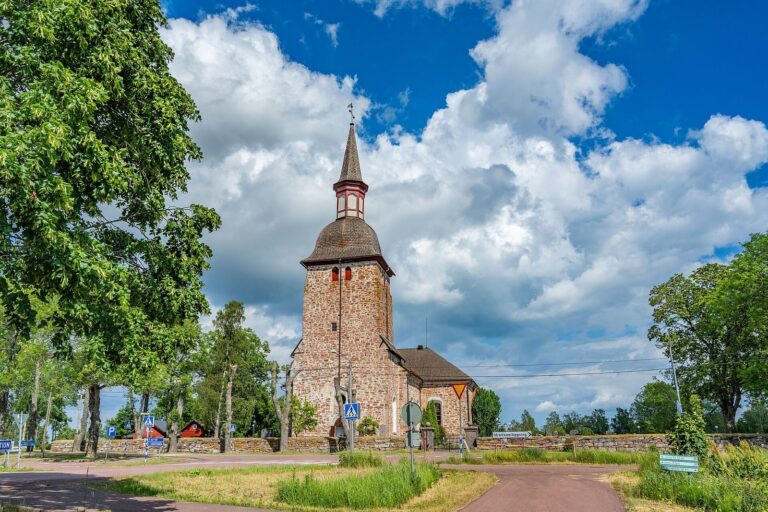
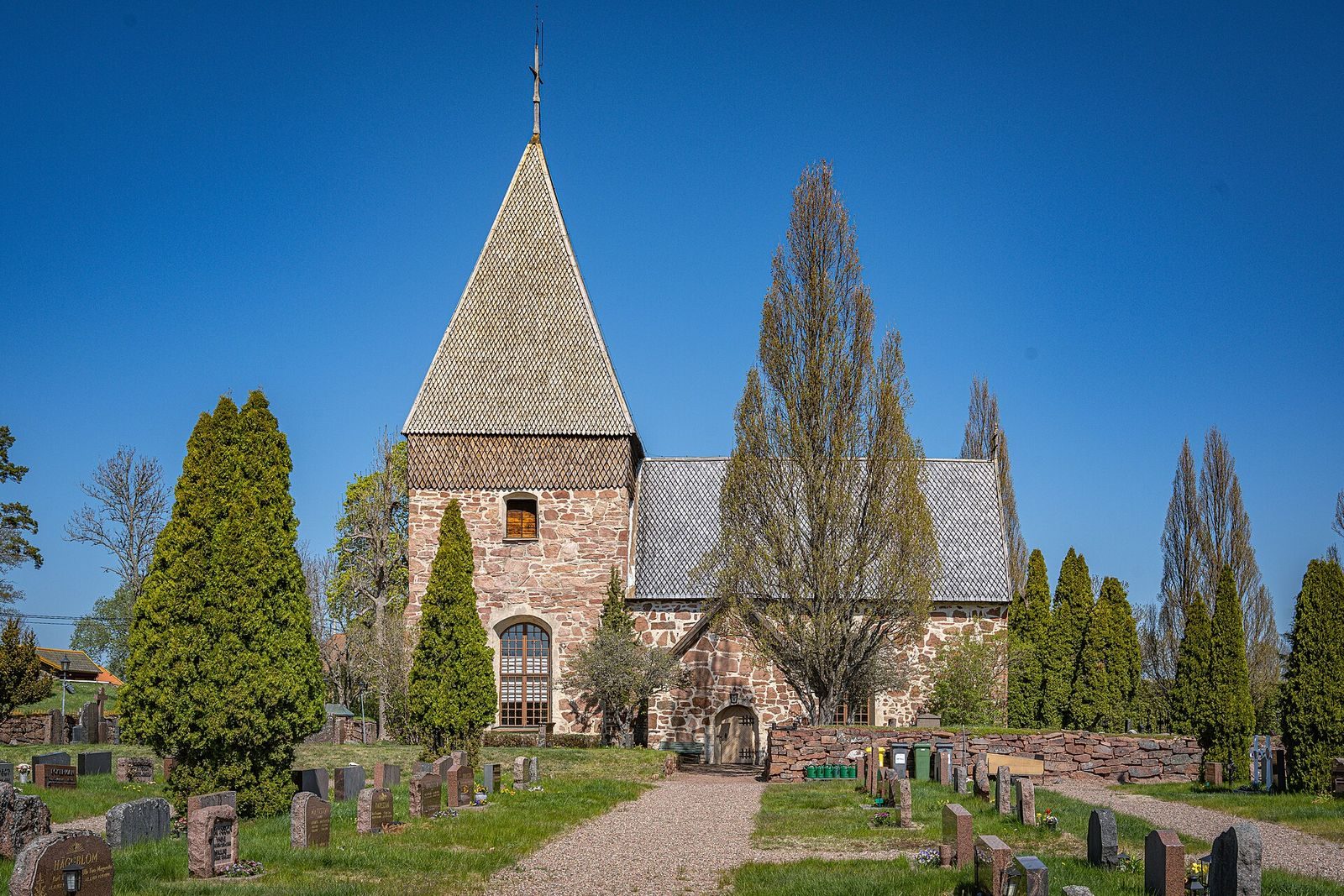
Eckerö Church is a medieval stone parish church in Eckerö, Åland, Finland, dedicated to St Lawrence, an early Christian martyr venerated as a saint. Its precise construction date is unknown, and it may also have served as a place of devotion for seafarers.
Early church and parish
Coins and burials point to activity before the stone church, probably at a smaller wooden chapel. Eckerö was recorded in 1325 as a chapel belonging to Hammarland parish. It became an independent parish in 1431, later returned to Hammarland’s jurisdiction, and regained independence in 1877 with its own priest. Before that final change, the church served as a chapel under Hammarland’s St Catherine’s Church.
Religious change and wartime damage
The church was originally Roman Catholic. The Reformation, a 16th-century movement that divided Western Christianity and led to Protestant churches including Lutheranism, was followed by a period of decline. In the 17th century the church was repaired, with new pews and a pulpit, and its wooden crucifix was renewed. During the Russian occupation of 1713–1721, known in Finnish history as the Great Wrath, the church was damaged and looted.
Later use and restoration
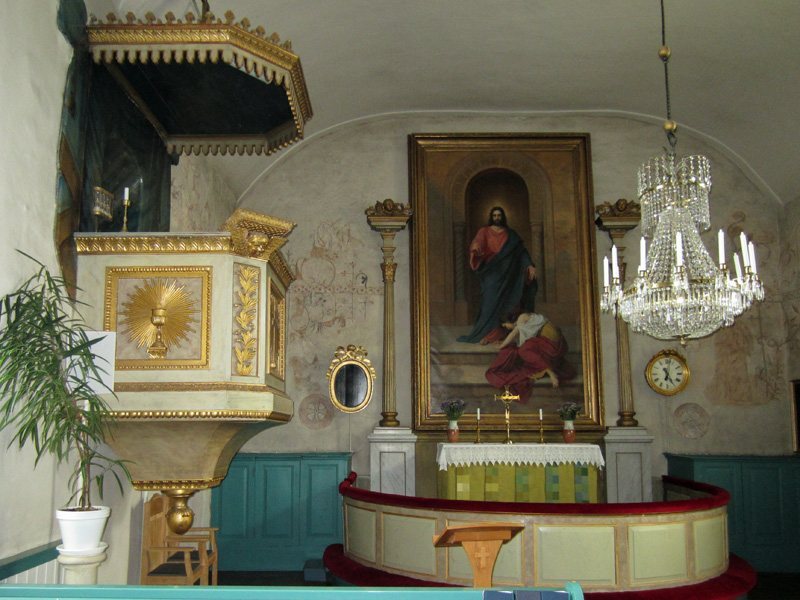
In the 19th century the church underwent further alterations and received a new altarpiece. Bernhard Reinhold painted the present work in 1876. After it was exhibited in Paris, it was purchased in Stockholm and carried by mail boat from Grisslehamn in Sweden to Eckerö.
Today Eckerö Church is an Evangelical Lutheran parish church in the Diocese of Borgå, a diocese of the Evangelical Lutheran Church of Finland; Borgå is the Swedish name for Porvoo. Renovation in 1950–1951 brought medieval wall paintings to light, and an archaeological investigation followed in 1952. Work in 1988 included repainting the interior, cleaning the altar, and restoring the paintings. The church is protected and appears in the Åland archaeological sites register.
Remains
Church fabric and layout
Plan and tower
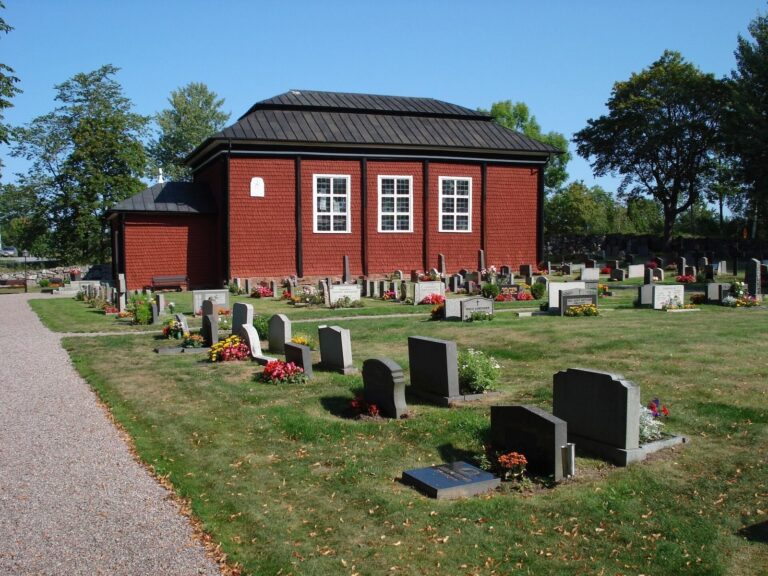
The church is built of red Åland rapakivi, a coarse-grained granite. Its rectangular nave, the main body of the church, runs east to west. The interior measures 13.3 by 7.4 metres, the walls exceed a metre in thickness, and seating is given as approximately 275. The nave is the oldest part. A broad, relatively low tower was added at the west end and completed in 1467; its masonry indicates that it postdates the nave. The main entrance is in the tower, whose medieval pyramid-shaped roof is covered with wooden shingles. The nave roof is also shingled.
Entrances and service spaces
The medieval south porch has niches on both its inner and outer walls, while a shallow niche sits in the south church entrance. A sacristy, a room for preparing services and storing liturgical objects, occupies an extension on the northeast side. An opening in the north wall connects the sacristy with the pulpit.
Interior and galleries
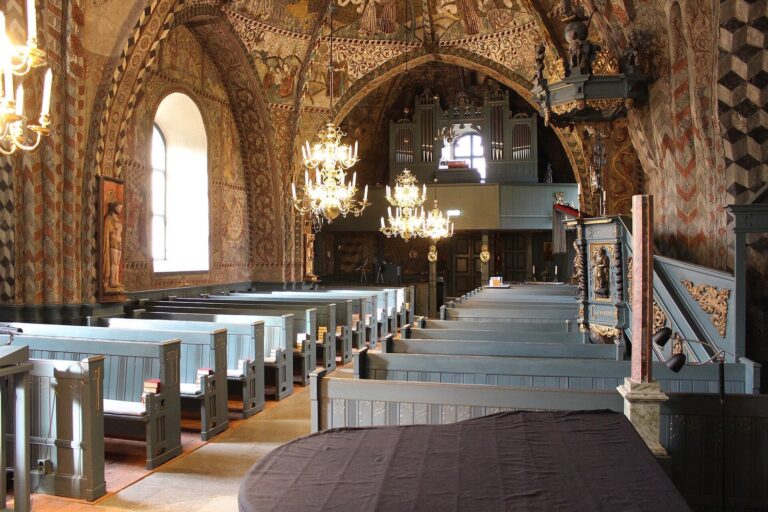
The tower and nave open into one interior beneath a wooden barrel vault, a continuous arched ceiling. Large windows occupy the north and south walls. The east window in the chancel, the area around the altar, was bricked up in 1908 to make room for Reinhold’s altarpiece. The original wooden ceiling stood 60 centimetres higher than the lowered ceiling; the lower surface was painted blue in an effort to make the interior feel warmer. The larger gallery, built in 1787, had a partition separating men and women. A smaller gallery was added in 1860 for the first organ.
Medieval paintings and furnishings
Wall painting and baptismal font
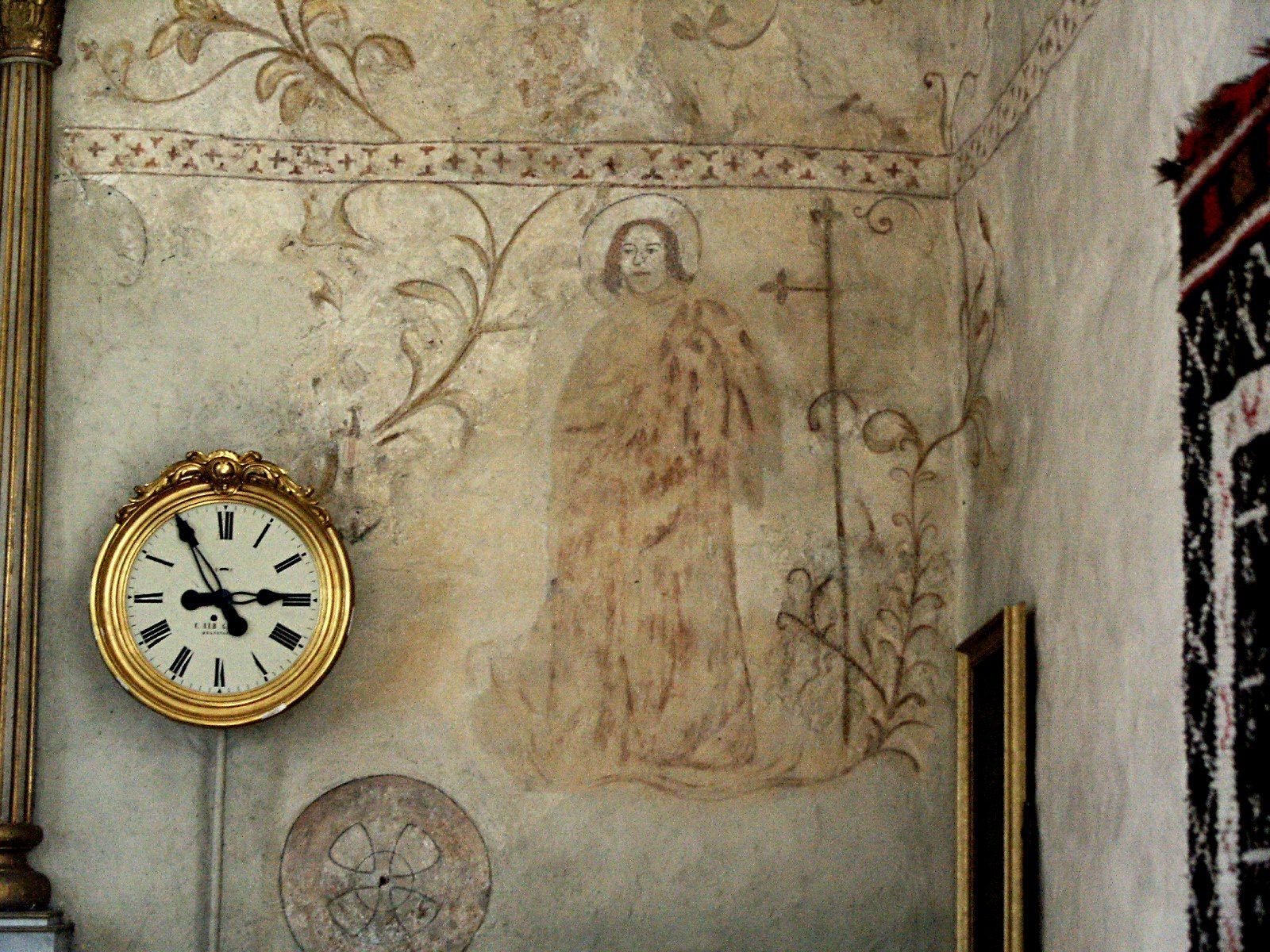
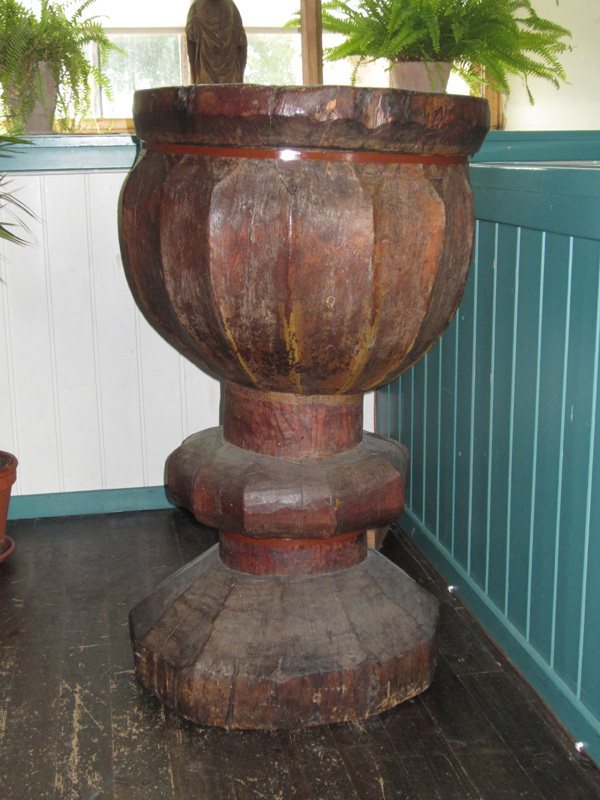
Late-medieval wall paintings include a bishop beside a baptismal font, and the font shown may represent the church’s own. The wooden font is fashioned from a thick pine trunk and has a shell-inspired design. It is broadly dated to the late Middle Ages.
Madonna and Child
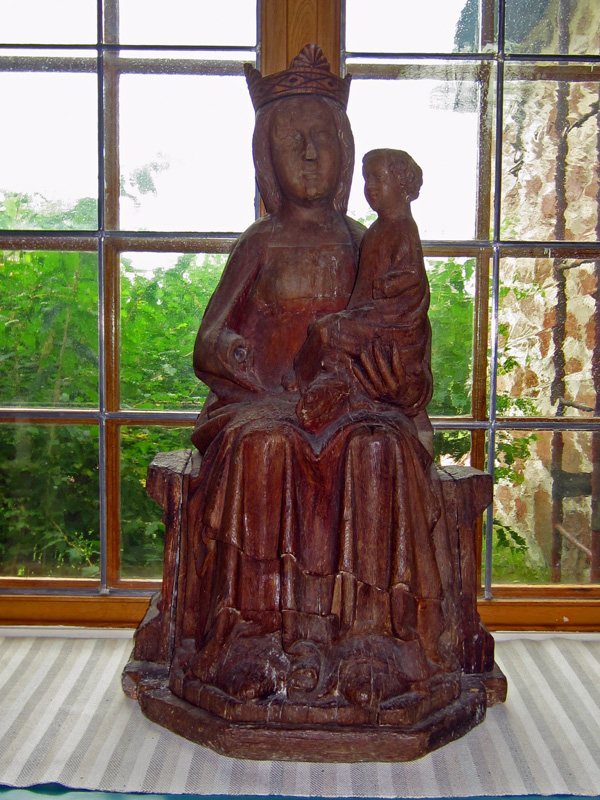
A wooden image of the Madonna and Child, Mary with the infant Jesus, came from Gotland and dates to around 1300. Later details were added to the crown. A faint blue trace remains in the Child’s eyes from the original paint, and the hair was restyled in the 16th century.
Crucifix and bell
A 14th-century wooden crucifix hangs on the north side of the church. It is a triumphal cross, a large crucifix traditionally placed between the nave and sanctuary. After a long period stored in the attic, it was reassembled by conservator Oskari Niemi. The small church bell dates to the early 13th century, earlier than the stone church.
Altars, pulpit, and other furnishings
Altars and pulpit
The present altarpiece, Christ and the Sinner, occupies the east end of the church. The earlier painting, made in 1821 by Lieutenant V. R. Brummer of Storby, depicted the Last Supper. Its original was moved to the gallery in 1876 and destroyed in a fire in 1930; a copy by Eckerö artist Berit Hartvik hangs beneath the gallery. Carl Ludvig Engel, a German-born architect known for his work in Finland, designed the pulpit and altar. The pulpit was made in 1840, gilded in 1843, and fitted with a clock.
Organs
Adam Ravander built an organ in 1861, originally placing it on the south gallery. In 1927 the Kangasala Organ Factory supplied a replacement with seven stops, each controlling a set of pipes with a particular tone; Ravander’s instrument was removed but kept. The Kangasala organ was dismantled in 1974, when organ builder and restorer Hans Heinrich installed an instrument with seven manual stops and a pedal. Heinrich also restored the Ravander organ, which returned to its original position in 1983. A digital Allen organ was installed on the west gallery in 1990, behind the Kangasala organ facade.
Statues and votive ship
A statue of St Sebastian, an early Christian martyr traditionally revered as the patron saint of hunters, stands beside the gallery door. A statue of St Erasmus of Antioch, a bishop and martyr traditionally regarded as a patron saint of sailors, occupies a niche in a south window. A votive ship, a model offered as a religious dedication, commemorates generations of Eckerö seafarers.
Surrounding archaeological setting
An Iron Age burial ground lies north of the church. A postal route ran north of it in the 17th century and may earlier have served as a pilgrimage route.