Ospedale del Ceppo: A Medieval Hospital in Pistoia, Italy
Site at a Glance
- Popularity
- High
- Country
- Italy
- Primary era
- Medieval
- Eras represented
- Medieval, Early Modern
- Civilizations
- Grand Duchy of Tuscany, Holy Roman Empire, Republic of Florence
- Site type
- Civic
- Remains
- Hospital
On this page13 sections
History
Ospedale del Ceppo is a historic hospital in Pistoia, Italy, traditionally founded in 1277 to care for poor and sick people. Its origins are linked to the Company of Santa Maria, and its buildings developed from a medieval core into a complex with a monumental Renaissance form. It became Pistoia’s principal hospital during the Black Death and continued as the city’s hospital until 2013.
Foundation and civic control
Tradition credits the foundation to the Company of Santa Maria, also called the Company of the Poor’s Offering Trunk. It is also associated with the Disciplinati of Santa Maria del Ceppo, a lay religious confraternity whose members practiced penitence and charitable work. Written records concerning the hospital date from 1286. Two explanations are offered for its name. In one legend, a stump blossomed miraculously in winter, and, after an apparition of the Virgin Mary, showed Antimo and Bendinella where to build the hospital. Alternatively, the name may refer to a hollow chestnut stump used to collect charitable offerings, as at other Tuscan institutions.
By 1345, work was under way on a new cloister, an oratory, and a domus, a residence or ward for women. During the Black Death, the plague epidemic that spread across Europe in the mid-fourteenth century, the hospital became Pistoia’s principal hospital in 1348. Many patients left it property, giving the institution extensive real estate after the epidemic. Inventories prepared to manage those holdings have helped researchers reconstruct the layout of medieval Pistoia.
Responsibility for the hospital initially belonged to the cathedral chapter, the clergy responsible for the cathedral. From 1350, Pistoia’s city government sought greater control over the confraternity and wanted municipal officials to lead it. Florence took control of Pistoia in 1401. A decree of 1424, renewed in 1439, established the hospital as a secular institution and assigned its leadership to a lay spedalingo, or hospital administrator.
Renaissance reorganization and administration
Between 1451 and 1456, the hospital’s administrators commissioned the Florentine architect Michelozzo di Bartolomeo to reorganize its buildings. The work gave the complex its first monumental form. The administrator’s election remained a point of contention among Pistoia’s noble families. In 1498, conflict between the Panciatichi, who supported Medici rule, and the Cancellieri brought violence and unrest.
The Company of the Ceppo was removed from the hospital in 1494, and the change was confirmed in 1500, when the institution was placed under Pistoia’s municipal priors, its senior civic magistrates. The company later took the name Company of the Crocetta of Saint Luke in 1533, after the church where it met. In 1501, the hospital itself came under Florence’s Santa Maria Nuova Hospital. Its Florentine administrator, Leonardo Buonafede, a Carthusian monk belonging to a contemplative Catholic order, commissioned the façade’s celebrated decorative frieze in 1522, and work began in 1525.
Buonafede had sought to succeed Bishop Niccolò Pandolfini, who died in 1518, but Antonio di Alessandro Pucci became bishop instead. During the 1527 Sack of Rome, Pucci was held hostage by Landsknechts, German-speaking mercenary infantry, but escaped. Buonafede later left Pistoia to take up the bishopric of Vieste and subsequently that of Cortona. His departure interrupted his involvement with the frieze. In 1586, the hospital’s rightmost panel was replaced with a work by Filippo di Lorenzo Paladini depicting the administrator Bartolomeo Montichiari.
Medical teaching and later use
Medical teaching may have taken place at the hospital from the early sixteenth century. A scene of a patient visit on the façade frieze has been interpreted as including students. Pistoia’s medical school was founded in 1666 and formally approved by Grand Duke Pietro Leopoldo in 1784. Its six-year course was divided into three classes and included practical medicine, surgery, anatomy, clinical cases, operations, and obstetrics. The school closed in 1844 because of low attendance. The physician and anatomist Filippo Pacini trained there.
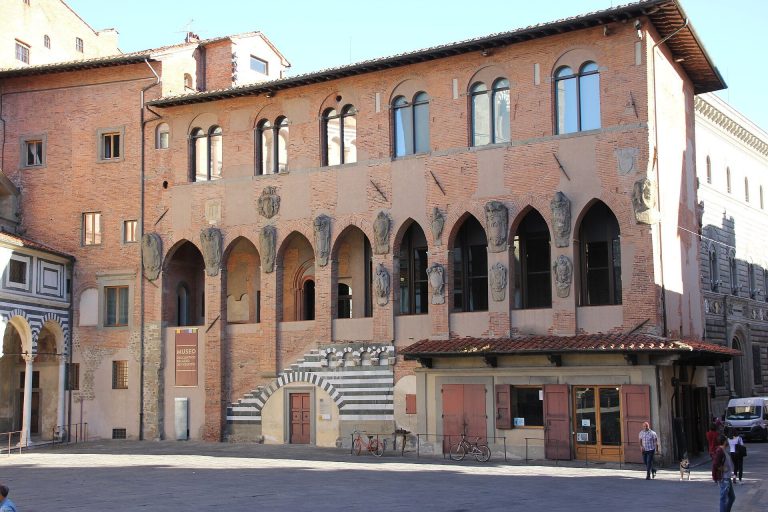
In 1784, Pietro Leopoldo united the Ceppo and San Gregorio hospitals as the United Hospitals of Pistoia and returned the administrator’s office to a local official. Ospedale del Ceppo remained Pistoia’s city hospital until 21 July 2013, when the new San Jacopo Hospital in the south of the city took its place. The historic complex now houses the Museum of the Ospedale del Ceppo.
Remains
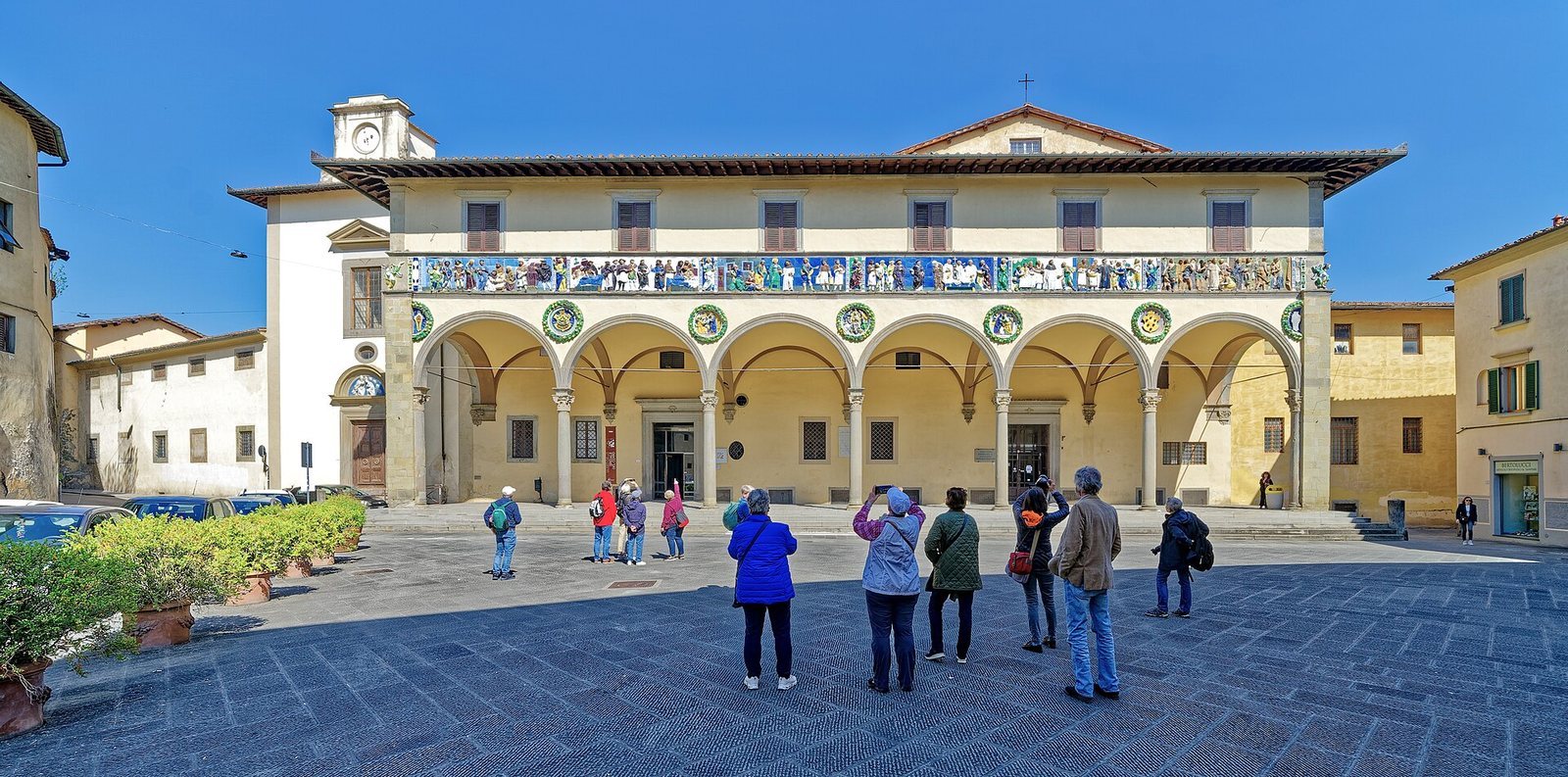
The present complex grew through additions and rebuilding around a thirteenth-century core. A fifteenth-century wing carries the main façade, whose early-sixteenth-century Renaissance loggia and sculpted ceramic decoration form a prominent architectural group. Other surviving spaces include hospital wards, an anatomical theatre, and rooms preserving medical collections.
Hospital wards
The thirteenth-century core is identified with the Sant’Atto ward on Via delle Pappe. It is a large space with broad windows, retained during a sixteenth-century renovation. The San Leopoldo ward, now occupied by the Pistoia Medical Academy, was intended for people with contagious diseases. A passage outside the building runs beneath the façade’s large window and allowed staff to treat these patients at a distance.
Renaissance façade
Loggia
The façade belongs to a wing added in the fifteenth century. Its loggia, a covered gallery open along one or more sides, was built in the early sixteenth century and modeled on the loggia of Florence’s Ospedale degli Innocenti. Seven arches open across its front. The design has been attributed either to Jacopo di Sandro or to Filippo Brunelleschi.
Glazed-terracotta frieze
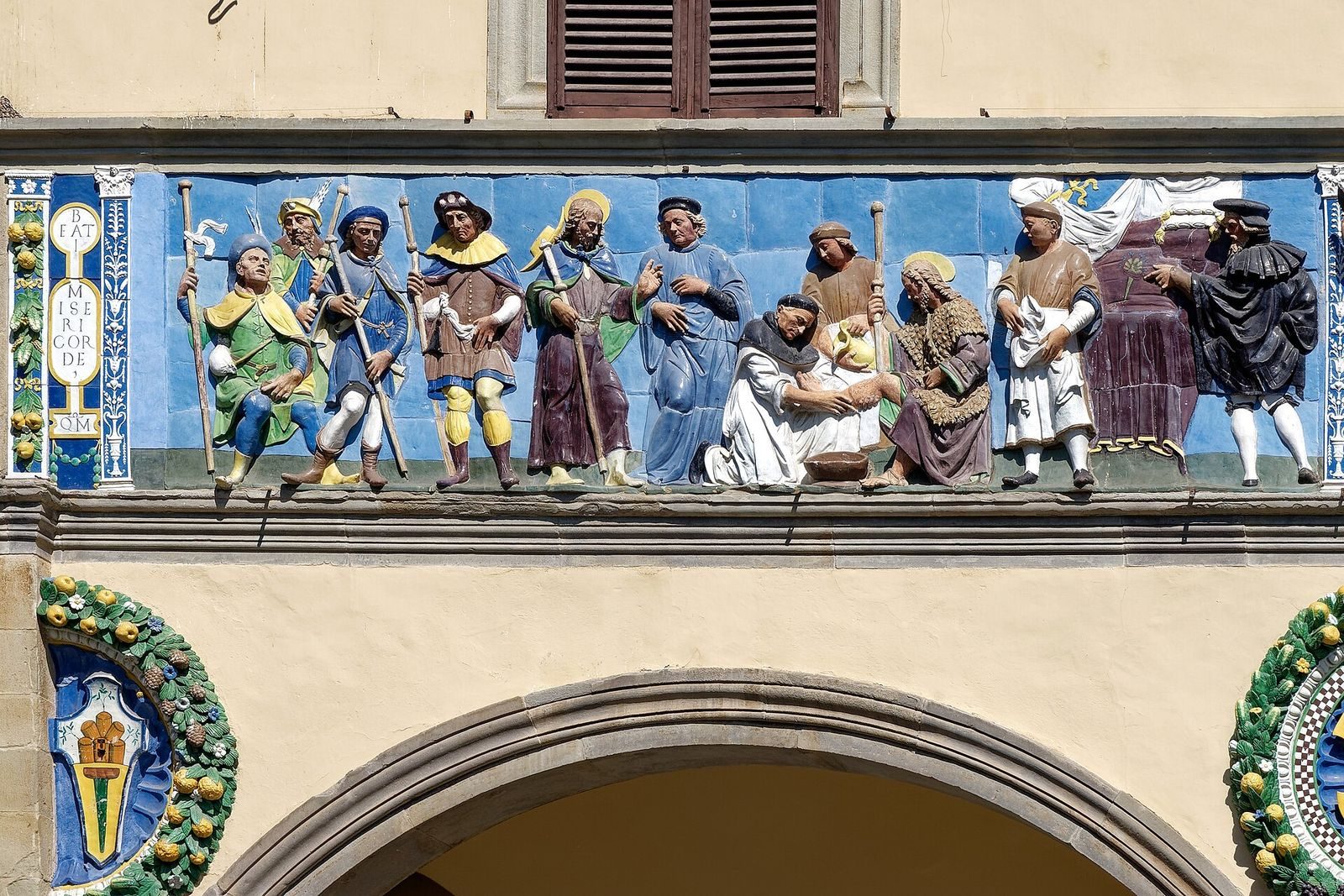
Above the arches, Santi Buglioni’s horizontal frieze is made of glazed terracotta, fired clay finished with a glasslike coating. Its panels show the seven Christian works of mercy: clothing the naked, sheltering pilgrims, visiting the sick, visiting prisoners, burying the dead, feeding the hungry, and giving drink to the thirsty. The scenes alternate with figures representing Prudence, Faith, Charity, Hope, and Justice. Decorated pilasters, shallow projections resembling columns, frame the panels. Harpies at the two ends serve as warnings. Fruit garlands, childlike figures, and Florentine emblems add to the decoration, whose colors include vivid blue grounds and bright white figures.
The original panel showing the giving of drink to the thirsty went missing, and its broken pieces were found inside the hospital in 1936, in the area where the Della Robbia family had kept its kilns. The replacement panel at the right end, made by Paladini in 1586, is unglazed. Conservation work in the twentieth century helped protect the frieze’s glazed surface and original colors. A copy is displayed inside the museum to help safeguard the façade decoration.
Roundels and portal decoration
Four circular glazed-terracotta panels, made by Giovanni della Robbia from 1525, occupy the spaces above the loggia arches. They depict the Annunciation, the Virgin in Glory, the Visitation, and the Medici coat of arms. In the first, the Archangel announces to Mary that she will bear Jesus; in the second, Mary prays among angels; and in the third, she shares the news with Elizabeth. Inscriptions beneath the first and third panels are associated with phrases from the Gospel of Luke, 1:46 and 1:42.
Above a portal beside the loggia is a semicircular panel made by Benedetto Buglioni in 1512, showing the Coronation of the Virgin in white figures against a blue background. Buglioni also made the hospital’s coat of arms, placed at the right-hand corner of the façade in 1515.
Anatomical theatre and medical collections
Anatomical theatre
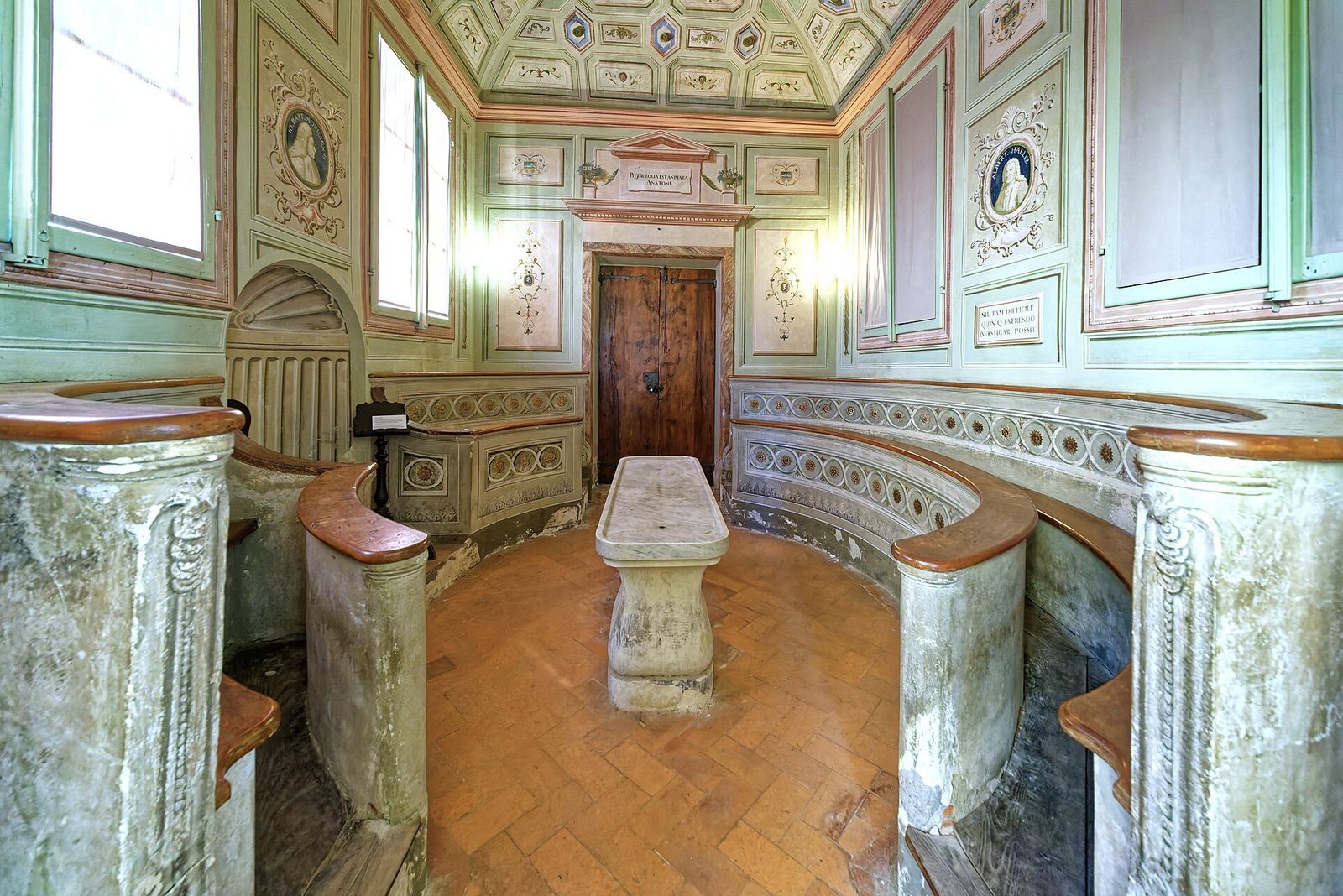
The late-eighteenth-century anatomical theatre is a separate building attached to the hospital’s outer walls. Its two rooms are in Neoclassical style, drawing on forms from ancient Greek and Roman art. The first has masonry benches arranged in rising semicircular tiers and decorated with frescoes. It was used for anatomy lessons and demonstrations involving dissection. In the second room, floor drains and a marble table served the preparation and dissection of cadavers by surgeons known as the Masters of the Apron.
Medical collections
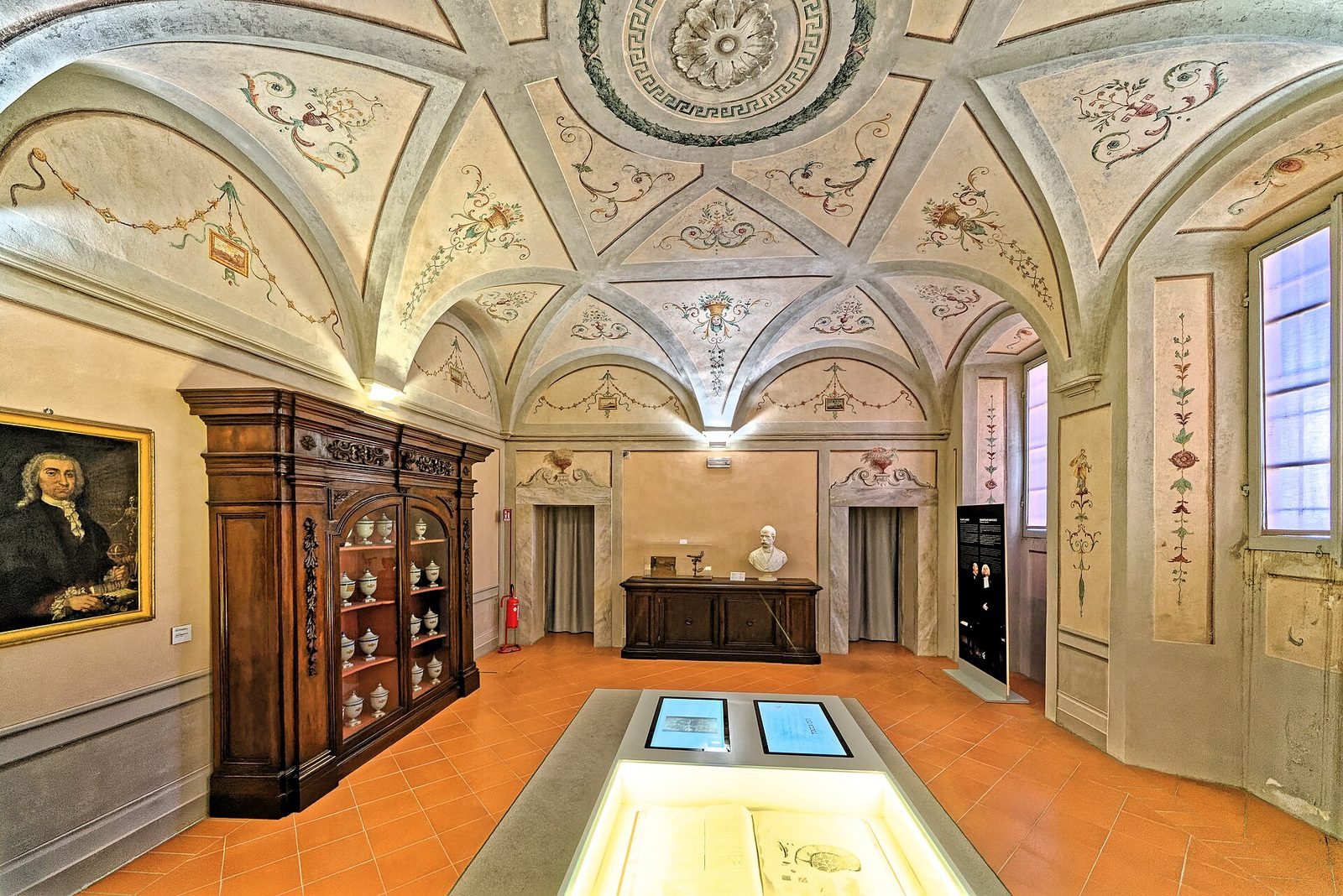
A small room in the former hospital contains medical instruments used there and old medical texts. The pharmacy laboratory preserves vessels and furnishings used to prepare medicines and store medicinal essences. The museum’s collections also include documents and archaeological finds connected with Pistoia’s medical history.