St. Bernard’s Abbey: A Cistercian Monastery in Hemiksem, Belgium
Site at a Glance
- Popularity
- Medium
- Country
- Belgium
- Primary era
- Early Modern
- Eras represented
- Medieval, Early Modern, Modern
- Civilizations
- Belgian, Duchy of Brabant, Dutch, Habsburg, Holy Roman Empire, Spanish
- Site type
- Religious
- Remains
- Monastery
On this page12 sections
History
St. Bernard’s Abbey was a Catholic Cistercian monastery in Hemiksem, Belgium, founded there in 1243 by a community that had first settled at Vremde in the 1230s. The Cistercians were a monastic order that developed from the Benedictine tradition. The abbey was named for Bernard of Clairvaux, a leading twelfth-century Cistercian abbot and religious writer. Its surviving complex, built mainly in the seventeenth and eighteenth centuries, is broadly Renaissance in character.
Foundation and regional influence
The community came from Villers Abbey and received support at Vremde from Gillis II Berthout, a medieval nobleman. Dukes Henry I and Henry II of Brabant also backed its establishment at Hemiksem, which Pope Urban IV confirmed. The foundation helped bring the village of Hemiksem into being.
From 1243, the abbey held lordship over Hemiksem, along with manorial rights, or rights attached to territorial lordship, in Puurs, Westmalle, and Zoersel. It held formal patronage rights over parishes in Oudenbosch, Wouw, Gastel, Hoeven, Kapellen, and Loenhout, giving it a role in supporting or appointing parish clergy. The monks also maintained town refuge houses in Antwerp, Lier, and Brussels, secure residences away from the monastery. The abbot sat in the Estates of Brabant, the duchy’s representative assembly, giving the abbey both political and ecclesiastical influence.
By the end of the thirteenth century, the abbey had helped clear and cultivate more than 2,000 hectares of heathland. The monks are thought to have been among the early users of clay from the nearby Rupel for brickmaking. This helped establish a regional industry that continued until the 1960s. The local word papesteen, meaning a type of brick, is associated with the abbey’s religious influence.
Religious upheaval and rebuilding
In 1559, when the Diocese of Antwerp was established, the abbey’s revenues were assigned to the diocese and the monks came under the bishop’s authority. Iconoclasts, who sought to destroy religious images and artworks, attacked the abbey on 21 August 1566, damaging religious art and driving out the monks. Abbot Thomas van Thielt fled into exile. In 1570, the bishops of Antwerp began holding the abbacy, the office of abbot, by virtue of their episcopal office. Amid religious and political upheaval, including the establishment of Calvinist Protestant rule in the region, the abbey was temporarily deserted in 1578.
A fire, probably set deliberately, ravaged the complex in 1582, and rebuilding followed in the early seventeenth century. The monks regained the right to elect their abbot in 1636, in return for paying half their revenues to the episcopal treasury. They recovered the abbey’s autonomy in 1649. Another major fire in 1672 destroyed much of the complex, including its library and many works of art. Rebuilding took place around 1726, and the western façade and tower were completed during the abbacy of Johannes van Heymissen.
Suppression and changing uses
During the upheaval following the French Revolution, the monks were expelled in 1796 and the abbey was formally suppressed in 1797. Its estates and rights were abolished, and its property was sold as national assets. The buildings were sold on 1 February 1794 for 100,000 francs to the French general commanding Antwerp, who transferred them to the local government. After their dispersal, the monks undertook pastoral work in the Netherlands. Unable to return to Hemiksem, members of the community re-established monastic life at Bornem Abbey in the mid-1830s.
The abbey church was demolished in the early nineteenth century. Religious property was sold or dispersed, some furnishings went to Bornem, and the remaining library was transferred to St. Michael’s Abbey in Antwerp. From 1811, surviving buildings served first as a naval hospital and later as a grain depot under the United Kingdom of the Netherlands. In 1821, Antwerp architect Pierre Bruno Bourla converted the complex into a correctional prison with large dormitories. At one point, it held 1,554 men, 457 women, and many children. From 1867, after communal sleeping rooms were replaced by individual cells, the complex served as a military depot.
Immediately after the Second World War, the buildings became an internment camp for collaborators. The military used them again from 1948 to 1977, after which they stood vacant. The complex received protected-monument status in 1973 and was acquired by the municipality of Hemiksem in 1988. Most military outbuildings were demolished, a park was created on the estate, and the west and east wings were restored in the mid-1990s.
Remains
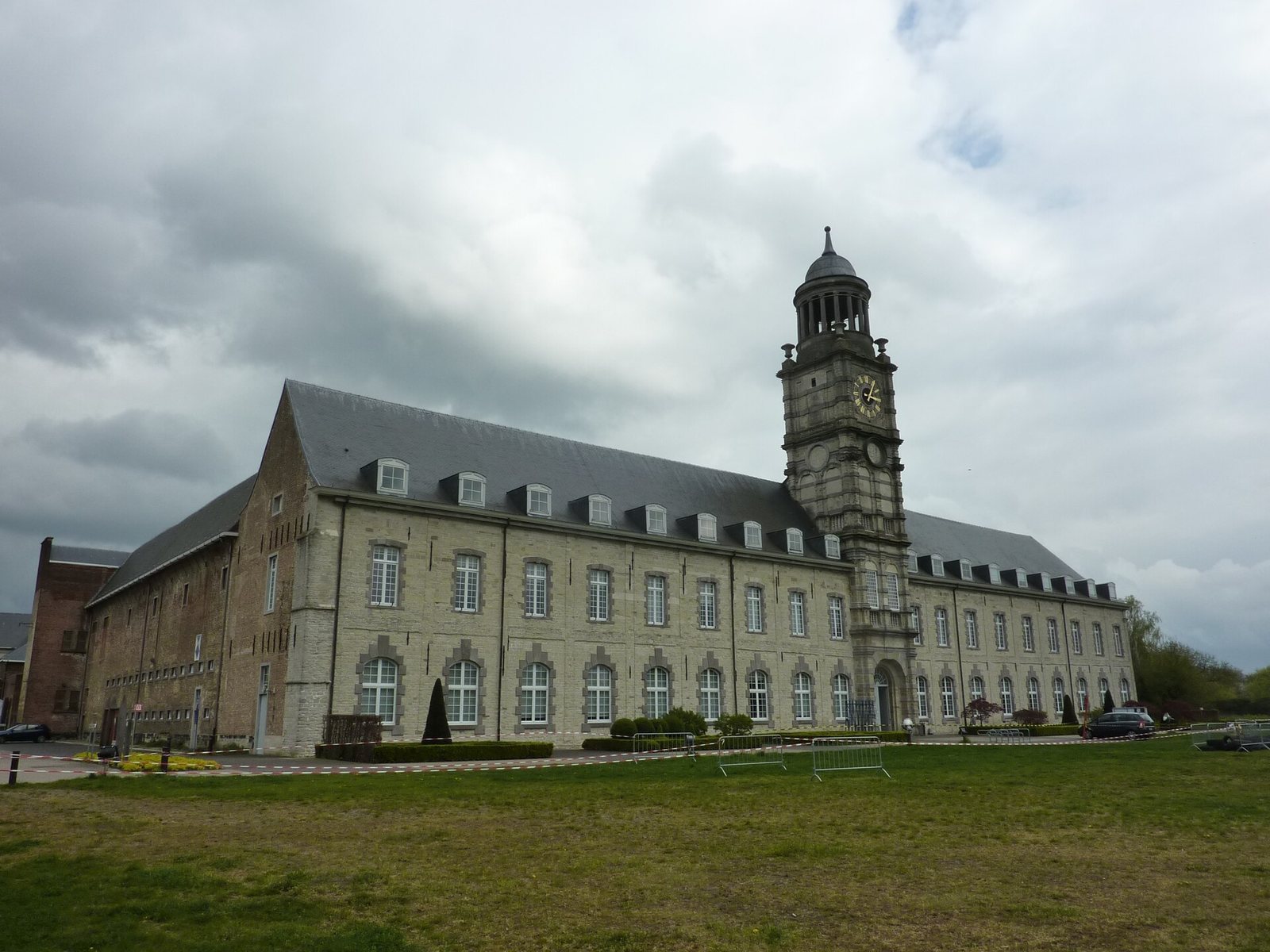
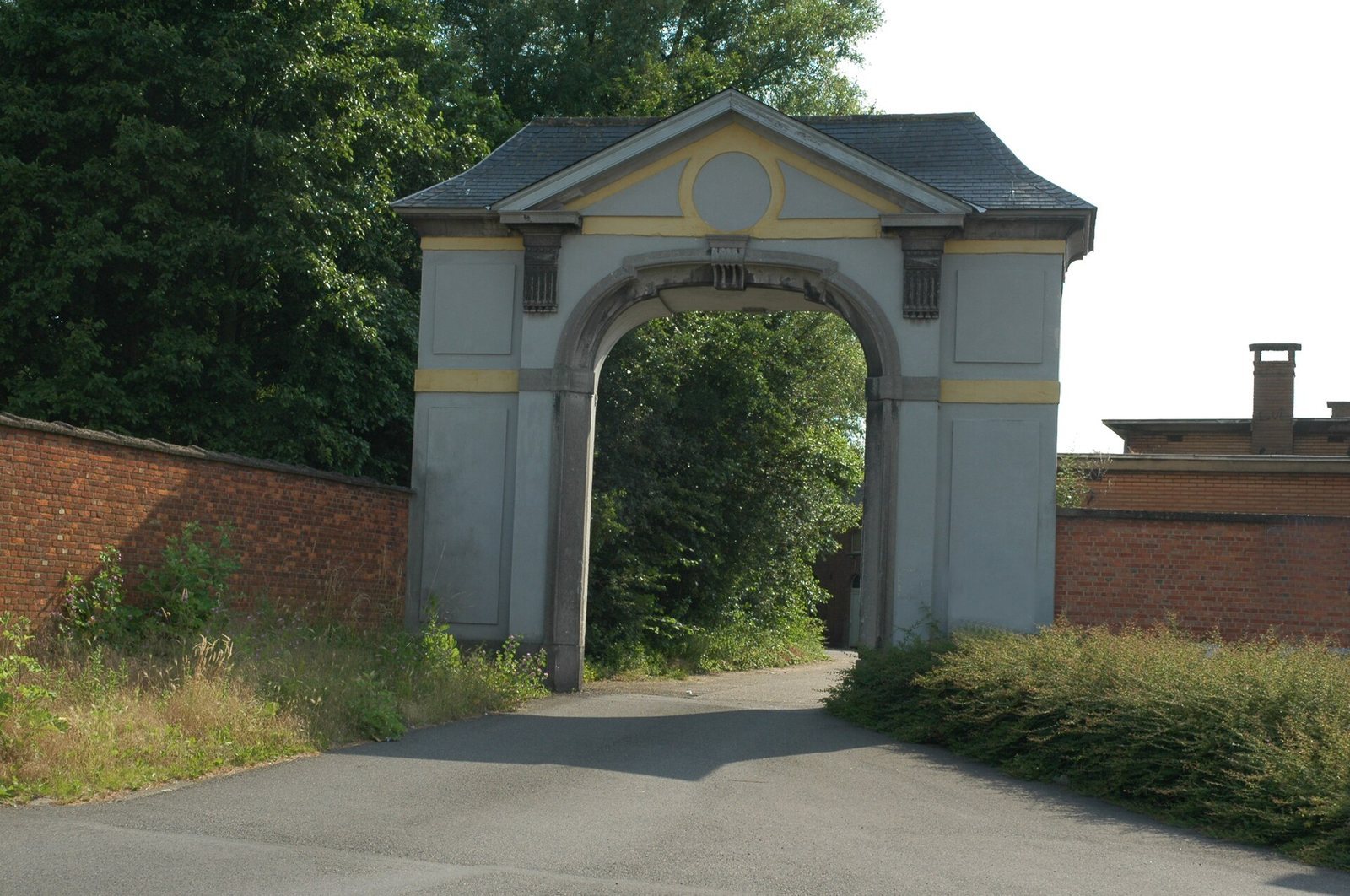
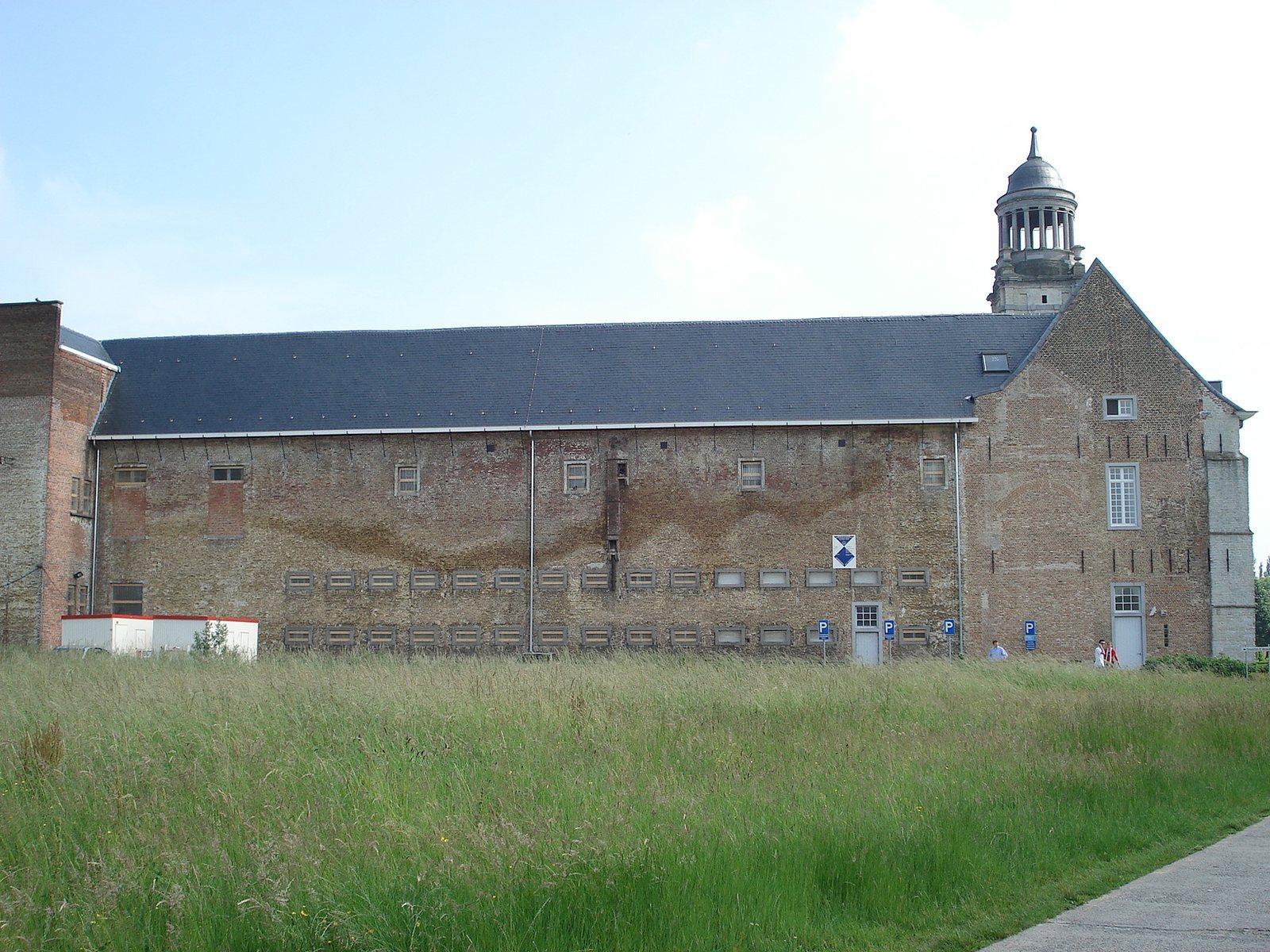
The abbey stood on the right bank of the Scheldt, where the Vliet meets the river, about eight kilometres south of Antwerp. Its estate extended around the confluence, and the monks constructed a basin between the abbey and the river for loading goods. The surviving complex is not the original thirteenth-century Cistercian monastery; its buildings date mainly from the seventeenth and eighteenth centuries. An entrance gate leads into an inner courtyard enclosed by buildings, while an 80-metre façade faces the Scheldt.
Surviving buildings
West wing and tower
The west wing has an early eighteenth-century Baroque façade made of brick and sandstone. Its central tower, described as Neoclassical, rises above the façade and is topped by a colonnaded rotunda and dome. The tower is 42 metres high. The complex as a whole is broadly classified as predominantly Renaissance in style.
Wings and present uses
The west and east wings accommodate municipal administrative offices and apartments for older residents, while the complex also houses local police headquarters. Part of the former abbot’s residence survives, and rooms are used by Hemiksem’s St. Sebastian’s guild for practice.
Museums and collections
The north wing houses a local-history museum with archaeological finds, historic interiors, and models of the abbey. The long central wing contains a ceramics and pottery museum displaying panels, moulds, and machinery from the former Gilliot factory. The factory’s work brought the Belgian ceramicist Joseph Roelants considerable renown at home and abroad; the Roelants Museum is named after him.
Furnishings outside the abbey
Altar, pulpit, and confessionals
The former high altar is now in St. Andrew’s Church in Antwerp, while the pulpit and confessionals are in the Cathedral of Our Lady there. The confessionals were made in 1713 by sculptors Willem Kerrickx and Michel Van der Voort.
Choir stalls
Commissioned by Abbot Antonius Spanoghe, the choir stalls were carved between 1690 and 1699 by Artus Quellinus the Younger and Lodewijk Willemsens. They included an abbot’s throne on the north side. In 1827, the stalls were sold to the priest of Wouw and installed in a church in the Netherlands. That church was destroyed by fire in 1944 on the orders of German General Chill, and the stalls were lost. Parishioners rescued 27 wooden statues from the ensemble, including one identified as Raymundus of Fitero, a medieval Cistercian religious figure.