Bagerovsky Quarries: Limestone Workings and a Wartime Partisan Base
Site at a Glance
- Popularity
- Low
- Country
- Ukraine
- Primary era
- Modern
- Eras represented
- Modern
- Civilizations
- Russian
- Site type
- Economic
- Remains
- Quarry
On this page10 sections
History
The Bagerovsky quarries are a limestone extraction complex beside Bagerovo, near Kerch in Ukraine. Quarrying for sawn stone took place from the nineteenth century through the 1970s. During the Second World War, the underground workings became a base for a partisan detachment and a refuge for local civilians.
Partisan operations, 1943–1944
Preparations for the detachment known as the Bagerovo Mine began in May 1943, when 12 to 15 people gathered food, water, and ammunition in the quarries. The group began military operations on 24 October. It later grew to about 240 people, including railway and collective-farm workers, Red Army soldiers cut off from their units, and prisoners of war who had escaped. The Red Army was the armed force of the Soviet Union. Many Bagerovo civilians also sought shelter underground.
Red Army personnel held the detachment’s command positions, including commander, commissar, chief of staff, and senior noncommissioned officer. A commissar was a political officer responsible for oversight within the unit. Its arms included two light machine guns, three automatic weapons, 45 rifles, three SVT self-loading rifles, eight carbines, and hand grenades. The SVT was a Soviet rifle type. Aircraft bombs were also used as explosives.
The partisans sabotaged Bagerovo railway station, destroyed an artillery depot at Nizhegorskoe station and explosives stores in Bagerovo, and disabled five locomotives by detonating mines in their fireboxes. They killed 30 enemy soldiers and officers. Occupying forces then sealed and blocked the principal entrances, leaving the detachment short of food. On 5 March 1944, enemy troops stormed the quarries and destroyed the unit; 220 partisans were killed.
An exploration club later surveyed the underground workings. Other quarries are believed to lie east of Bagerovo, but they have not been surveyed.
Remains
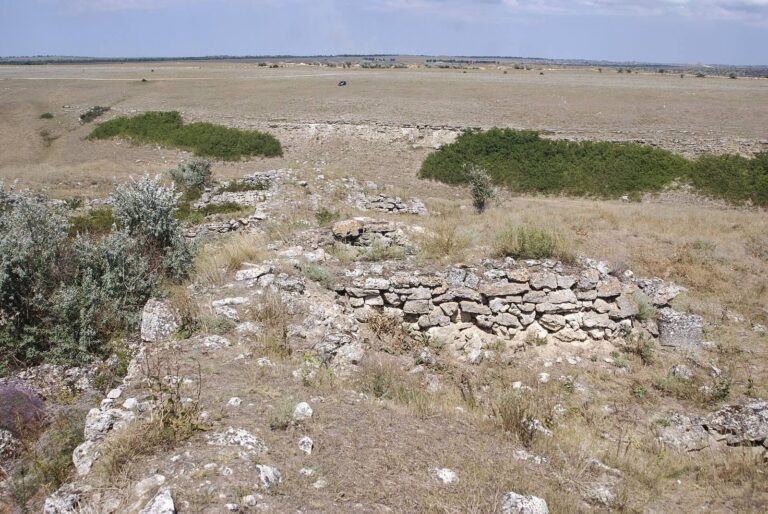
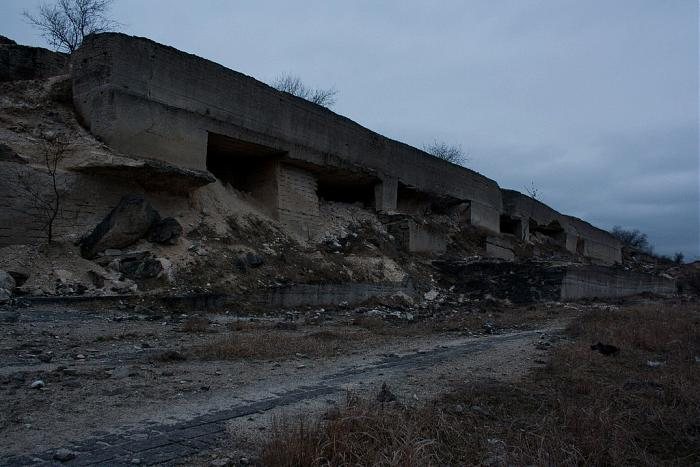
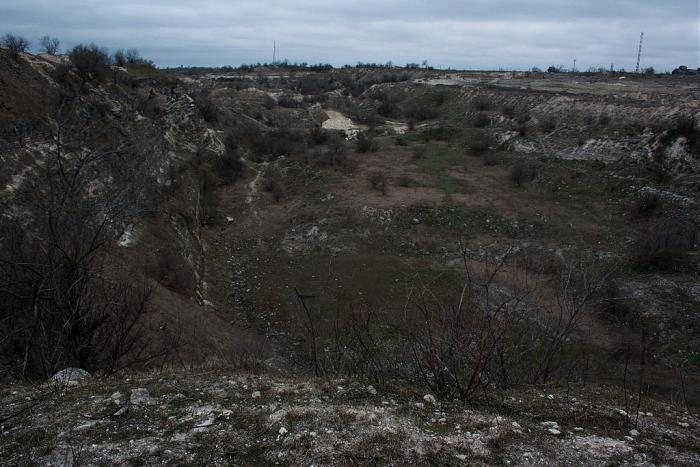
The quarry complex includes underground limestone passages, open excavations, and spoil heaps. Its largest open quarry lies north of Bagerovo’s center. Quarry 2 opens in the northeastern part of this excavation, while entrances to smaller workings pierce its southern wall. Some passages there were cut through by later quarrying at Quarry 1, whose principal entrance is in the open quarry’s southern slope. A shallower, older open quarry lies about 100 metres west of the main one.
Bagerovo Quarry 1
Quarry 1 is the largest underground working in the group, extending for more than 18 kilometres across an extraction front over 1,200 metres wide. In the east, its passages reach as far as 250 metres into the rock, while the network becomes narrower toward the west. Stone was brought out through a vertical shaft in the eastern area. In the west, miners cut the rock in stepped sections, with some areas arranged on two levels. The oldest dated miners’ graffiti found here carry the years 1898 and 1900.
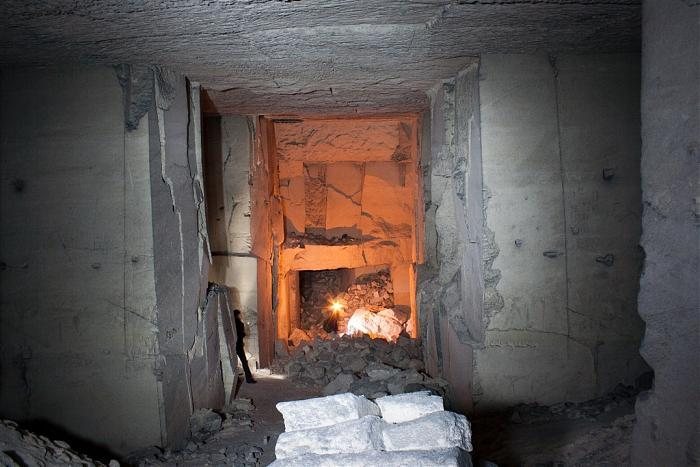
Passages average about 4 metres in height, though some ceilings rise to around 8 metres where stone was removed in two or three stepped cuts. In the western part of the main level, later cutting widened some areas into halls 8 to 10 metres high, supported by only a few pillars of standing rock. The central section includes local multi-level areas and two-level passages.
Bagerovo Quarry 2
The second-largest quarry occupies the eastern side of the main open excavation. It consists of two separate underground workings from different periods and at different heights, joined by passages and numerous vertical shafts.
The 1934 Mine
The lower working, known as the 1934 Mine, was cut by hand sawing during the 1930s. An inscription gives 19 January 1934 as its starting date. Some areas contain two or three stepped cuts, and the passages reach heights of 8 metres or more. Inscriptions about the quarrying process indicate that stone was raised through shafts.
The Distillery
The upper working, called the Distillery, was cut using machine saws and has two levels, with a combined estimated length of up to 5 kilometres. Inscriptions in its lower portion are dated 1965. Conical heaps of sawing waste and broken stone lie beneath shafts that descend from the Distillery; workers dropped the waste through them during excavation. The rock separating the Distillery from the lower working is no more than 1 metre thick.
Smaller workings
Bagerovo Quarry 3
Quarry 3 lies in the southern side of the smaller open excavation west of the main quarry. Its passages extend for about 200 metres. The southern side of this open cut also contains several separate, short horizontal passages.
Bagerovo Quarry 4
Entrances to Quarry 4 lie high on the steep southeastern side of the eastern open excavation. Its passages continue 10 to 20 metres into the slope before collapsed rock blocks the route between supporting pillars. The surviving fragment stands well above the quarry floor and may represent an upper level; open quarrying may also have removed part of the working. The condition of the remaining passages is uncertain.
The rock is deteriorating, and numerous collapses have left the underground network in ruins. Entry by people without preparation is dangerous.