Tiverton Castle: A Medieval Fortress and Country House in Devon


Site at a Glance
- Rating
- 4.3
- Popularity
- Low
- Country
- United Kingdom
- Primary era
- Medieval
- External website
- Open
- Eras represented
- Medieval, Early Modern
- Civilizations
- English, Norman
- Site type
- Military
- Remains
- Castle
On this page9 sections
History
Tiverton Castle is a medieval fortress in Tiverton, United Kingdom, built by the Norman lord Richard de Redvers in 1106. King Henry I granted the important manor of Tiverton to de Redvers, who established a Norman motte, a raised earthwork used for a keep or defensive structure. The castle stood above the River Exe and was enlarged and altered during the twelfth and thirteenth centuries.
The Courtenay lordship
Throughout the medieval period, Tiverton Castle was the principal seat of the Courtenay earls of Devon, a powerful noble family whose authority at Tiverton was connected with the administration and territorial lordship of Devon. The Courtenays inherited the manor through Hugh de Courtenay after Isabella de Forz died without surviving children in 1293. Hugh was summoned to Parliament as Lord Courtenay in 1299 and became Earl of Devon in 1335.
The Courtenay hold over Tiverton ended in 1539. Henry Courtenay, 1st Marquess of Exeter and 2nd Earl of Devon, was executed on the orders of Henry VIII after being implicated in a plot. The manor and castle were then granted to John Russell, 1st Earl of Bedford, and later passed to Edward Seymour, 1st Duke of Somerset, apparently through an exchange of land between Russell and Seymour.
Tudor transfers and divided inheritance
Edward Seymour was executed in 1552 on the order of his nephew, King Edward VI. The king granted Tiverton to Sir Henry Gates, who was later tried for treason and attainted after Queen Mary I came to the throne. Gates was pardoned in 1553 but deprived of the property. Mary restored Tiverton to Edward Courtenay, the only son of Henry Courtenay, and created him Earl of Devon under a new title.
Edward Courtenay died without children in 1556. The manor and castle then passed to distant cousins descended from four sisters of his great-grandfather. The Courtenay estates were divided among the Arundell, Trethurfe, Mohun, and Trelawney families, and some of the heirs sold their shares. Roger Giffard acquired one quarter of the manor and all the buildings belonging to the castle, which were temporarily known as “Giffard’s Court.” His descendants later inherited the property through Roger Burgoyne’s marriage to Giffard’s granddaughter.
About 1605, Sir Reynell Mohun sold his quarter share to John West, a Tiverton merchant. The West family also acquired the Trelawney share and appears to have lived at the castle until its dismantling after the English Civil War. Part of the complex was rebuilt or adapted as a residence during the seventeenth century.
The Civil War siege
During the English Civil War, the conflict fought between supporters of the monarchy and Parliament from 1642 to 1651, Tiverton Castle served as a Royalist stronghold. Royalists supported King Charles I, while Parliamentarian forces fought for greater parliamentary control. Sir Thomas Fairfax commanded the Parliamentarian besiegers. Their headquarters were at Blundell’s School, while artillery was placed on Skrink Hills, also called Shrink Hills, near Cranmore Castle, about 800 metres from Tiverton Castle.
The bombardment began on 19 October 1645. A shot severed one of the chains supporting the drawbridge, causing it to fall and allowing a small Parliamentarian force to enter. The castle and church were taken. Among the captured Royalists were Colonel Sir Gilbert Talbot, the governor, Major Sadler, 20 other notable officers, and 200 common soldiers. The victors also seized four pieces of ordnance, about 500 weapons, ammunition, provisions, and treasure.
After the capture, Parliamentarian troops demolished most of the defensive structure so that the castle could not again be used for military purposes. The complex was subsequently dismantled, while part of it remained in residential form as a country house.
Later ownership
After John West died in 1728, his family held shares amounting to six-eighths of the original manor. The property passed through his daughter Dorothy West to her husband, Sir Thomas Carew, 4th Baronet. By 1822, Sir Henry Carew, 7th Baronet, had increased the Carew share to seven-eighths, while the remaining eighth belonged to Reverend Dr. Short, Archdeacon of Cornwall.
The Carews apparently leased the castle to the tenant of the adjoining Barton estate before taking it back and fitting it up as a residence for Lady Carew, Sir Henry Carew’s mother. It was her home in 1822. The Carew descendants sold Tiverton Castle in 1923. Following several changes of ownership, Ivar Campbell bought it in 1960, and his nephew Angus Gordon inherited it in 1985.
Remains
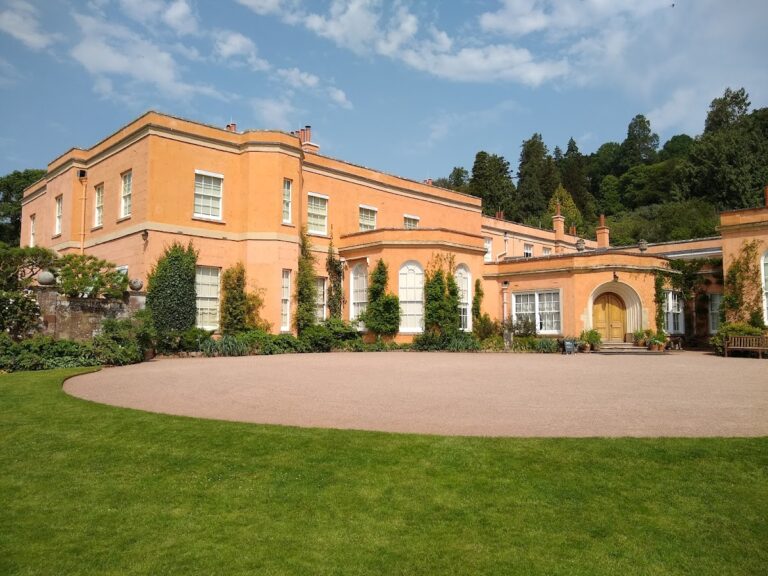
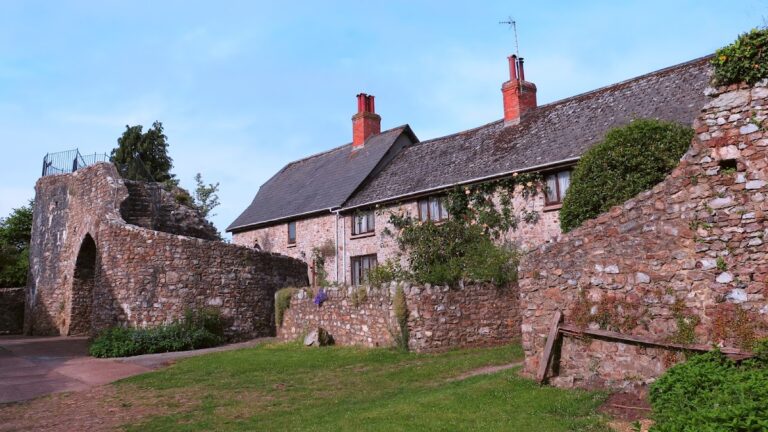
Tiverton Castle occupies a defensive position above the River Exe. Its surviving fabric brings together ruined wall sections, towers, and buildings from several construction phases. The medieval layout included a motte, perimeter fortifications, towers, a gatehouse range, and a ditch crossed by a drawbridge. Later residential work altered part of this fortified complex after its military dismantling.
Medieval defensive complex
The original castle was a considerably larger fortified enclosure. Its defensive system was organized around the motte and enclosed areas protected by perimeter walls and towers. The gatehouse range formed part of the principal entrance, while the drawbridge crossed the castle ditch and was raised by chains. The surviving walls and towers preserve portions of this medieval defensive arrangement, although the complex also contains fabric from later periods.
Courtyard and later residential buildings
A projecting tower porch stands within the courtyard at the angle where the gatehouse range meets the seventeenth-century north range. A date stone set into the wall bears the date 1588 and the initials “RG,” linking the work with Roger Giffard. The north range and other surviving buildings reflect the adaptation of part of the castle into a residential country house after the defensive structure was dismantled.
The drawbridge and the 1645 assault
The drawbridge’s chains were central to the castle’s military history. On 19 October 1645, artillery fire broke one chain, and the resulting fall of the bridge enabled Parliamentarian soldiers to enter during the siege. The surviving remains therefore preserve the physical setting of an entrance whose operation directly shaped the castle’s capture and subsequent military destruction.