Acemhöyük: An Anatolian Bronze Age Trade Centre
Site at a Glance
- Popularity
- Medium
- Country
- Turkey
- Primary era
- Bronze Age
- Eras represented
- Bronze Age, Classical
- Civilizations
- Unclassified
- Site type
- City
On this page17 sections
History
Acemhöyük is an ancient settlement near Yeşilova in Aksaray, Türkiye, occupied from the beginning of the third millennium BCE and an important centre in Anatolian trade during the Early Bronze Age. Its history spans the Bronze Age and later Hellenistic and Roman resettlement.
Early Bronze Age
Acemhöyük was part of an extensive exchange network. Connections reached west to Troy and the Cyclades and east to Mesopotamia. By the middle of the third millennium BCE, the settlement also had links with western Anatolia and Syria.
The settlement’s ancient name remains uncertain. Purušḫanda, Purušḫattum, and Ullama have all been proposed. Many scholars associate Acemhöyük with Burushattum, a city known from Assyrian records, but no excavated document confirms that identification.
Assyrian trading colony
During the Middle Bronze Age, Acemhöyük became an Assyrian karum, or merchant colony and trading station. Assyrian commerce linked Mesopotamia and Anatolia through centres in Syria, including Mari and Carchemish. Assyrian commercial dominance began around 2000 BCE, while the colony period at Acemhöyük is dated to about 1950–1750 BCE.
The settlement’s role helps explain an economic system in which Assyrian merchant colonies operated alongside independent local principalities. Assyrian influence in trade weakened after about 1750 BCE, following the deaths of leaders including Shamshi-Adad I, king of Upper Mesopotamia, and Hammurabi, king of Babylon.
Fire and later settlement
The Middle Bronze Age settlement is divided into five archaeological layers, numbered I to V. The earliest two, Layers IV and V, predate the establishment of Assyrian trading colonies in central Anatolia, while Layer III represents Acemhöyük’s peak prosperity. A major fire badly damaged Layer III, although its cause is unknown. Houses were then built hastily over the ruins in Layer II, and Layer I was largely affected by its proximity to the surface.
Occupation on the hill ended after these Bronze Age phases and resumed in the early Hellenistic or Roman period. This later settlement was eventually abandoned; its final archaeological layer is Greco-Roman.
Excavation and research
Excavations began in 1962 through cooperation between the General Directorate of Antiquities and Museums and Ankara University. Nimet Özgüç directed the work through 1988. Aliye Öztan took over in 1989, and excavations continued through at least 2019.
Remains
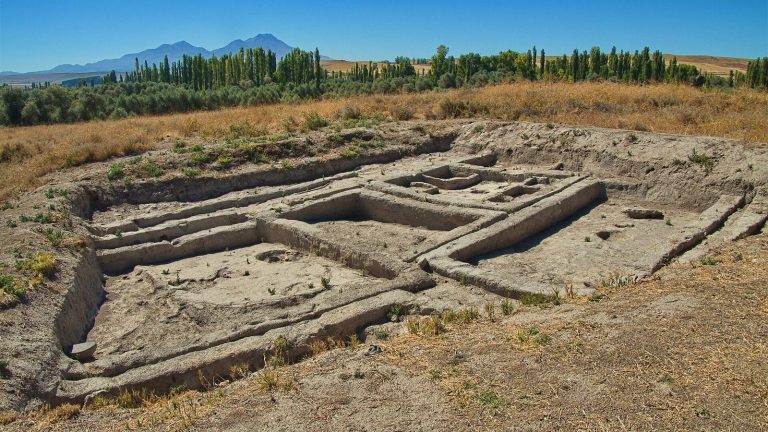
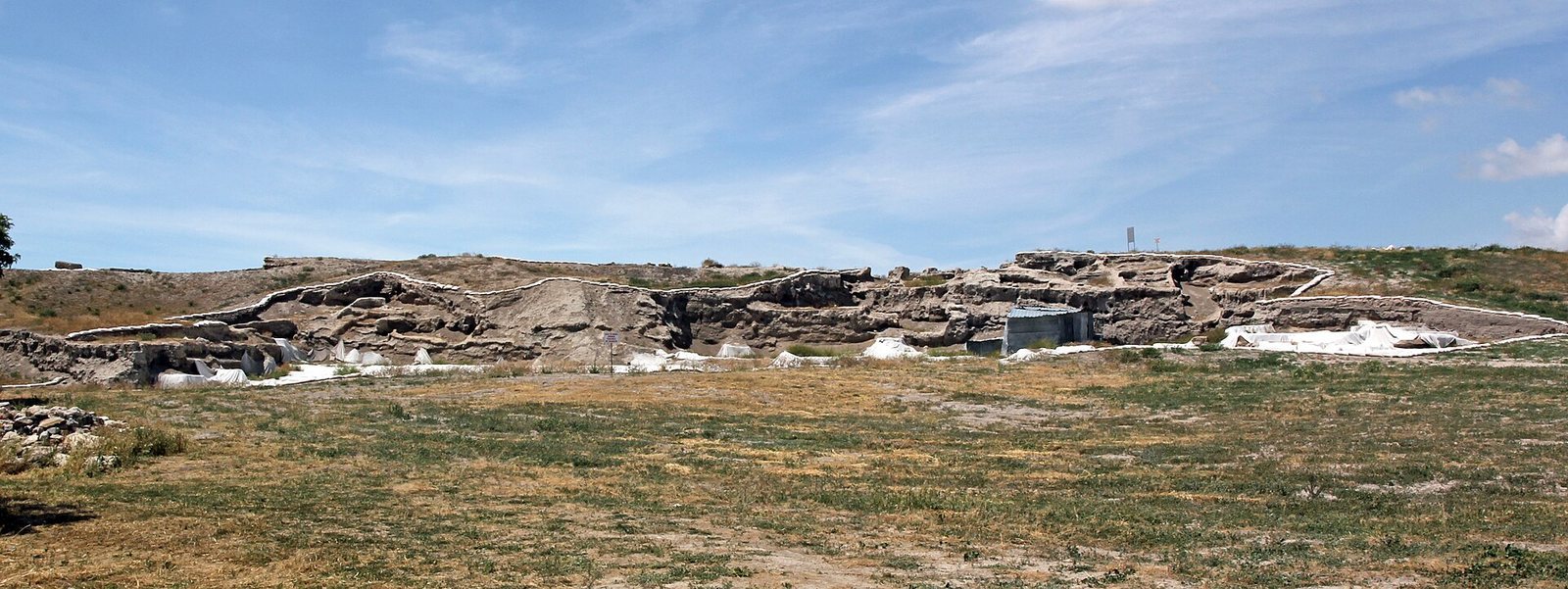
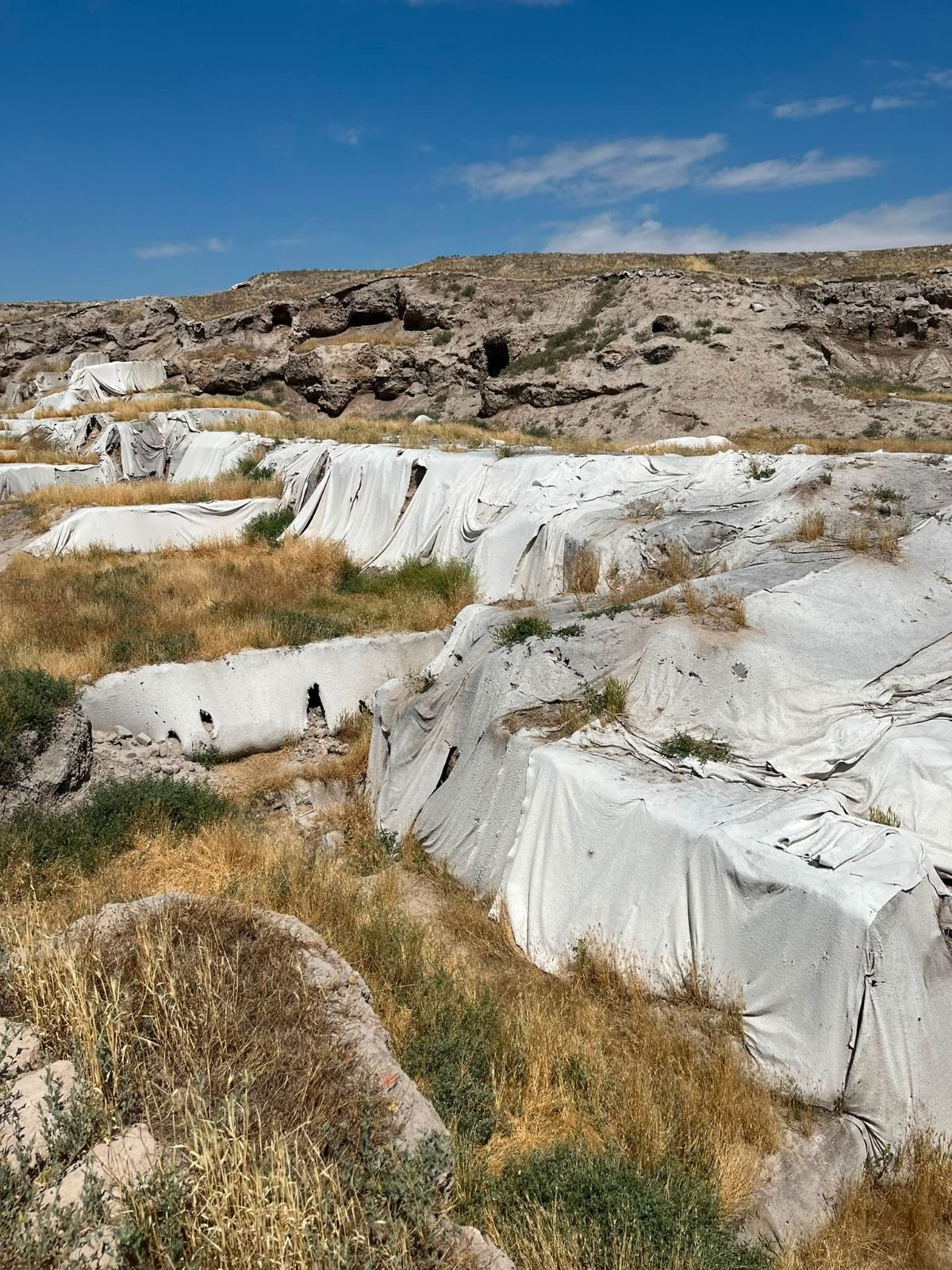
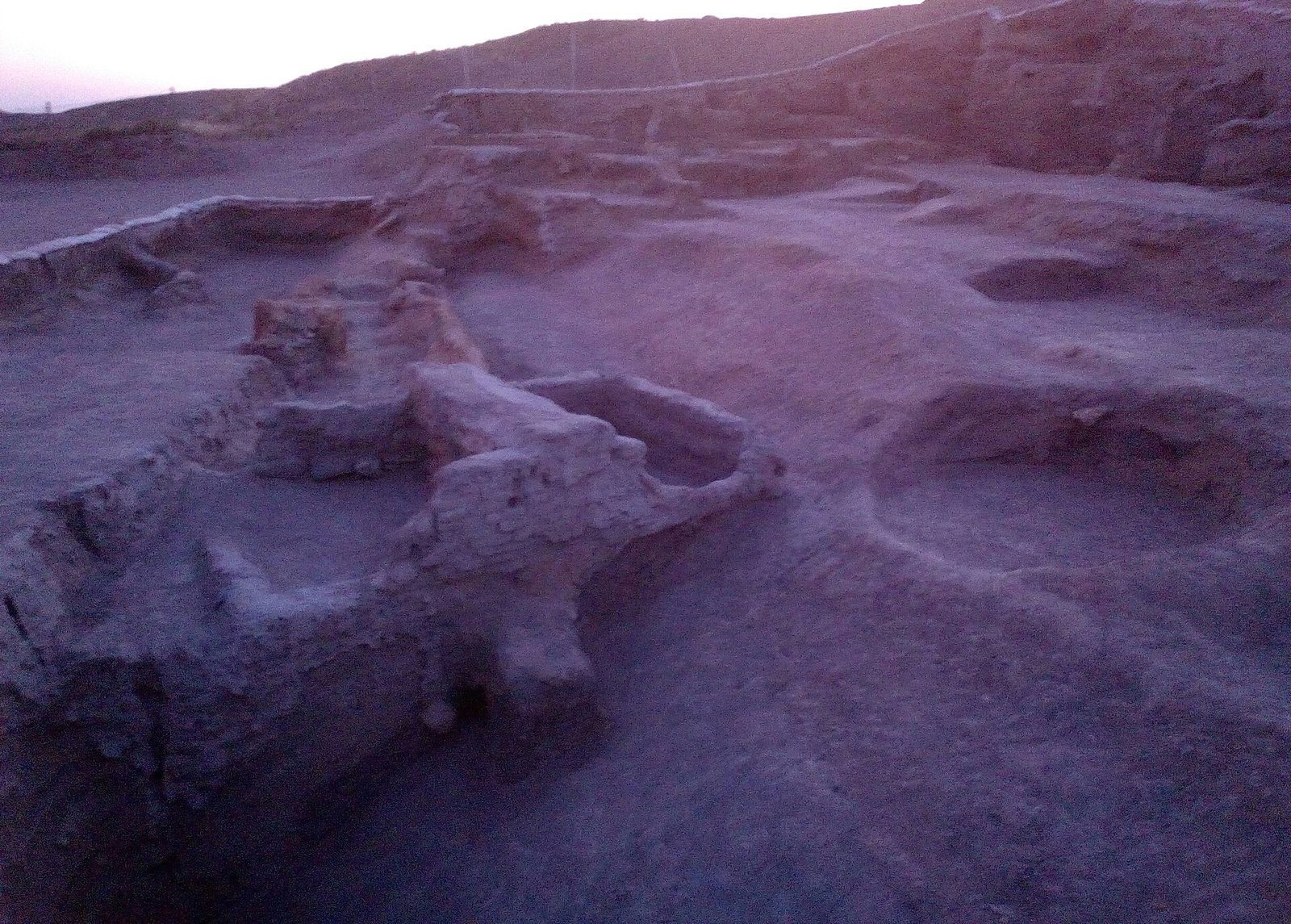
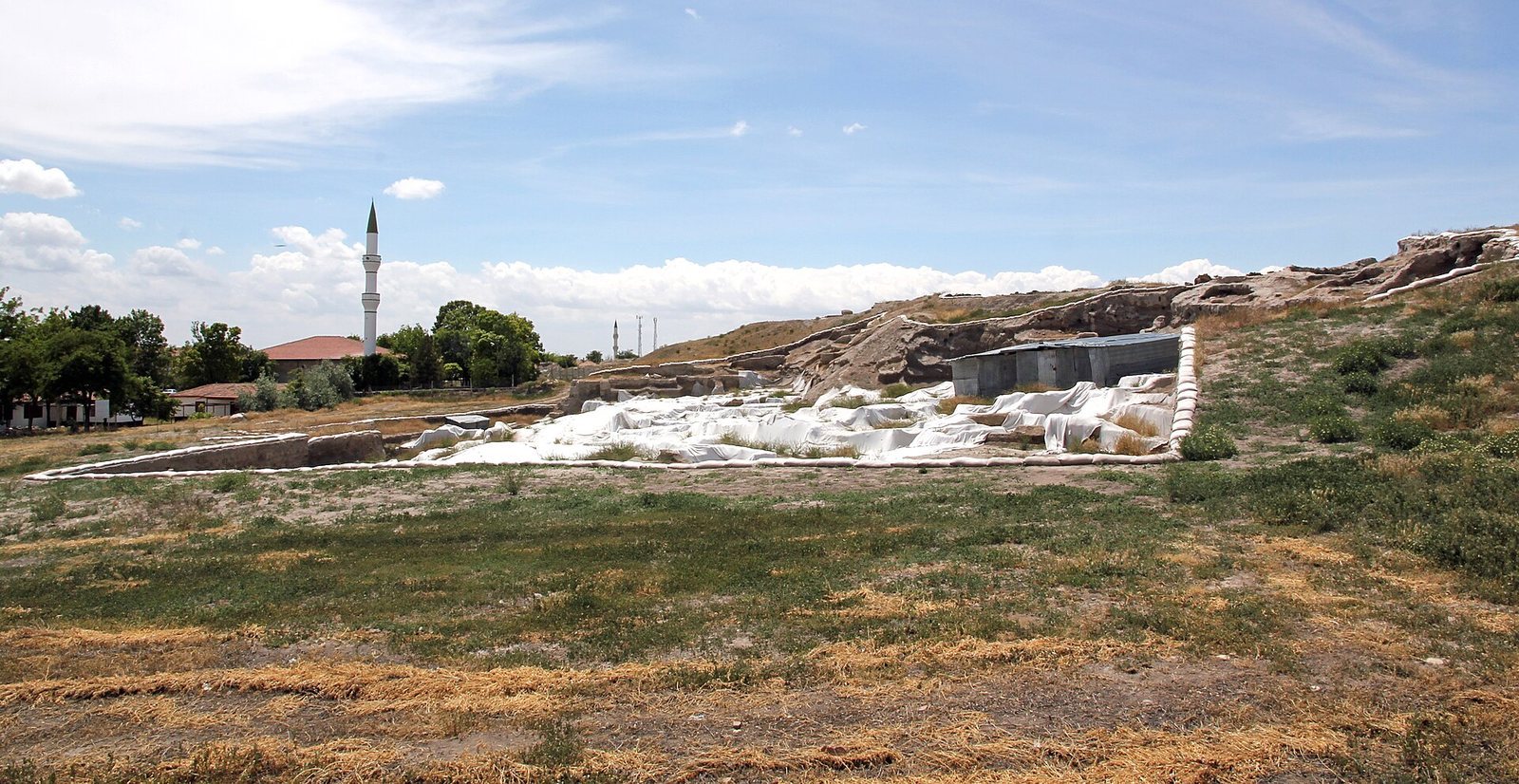
The site forms a nearly circular settlement on a fertile plain at the southeastern end of Salt Lake, around 18 km northwest of Aksaray. It lies by the Uluirmak, also known as the Melendiz River. The remains include a raised hilltop citadel, a fortified central area, and a lower city partly covered by modern Yeşilova. The hilltop settlement measures about 700 m east to west and 600 m north to south. Pottery spreads across roughly 800 by 700 m, and the lower city has been estimated to cover a similar area. The principal excavated buildings are mudbrick palaces on broad stone foundations.
The citadel, called Sarıkaya, or “Yellow Cliff,” rises about 20 m above the surrounding land. Its yellow mudbricks account for the name. Excavated areas lie within an enclosure in two elevated zones, Sarıkaya and Hatipler Tepesi. The two palace buildings have similar construction and may have formed part of one residential and administrative complex.
Palaces
Hatipler Palace
Hatipler Palace contained 76 rooms and stood two storeys high. Like Sarıkaya Palace, it rested on large stone foundations about 4 m wide and had mudbrick walls roughly 1.5 m thick. Cedar of Lebanon, juniper, and black pine were used in the palaces’ construction. The trees used for this building work were felled between 1829 and 1753 BCE. Hatipler had more rooms for storing food in large jars than Sarıkaya Palace.
Sarıkaya Palace
Sarıkaya Palace had about 50 rooms and was also two storeys high. Its walls are 1.5 to 2 m thick and survive in places to a height of 3.8 m. Later settlement and modern activity destroyed the building’s western part. Tree-ring and radiocarbon research places the palace’s primary construction in the Middle Bronze Age; the construction timber came from trees felled between 1829 and 1753 BCE.
A roofed colonnade, or portico, ran along the north, east, and west sides, supported by wooden columns on marble bases. It may also have continued along the fourth side, which has not survived. The porticoes faced open courtyards that may have provided access to service rooms. The ground floor served for storage, including a room with large storage jars. Officials’ rooms are thought to have occupied the upper floor, based on comparison with Kültepe.
Settlement layers and early remains
Early Bronze Age buildings
Early Bronze Age occupation included a village of trapezoidal buildings with stone foundations, mudbrick walls, and compacted-earth floors. An eastern test trench reached these early levels, while surface work also yielded Late Chalcolithic material. Pottery from the Bronze Age settlement includes Anatolian wares as well as material from Mesopotamia and northern Syria.
Burials
A small number of earth and jar burials lay within the settlement, while the main cemetery was toward Aksaray. Two jar burials were identified as one child’s and one adult’s. One contained two copper bracelets, a gold hairpin, an earring, and small vessels.
Later occupation layers
Layer I contained ovens and buildings. Foundations from habitation make up the final, Greco-Roman settlement layer.
Palace finds
Sealings and documents
Clay sealings from a room in Sarıkaya Palace bear the names of Dugedu, daughter of Yahdun-Lim of Mari, Shamshi-Adad I, and Aplahanda, king of Carchemish. Sixteen impressions came from two of Aplahanda’s seals.
In 2012 and 2013, excavations in the palace’s Service Building uncovered an Old Assyrian-period label and a small tablet, the first tablet found at Acemhöyük. The tablet’s features place it around 1700 BCE, near the end of the Old Assyrian period, and make it contemporary with Level Ib at Kültepe.
Ivory objects
An ivory box made from a single piece and decorated with lapis lazuli, bronze, and iron was found at Acemhöyük. Other ivory pieces excavated at Sarıkaya Palace resemble fittings collected by George D. Pratt, who donated a group of second-millennium BCE ivories to the Metropolitan Museum of Art between 1932 and 1937. Later research reconstructed some of the Pratt pieces as parts of an elaborate gold-and-ivory throne. One excavated wing matches a falcon in that collection. Photographs of ivories offered by a nearby dealer, alongside reports of looting, further supported the association of the collection with Acemhöyük.
Pottery and imported vessels
Among the finds from Level XI is a fine Syrian bottle, a vessel type found across Syria, Anatolia, and Mesopotamia and probably used for oils or perfumes. The example appears to have been imported and dates to about 2450–2300 BCE, at the beginning of Early Bronze Age III. Finds from Acemhöyük are displayed at the Aksaray Museum and the Niğde Archaeological Museum.