Halton Castle: A Medieval Fortress and Courthouse in England


Site at a Glance
- Rating
- 4.3
- Popularity
- Low
- Country
- United Kingdom
- Primary era
- Medieval
- External website
- Open
- Eras represented
- Medieval, Early Modern, Modern
- Civilizations
- British, English, Norman
- Site type
- Military
- Remains
- Castle
On this page13 sections
History
Halton Castle is a medieval castle in Runcorn, England, established under Norman rule after the conquest of England that began in 1066. Its origins are associated with the Barony of Halton, a territorial lordship created by Hugh Lupus, the Norman Earl of Chester, and its development spans the eleventh to the twentieth century. The castle became the seat of the Barons of Halton before later serving as a royal possession, a military stronghold, a prison, an administrative centre, and a courthouse.
Norman origins and the Barons of Halton
Hugh Lupus appointed Nigel of Cotentin as the first Baron of Halton. Nigel probably established a wooden motte-and-bailey castle, a fortification combining a raised earth mound with an enclosed courtyard protected by timber defences. The proposed early castle included a palisade and timber tower. During the twelfth century, this timber construction was probably replaced by a local sandstone castle.
Halton Castle remained the seat of the Barons of Halton from the eleventh through the fourteenth century. Later alterations have sometimes been attributed to John of Gaunt, a fourteenth-century English prince and major landowner who was the fourteenth Baron of Halton, but that attribution is not supported by documentary evidence. His son, Henry Bolingbroke, became the fifteenth Baron and later took the throne as King Henry IV. The castle then passed into the Duchy of Lancaster, the hereditary estate associated with the English Crown.
Royal visits and late medieval maintenance
King John is believed to have visited Halton Castle in 1207 and contributed £5 towards maintaining its chapel, although the visit does not survive in documentary evidence. Edward II certainly stayed at the castle for three days in November 1323, visiting Norton Priory during the same stay.
The earliest documentary evidence for work on the castle shows that it was regularly maintained during the fifteenth and early sixteenth centuries. A new gatehouse was built between 1450 and 1457. The castle was not involved in the Wars of the Roses, the fifteenth-century dynastic conflicts between rival English royal houses, and its relatively remote position made such a role unlikely.
By 1609, a survey of royal castles reported that Halton needed repair and was already deteriorating. During the Tudor period, it functioned less as a fortress than as a prison, administrative centre, and courthouse. In 1580 and 1581 it was designated for the imprisonment of Catholic recusants, Catholics who refused to conform to the established Church of England after the Reformation.
The English Civil War
At the outbreak of the English Civil War, the armed conflicts of the 1640s between supporters of the monarchy and Parliament, Halton Castle held a Royalist garrison under Captain Walter Primrose, who had been appointed by the Earl of Rivers. Parliamentary forces commanded by Sir William Brereton besieged the castle in 1643, and the Royalists surrendered after several weeks.
Parliamentary troops later abandoned the castle when they learned that a larger Royalist force led by Prince Rupert was approaching. Royalists under Colonel Fenwick reoccupied the site, but a second siege followed in 1644. The Royalists withdrew, allowing Brereton’s Parliamentary forces to occupy the castle again.
In 1646, a Council of War at Warrington ordered the defences of Halton Castle and Beeston Castle to be dismantled. The order was carried out, ending Halton’s military function. By 1650, the castle was described as being in a severely ruined state.
Courthouse, estate, and later transformations
The castle continued to deteriorate, although its gatehouse remained in use as a courthouse. In 1728, George Cholmondeley, 2nd Earl of Cholmondeley, leased the estate from the Crown. A new courthouse was built on the site of the medieval gatehouse in 1737, and court proceedings continued there until 1908.
By 1792, the courthouse itself required renovation, and money was obtained for the work. Around 1800, three decorative folly walls were added to the eastern side of the ruined castle walls. Such a wall was intended to create a picturesque effect rather than provide practical defence. The additions made the site appear more imposing from Norton Priory, the home of Sir Richard Brooke. One of the three walls was demolished around 1906.
During the Victorian period, the era of Queen Victoria’s reign from 1837 to 1901, a sunken garden and two bowling greens were created inside the castle enclosure. In 1977, the ruined castle was leased to Halton Borough Council, and archaeological excavations followed in 1986 and 1987. The Duchy of Lancaster retains ownership, while the Norton Priory Museum Trust manages the site. English Heritage has designated Halton Castle both a Grade I listed building and a Scheduled Monument. The adjacent former courthouse, now the Castle Hotel, has Grade II* listing.
Remains
Hilltop enclosure and medieval castle
The castle ruin occupies the summit plateau of Halton Hill, a sandstone hill above the former village of Halton. Its elevated position provides views across Lancashire and Cheshire, towards the Pennines and the hills of the Peak District, and to the mountains of North Wales. The surviving castle walls are ruinous, but the perimeter remains intact and can be circumnavigated externally.
The earliest proposed arrangement was a wooden motte-and-bailey castle, with a raised mound, enclosed courtyard, timber tower, and palisade. Excavations carried out in 1986 and 1987 examined the site in relation to this early form. The later castle was built in locally quarried sandstone, probably during the twelfth century, and its surviving perimeter represents the principal physical remains of the medieval stronghold.
Medieval gatehouse
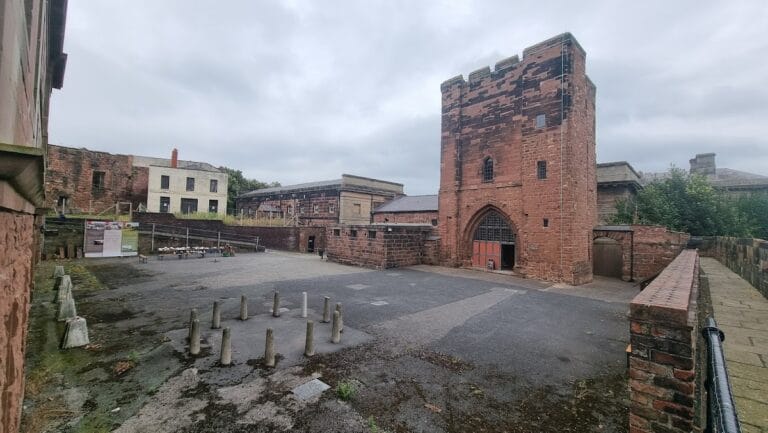
A new entrance tower or gatehouse was constructed between 1450 and 1457. It occupied the entrance position of the castle until the medieval structure was replaced on the same site by the eighteenth-century courthouse. This succession of buildings preserves the entrance area as a focus of the castle’s later administrative history.
Courthouse and associated buildings
1737 courthouse
The courthouse built in 1737 stands on the site of the medieval gatehouse. Its courtroom occupied the first floor, while the basement contained a prison. The building now functions as the Castle Hotel pub. Its upper floor is used for hotel accommodation and ceremonies, and the basement contains the pub’s drinking premises or cellars. The courthouse and other associated buildings are in better condition than the castle walls.
Eastern additions and enclosure features
Folly walls
Three decorative walls were added around 1800 to the eastern side of the ruined medieval walls. Built for visual effect rather than defence, they formed part of a picturesque remodelling intended to strengthen the appearance of the ruin when seen from Norton Priory. One of the three walls was demolished around 1906.
Victorian garden and bowling greens
The castle enclosure was altered during the Victorian period with the creation of a sunken garden and two bowling greens. These features belong to the site’s later recreational and landscaped phase, after the dismantling of its defences and the end of its military use.