Hohenstaufen Castle: Ancestral Fortress of a Medieval Imperial Dynasty


Site at a Glance
- Rating
- 4.6
- Popularity
- Medium
- Country
- Germany
- Primary era
- Medieval
- External website
- Open
- Eras represented
- Medieval, Modern
- Civilizations
- Holy Roman Empire
- Site type
- Military
- Remains
- Castle
On this page10 sections
History
Hohenstaufen Castle is a ruined medieval fortress in Hohenstaufen, now part of Göppingen in Germany. Built around 1070 on the summit of the 684-metre Hohenstaufen mountain, it became the ancestral castle of the Hohenstaufen, or Staufer, dynasty, which supplied kings and emperors of the Holy Roman Empire.
Before the Medieval Castle
The summit had been occupied long before the castle was built. Archaeological evidence includes Bronze Age settlement, activity from the late Hallstatt period, and occupation during the early La Tène period, including material dating to the fifth century BC. A burial ground was used from the late Merovingian period, during the first half of the eighth century, into the early medieval period. The mountain’s name refers to its conical, inverted-cup shape, since Stauf means a cup or similarly shaped vessel.
Otto of Freising, a twelfth-century bishop and historical writer, described a settlement being transferred into a castle. This account provides the principal written basis for interpreting the site’s early development. Friedrich I of Swabia probably enlarged an earlier and simpler fortification or settlement after this change. Because he was still a count, the castle began as his private property rather than as an imperial castle held directly for the king or emperor.
The Hohenstaufen Dynasty
Friedrich I resided at Hohenstaufen intermittently and was the first member of his family to take his name from the castle and mountain. The fortress remained the family’s ancestral stronghold until the dynasty’s decline in the thirteenth century. It was enlarged and strengthened during the twelfth century, and Duke Friedrich IV was using the title “Duke of Staufen” by 1163, probably while residing at the castle.
The fortress also figured in the conflicts between the Hohenstaufen and their rivals, the Welfs. In 1132, after Friedrich II’s campaign had devastated Welf possessions in Upper Swabia, Duke Henry the Proud of Bavaria led a retaliatory expedition that ravaged and burned Hohenstaufen lands. The ancestral castle remained unconquered in both the 1132 and 1134 campaigns.
Emperor Frederick Barbarossa, the twelfth-century Hohenstaufen ruler and grandson of Friedrich I, was present at the castle on 11 May 1181, when he issued a charter for Adelberg Abbey. Queen Irene, the widow of the murdered Philip of Swabia, died at Hohenstaufen on 27 August 1208 during the premature birth of her child.
Imperial Possession and Conflict
During the fourteenth century, the name Hohenstaufen became usual for both the mountain and the castle, while the nearby village continued for a time to be called Staufen. Castle ministerials, members of the medieval service nobility who carried out administrative, military, or castle duties, established their own strongholds in the surrounding region. This area was already known as Stauferland, and the village held special market-town privileges within Württemberg territory.
The imperial tax register named Hohenstaufen for the last time as Hohenstaufen property in 1241. After the dynasty fell in 1268, King Rudolf of Habsburg made the fortress an imperial castle and visited it in 1288. Its strategic and dynastic importance then made it a continuing point of conflict between Württemberg and the Empire.
Count Eberhard of Württemberg captured Hohenstaufen in 1319. Emperor Charles IV took it again in 1360, and Duke Albert of Austria bought Hohenstaufen and Achalm from Charles IV on 17 May 1366. In 1371, Charles IV authorized an increase in the pledge payment to finance repairs, noting that the castle’s walls and roofs had largely collapsed. Hohenstaufen returned to the counts of Württemberg in 1372.
Destruction and Later Loss
After Duke Ulrich of Württemberg was expelled in 1519, Georg Staufer of Bloßenstaufen claimed Hohenstaufen by presenting himself as a descendant of the old imperial dynasty. Emperor Charles V granted him the castle in 1520 for his services to the Swabian League.
The castle was destroyed during the German Peasants’ War, a major uprising of peasants in the German lands in 1524 and 1525. On 29 April 1525, a small garrison defended Hohenstaufen against insurgents from Gaildorf and Schwäbisch Hall. The garrison, commanded by the knight Michel Reuß von Reußenstein, escaped through cannon fire and gun smoke after a short siege and an initial assault. The castle was then plundered and burned. The precise sequence remains uncertain: the destruction may have followed a second assault by Jörg Bader’s force from Böblingen, while the burning may have taken place during the early afternoon of 1 May.
In 1555, Duke Christoph of Württemberg authorized the burned ruin to serve as a stone quarry for Göppingen Castle. Martin Crusius still saw substantial remains in 1588, but described only roofless walls and towers, with stones continuing to be taken for buildings in Göppingen. Hohenstaufen had no military role during the Thirty Years’ War. From 1636 to 1648, it belonged to Austria within the Göppingen administrative district, while uncertainty over its legal ownership prevented rebuilding.
A tower shown in a 1685 watercolor was demolished in 1705 after a crack made it dangerous to people and livestock. It was probably the southwest Bubenturm rather than the central keep, known as the Mannsturm. Duke Carl Alexander of Württemberg planned a new fortress on the mountain in 1736, and explosive leveling and trenching began that summer. The project ended after his death in 1737. Masonry may have been removed from the summit for house construction in 1769, although its medieval or eighteenth-century origin is uncertain. A 1798 woodcut showed the last surviving wall, and no visible part of the original castle remained above ground by the early nineteenth century.
Excavation and Commemoration
After the foundation of the German Empire in 1871, the castle hill was regarded as a German national monument. Three reconstruction initiatives failed for financial reasons. The Hohenstaufenverein proposed an observation tower, while two Hohenstaufen committees proposed a national monument and conducted initial excavations in 1871 and 1888.
Archaeological work resumed with excavations led by Walther Veeck from 1936 to 1938, followed by further campaigns from 1967 to 1971. These investigations exposed and secured the castle foundations. Conservation completed in 2010 secured the surviving remains and partly extended the visible ruins. A reconstruction proposal made public in 2010 was considered impossible by 2012 on heritage-protection and financial grounds, and a proposed observation tower was not pursued.
A documentation center devoted to Hohenstaufen history and the dynasty was established at the foot of the mountain in 1977. Together with the castle ruins, it forms part of the Staufer Route. A commemorative Staufer stele was installed on the summit on 1 June 2002.
Remains
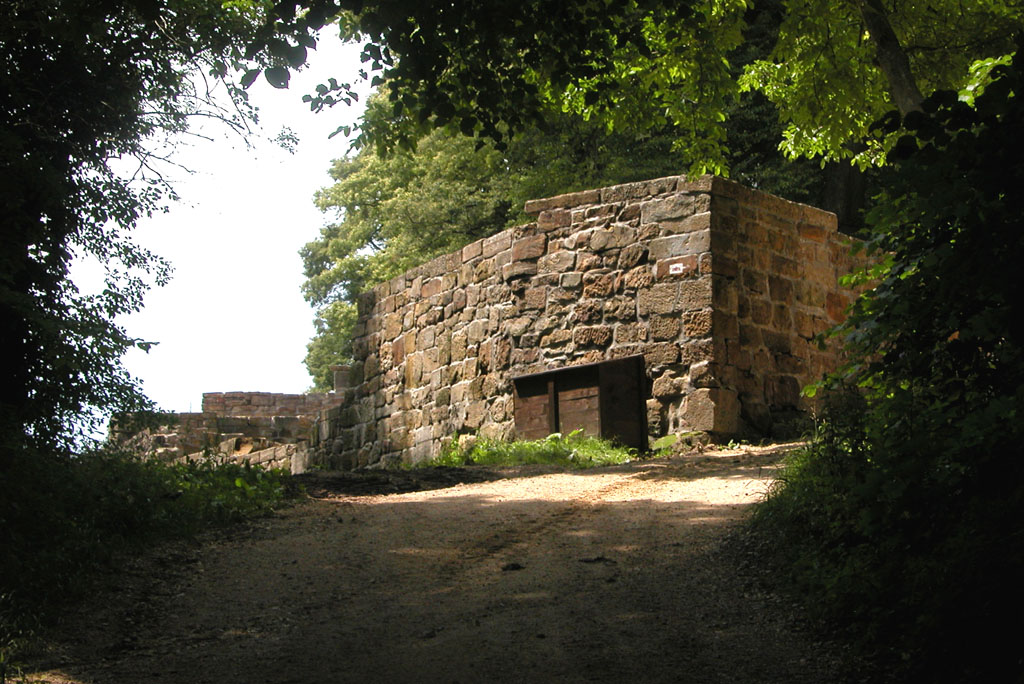
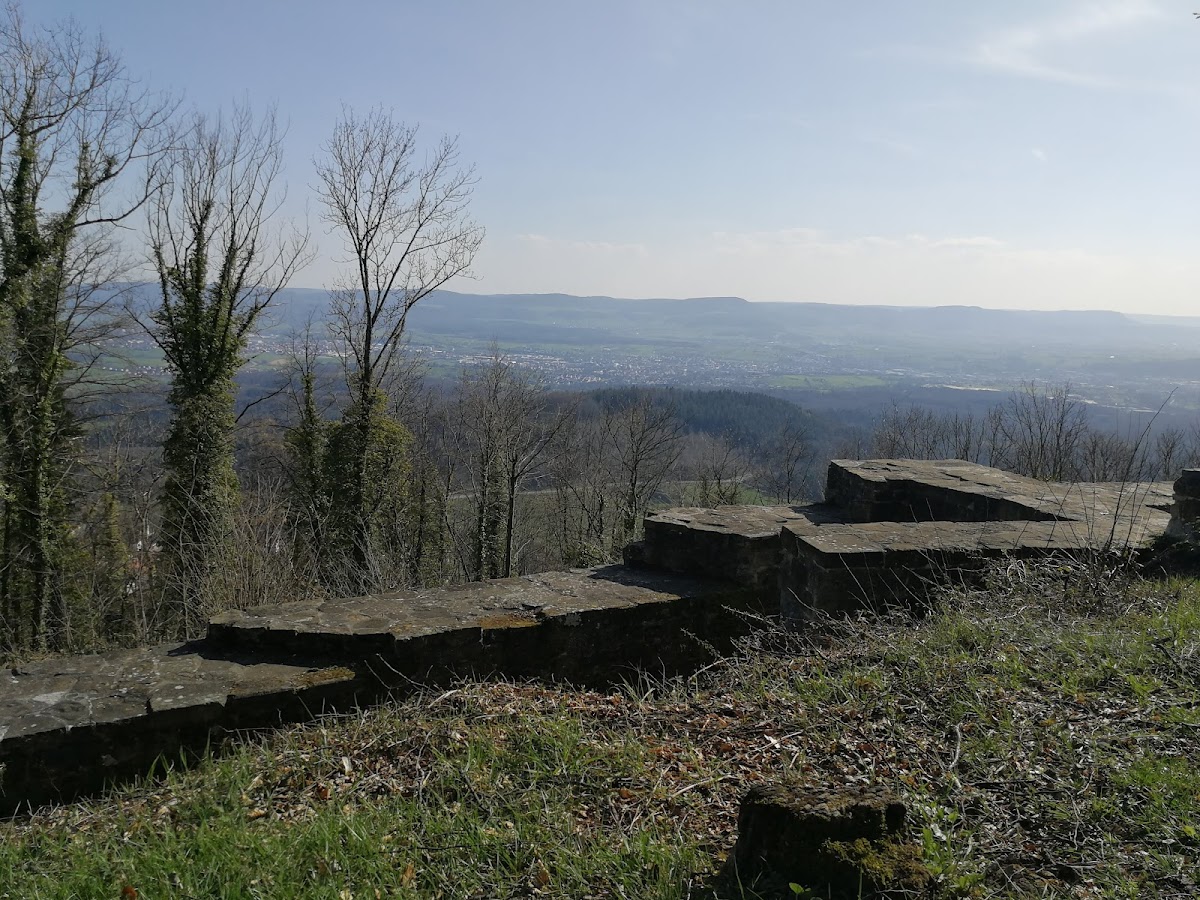
Hohenstaufen occupies the peak of a conical mountain and survives as the foundations and secured remnants of a medieval summit castle. The complex was divided into a main castle and an outer bailey. A substantial internal wall separated the outer fortified section from the citadel, creating an elongated oval plan around the central keep and other defensive structures.
Castle Plan and Masonry
The central keep, called the Mannsturm, had sides measuring 10 metres. Parts of the surviving masonry use bossed ashlar, in which roughly projecting stone faces form the outer surface of the wall. The castle’s foundations were exposed during the excavations of 1936 to 1938 and 1967 to 1971, then secured through later conservation. Some existing ruins were extended during the conservation work completed in 2010.
Earlier Archaeological Remains
The northeastern part of the summit plateau contains a burial area with 20 graves of men, women, and children. Radiocarbon dating places these burials from the first half of the eighth century into the early medieval period. Ceramic finds from later spot excavations belong to the same broad period and include older yellow wheel-thrown pottery of the Runder Berg type, dating from the eighth century to the middle of the eleventh century.
Excavations and renovation work between 2009 and 2013 also revealed traces of settlement from the Bronze Age, the late Hallstatt period, and the early La Tène period. Some of this material dates to the fifth century BC, while its interpretation was still incomplete in 2014.
Surviving Ruin and Memorial Features
By 1588, the visible castle fabric consisted of roofless walls and towers. The tower represented in 1685 was probably the Bubenturm, a southwest tower that was demolished in 1705 because of structural cracking. The final surviving wall was shown in 1798, after which no visible medieval structure remained above ground until archaeological excavation and conservation exposed and secured the foundations.
The Staufer stele installed on the summit in 2002 marks the site’s association with the Hohenstaufen dynasty. At the foot of the mountain, the documentation center presents the history of the castle and the dynasty.