Château de Peyrelade: A Medieval Fortified Castle in France


Site at a Glance
- Rating
- 4.5
- Popularity
- Medium
- Country
- France
- Primary era
- Medieval
- External website
- Open
- Eras represented
- Medieval
- Civilizations
- Unclassified
- Site type
- Military
- Remains
- Castle
On this page11 sections
History
Château de Peyrelade is a medieval fortified castle in France, near Rivière-sur-Tarn, probably founded in the eleventh century and documented from at least the twelfth century. Built on a rocky spur above the entrance to the Tarn Gorges, it controlled an important position in the former Rouergue, a historical province corresponding broadly to much of modern Aveyron. Objects found at the site may point to prehistoric occupation, although that interpretation remains uncertain.
The Roquefeuil and Sévérac lordships
Peyrelade was held as a co-seigneurie, a feudal lordship divided among several co-lords who shared its rights and revenues. The Roquefeuil family controlled the site from the late tenth century until 1174. During this period, Raymond made a donation to Saint-Guilhem-le-Désert Abbey in 1080. His second son Bernard continued the line of the viscounts of Creyssel and became lord, then co-lord, of Peyrelade after a donation to Gui de Sévérac. Bernard’s daughter and heir, Ermengarde, married Hugues I, Count of Rodez.
In 1174, Gui III of Sévérac received the fief from Bernard de Roquefeuil by donation, beginning the Sévérac family’s control. The succession passed through Gui IV, Gui V, Gui VI, Gui VII, Déodat, Gui VIII, Gui IX, and Gui X. Through marriage, the co-seigneurie became connected with the families of Gévaudan, Canillac, Combret, Panat, Bruniquel, Béziers, Narbonne, Auvergne, and Landorre.
The arrangement remained politically complex. In 1240, an arbitral judgment gave Hugues IV, Count of Rodez, possession of the castle in alternation with the Sévérac family, with each side holding it for three-month periods. This division reflected Hugues’s possession of the viscounty of Creyssel. The co-seigneurie eventually entered the domain of the kings of France in 1589.
Competing families and wartime control
The Henry, or Ahenricy, family held portions of Peyrelade from the early twelfth century until 1422. Henri, also called Ahenricy de Peyrelade, appears in 1132 in a treaty involving Bérenger Raymond, Viscount of Gévaudan and Count of Provence, and Guilhem VI, lord of Montpellier. Later members of the family continued to render homage for their shares. Raymond did so to Gui de Sévérac in 1268 for half of Peyrelade, while his son Bernard acquired the possessions of his brothers. In 1331, Pierre sold one quarter of his fief to Jeanne de Narbonne. Pierre II rendered homage to Gui IX de Sévérac in 1363 and sold part of his land to Pierre de Guitard in 1389. Jean rendered homage to Gui X in 1409, and his sister and heir, Catherine Tiburge, later sold her possessions to Jean de Ricard.
The Guitard family held parts of the fief from the mid-thirteenth century to 1291 and again from the fourteenth century until after 1524. Saysette, daughter and heir of Étienne, brought her possessions to Pierre Ricard through their marriage around 1291. Pierre later supported the English side during the Hundred Years’ War, the long conflict between the English and French crowns, and in 1381 rendered homage to Jean d’Armagnac, Count of Rodez and Viscount of Creyssel. Pierre II repeated this act in 1429, followed by his son Jean in 1462. Jean’s daughter and heir, Hélix, married Azémar du Claux.
Jean Ricard acquired part of Catherine Tiburge de Henry’s fief in 1422, and the Ricard family retained its share until 1603. Hugues was confirmed in possession of one quarter of the castle in 1483. Raymond declared his possessions in 1541, while his nieces and heirs, Diane and Marguerite de Garceval, sold the seigneurie to Charles de Brunel and Pierre de Pélamourgue in 1603.
Peyrelade was repeatedly contested from the Hundred Years’ War through the Wars of Religion, the sixteenth-century conflicts between Catholics and Protestants in France. Calvinists conquered the stronghold, but Raymond de Ricard, himself a co-seigneur, expelled them and took control of the entire site. Georges d’Alboy de Montrozier recovered his property only in 1596. This episode illustrates the instability created by both religious warfare and the castle’s divided ownership.
Later co-lords and dismantling
The Jouery du Claux family held a portion after 1524 until about 1570. Azémar du Claux married Hélix de Guitard, and their son Gaspard married Antoinette de Mostuéjouls in 1506. Their daughter Madeleine married Jean d’Alboy de Montrozier, while her brother François died without issue around 1570. The d’Alboy de Montrozier family then held its portion until 1663. Georges succeeded his brother in 1577 and married Jeanne d’Arjac du Cayla. His descendant Marie-Madeleine married Jean de Granger, lord of Montméjan, in 1637, while retaining control of her property.
Charles Brunel acquired a share in 1603. His son Jean inherited it, but Jean’s son Georges died unmarried in 1637. Georges’s sister and heir, Jeanne, transferred the co-seigneurie to the Puel family in 1641. Pierre de Pélamourgue also bought a share in 1603. His son Antoine was a co-seigneur in 1667, while the senior branch included Jean-François de Pélamourgue and his son Jean-Félix, who married Marie de Brunet de Castelpers de Panat in 1700. Jean-Félix’s grandson and heir, Félix de Malbosc, sold the family’s Peyrelade possessions to Louis de Puel in 1753.
The castle’s active history effectively ended in the seventeenth century, when it was dismantled. The precise date is uncertain, and tradition attributes the destruction to an order from Cardinal Richelieu, the chief minister of Louis XIII who supported the consolidation of royal authority and the reduction of some noble fortifications.
Excavation and protection
Excavation and restoration began in 1977 on the initiative of Pierre Bloy, mayor of Rivière-sur-Tarn from 1977 to 2008. The commune has owned the castle since that year, and it was opened to visitors in 1996. The ruins have been protected as a French historic monument since 6 March 1998. Peyrelade is also one of twenty-three castles in Aveyron associated with the Route des Seigneurs du Rouergue.
Remains
Fortified enclosures
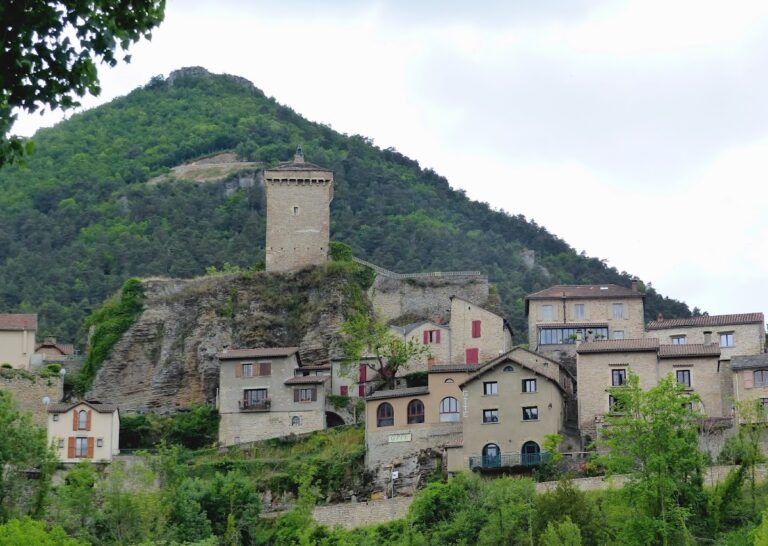
The ruins occupy a rocky spur about 1.5 kilometres northeast of Rivière-sur-Tarn, overlooking the Tarn valley at the entrance to the Tarn Gorges. Built of stone, the surviving enceinte, or enclosing defensive wall, extends for more than 250 metres. It reaches about 10 metres in height and up to 2.1 metres in thickness. The walls and associated remains preserve enough of the site’s organization to convey its medieval layout.
Outer walls and courtyards
Three successive enclosures surrounded the castle during the medieval period. The first was entered through two gates and enclosed the first and second courtyards. The second protected the residential building and an arms yard. The third enclosed the rocky height and the donjon, the principal fortified tower of a medieval castle, which served as a defensive refuge and contained residential and service spaces.
The rocky keep and donjon
Natural rock and access
The donjon is set against, or integrated with, a prominent natural rocky outcrop. The rocky keep complex rises about 50 metres. Access was provided by a drawbridge, and the donjon opened onto a terrace. Another description places the approach through an attached round tower, emphasizing the close relationship between the natural rock and the fortified structure.
Interior services and alarm
The donjon remains in relatively good condition and contained an oven, a cistern, and a belfry. Its bell served to raise an alarm in danger. Together with the surviving walls, these features show how the highest part of Peyrelade combined defense, practical services, and warning functions within the castle’s larger system of enclosures.