Țigănești Monastery: An Orthodox Monastic Community in Moldova
Site at a Glance
- Popularity
- Medium
- Country
- Moldova
- Primary era
- Modern
- Eras represented
- Early Modern, Modern
- Civilizations
- Ottoman, Principality of Moldavia, Russian
- Site type
- Religious
- Remains
- Monastery
On this page14 sections
History
Țigănești Monastery is an Orthodox monastery in Moldova, within the Diocese of Chișinău of the Russian Orthodox Church, with origins in a wooden church built around 1725. Dedicated to the Dormition, the Eastern Christian commemoration of Mary’s death and assumption into heaven, the church was built by the landholding nobleman Lupu Dencu and freeholders from Țigănești and Cobâlca, now Codreanca, to shelter nearby Christians from Tatar raids.
Foundation and early community
By 1741, a skete, a small monastic community, had formed beside the church. Its early leaders were Bartholomew and Abraham. Hieromonk Samuil, a monk ordained as a priest, became its first abbot, the head of a monastery. In 1758, Tatars plundered the community, forcing the monks to flee and capturing Samuil. They took property and documents. In a testament, Samuil described the estate boundaries and his capture.
Land disputes and expansion
A dispute over the monastery’s estate began around 1803 between the monks and landowner Lupu Roset. The case went to court under Hieromonk Macarie. During Martirie’s leadership from 1835 to 1840, the land was awarded to Roset, leaving the monastery with 48 desetine, a traditional land-area unit, and 1,220 stânjeni, a traditional measure of length used in land descriptions.
The monastery expanded during the nineteenth century, with new churches and residential buildings. In 1860, Catrina Petceva of Chișinău gave it a house on Armenian Street in that city. Ion Brâncă of Hârtopul Mare donated 35 desetine in 1879, and Grigore Vitu of Țigănești gave arable land in 1893. By the late nineteenth century, the monastery held an estate of 50 desetine, three watermills, orchards, and vineyards, and had a library of books in Romanian and Russian. Sava Bărbuță and Simeon Garnati donated arable land in 1903, followed by a gift from Teodor Țaca in 1908.
The community grew from 10 residents in 1900 to 48 in 1904. Under Abbot Teodosie, who led the monastery from 1909 to 1912, it acquired 12 desetine of forest and built a lodge for pilgrims. Lawyer Vasile Bodi donated another 12 desetine of forest during Abbot Agatanghel’s leadership from 1912 to 1916. In 1918, the skete became an independent monastery. It then had 56 residents and 110 desetine of land, including forest, fields, vineyards, vegetable gardens, and a one-hectare lake.
War, closure, and hospital use
During the Second World War, hundreds of Romanian, German, and Russian soldiers killed in combat were buried in the monastery cemetery. Soviet authorities confiscated 500 hectares of forest in 1940. In 1941, the monastery had 130 hectares of land and 34 residents; authorities took another 64 hectares of arable land in 1944. In 1945, a captain and several soldiers arrived to try to close the monastery. The attempt failed, and the soldiers reportedly left after observing the community’s life and work.
From 1948, the authorities imposed increasingly heavy obligations while taking more of the monastery’s land. By 1959, it retained seven hectares occupied by its buildings. On 3 July that year, the monastery was closed, and icons and church books were burned. The community was dispersed: 22 monks went to Hârbovăț Monastery, eight to Căpriana Monastery, nine to village parishes, and one to a seminary. Novices, people preparing for monastic vows, were sent home. Abbot Ioachim Burlea was made to live under surveillance in his home village of Bravicea.
From 1960 to 1961, the buildings housed a hospital for people with physical disabilities; afterward, a psychiatric hospital occupied the complex until July 1992. The Dormition church became a storage space and the Saint Nicholas church a hospital ward. The cemetery was levelled. The Nuns’ Path, linking the community with the nuns’ monastery at Tabăra, also disappeared. The two communities had exchanged goods and helped one another.
Revival
On 8 September 1992, a community of two monks and 10 novices began restoring monastic life under Archimandrite Artemie Bocșa, a senior monastic cleric who had come from Căpriana. The monastery received 49 hectares of land back that year. Its buildings were in poor condition after decades without repairs, and theft by hospital employees had added to the damage. Restoration renewed the churches over the following years, and a third church was built. Archimandrite Donat led the monastery from 1994 to 1997; Hieromonk Irinarh became abbot in 1997. The community had 18 monks in 2013.
Remains
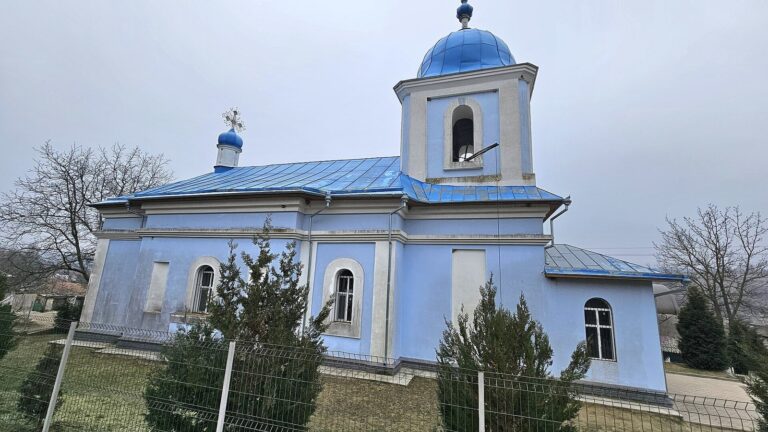
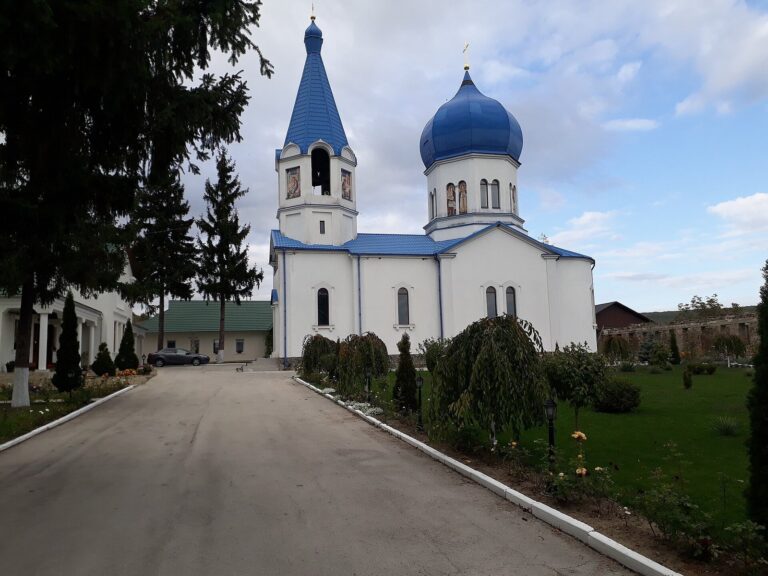
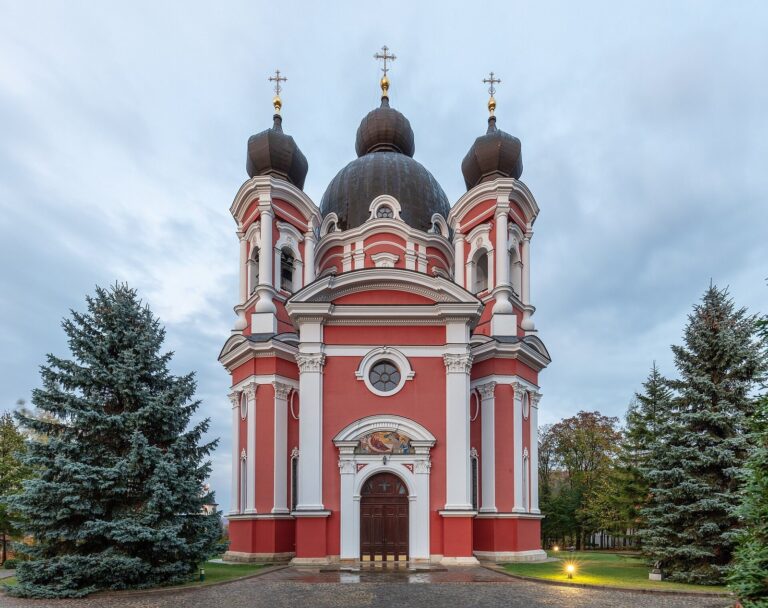
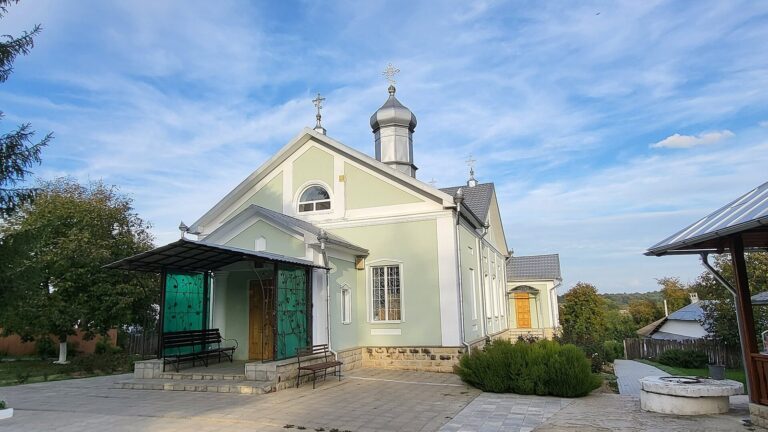
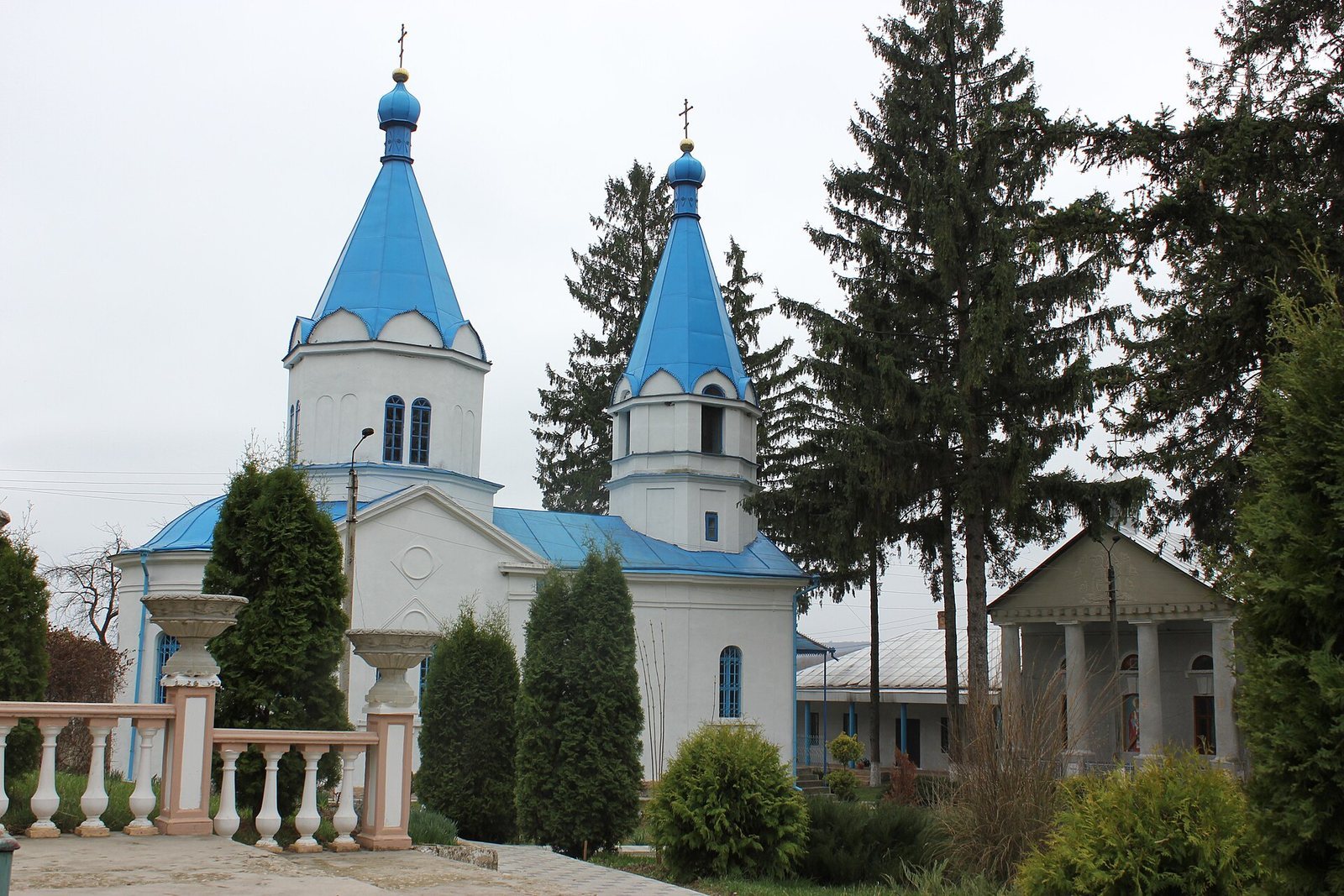
The monastery’s historic complex grew from a wooden church and simple monastic accommodation into an ensemble of churches, cells, communal spaces, and service buildings. The two principal stone churches have different architectural styles, Russian and Moldavian, while a third church is associated with a spring.
Churches
Dormition Church
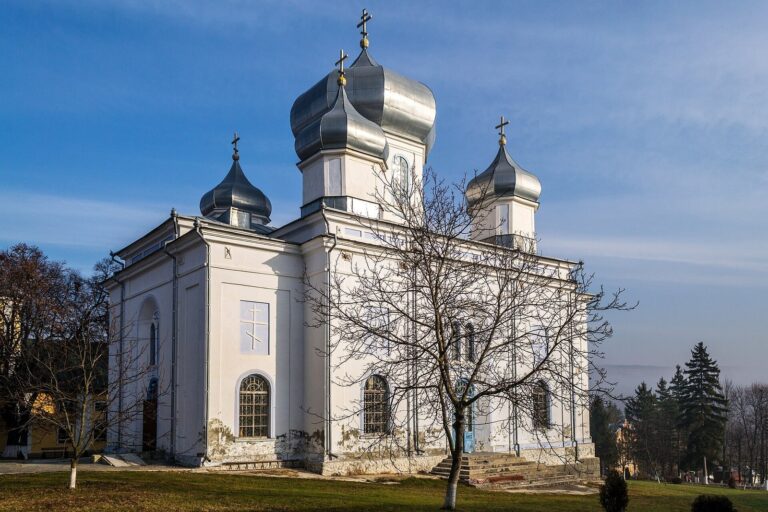
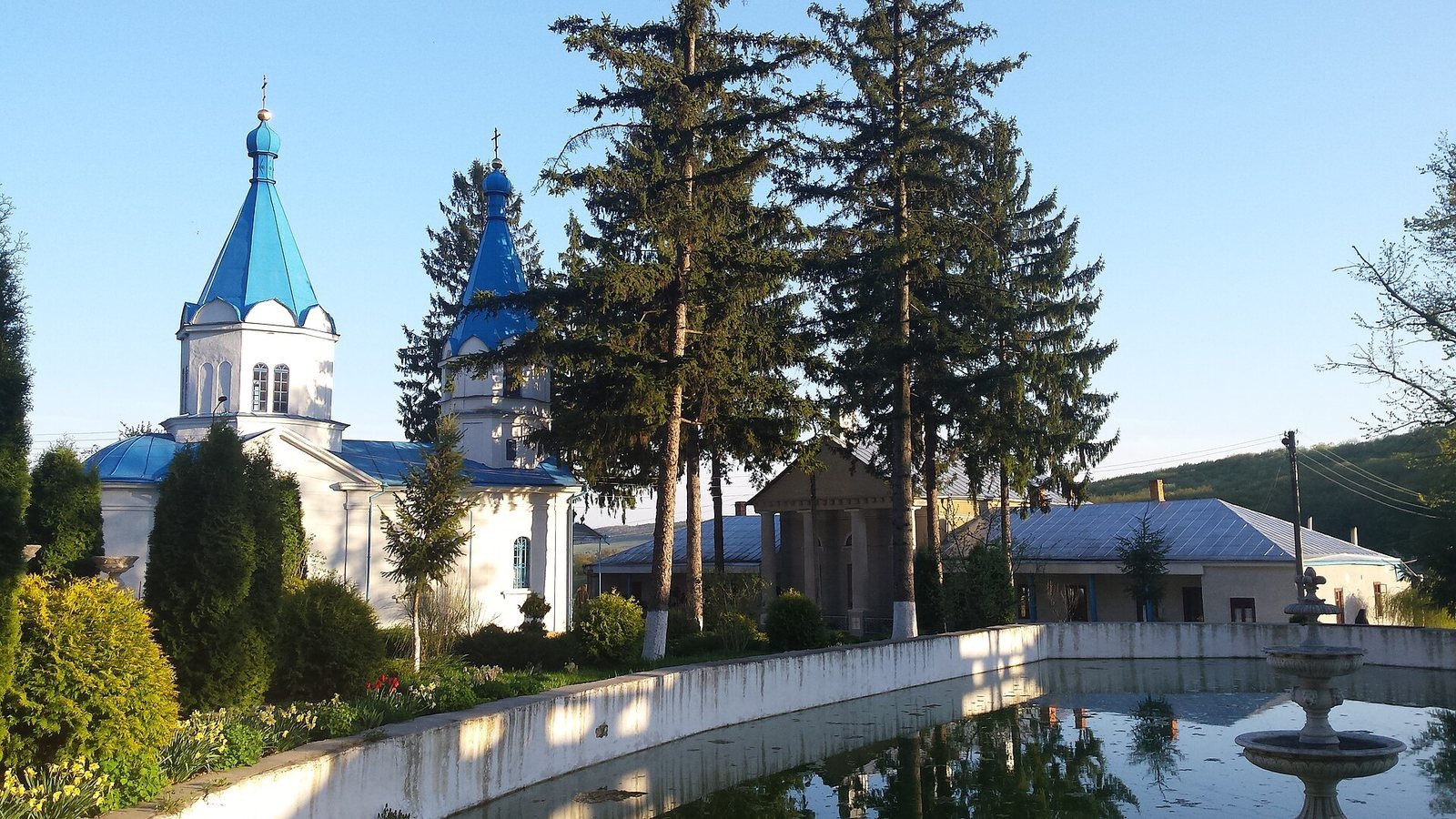
The small Dormition church has a rectangular plan and is in the Russian style. Building began in 1846. The church was consecrated on 15 August 1851, although its construction is also dated to 1846 to 1853. Its two Gothic-style turrets rise above the narthex, or entrance hall, and the naos, the main worship space. The side apses, curved projections at the sanctuary, extend only slightly from the walls. Inside, the traditional divisions are topped by a vaulted ceiling, and a choir gallery occupies the upper part of the entrance hall. The altar was consecrated on 26 August 1993; restoration continued until the church’s consecration on 21 May 1998.
Saint Nicholas Church
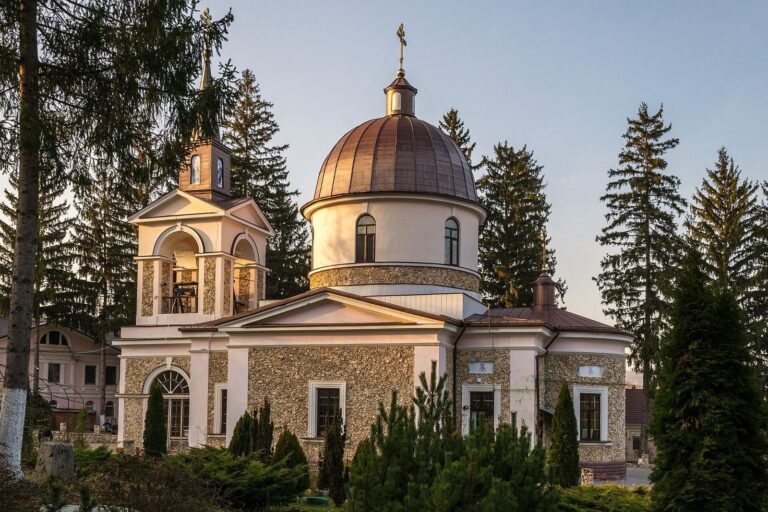
The winter church, dedicated to Saint Nicholas the Hierarch, was built between 1868 and 1874 with contributions from Christians and substantial support from Chișinău merchant Hristofor Carandje Iscrov. Its architecture is in the Moldavian style. Repairs began in 1998. The altar was consecrated on 19 December 2000, and the restored church was consecrated on 1 November 2009.
Life-Giving Spring Church
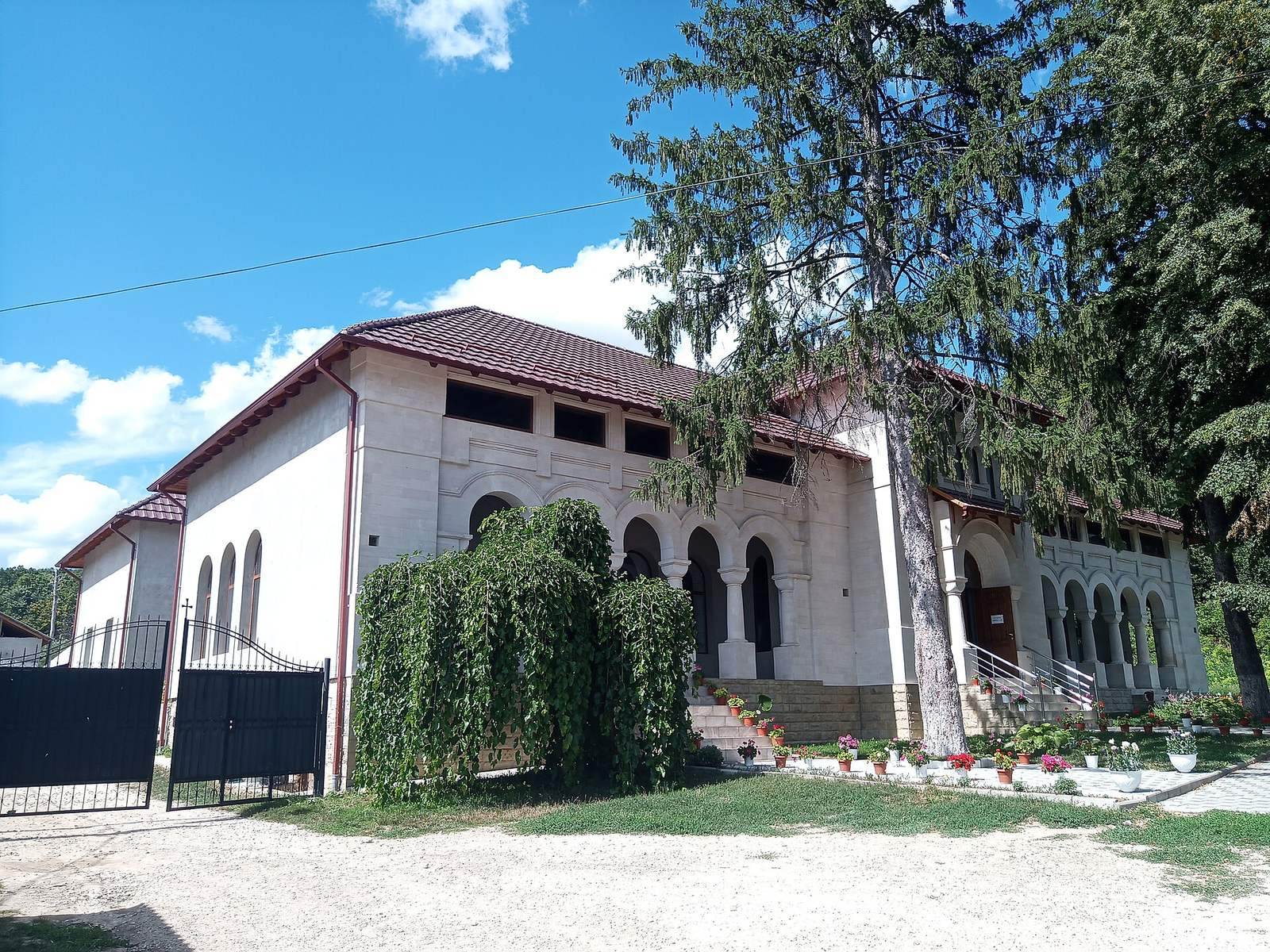
Built in 2009, the third church is dedicated to the icon of the Mother of God called Life-Giving Spring. It is housed in a building above a spring.
Monastic buildings
Cells and communal buildings
In 1820, the skete had 15 monks’ cells, a residence for the deputy superior, and six houses for novices, alongside its wooden Dormition church and a wooden bell tower with three bells. By 1851, the monastery included 10 wooden cells and a refectory. Its residential and communal buildings later expanded: by 1905, an abbot’s residence had four cells, two stone monks’ buildings had 12 and 16 cells, and a stone refectory building contained 10 cells. A kitchen also served the complex.
Service buildings and watermills
The complex’s other buildings in 1905 included a large stone fountain and a smaller fountain, a wooden barn, a house with a cellar, sheds and stables, a stone wine cellar, and two corn barns. Three watermills formed part of the monastery’s estate.
Library and icon
The monastery library includes books more than a century old. An icon of Saint Panteleimon containing a fragment of his relics survived the burning of the monastery’s icons in 1959. Bishop Serafim (Ciciagov) of Chișinău and Hotin had given the icon to the monastery in 1909.