Kamenskoye Gorodishche: A Scythian Settlement in Ukraine
Site at a Glance
- Popularity
- Medium
- Country
- Ukraine
- Primary era
- Classical
- Eras represented
- Classical
- Civilizations
- Scythian
- Site type
- City
On this page11 sections
History
Emergence and Scythian-era role
Kamenskoye Gorodishche was an ancient Scythian settlement on the left bank of the Dnieper near present-day Kamianka-Dniprovska in Ukraine. It developed from around the late fifth or fourth century BCE. The Scythians were peoples of the Eurasian steppe, particularly associated with the northern Black Sea region. The settlement grew on their wintering grounds, a development linked to a shift toward more settled life.
The settlement’s purpose and political status remain debated. B. N. Grakov and other researchers identified it as the Scythian kingdom’s capital, possibly during the reign of Ateas, a fourth-century BCE ruler, but that identification is uncertain. Other interpretations describe a major craft, trade, and administrative center, a seasonal trading place, or a group of smaller settlements. N. A. Gavrilyuk viewed the communities as small pastoral groups that controlled floodplain pastures and important trade routes.
Residents combined farming and livestock raising with crafts and household production. Trade connected the Scythian steppe with Greek cities on the northern Black Sea, including Olbia, and with the Bosporan Kingdom, an ancient state centered around the Kerch Strait. Objects made at Kamenskoye also reached nearby burial grounds, where Scythian elites, including rulers, were buried.
Decline and archaeological investigation
Occupation continued into the third century BCE. The settlement then declined and was abandoned around the late third or early second century BCE, although a smaller fortified area remained in use into the early centuries CE.
D. Ya. Serdyukov carried out the first excavations in 1899–1900. B. N. Grakov excavated in 1938–1941 and 1944–1950, followed by expeditions from the Institute of Archaeology of the Academy of Sciences of the Ukrainian SSR, the Soviet-era Ukrainian republic. V. I. Bidzilia led an expedition from 1981 and N. A. Gavrilyuk from 1987. Much of the site now lies beneath the Kakhovka Reservoir and is investigated underwater. It is protected as a cultural heritage monument of national significance in Ukraine.
Remains
Landscape and defenses
Settlement setting and outer boundary
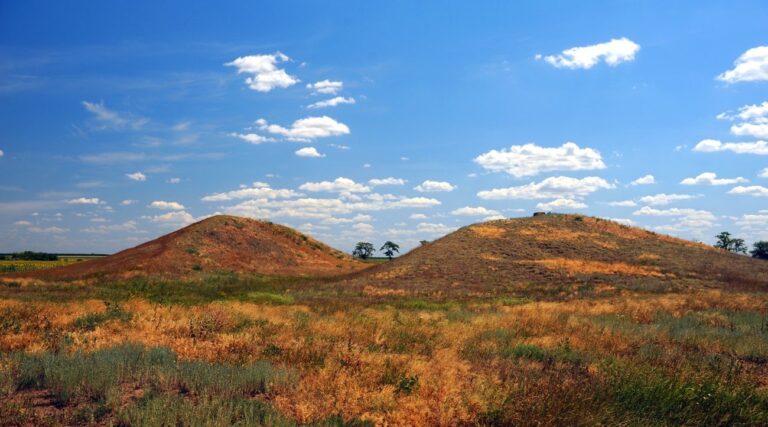
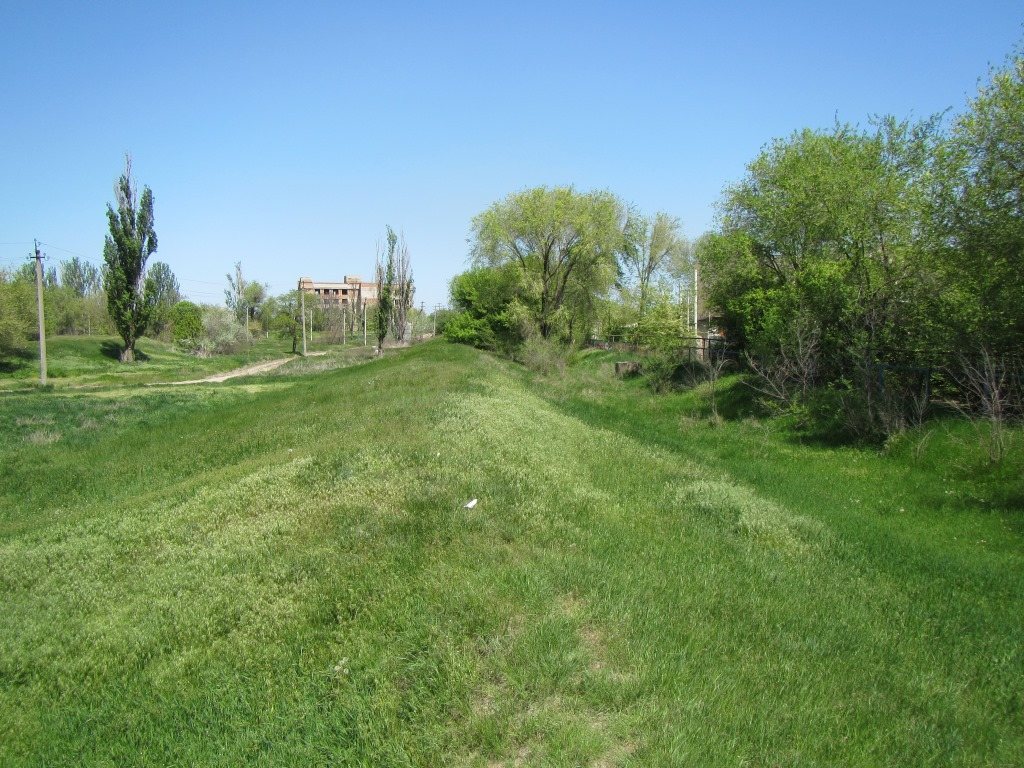
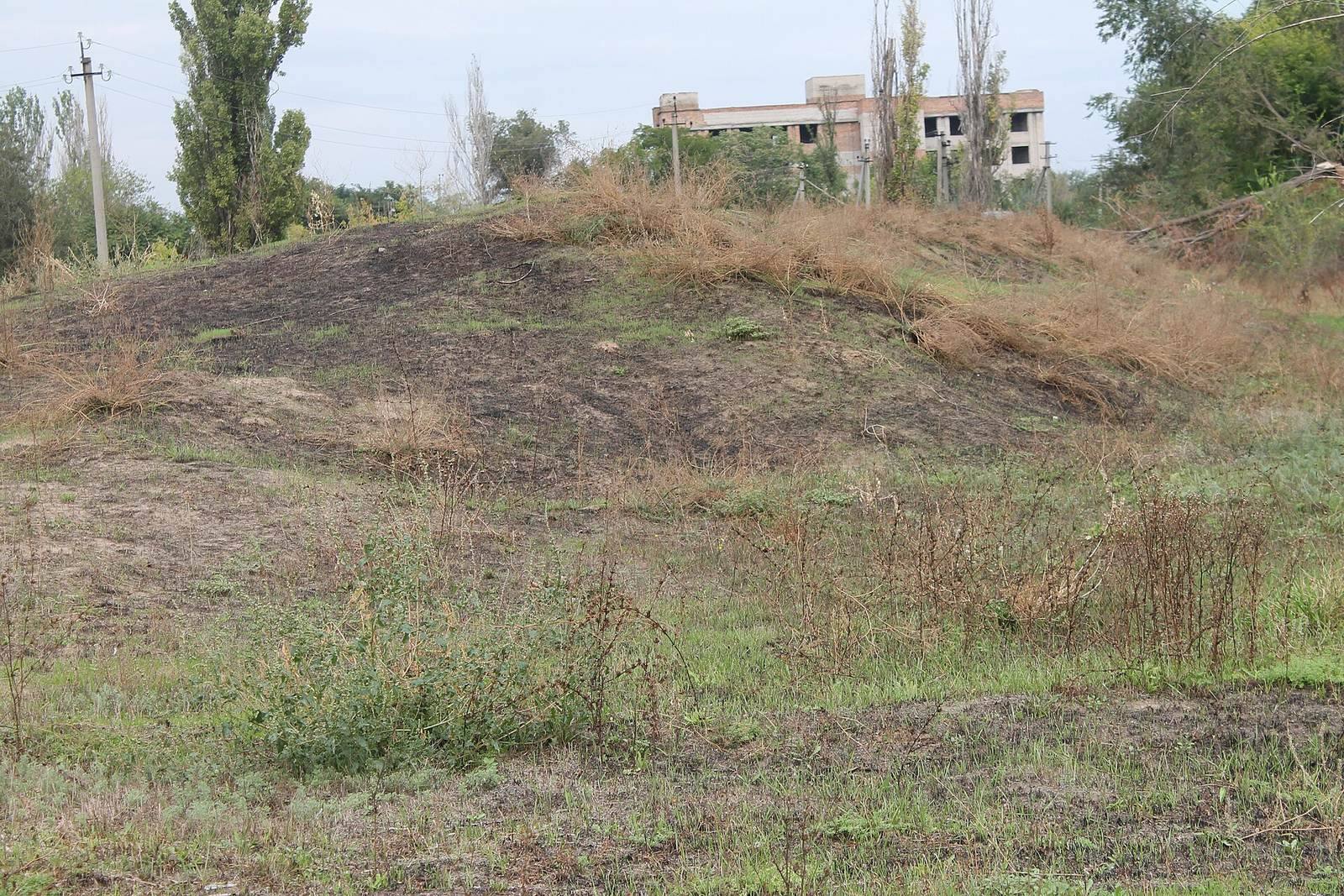
The site covered about 12 square kilometres and occupied a dune promontory among floodplain wetlands. The Dnieper lay to the north, the Konka River to the west, and the Belozersky estuary to the south, while the steppe extended to the east. The settlement is described as the largest monument of Scythian culture in the region. Steep banks above the river and estuary formed natural boundaries, while an earth rampart, about two metres high, and a ditch defended the steppe-facing side.
Fortified central area
A smaller fortified area of more than 32 hectares, associated with the nearby Znamenskoye settlement, lay between the Konka and the Belozersky estuary. Its western part is identified as the Acropolis, meaning a fortified central or elevated area of an ancient settlement. An additional substantial rampart, strengthened along its top with heavily fired bricks, enclosed this area. It is associated with an administrative center and a residence of Scythian rulers. A much larger sector lay to its northeast.
Dwellings and production
Houses and household features
Soil containing traces of human activity survives in lens-shaped deposits. Excavations revealed homesteads, household pits, frame-built houses, partly sunken dwellings, and above-ground houses.
Workshops and material finds
Work areas included bronze-casting installations, facilities for shaping bone and horn, and smithies. The larger sector was a production area where local bog iron, iron-rich material formed in wetlands, was used. Workshops made iron and bronze weapons, tools, everyday objects, and ornaments.
Finds include local and Greek pottery, among it black-glazed, painted, and gray-clay tableware, as well as fragments of wine containers and glass. Other objects include tools, horse harness, flint and metal items, and products of bone and horn. Bronze, stone, and gold ornaments were also recovered, along with coins from the Bosporan Kingdom, Istros, and Olbia.
Burial remains
The necropolis contained several kinds of graves and a range of grave goods. Gold ornaments from the burials were made more often in Greek workshops than in local ones. Numerous Scythian burial mounds stood in the surrounding area on both sides of the Dnieper, including the royal barrows of Solokha and Chertomlyk.