Church of the Cross: A Confraternity Oratory in Senigallia
Site at a Glance
- Popularity
- Medium
- Country
- Italy
- Primary era
- Early Modern
- Eras represented
- Early Modern
- Civilizations
- Papal States
- Site type
- Religious
- Remains
- Church
On this page10 sections
History
The Church of the Cross is a Roman Catholic church near Piazza Roma in Senigallia, Italy. Built in the late Renaissance for the Confraternity of the Sacrament and the Cross, it served a religious association whose members combined devotional practice with charitable work, including aid to people in need. Construction began in 1605, and the church was consecrated in 1608. It belongs to the Diocese of Senigallia.
Muzio Oddi, an architect associated with the court of Urbino, probably designed the church. Girolamo Marini da Barchi built it, and the façade is attributed to him. Each of the church’s seven altars was originally assigned to an arts guild, an association of people working in a particular trade or craft.
The church continues to be used for daily adoration of the Blessed Sacrament, the consecrated host in Catholic worship. The Confraternity also restored one of its paintings in 1997.
Remains
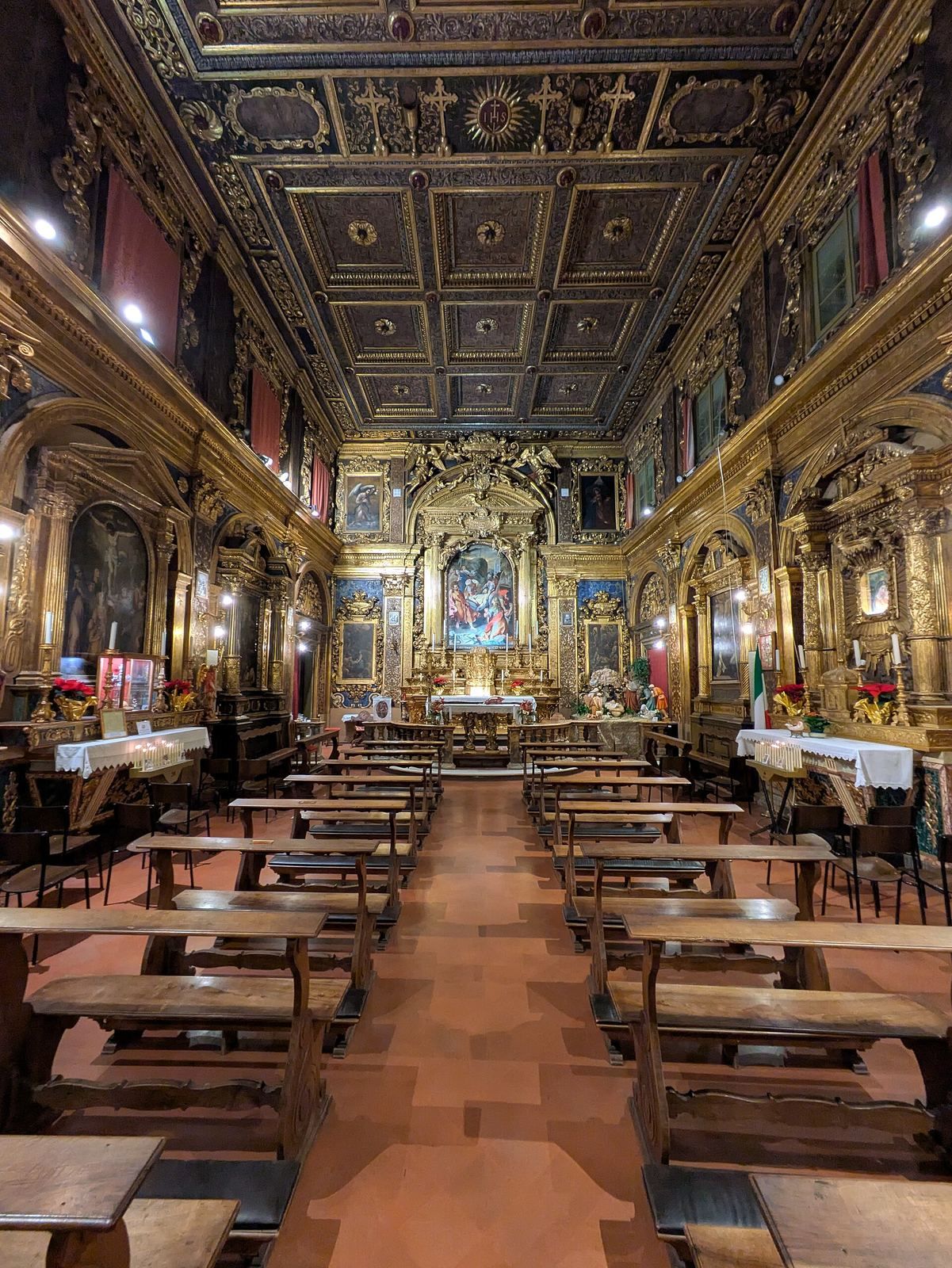
The church pairs a late-Renaissance exterior with a Baroque-decorated interior whose architectural lines retain a restrained Renaissance character. Inside, the rectangular, hall-like space reflects its original use as a confraternity oratory.
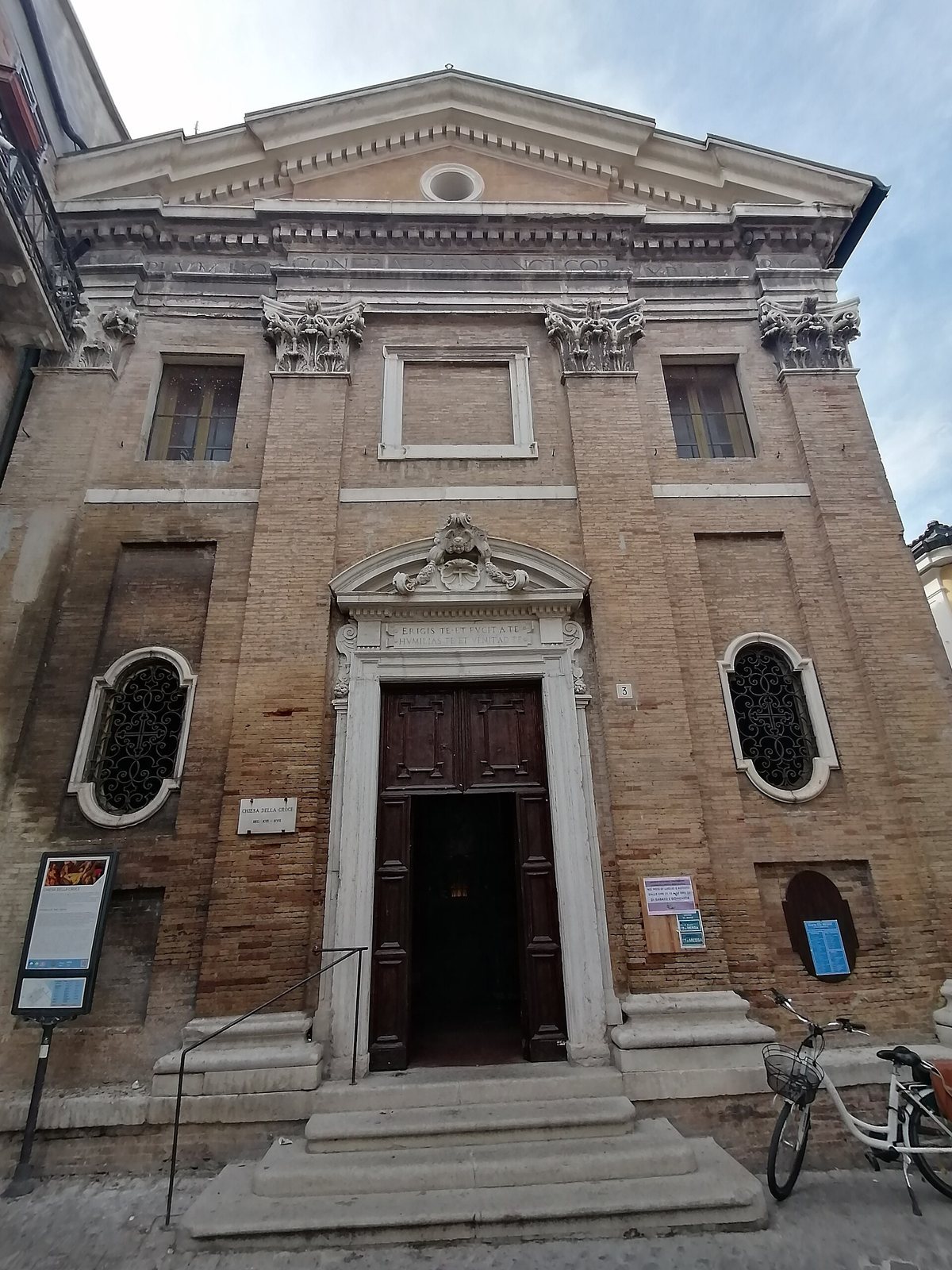
The façade is divided by four pilasters, shallow columns attached to the wall, topped with composite Corinthian capitals that combine acanthus leaves and scrolls. A strongly projecting pediment, the gabled feature at the top of the façade, has a central round opening and geometric ornament in Istrian limestone. The stone is also used for the pilaster bases and capitals. A projecting cornice bears the confraternity’s name and the consecration date. Above the entrance, an admonition attributed to Saint Augustine reads, “If you exalt yourself, the Lord flees from you; if you humble yourself, he comes to you.”
Interior and furnishings
Wall paneling and ceiling
Gilded wooden panels cover the interior walls, with carved decoration and reliefs. Luca Palmieri da Jesi made the wooden coffered ceiling, formed of recessed panels and decorated with interlaced patterns. Its central band displays the Cross and Eucharist, the confraternity’s emblem.
Main altar
The main altar has a tabernacle, a receptacle for the consecrated Eucharist, and extensive gilded decoration. Floral carvings, garlands, and small childlike figures adorn it. An iron grille with curling tendrils supports a cross, while a seventeenth-century wooden statue of the dead Christ is set within the altar.
Barocci altarpiece
Above the main altar, an elaborate architectural frame surrounds Federico Barocci’s oil painting The Entombment of Christ. Barocci made the painting between 1579 and 1582, completing it in 1582, and also designed its frame. The canvas measures 295 × 187 cm. Its diagonal composition leads toward a view of the Ducal Palace of Urbino, a reference to the painter’s native city.
Paintings by Giovanni Anastasi
Four paintings by Giovanni Anastasi flank the Barocci altarpiece at the rear of the church. The Nativity and Adoration of the Magi are positioned below, with the Angel and Virgin of the Annunciation above.
Altars on the left
The first altar is dedicated to Saint Barbara. Its columns take the form of cannons, and its decoration includes cannonballs, set squares, and sabers. Claudio Ridolfi painted the image of the saint. A large niche above the second altar holds Ridolfi’s canvas The Crucifixion. The painting above the third altar shows the Holy Family and Saint Gregory interceding for souls undergoing purification after death, according to Catholic belief. This work belongs to the Barocci school and dates to the early seventeenth century.
Altars on the right
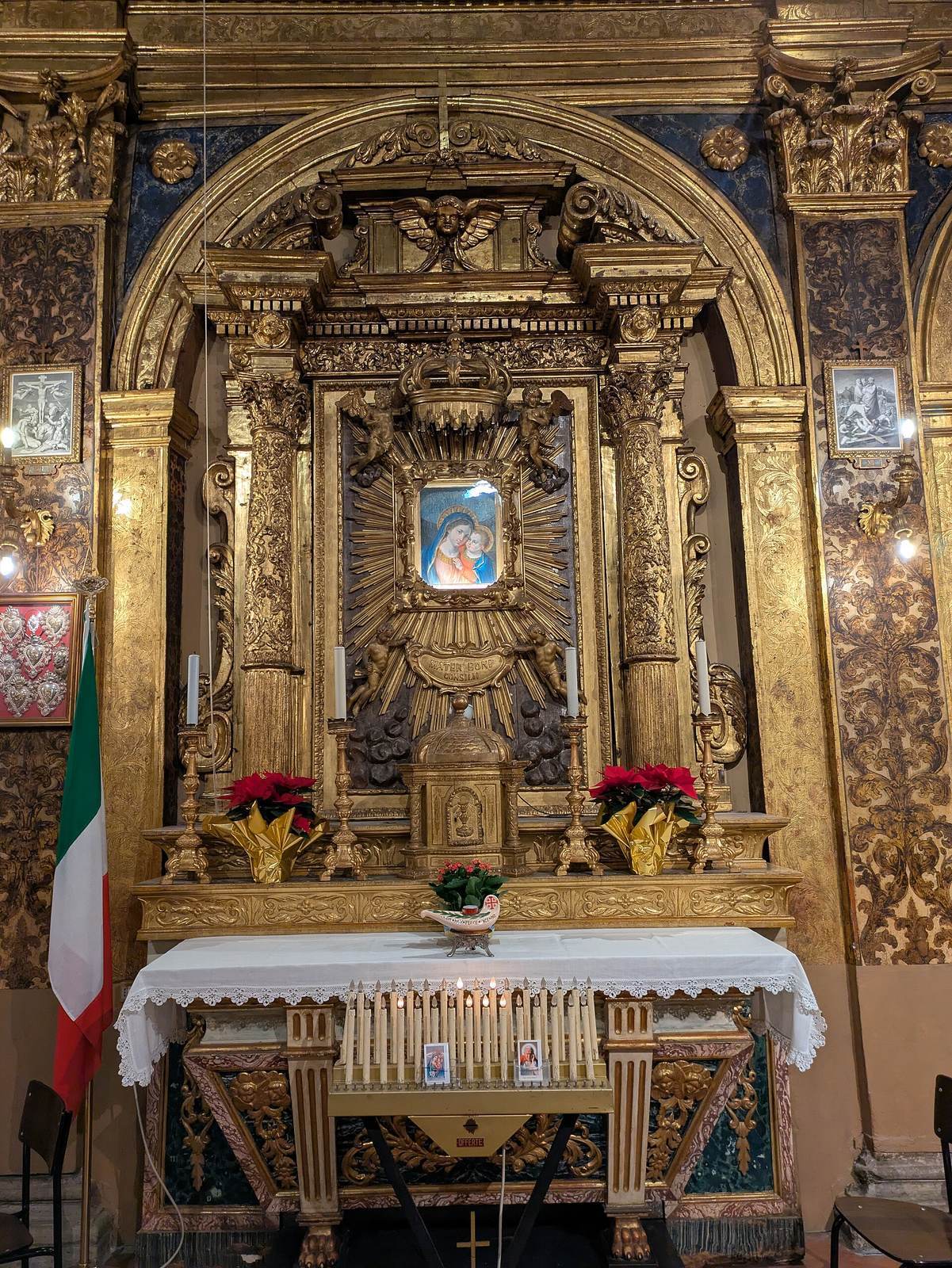
The painting above the first altar shows the Assumption of the Virgin with Saint Francis and Saint Nicholas of Tolentino; two further saints may be visible behind them. The work is attributed to a local Marche school of the seventeenth century. Above the second altar, a small canvas copies the image of Our Lady of Good Counsel, a devotional title for the Virgin Mary associated with a sanctuary at Genazzano near Palestrina. Pope Pius IX, who was born in Senigallia, was devoted to the image. The third altar has an anonymous painting from the local school, showing the crucified Christ with adoring angels and Saints Thomas Aquinas and Bonaventure below. The Confraternity restored this painting in 1997.
Organ
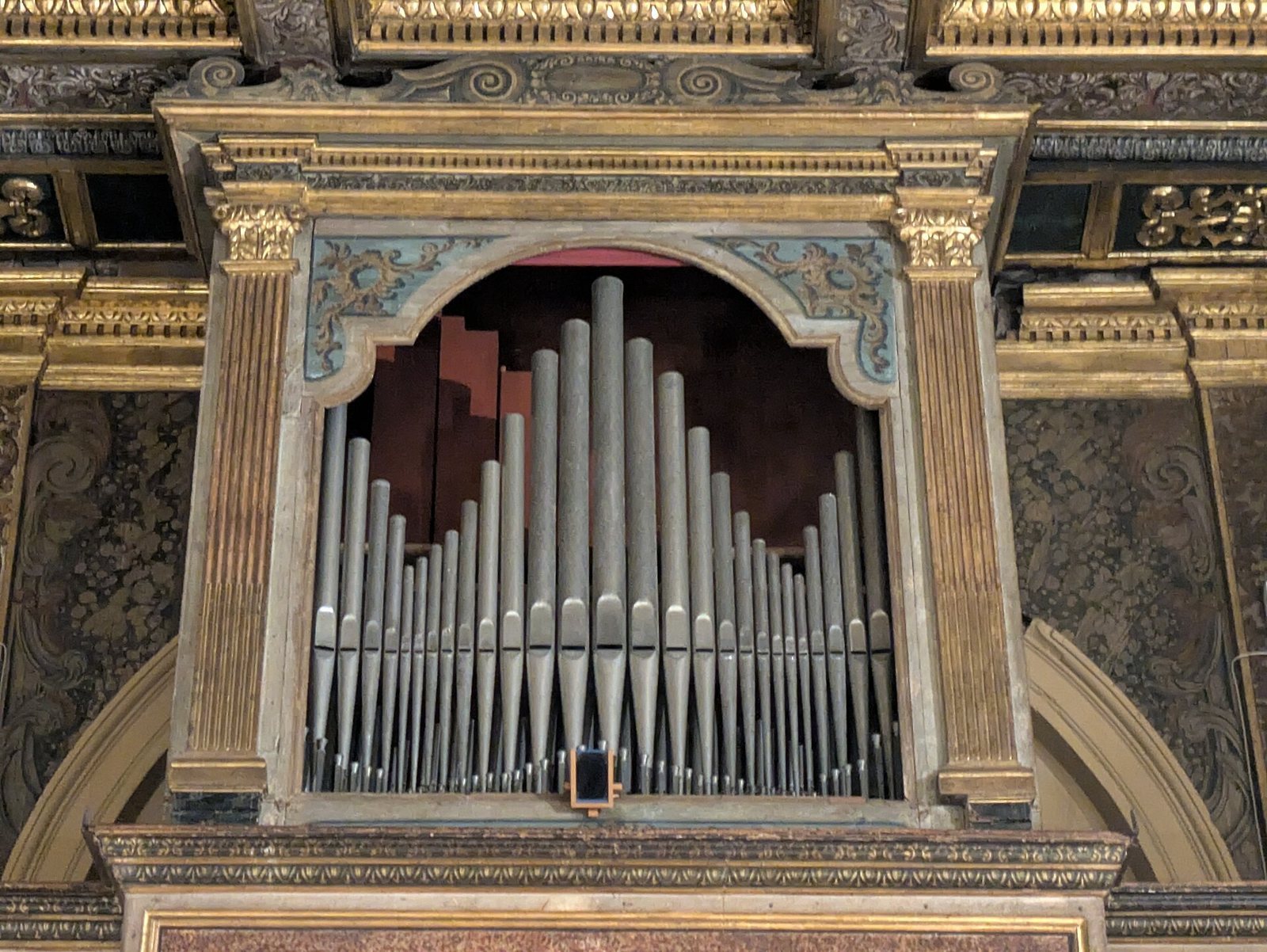
A 1775 organ by Venetian builder Gaetano Callido stands in a wooden case on the choir loft above the main entrance. It has a 45-key manual keyboard and a lectern-shaped pedalboard. Its lowest octave has a reduced set of notes, and the pedalboard is permanently coupled to the manual.