Hephaistia: An Ancient City-State on Lemnos, Greece
Site at a Glance
- Popularity
- Medium
- Country
- Greece
- Primary era
- Classical
- Eras represented
- Iron Age, Classical, Medieval
- Civilizations
- Ancient Greek, Byzantine, Roman
- Site type
- City
On this page16 sections
History
Hephaistia was an ancient Greek city-state on the Palaiopolis peninsula of Lemnos, Greece. The settlement was occupied from the Late Bronze Age into the Byzantine period, and the city is thought to have existed by around 1000 BCE. It was one of Lemnos’s two city-states, alongside Myrina, and served as the island’s capital from the 8th to the 6th century BCE. It reached its greatest extent during the Hellenistic period, an era of widespread Greek cultural influence across the eastern Mediterranean.
Origins and early city
Ancient Greek writers described Lemnos’s early inhabitants as Pelasgians or Tyrrhenians. Pelasgians was a broad term for peoples writers considered pre-Greek, rather than the name of a clearly defined population; Tyrrhenians was associated with the Etruscans of Italy. Tradition attributed Hephaistia’s foundation to the Pelasgians. The city’s name came from Hephaestus, the Greek god of metalworking. In myth, Zeus cast him from Olympus and he landed on Lemnos.
Athenian rule and prosperity
Herodotus recounts that the Pelasgians agreed to surrender Lemnos if north winds carried Athenian ships from Athens to the island in fewer than nine days. Around 500 BCE, the Athenian commander Miltiades the Younger completed the crossing in eight days. Hephaistia’s inhabitants submitted and left, while Myrina resisted and was besieged until it surrendered. Hephaistia’s population declined after the Athenian conquest. Lemnos later came under Persian rule for a time.
In the 5th century BCE, Hephaistia belonged to the Delian League, an alliance led by Athens. Its civic organization followed the Athenian model, with an assembly, tribes and local districts, and a chief magistrate whose year in office gave its name to the year. In 452/1 BCE, Hephaistia and Myrina together paid nine talents in tribute. A talent was a unit of weight used here to measure monetary tribute. After 450/49 BCE, the cities paid separately: Hephaistia contributed three talents and Myrina one and a half.
Hephaistia’s prosperity extended from the 7th to the 1st century BCE, with its peak in the 4th and 3rd centuries BCE. Trade connected the city with other Aegean islands, Macedonia and mainland Greece. It was also a principal center of ancient Greek religion on Lemnos. Hephaestus was its patron deity, and the city honored him in the Hephaistia festival, which included torch races. A sanctuary served the Great Goddess of Lemnos, whose cult became associated over time with Cybele, an Anatolian mother goddess whose worship spread around the ancient Mediterranean.
Christian period and abandonment
Christianity spread on Lemnos around the 2nd and 3rd centuries CE and contributed to Hephaistia’s decline. Christians moved to Kotzinos in search of a new center for their religious life, and the settlement’s growth hastened Hephaistia’s abandonment. Deposits carried by rainwater gradually silted up the harbor, adding to the city’s difficulties. Hephaistia became a bishopric, a district overseen by a bishop, in the 4th century CE. Its bishop attended the First Council of Nicaea, an early gathering of Christian bishops.
Venice took control of Hephaistia and the rest of Lemnos in 1204. A landslide partially destroyed the city in 1395, after which it was abandoned. Excavations began in 1926 under Alessandro Della Seta, then head of the Italian School of Archaeology at Athens. Italian and Greek archaeologists continued the work in later years.
Remains
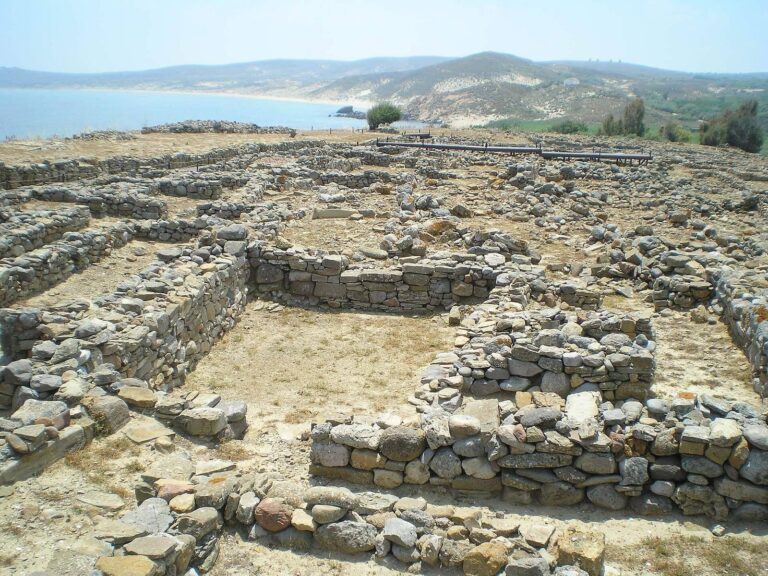
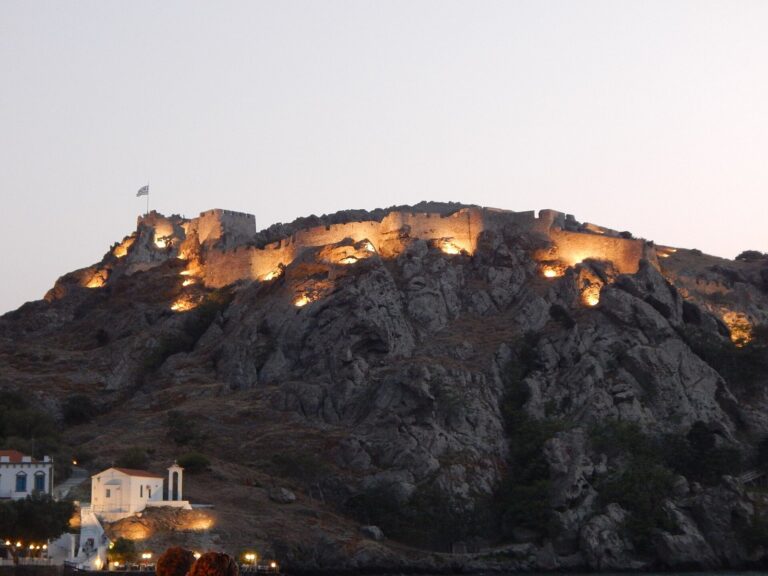
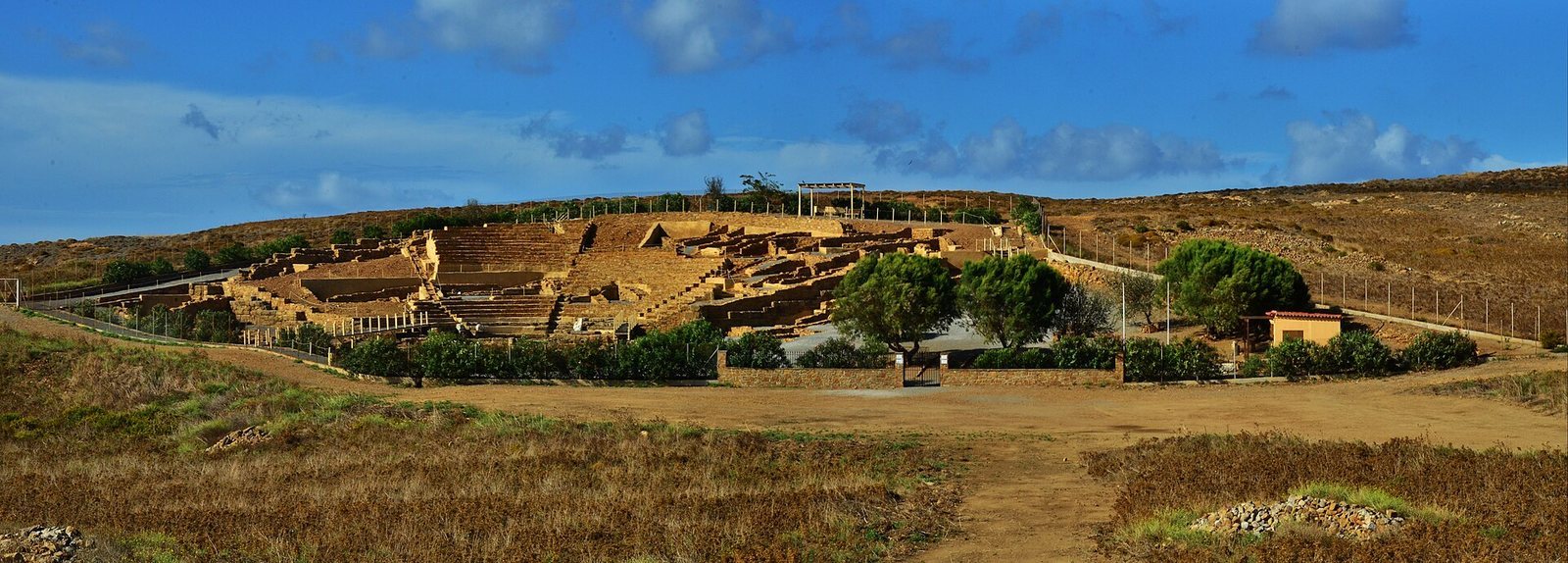
Hephaistia occupied a walled peninsula beside the Gulf of Pournias, where the land formed two natural harbors used according to the weather. Excavations have uncovered houses, churches, baths and wells. Residential and bathing remains date from the Hellenistic to the Byzantine period, including houses and bath buildings southeast of the city beside the sea. A large excavated building is interpreted as a palace and may be the labyrinth of Lemnos mentioned by Pliny the Elder, a Roman author. Southwest of the city, Mount Mosykhlon supplied red chalk, known as Lemnian earth, which was used as medicine.
Religious and craft buildings
Sanctuary of the Great Goddess
Within the western part of the city walls, the sanctuary of the Great Goddess occupied two levels. In use from the mid-8th century to the late 6th or early 5th century BCE, it was destroyed by fire. Its lower western level contained seven or eight small rooms; three rooms on the higher eastern level opened onto a courtyard. Fragments of a cult statue, a religious image used in worship, came from the central room. A separate rectangular ritual building stood east of the sanctuary, where worshippers left votive offerings, objects dedicated to a deity. Some finds from the sanctuary date to the Hellenistic period.
Temples and pottery kilns
Other identified religious buildings include temples to Hephaestus and Heracles, the Greek hero and deity. Two pottery kilns dating to the 2nd or 1st century BCE stood near the sanctuary of the Great Goddess.
Theatre
Early wooden theatre
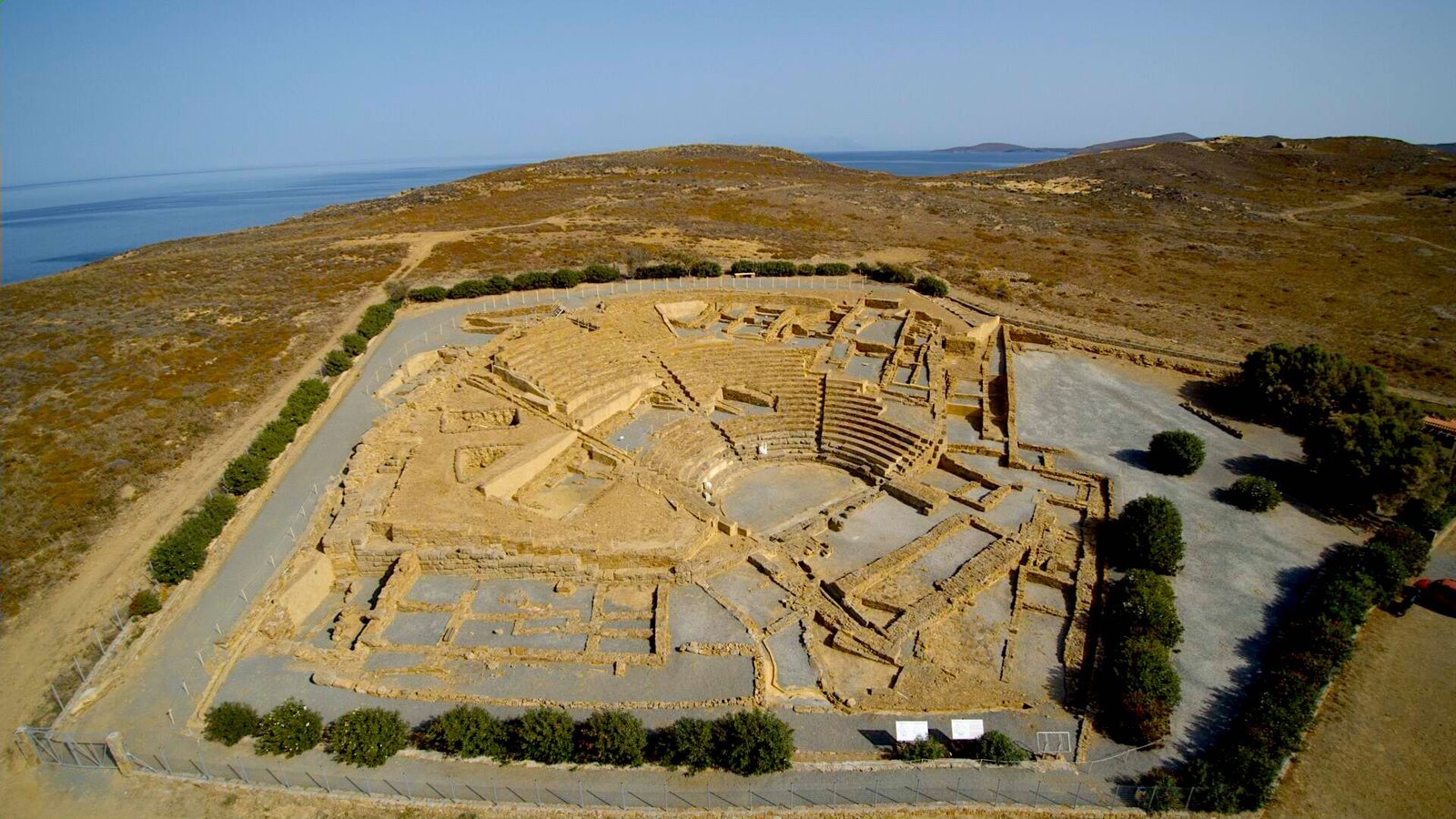
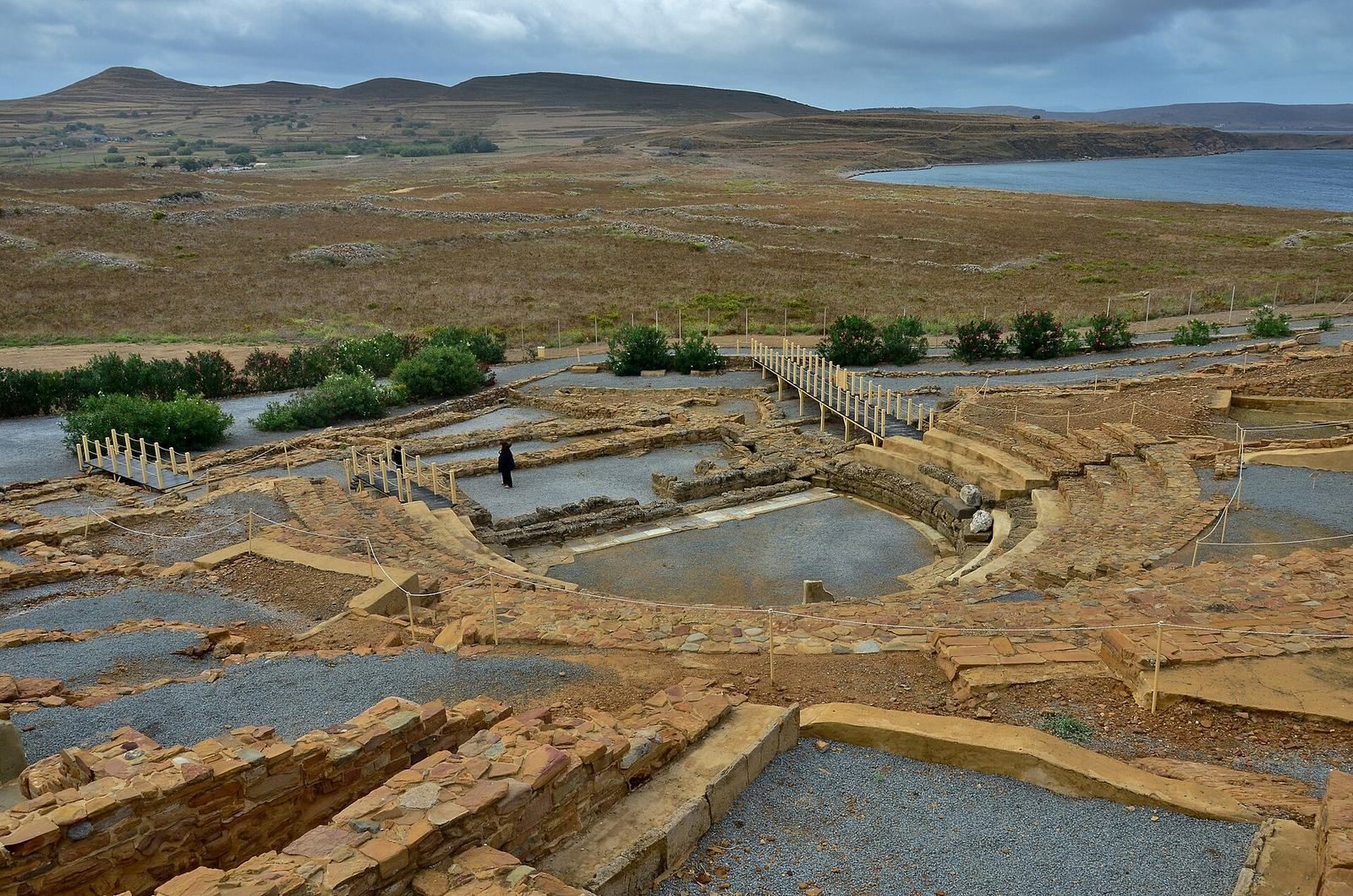
The theatre lies at the peninsula’s narrowest point, on its northeastern side and on the slope of a low hill. An early wooden structure occupied the site by the late 6th or early 5th century BCE. It was probably rectangular, with wooden seats, and covered the central seating area of the later stone theatre.
Stone theatre
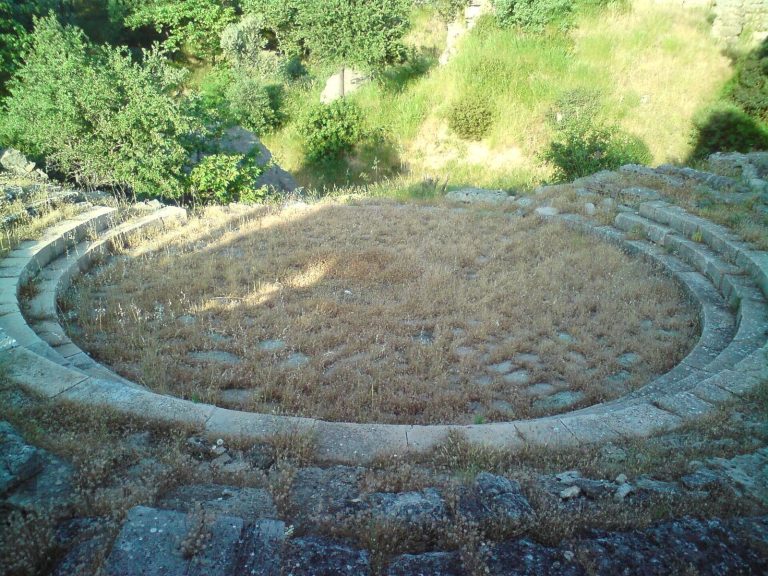
Built in the late 5th or early 4th century BCE, the stone theatre is among the earliest in the Greek world. Its first phase had a circular orchestra, the central performance area, 12.40 metres across, and ten rows in the lower seating section. Later, builders enlarged and raised the seating, adding an upper theatre, an additional tier of seats, on the hillside above the remains of the wooden structure. The front rows, used by officials and citizens, were made of soft, porous local stone. The higher seating, used by women and enslaved people, was built from local slate and limestone. The hill faces the low Kastro Bouni range, which bounds the plain to the south.
Stage alterations and reconstruction
A stage-front building added in the 3rd century BCE reduced the orchestra. In the early Roman period, it was extended farther into the orchestra’s southern part as performances shifted from the central area to the stage. The theatre was reconstructed between 2000 and 2004.
Burial grounds
Cemeteries
Burial areas include a cemetery dated to about the 9th–8th centuries BCE, a large burned burial ground associated with Greek inhabitants of the 8th–6th centuries BCE, and graves southwest of the city dating from the 8th to the 5th century BCE.
Ossuaries and grave goods
Excavations recovered more than 130 ossuaries, containers for human bones, along with bronze objects and pottery. Male ossuaries contained knives and axes. Earrings, bronze pins, necklaces, gold diadems and bracelets came from female burials. Some gold ornaments have Mycenaean-style spirals, referring to the Late Bronze Age Greek civilization, without geometric decoration. Spiral patterns also appear on pottery from the Geometric period, an early phase of Greek art named for its geometric ornament.
Inscriptions, pottery and other finds
Finds from Hephaistia include weapons, gold objects, fired-clay figurines and locally styled pottery. Some pottery fragments carry writing in the Lemnian language, comparable to the inscription on the Kaminia stele, an upright inscribed stone attributed to the Pelasgians. Protocorinthian, or early Corinthian, pottery and Attic pottery made around Athens point to connections with mainland Greece. The Attic material includes black-figure pottery, in which dark figures stand out against lighter clay. Coins found at the site bear a burning torch on one side, evidence for the Hephaistia festival and its torch races. Finds from the city are held or exhibited at the Archaeological Museum of Lemnos in Myrina.