Santa Maria degli Agonizzanti, Palermo: A Church for the Dying
Site at a Glance
- Popularity
- Low
- Country
- Italy
- Primary era
- Early Modern
- Eras represented
- Early Modern
- Civilizations
- Kingdom of Sicily, Spanish
- Site type
- Religious
- Remains
- Church
On this page15 sections
History
Santa Maria degli Agonizzanti is a Roman Catholic church in Palermo, Italy, associated with a religious group devoted to people facing execution and death. Its first church was consecrated on 10 March 1630, and architect Antonio Interguglielmi rebuilt it between 1778 and 1784 into its present form. The church belongs to the Archdiocese of Palermo and follows the Roman Rite, the Catholic Church’s principal liturgical tradition.
Origins and establishment
The association began after Francesco Anello of Caccamo was hanged in 1613. His curses and blasphemies at the execution disturbed members of the Company of San Girolamo, who responded by praying for the souls of people condemned to die. On 29 October 1614, nine Palermo citizens led by the priest Vincenzo Di Maria formed a pious association under the protection of the Virgin Mary as Our Lady of the Dying. Its members gathered for spiritual exercises on Wednesdays and fasted during the three days before an execution.
The founders proposed establishing their group within the Company of San Girolamo, using rules modeled on those of two other religious associations, the Company of the Blacks of Saint Ursula and the Company of the Miseremini of Saint Matthew. The proposal was refused, and the company expelled members of the new association. In 1616, Discalced Augustinians, members of a reformed branch of the Augustinian order, gave the group a meeting place at the Oratory of the Notaries. Following disputes with the Augustinian fathers, it moved in 1623 to the church of San Vincenzo dei Confettieri. There, Di Maria set out its rules, which Cardinal Giannettino Doria, a member of the association, confirmed.
The church and confraternity
The association rented premises and built a church on the site of a disused warehouse in the Ferraria street area of the Guzzetta district. The building was consecrated in 1630. The confraternity, a religious association whose members shared devotional and charitable duties, spiritually supported condemned people through prayer and fasting in the days before execution. At executions, its members and other worshippers received a blessing with the Blessed Sacrament, or Eucharist. The group included titled people, nobles, clergy, and twelve artisans, and spread through Sicily as well as to Rome, where it had a presence at a church of the Brothers Hospitallers, a Catholic order devoted to caring for the sick.
Rebuilding and later change
Between 1778 and 1784, the church was rebuilt and refined by Antonio Interguglielmi. The work removed earlier interior stucco decoration by Procopio and Giacomo Serpotta, replacing it with more restrained neoclassical forms and paintings. The change recast the church’s interior while preserving its association with prayers for people near death.
The confraternity’s work connected it closely to executions in Palermo. Its execution-related role appears to have shifted in 1799, when executions took place near the Ponte dell’Ammiraglio and people who had been beheaded were buried in a common grave in a park before what is now the Sanctuary of the Decapitated. Burials at that place ended in 1867.
Remains
Layout
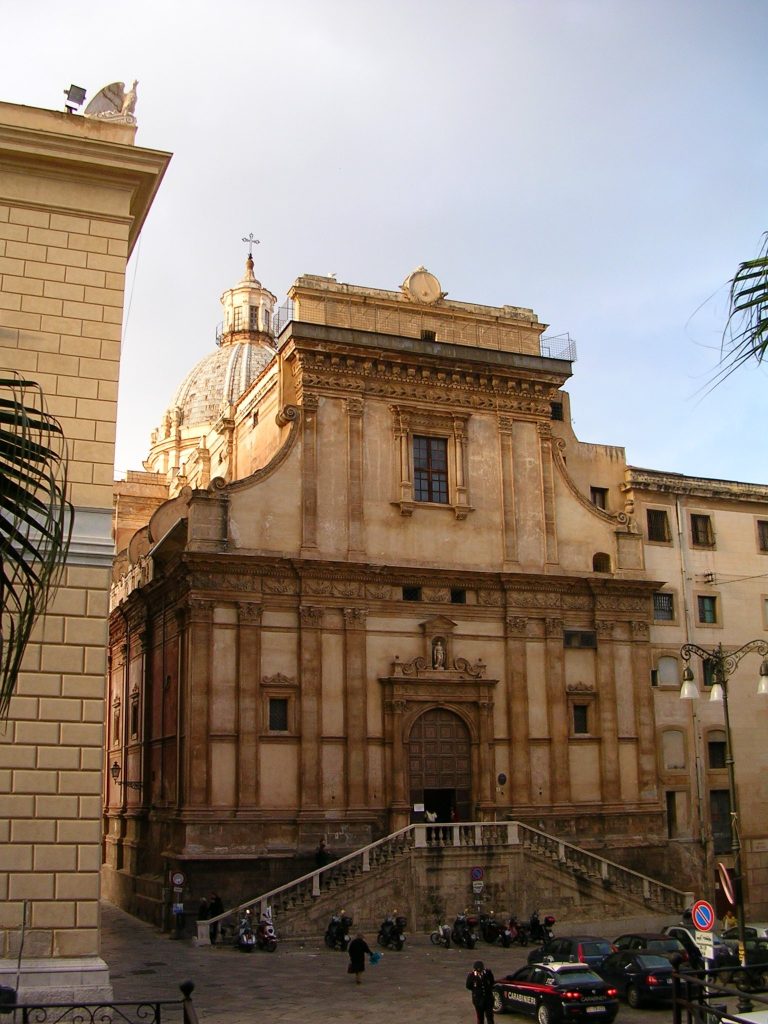
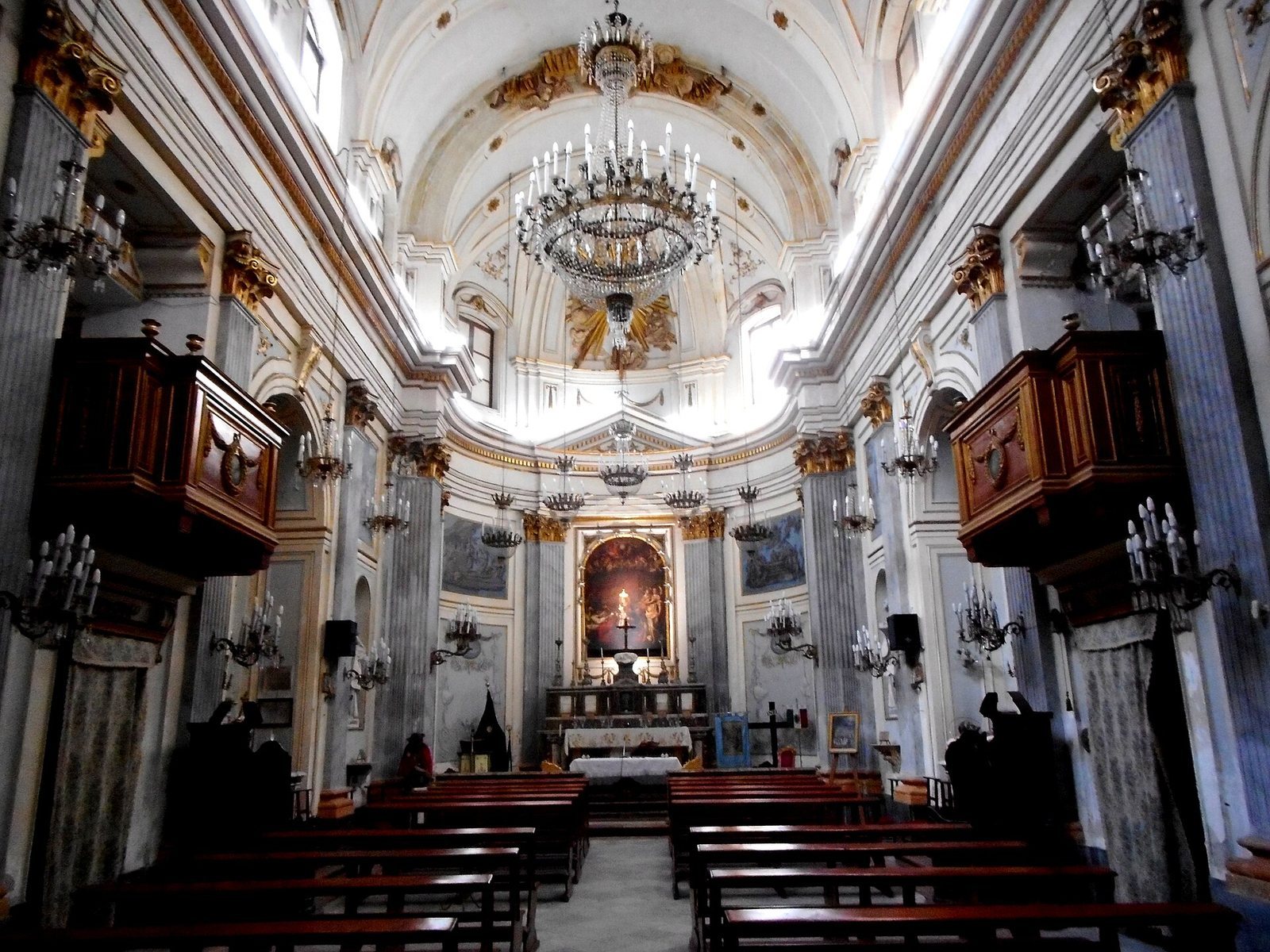
Santa Maria degli Agonizzanti stands on Via Giovanni da Procida in Palermo’s historic center, in the Kalsa quarter between Via Roma and Via Maqueda. The Baroque church has a single nave, or main central space, ending in a large semicircular apse, the rounded end of the building. Its late-eighteenth-century stone façade and interior arrangement frame a sequence of chapels and five altars.
Facade
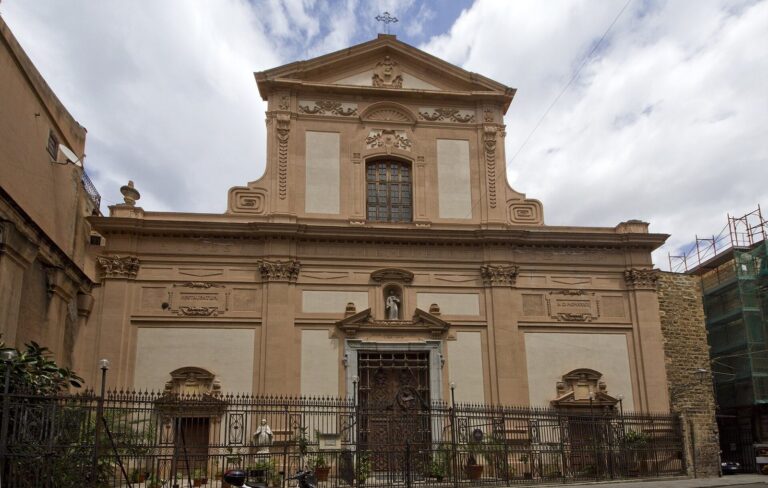
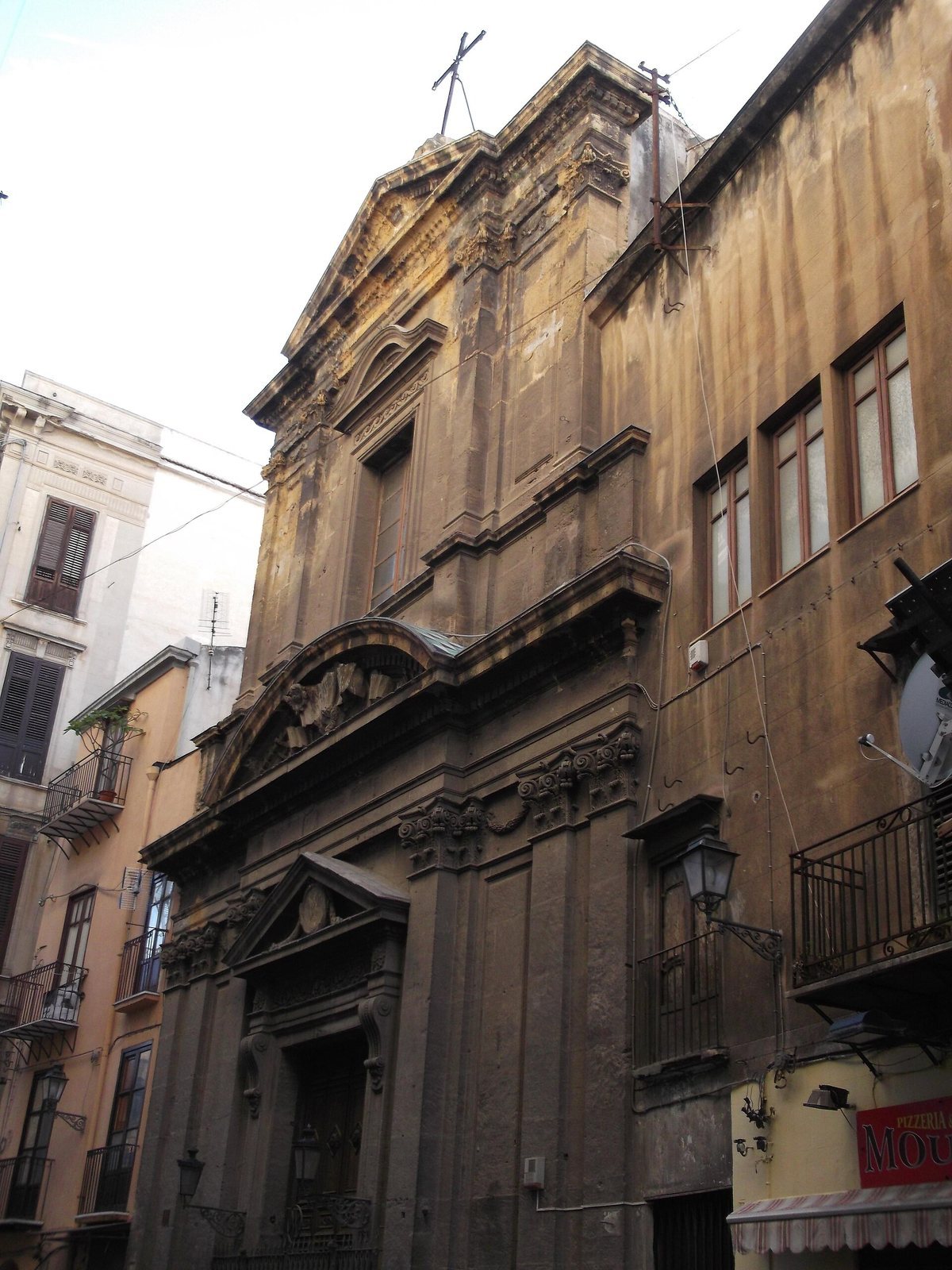
The façade is built of cut stone, with a projecting central section arranged in two levels. Pilasters, flat attached columns, with Corinthian capitals divide its face. Triangular and curved pediments, shaped crowns above openings, rise in sequence from the portal to the top. Lanterns flank the entrance, which is surmounted by a window-loggia, an open gallery. The confraternity’s arms appear in the triangular pediment above the portal. Higher up, an inscription scroll framed by putti, childlike decorative figures, sits in a tympanum supported by ornamental brackets. Marian emblems and interlaced cartouches decorate the levels; an iron grille marks the entrance, and a large iron cross crowns the façade. Above a broken cornice, a plain upper storey with an unadorned window ends in a shallow triangular pediment.
Nave and side walls
The nave’s barrel vault, a continuous arched ceiling, has ribs and sail-like sections at the windows. A simply formed cornice with rich moulding runs around the interior. The side walls have openings beneath the choir; paired fluted pilasters with gilded stucco Corinthian capitals frame their bays, and wooden choir galleries sit above the openings. The church contains five altars, including the high altar in the main chapel.
Choir
On the wall opposite the entrance, the choir gallery is decorated with stucco vegetal festoons. An organ dating to 1924 stands there. A separate room above the church served the confraternity as an oratory, a space set aside for prayer.
Presbytery and main altar
Frescoes
In the presbytery, the area around the altar, Elia Interguglielmi’s monochrome frescoes of 1782 show six episodes: the Annunciation, the Visitation to Saint Elizabeth, the Circumcision, the Presentation of Jesus at the Temple, the Pietà, and the Assumption of the Virgin. The Pietà depicts Mary mourning the dead Christ; the Assumption refers to the Catholic belief that Mary was taken bodily into heaven.
Stucco figures and paintings
Stucco decoration by Gaspare Firriolo includes statues of the four Doctors of the Church, saints recognized for their contributions to Christian teaching. The statues date to 1781, and chiaroscuro frescoes above them use contrasts of light and dark to depict Saint Ambrose, Saint Gregory the Great, Saint Augustine of Hippo, and Saint Jerome. Firriolo was a pupil of Giacomo Serpotta and the son-in-law of Procopio Serpotta. Monochrome paintings by Giuseppe Velasco portray the story of Saint Clare, founder of the Poor Clares.
High altar
The high altar is made of polychrome marble and incorporates reliefs by Ignazio Marabitti dating to 1781, including one in white marble. Above it hangs an eighteenth-century painting of the Virgin Mary as Our Lady of the Dying, by an unidentified artist and restored by the Flemish painter Guglielmo Borremans. The scene shows a condemned person attended by praying confraternity members. The Vicaria prison and the church of Santa Maria di Porto Salvo appear behind them, providing a view of contemporary execution practices. A curved triangular pediment topped with a sunburst completes the perspective of the rounded apse interior, and a stucco group occupies the apse arch.
Paintings and crucifix in the nave
In the first bay on the right wall, an 1782 painting by Elia Interguglielmi shows Saint Anne with the young Mary; Saint Anne is traditionally regarded as Mary’s mother. His painting of Saint Rosalia at Quisquina, also from 1782, occupies the second bay. On the left wall, the first bay holds his 1782 painting of Saint Joseph, traditionally regarded as Mary’s husband and Jesus’ earthly guardian. The second contains a wooden crucifix by an unknown Sicilian artist, dating to the nineteenth century, with a reliquary, a container for relics, attached to it.
Sacristy painting
A painting in the sacristy showing confraternity members working to save the souls of executed people was transferred to the Diocesan Museum.