Elis: An Ancient Greek City and Olympic Organizing Center
Site at a Glance
- Popularity
- High
- Country
- Greece
- Primary era
- Classical
- Eras represented
- Bronze Age, Iron Age, Classical, Medieval
- Civilizations
- Ancient Greek, Crusader, Mycenaean, Principality of Achaea, Roman
- Site type
- City
On this page22 sections
History
Elis was an ancient Greek city-state in the northwestern Peloponnese of Greece and the capital of the territory of Elis. Human activity at the site reaches back to at least the Middle Paleolithic, around 120,000 BC, while more substantial settlement developed in the Early Helladic period, about 2800–2200 BC. In Mycenaean times, around 1600–1100 BC, Elis was counted among the region’s leading centers.
Early settlement and foundation traditions
Greek tradition offered different accounts of the city’s beginnings. Aethlius was remembered as its first king and founder, while another story credited Oxylus, an Aetolian, with bringing existing settlements together as one city. The unification was placed around the late 12th or early 11th century BC. Settlement grew again in the Sub-Mycenaean and Early Geometric periods, around the 11th–9th centuries BC.
In the Mycenaean period Elis was an independent kingdom, and its inhabitants were also known as the Epeii. Homer described Elis as a town of the Epeii, and local tradition said they joined the Trojan War under Polyxenus. The city’s early growth was especially strong in the 10th and 9th centuries BC.
Olympic administration and regional power
Elis’s enduring historical role was organizing the Olympic Games at Olympia. The contests are known to have taken place by at least 776 BC, and Elis administered them for more than a thousand years, until they ended in AD 393. Tradition credited Aethlius with first arranging the games and King Iphitos with reorganizing them. Around 776 BC, Iphitos, the Spartan lawgiver Lycurgus, and Kleosthenes, ruler of Pisa, probably established the Olympic truce, a sacred agreement that protected Elis and Olympia from armed forces and suspended fighting for the games. The protected period initially lasted a month and was later extended to three. The agreement was inscribed on a bronze disk kept at Olympia.
Control of the games was contested. Pisa organized them during periods when it held Olympia, approximately 668–572 BC, before Elis recovered the sanctuary with Spartan assistance. In the Archaic period, Elis extended its authority over Olympia and nearby territories, including Akroreia and Pisatis. Its territory eventually encompassed Pisatis and Triphylia across a broad part of the region. Fertile farmland helped support its prosperity. Later prosperous phases included the fifth and fourth centuries BC and the Roman period, from the first century BC to the third century AD.
Athletes came to Elis to prepare for the games. They trained, learned the rules, and were assessed and assigned to events and categories. The city also hosted equestrian contests, although it is uncertain whether a horse race mentioned in Homer was part of the Olympic Games. The city’s hippodrome was used to exercise horses and may have hosted competitions. Men also competed in beauty contests in honor of Athena.
Women’s contests called the Heraia honored Hera and took place at a different time from the men’s games. Sixteen women of Elis organized the contests and wove a garment for the goddess. A local tradition says that Kleitagora, one of the sixteen, served as high priestess at three Olympiads and was the first to pass a torch to an athlete while calling for victory. The games drew competitors and visitors from across the Greek world, and the city’s population in the historical period exceeded 60,000.
Government and changing alliances
In 471 BC, residents of surrounding townships moved into the capital in a further unification of settlements. Elis expanded around its acropolis. Later in the fifth century BC, political reforms ended the aristocratic families’ exclusive privileges and established democratic government. Citizens were organized into local tribes, with one Hellanodikes, an official responsible for supervising the games, selected by lot from each tribe. The number of these officials changed as the territory changed.
The city’s institutions linked religious duties with the Olympic festival. Officials announced the date of each Olympiad to other cities, organized sacrifices and ceremonies, and received visiting delegations. A body called the mastores ranked above the Hellanodikai as a court. At least until the fifth century BC, citizens and priests oversaw the city’s activities. Elis also gave villages and communities considerable autonomy to sustain farming and herding, and travelling courts settled local disputes. The city began issuing its own coins by the end of the sixth century BC.
Elis remained outside the Persian Wars, the conflicts between Greek states and the Persian Empire in the early fifth century BC. It was allied with Sparta until the Peloponnesian War, the fifth-century conflict between Athens, Sparta, and their allies. Elis initially supported Sparta, then changed sides to support Athens. After the war, it joined the Achaean League, a federation of Greek city-states in the Peloponnese, in 191 BC. Rome made Elis part of the province of Achaia in 146 BC, though the city retained some autonomy.
Roman rule, decline, and rediscovery
During the Roman Imperial period, public and private buildings were reconstructed from the first through the fourth centuries AD. In the fourth century BC, Phaedo of Elis had founded a philosophical school in the city. Elis remained inhabited in the Early Christian period, when an ancient portico was converted into a basilica, and settlement continued into the early Byzantine period.
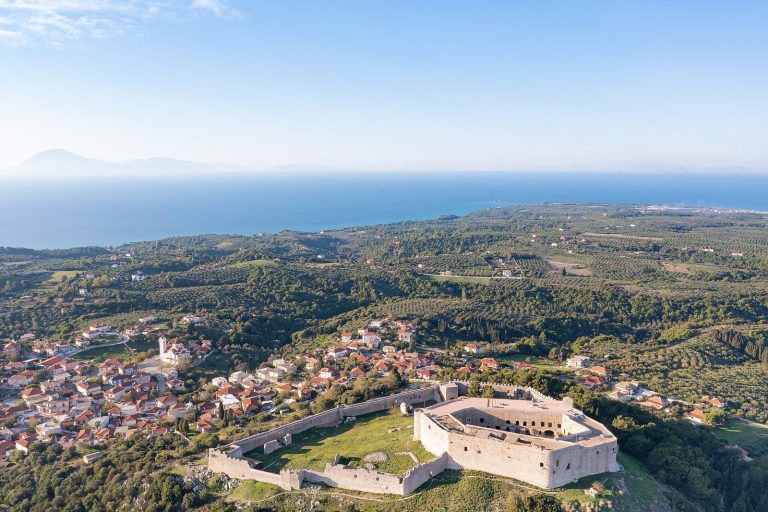
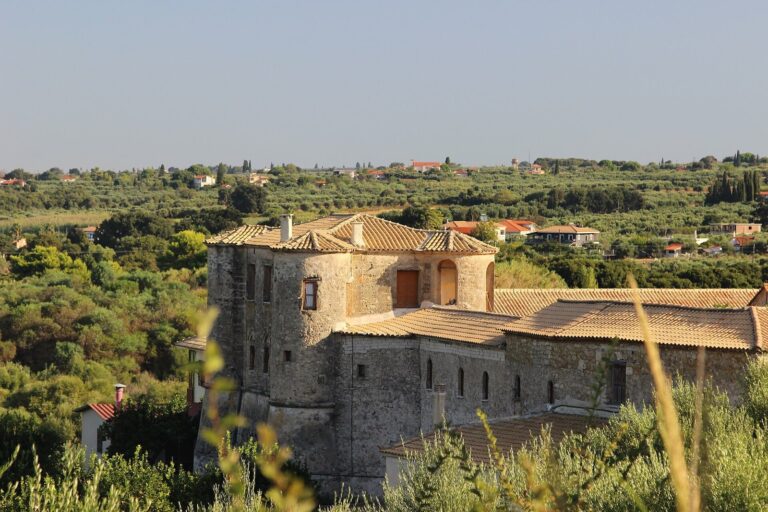
The Heruli, a Germanic people active in the Roman period, destroyed the city in AD 267. Elis declined after the Olympic Games ended in AD 393 and was ultimately abandoned around the end of the sixth century, following an earthquake. During Frankish rule, a castle was built on the former acropolis using material from ancient buildings.
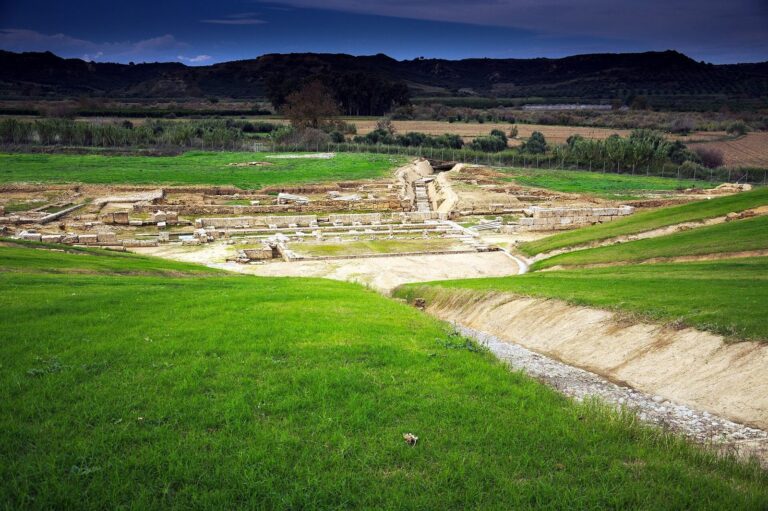
The ancient city was identified in the 19th century. Excavations took place in 1910–1914, including work by Austrian archaeologist Otto Walter in 1911, and resumed in 1960 with Austrian and Greek archaeologists. In 1968, construction of an irrigation canal for the Amaliada plain exposed ancient remains. Excavation then revealed streets, buildings, and finds, helping establish how Elis prepared for and organized the Olympic Games.
Remains
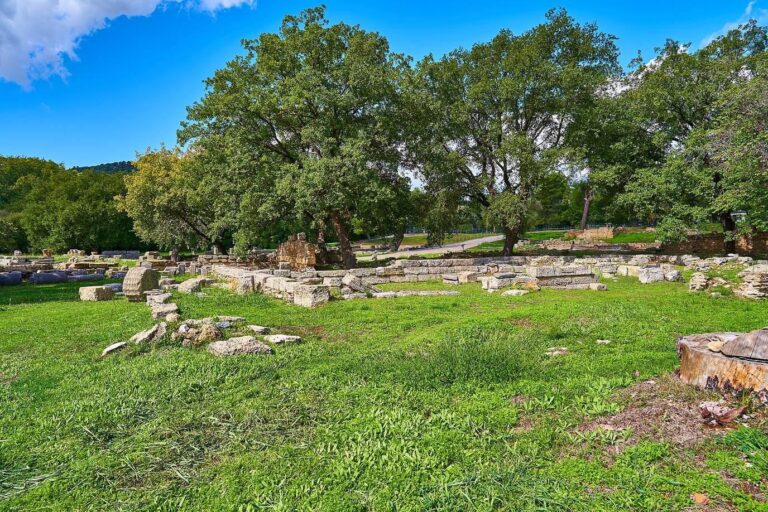
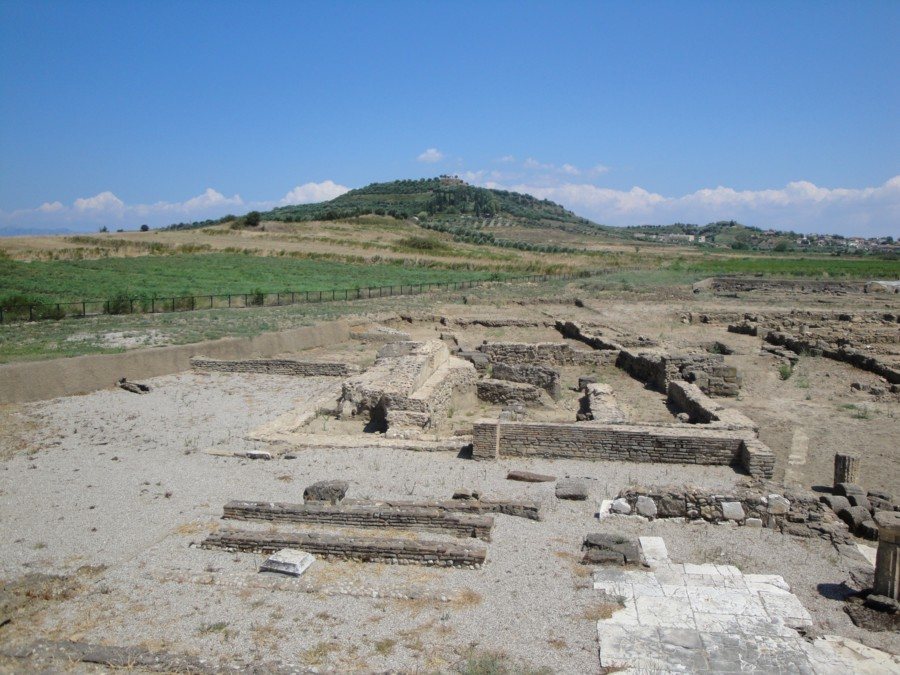
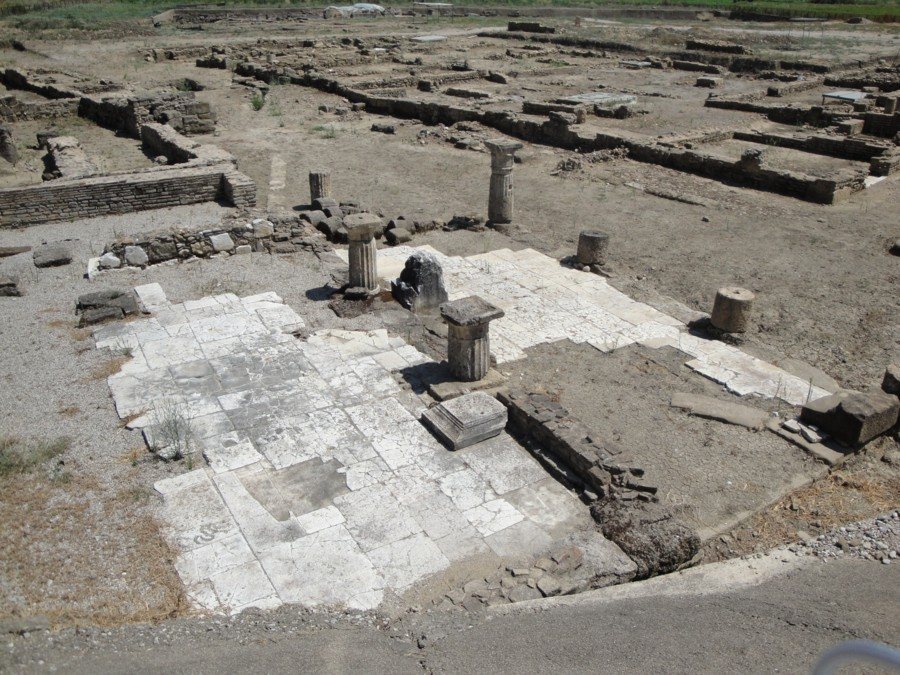
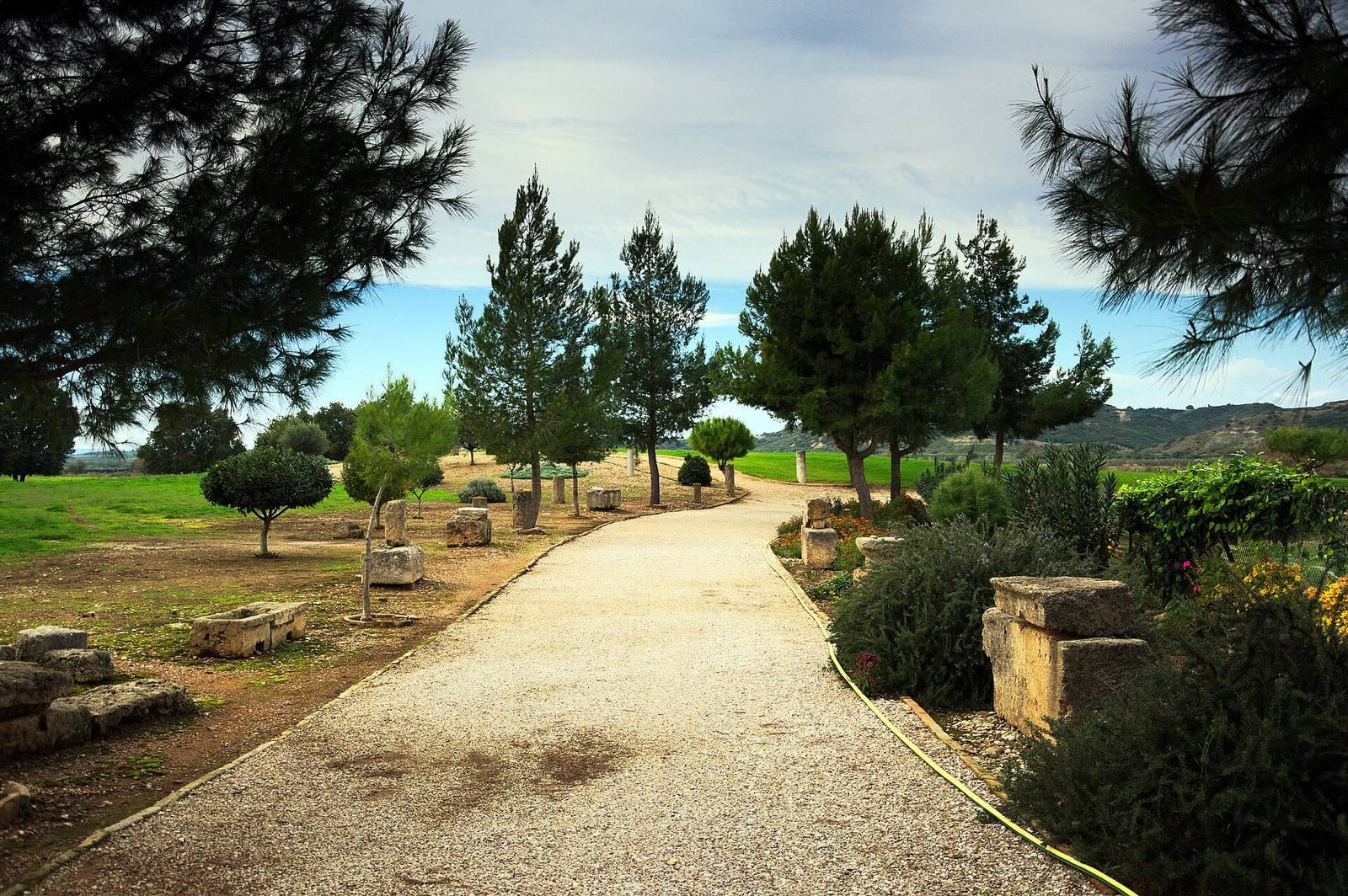
Elis occupied about 150 hectares around a peaked hill that formed its acropolis, near where the Peneius River emerged from the hills onto the plain. The settlement extended across the river, with most public buildings probably on its left bank. A rectangular street grid, associated with the Hippodamian plan, an orderly system of city planning, structured the urban area. Athletic grounds, a central public square and marketplace called an agora, sanctuaries, workshops, shops, and homes formed part of the city. The archaeological area also includes cemeteries and remains of smaller settlements nearby.
Acropolis
Fortifications and castle
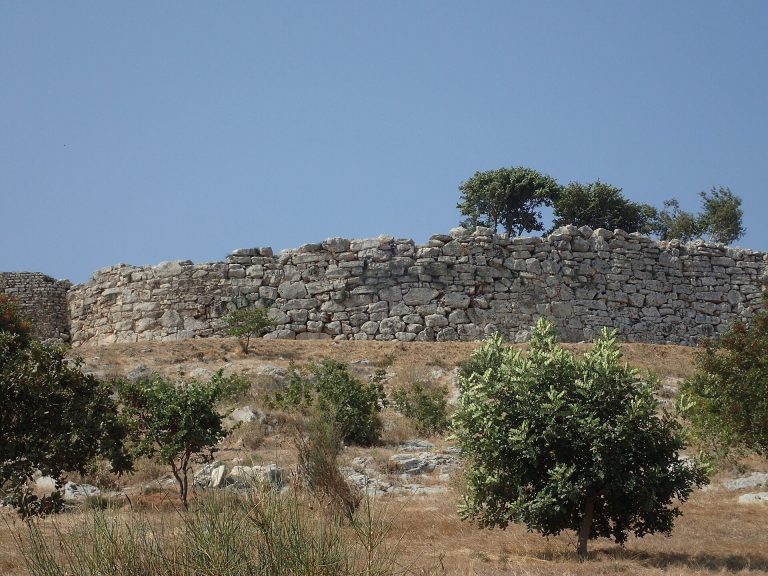
The acropolis lay east of the city. Sections of its defensive walls survive particularly on the north and west sides, while the summit also preserves remains of the later castle. Doric column fragments built into the castle walls probably came from the temple of Athena.
Temple of Athena
A temple to Athena stood on the acropolis. It housed a statue attributed to the sculptor Pheidias, made of gold and ivory. The goddess appeared as Athena Ergane, her aspect as patron of crafts, wearing a helmet decorated with a rooster.
Gymnasium and agora
Athletic grounds
The gymnasium, a public complex for athletic training, and the agora occupied much of the ground between the river and the acropolis. The gymnasium’s extensive training area served athletes staying in Elis before competing at Olympia. Its enclosure was generally called the Xystus, and plane trees separated spaces used by runners. Three divisions had names linked to their features: Plethrium referred to dimensions, Tetragonum to a space’s shape, and Malco to the softness of the ground. A square wrestling court, or palaestra, was also part of the complex.
Two principal entrances connected the gymnasium to other parts of the city. One led along the Street of Silence, also called Siope, to the baths. The other passed above the memorial tomb of Achilles, a cenotaph without the deceased’s remains, toward the agora and the officials’ building.
Council chamber
The council chamber, or bouleuterion, stood in the area called Malco. Known as the Lalichium after its founders, it also hosted literary performances.
Agora and horse ground
The agora occupied a plateau between the athletic grounds to the west and the theatre. Its colonnades were interrupted by roads rather than forming a continuous enclosure. Part of the square was used as a hippodrome for exercising horses.
Southern stoa and officials’ building
Foundations survive of the southern stoa, a covered colonnade or hall, which had three rows of Doric columns. The Hellanodikai used it as a daytime gathering place. Toward one end stood the Hellanodikaion, their official residence and training place during the ten months before the festival. A street separated the building from the agora.
Corcyraean stoa
The Corcyraean stoa had two rows of Doric columns divided by a wall. One side opened toward the agora, while the other faced the temple of Aphrodite Urania. Its construction was funded with a tenth of spoils taken from the Corcyraeans.
Sanctuaries and monuments
The agora contained temples to Apollo Acacesius, the Graces, and Silenus, as well as statues of Helios and Selene and the tomb of Oxylus. Apollo Acacesius, a healing aspect of Apollo, had the city’s principal temple. Wooden statues of the three Graces carried, respectively, a rose, an astragalus, or a myrtle branch. The temple of Silenus was also associated with Dionysus and Methē.
A sanctuary of Tyche, the personification of fortune, contained a large image in a stoa. The wooden statue was gilded except at its extremities. In the temple of Sosipolis, the deity appeared as a child in a star-decorated cloak, holding a cornucopia; Elis regarded Sosipolis as a personification of Zeus. The temple of Aphrodite Urania held a gold-and-ivory statue attributed to Pheidias, showing the goddess with one foot on a tortoise. A separate precinct of Aphrodite Pandemos contained a bronze statue attributed to the sculptor Scopas, depicting the goddess seated on a goat.
Other buildings and routes
Heraia and baths
The Loikos served the sixteen women who organized the Heraia and wove Hera’s garment. Baths and bathing establishments formed part of the city’s facilities, connected to one gymnasium entrance by the Street of Silence.
Theatre and nearby sanctuary
The theatre was built in the fourth century BC on the acropolis slope, northwest of the agora and between it and the Menius stream. It was altered in Hellenistic and Roman times. Spectators sat on the natural slope rather than on constructed seating tiers. The archaeological site includes a restored ancient theatre and a modern wooden theatre built for the Ancient Elis International Festival.
A temple of Dionysus stood near the theatre, between the agora and the Menius stream. It contained a statue of the god attributed to the sculptor Praxiteles. Near the gymnasium were a sanctuary of Artemis Philomeirax and the cenotaph of Achilles. The temple of Hades was opened once a year.
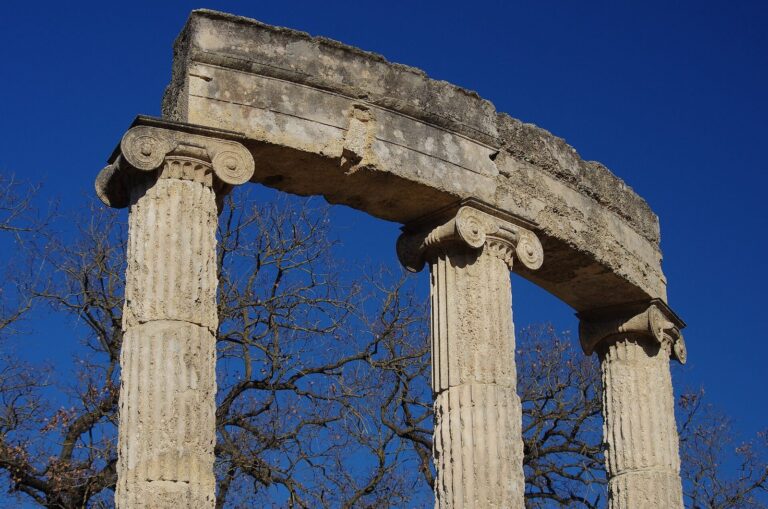
Temple of the Roman emperors
The city’s temple to the Roman emperors was circular and surrounded by columns. Its roof had collapsed by the time of Pausanias.
Routes to Olympia
Two routes linked Elis with Olympia. The shorter, mountainous road ran east alongside the Peneius and covered about 130 stadia, approximately 25 kilometres. It was difficult to travel. The longer sacred route measured about 300 stadia, or 58 kilometres, with 180 stadia from Elis to Letrinoi and another 120 from Letrinoi to Olympia. This route was level and broad.
Excavated finds
Excavations have yielded marble, bronze, and terracotta objects, as well as coins. Finds from the city are displayed in the archaeological museum near the site, on the southern slope of the acropolis.