Pieve di San Giovanni Battista: The Parish Church of San Giovanni d’Asso
Site at a Glance
- Popularity
- Very Low
- Country
- Italy
- Primary era
- Medieval
- Eras represented
- Medieval, Early Modern, Modern
- Civilizations
- Grand Duchy of Tuscany, Italian, Republic of Siena
- Site type
- Religious
- Remains
- Church
On this page11 sections
History
Origins and parish status
The Pieve di San Giovanni Battista is the parish church and principal Catholic place of worship in San Giovanni d’Asso, Italy. Construction began in the early 14th century, during the period when the Petroni family acquired the village castle, and the church was consecrated in 1323. It follows the Roman Catholic rite and belongs to the Diocese of Montepulciano-Chiusi-Pienza, a territory overseen by a bishop.
In 1492, the church became the village parish, taking the place of San Pietro in Villore. In 1539 it was raised to the status of a pieve, a parish church that historically often served as a local center for baptism and worship, and received its own baptismal font.
Patronage and religious traditions
The Pannilini family assumed the church’s patronage and undertook extensive renovations in 1639. The church was reconsecrated on 5 June that year. Further renovation followed in 1879.
Cardinal Riccardo Petroni, a senior Catholic Church official, donated relics, sacred remains or objects associated with saints. An annual observance known as the “Creaking” feast centers on the relic cabinet: on the Saturday before the Sunday after Easter, a saint’s name is drawn, and that saint’s relic is carried in procession the next day before being returned. The sound of the cabinet doors creaking shut is regarded as a good omen for the harvest.
Restoration and later changes
Major restoration in the second half of 1973 removed the interior’s white-and-black wall bands and created a new area around the altar. The church was dedicated on 1 January 1974 in a ceremony led by Bishop Renato Spallanzani.
The Pinchi organ, opus 337, was housed in the church from 2016 to 2018. In 2025, organ builder Enrico Barsanti transferred a 1990 Dargassies-Gonzales organ to the church from a private residence in Paris.
Remains
Plan and exterior
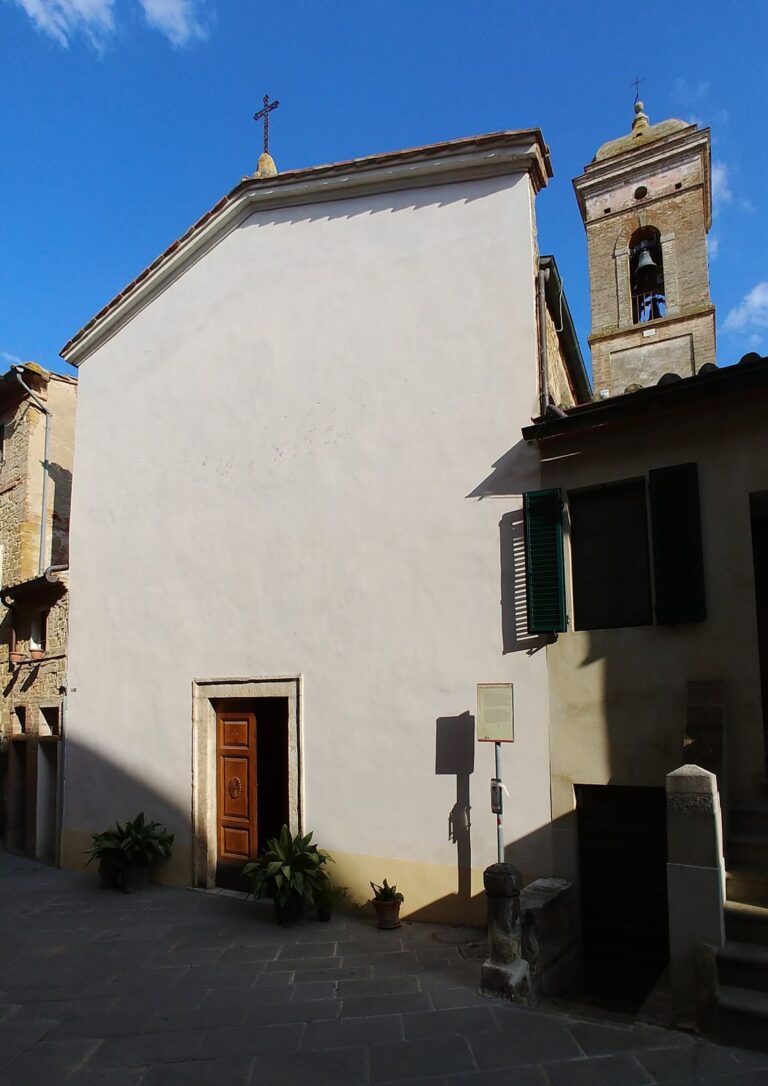
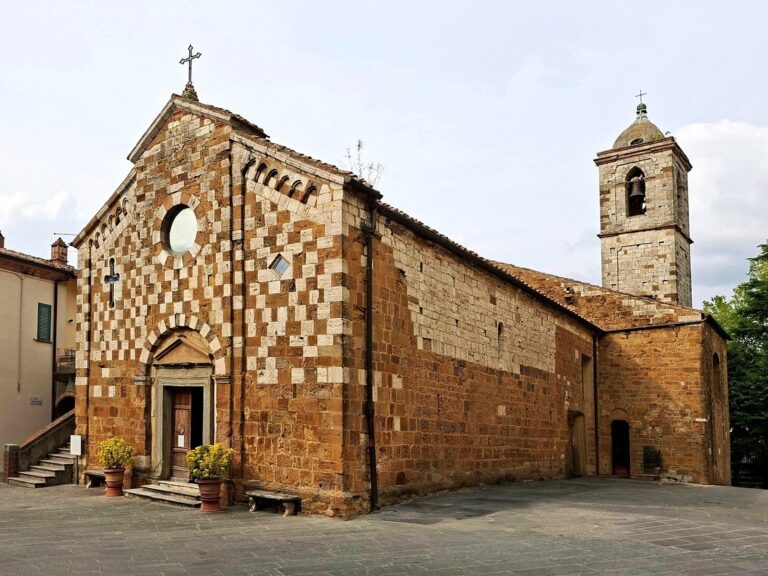
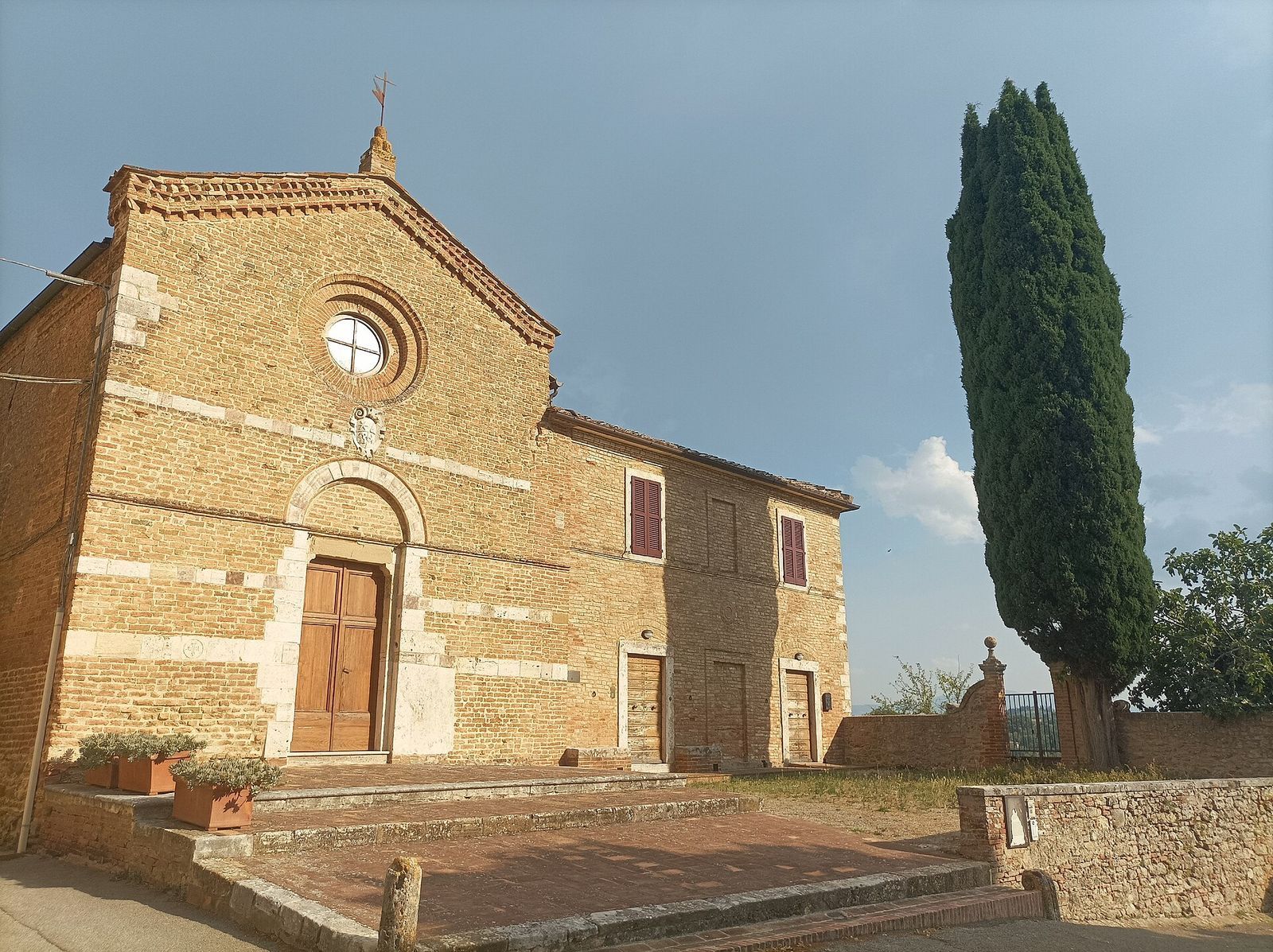
The church combines Romanesque and Baroque forms, with construction beginning in the 14th century and reaching completion in the 18th. Its simple, gabled brick facade faces the village’s main square. A doorway fills the lower part, with a round rose window above; three stone bands cross the brickwork at different heights. At the rear of the main body, a bell gable has two openings for bells. Inside, two rounded arches divide the single main hall into three sections. The building has no separate semicircular sanctuary recess.
Interior furnishings
Baptismal font
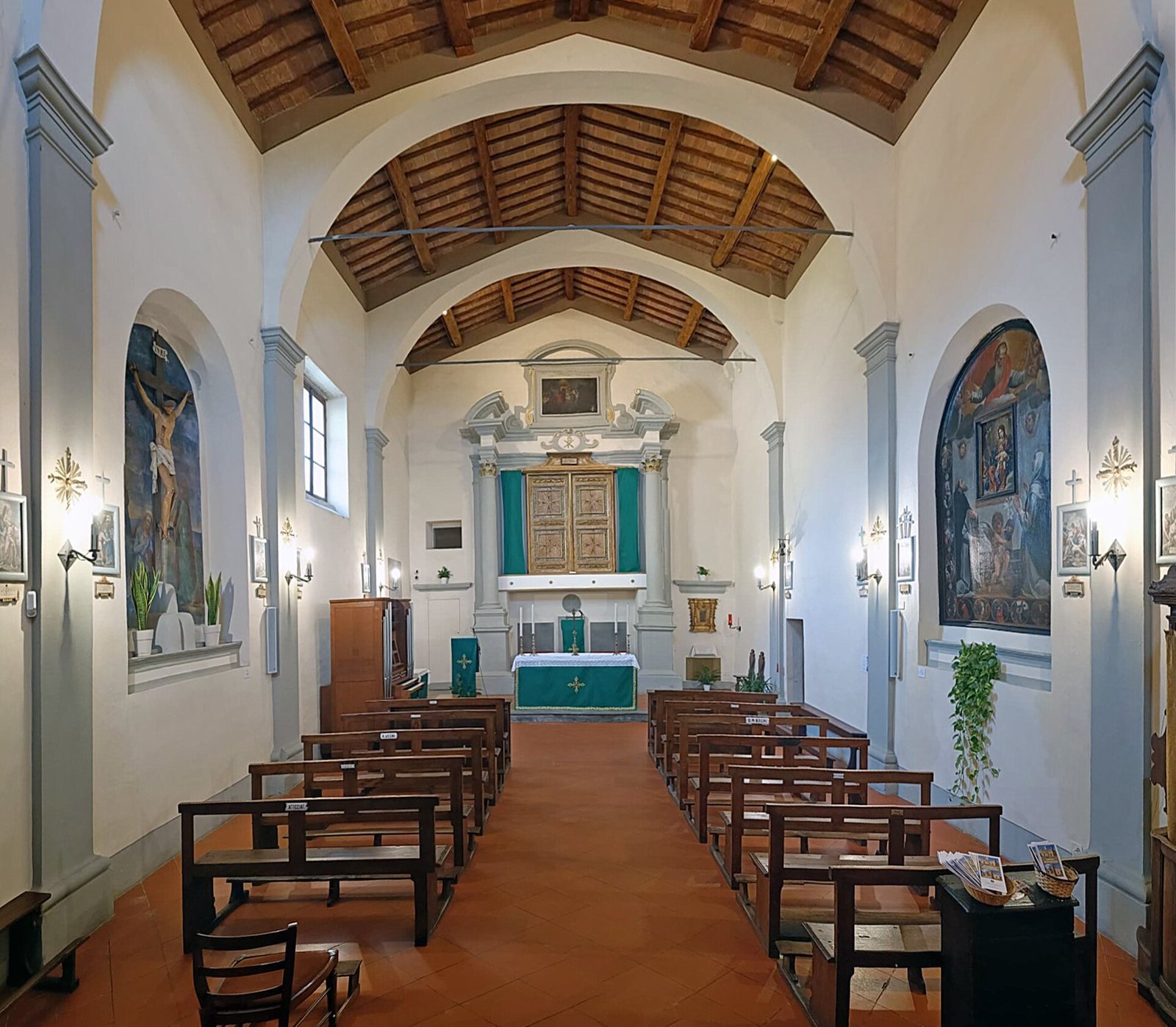
A 16th-century baptismal font stands in a niche in the left wall of the first section of the church.
Side altars
The second section contains altarpieces from two side altars. Their altar tables were removed during the 1973 restoration. One altarpiece holds a painted wooden crucifix in a niche; the other contains a painting of the Madonna of the Rosary attributed to Girolamo Cerretelli and dated to about 1610.
Altar area and relics
The area around the altar lies at the back of the church. Its 1973 arrangement includes a new altar, a raised reading stand later fitted with a sloping wooden surface, and a presider’s chair made of pietra serena, a gray sandstone used in Tuscan architecture.
Above the chair, an altarpiece from an 18th-century altar contains a cabinet holding relics of thirty saints, among them Saint Peter the Apostle, Saint Catherine of Siena, and Saint John the Evangelist. The cabinet has painted wooden doors. An older, brightly painted wooden tabernacle stands to its right. Above these features is a painting of the Baptism of Jesus from the school of Baroque painter Rutilio Manetti.
Organ
The Dargassies-Gonzales organ has electrically operated action and a multiplex system that lets pipe ranks serve multiple stops. It has 19 stops, or selectable pipe sounds, two keyboards, and a pedalboard. Shutters enclose the instrument in a swell box, a casing that controls volume.