Nativity of the Virgin Mary Church in Rajbrot: A Late-Gothic Wooden Parish Church
Site at a Glance
- Popularity
- Medium
- Country
- Poland
- Primary era
- Early Modern
- Eras represented
- Early Modern, Modern
- Civilizations
- Austria-Hungary, Austrian Empire, Habsburg, Kingdom of Poland, Polish–Lithuanian Commonwealth
- Site type
- Religious
- Remains
- Church
On this page15 sections
History
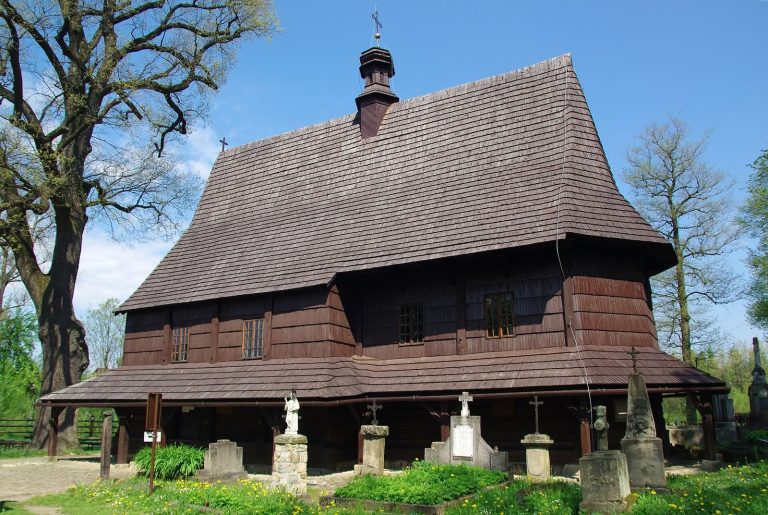
The Nativity of the Virgin Mary Church in Rajbrot, Poland, is a late-Gothic wooden parish church built around 1511 by builders whose names are unknown. Late Gothic was a European style of the later Middle Ages. The parish traces its origins to 1260, when a wooden church dedicated to the Nativity of the Virgin Mary was associated with Bolesław V the Chaste, a thirteenth-century Polish ruler.
Medieval parish and church
An 1816 inventory attributed the first church to Bolesław. Another tradition credits his wife, Saint Kinga, a Hungarian-born princess who later became a nun and saint, with building a church of larch wood. The first church’s fate is uncertain; it may have been destroyed by fire or another event. According to a local legend, a second church was swept away in a great flood. The building raised around 1511 is regarded as the third church on the site.
Pilgrimage and later changes
In the first half of the nineteenth century, parish priest Wincenty Katarzyński developed the church grounds as a pilgrimage destination. He added an enclosure wall, chapels, Stations of the Cross, a sequence of devotional scenes recalling Jesus’s final journey to the crucifixion, and statues. A chapel was added to the church in 1823.
A parish cemetery established around the twelfth century lay about 50 to 100 paces from the church. Austrian authorities ordered it closed in the late eighteenth century on sanitary grounds, requiring burial places to be separated from heavily frequented areas. The present parish cemetery, established in the second half of the nineteenth century, lies about 300 metres away. An eighteenth-century wooden parish rectory stood beside the church into around the 1960s.
Renovations in 1879 included removing the roofed galleries. Fighting between Russian and Austro-German forces damaged the church in December 1914, and further renovation took place in 1966. In 1968, the church ensemble was entered in the regional register of immovable monuments.
Remains
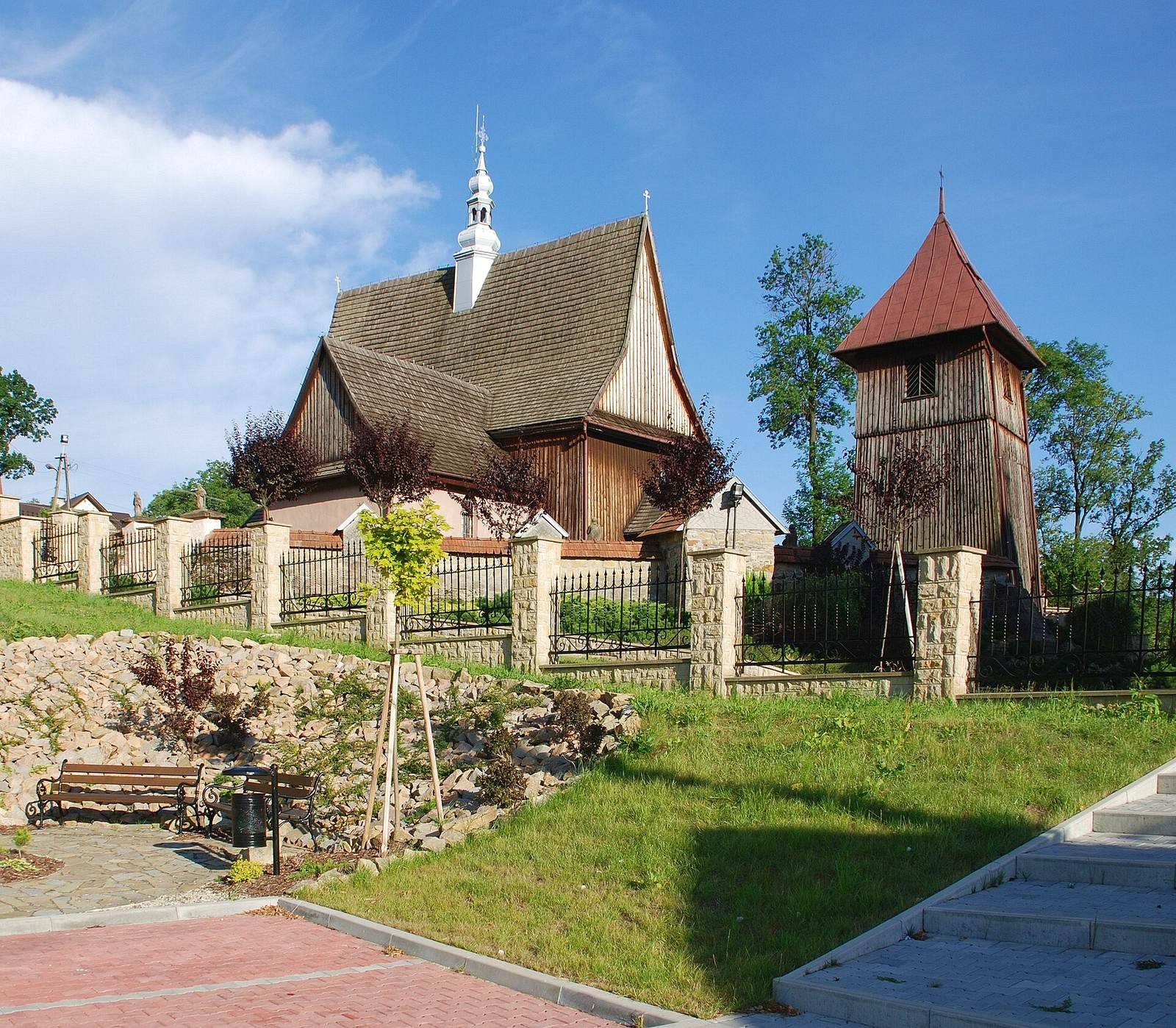
The complex centers on a timber church with a single nave and a narrower chancel, the area around the altar. A sacristy adjoins the chancel, while a separate chapel and porches extend from the nave. The surrounding grounds include an enclosure with chapels and devotional features, as well as a freestanding wooden bell tower.
Church and grounds
Church structure
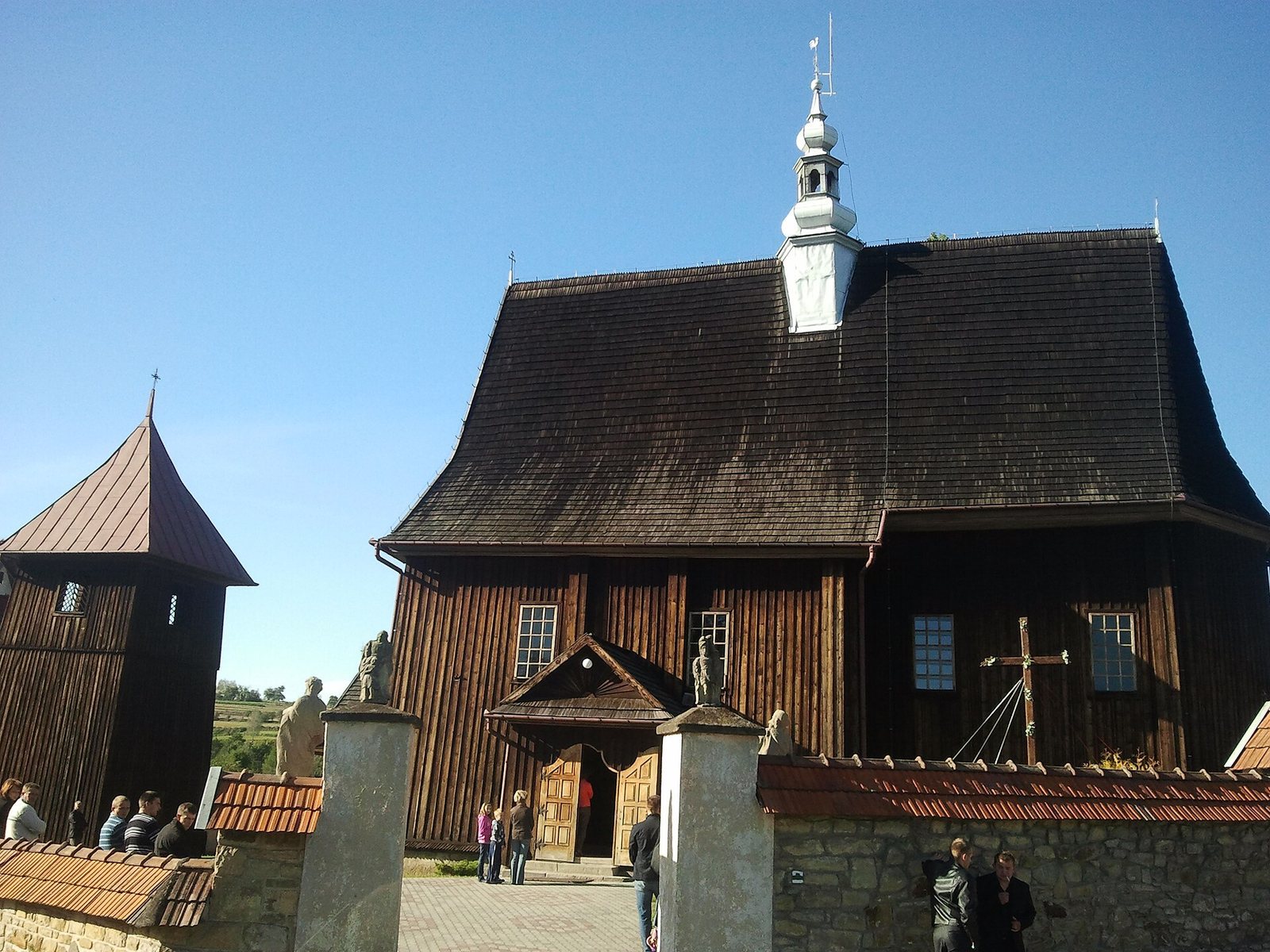
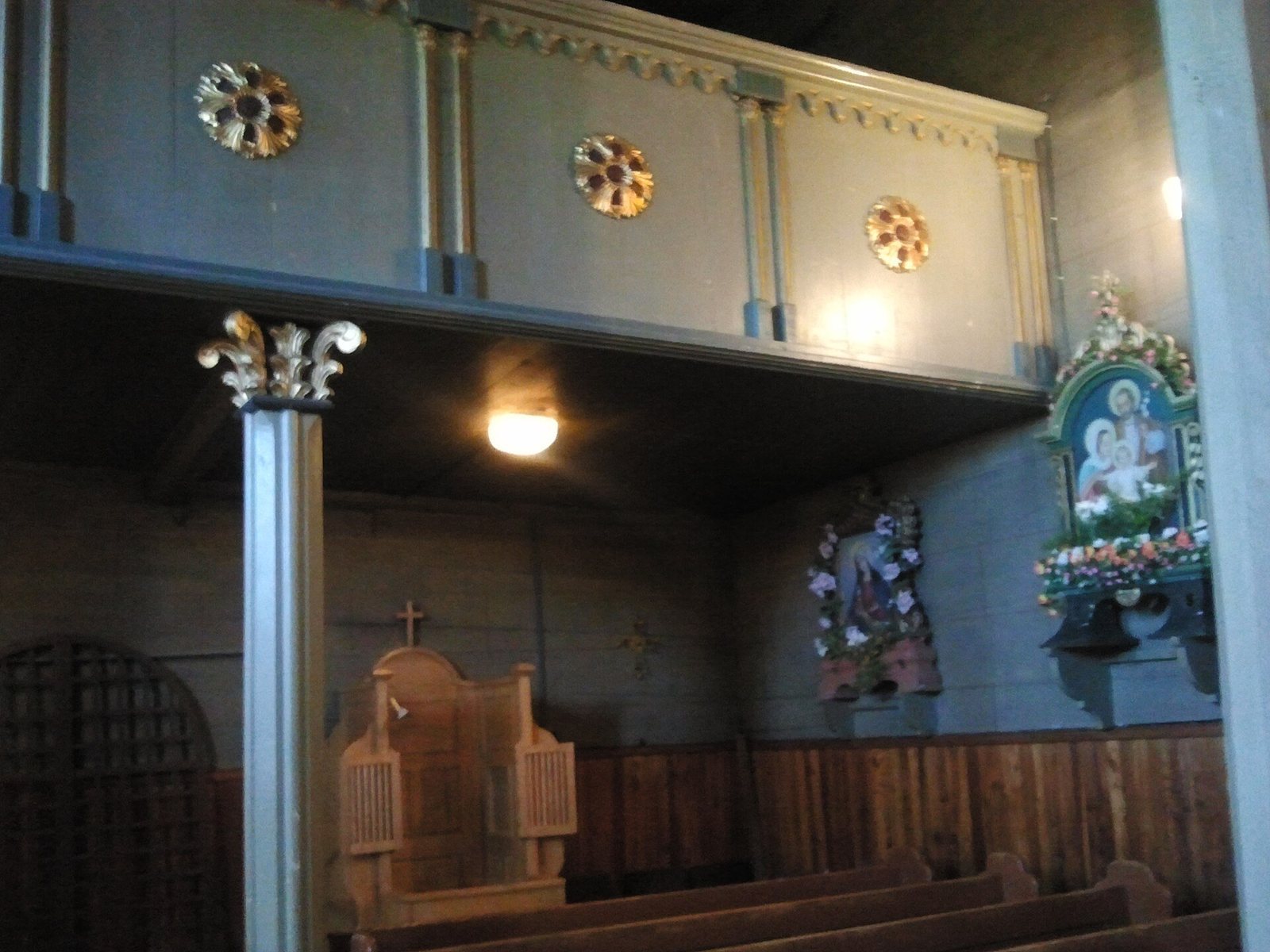
The church covers about 200 square metres and has a log-built frame clad with boards. Its chancel ends in three angled sides, and a sacristy adjoins its north side. A stone-built, plastered chapel is attached to the north side of the nave; porches stand on the south and west. The steep roof is covered with wooden shingles and carries a seventeenth-century Baroque bell turret, in a broad European art and architectural style, topped by a lantern.
Windows are set only along the south side. This arrangement was associated both with climatic considerations and with the former belief that evil lurked to the north. Two late-Gothic doorways and carpentry details from the church’s construction period also survive.
Bell tower and enclosure
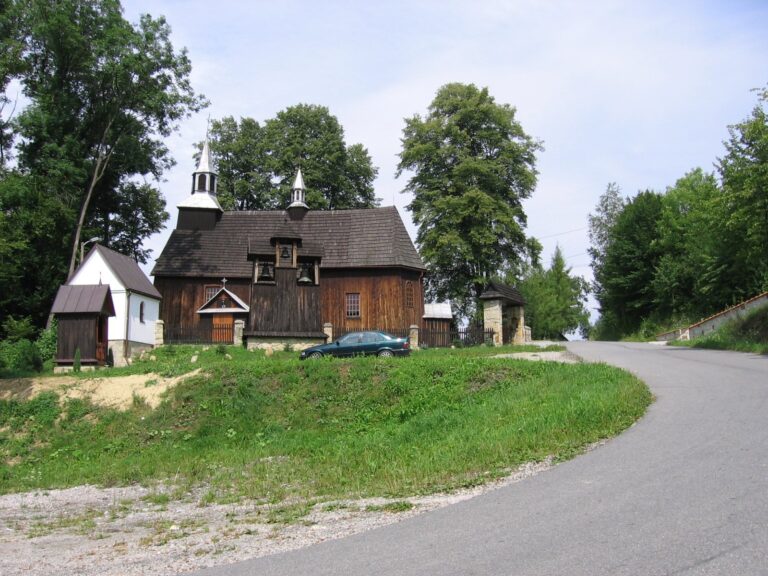
A separate, board-clad wooden bell tower stands beside the church. Dating to around the nineteenth century, it replaced an earlier tower from the eighteenth century. It holds four bells named Maria, Józef, Ludwik, and Stanisław, cast in Łódź in 1952.
The enclosure wall dates to the first half of the nineteenth century and has two gates. Five chapels and fourteen Stations of the Cross are incorporated into the grounds. Nearby stone figures represent apostles, the Immaculate Virgin, and Saints Mary Magdalene, Anne, Florian, John, and Peter. The Immaculate Virgin refers to the Catholic belief that Mary was conceived without original sin.
Parish granary
A parish granary was built beside the church between 1791 and 1801 at the initiative of priest Andrzej Szymczakiewicz. Remodeled in the 1950s, it was moved to a site behind the school beside the church.
Interior and furnishings
Nave and chancel
The nave ceiling has lowered sections along its sides. A pointed arch separates it from the chancel and carries a late-Gothic crucifix dated 1520. A separate sixteenth-century late-Gothic Crucifixion group is mounted on the chancel arch beam.
Painted decoration
The interior walls have polychromy, meaning multicolored painted decoration, added in 1879. Its ornamental and figural scenes include the Nativity of Jesus and the Annunciation. A concealed fragment of ornamental painting on the west wall dates to the sixteenth or seventeenth century and combines Renaissance and Baroque characteristics.
Main altar
The Baroque main altar dates to the second half of the seventeenth century. Its central field holds a painting dated 1678, in an Italian style, of the Virgin and Child with the young Saint John the Baptist. The locally venerated painting bears the initials T.B. and underwent major conservation in the 1960s. Sculptures of Saints Adalbert and Stanislaus flank it. A painting of the Virgin and Child, dated to the eighteenth or nineteenth century, appears on the sliding panel, and a painting of the Immaculate Conception crowns the altar.
Side and chapel altars
Two Baroque side altars date to the nineteenth century. The left altar includes a Sacred Heart of Jesus sculpture, an eighteenth-century painting of Saint Valentine, a Holy Family painting on its sliding panel, and a Crucifixion painting above. The right altar has a sculpture of Saint Joseph, paintings of Saint Nicholas and Our Lady of the Rosary on its sliding panel, and a painting of Saint John Cantius above. The chapel altar, dated 1850, contains a carved Crucifixion group.
Sculpture and church furnishings
A late-Gothic sculpture of the Risen Christ dates to the first half of the sixteenth century, while a Baroque sculpture of the crucified Christ dates to the seventeenth century. The seventeenth-century Baroque pulpit depicts the Evangelists, the traditional authors of the four Gospels. The church also has a sixteenth-century stone baptismal font and two stone vessels for holy water, one from the sixteenth century and one dated 1844.
A late-Gothic Madonna sculpture made around 1530 to 1540 belongs to the Beautiful Madonna type, depicting the Virgin and Child. It came from the Rajbrot church and is now held at the Diocesan Museum in Tarnów.
Organ
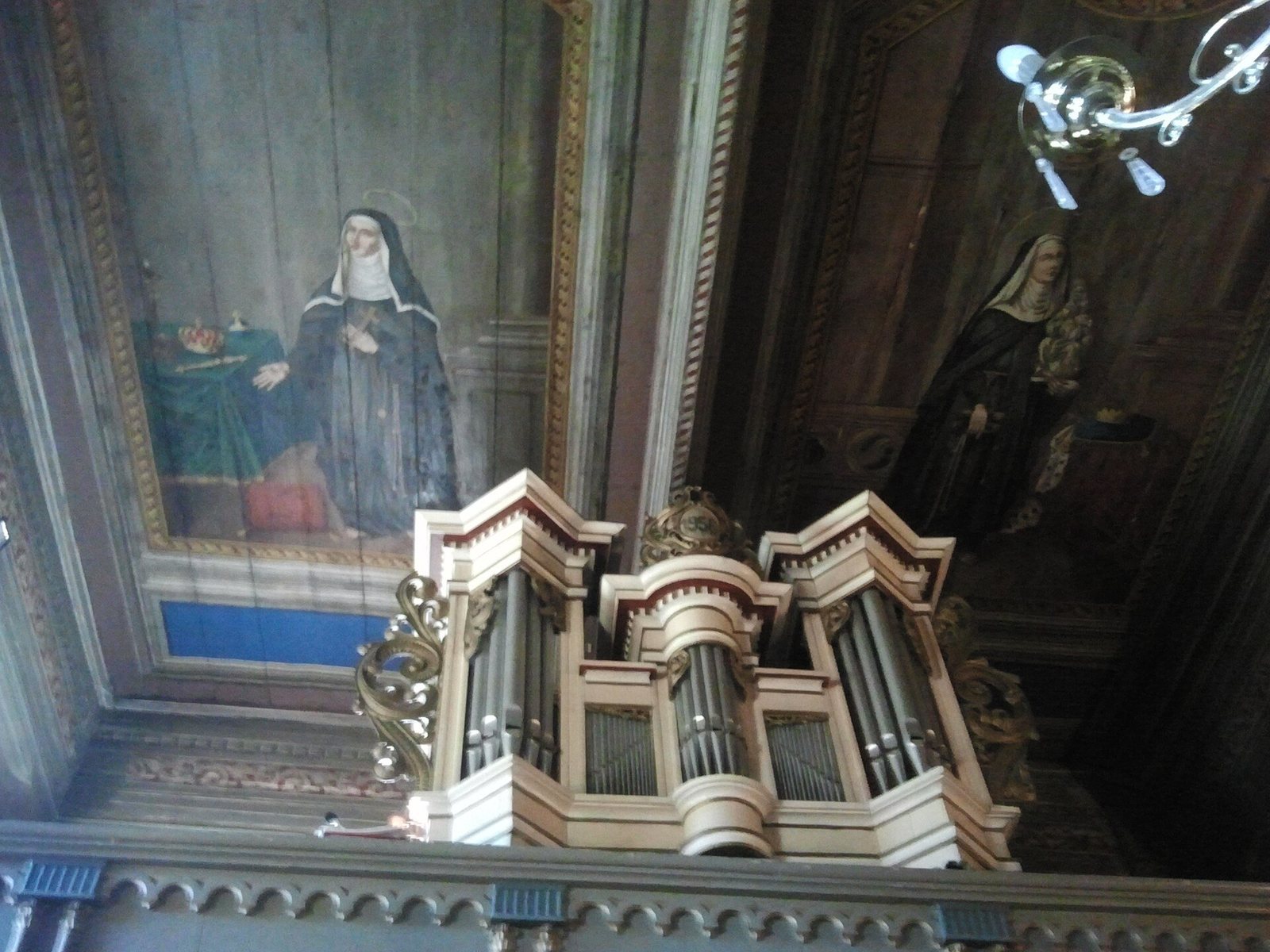
The church’s late-Baroque organ has ten sound stops and is dated to the eighteenth or nineteenth century. It was transferred from the church in Ochotnica Dolna in 1956 and was probably built by Jan Baranowski of Stary Sącz.