Palaiopolis: Archaeological Site of Ancient Andros
Site at a Glance
- Popularity
- Very Low
- Country
- Greece
- Primary era
- Classical
- Eras represented
- Iron Age, Classical
- Civilizations
- Ancient Greek
- Site type
- City
On this page8 sections
History
Palaiopolis is the archaeological site of ancient Andros, in the village of Palaiopolis on the middle part of Andros’s western coast in Greece. Andros developed as an Ionian colony in the seventh century BC and was then dependent on Eretria, an ancient Greek city on Euboea.
Origins and growth
A settlement existed at Zagora during the Geometric period, an early phase of Greek history named for the geometric patterns on pottery. Andros flourished especially in the sixth and fifth centuries BC as a polis, an ancient Greek civic community centered on a city and its surrounding territory. Around 654 BC, it established colonies in Chalkidiki, including Akanthos and Stageira.
Greek myth offered two explanations for the island’s name. It might derive from the seer Andros, said to be the son of Eurymachus or Anius, or from Andreus, a commander of Rhadamanthys who received the island from a king. Rhadamanthys was a figure in Greek mythology associated with Crete and judgment after death.
Persian Wars and Athenian alliances
During the Persian Wars, conflicts between Greek states and the Persian Empire in the early fifth century BC, Andros surrendered to the Persians in 490 BC. In 480 BC, the Persian king Xerxes required the island to provide ships for his fleet. The Athenian statesman and military leader Themistocles tried, unsuccessfully, to take the city.
After the wars, Andros joined the Delian League, an alliance led by Athens. From 450 to 440 BC, it was an Athenian cleruchy, a settlement of Athenian citizens on land controlled by Athens. In 378–377 BC, Andros belonged to the Second Athenian League, a later alliance also led by Athens.
Macedonian and Roman rule
Andros came under the rule of the kingdom of Macedonia in the late fourth century BC. In 200 BC, forces from Pergamon, a Hellenistic kingdom in western Asia Minor, and Rome captured and plundered the city. Rome then gave the island to Attalus I, king of Pergamon.
In antiquity, the island was sacred to Dionysus, the Greek god associated with wine, and was known for its wine. Marble was quarried in the north of the island. Excavations in the city area have taken place since 1956.
Remains
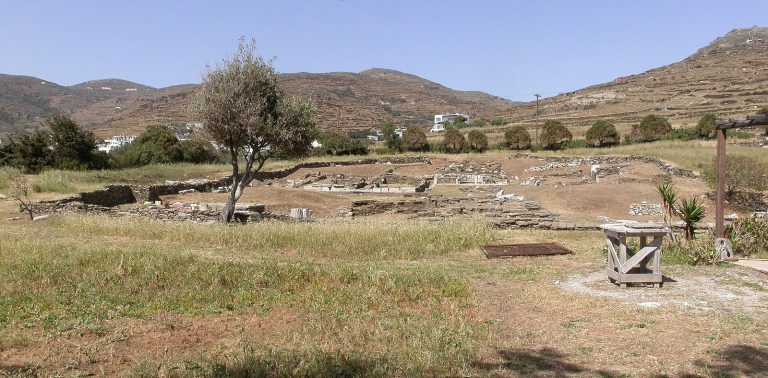
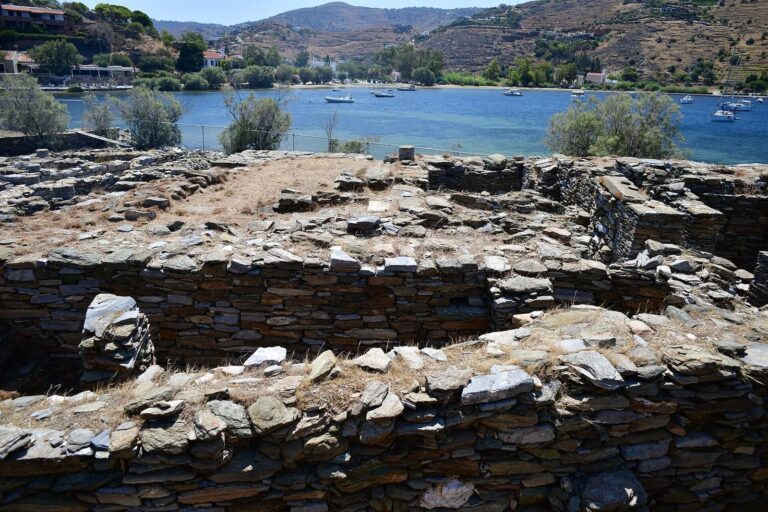
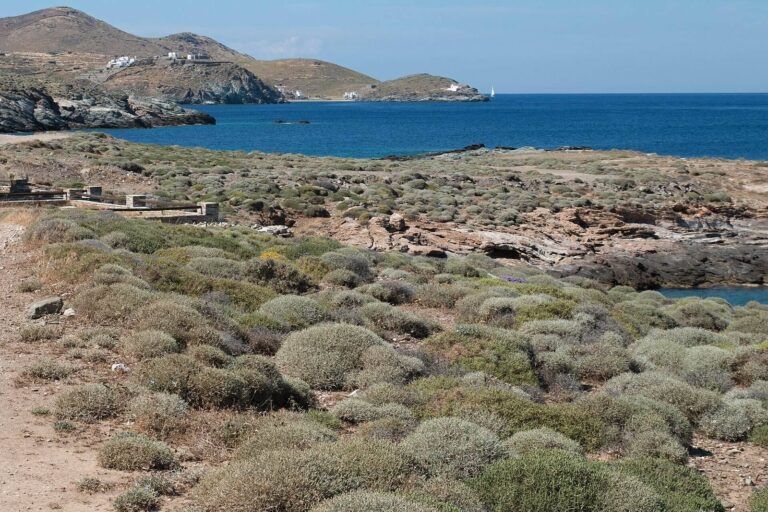
The remains of ancient Andros include its upper city, civic and religious buildings, and harbor features. The city’s agora, or civic gathering and marketplace area, is now largely covered by the sea, and some harbor structures at the city itself are submerged.
Upper city and civic center
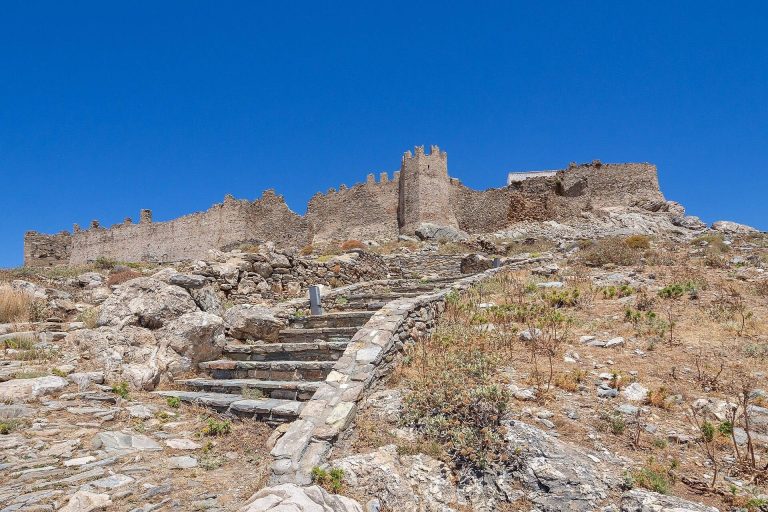
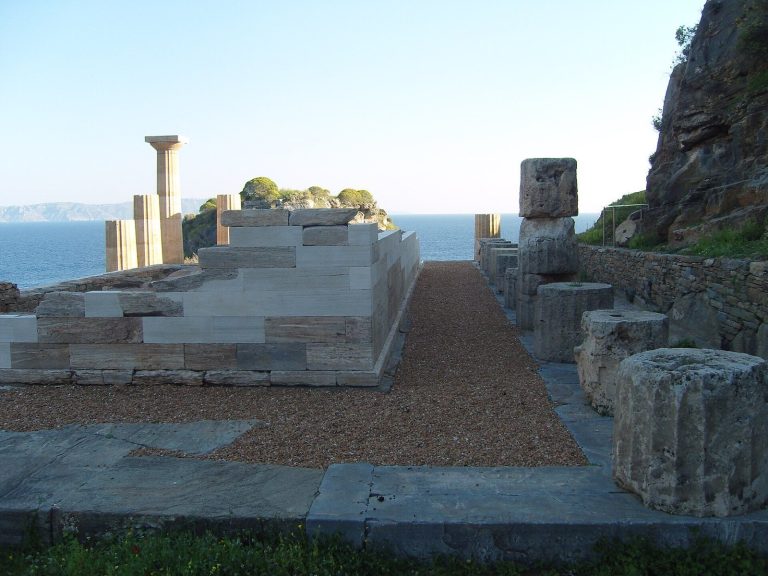
The acropolis, the elevated or fortified upper part of the city, retains sections of its walls and one gate. The city also had temples dedicated to Dionysus, Apollo, Hestia, and Athena, all major Greek deities, as well as a spring associated with Zeus. A theatre formed another part of the ancient city.
Agora and harbor
Ruins of a stoa, a covered hall with a colonnaded side, have been found in the agora. The building dates to the second or first century BC. Gaurion, also called Gaureleon, served as Andros’s port at the site of the present-day village of Gávrion, about 12 km north of the city. Harbor structures at Andros itself survive beneath the sea.
Nearby remains and finds
Remains of a tower from the Hellenistic period, the era following Alexander the Great’s conquests and preceding Roman domination of the eastern Mediterranean, stand at Ágios Pétros village. Finds from the city area are held at the Paleopolis Archaeological Museum and the Andros Archaeological Museum.